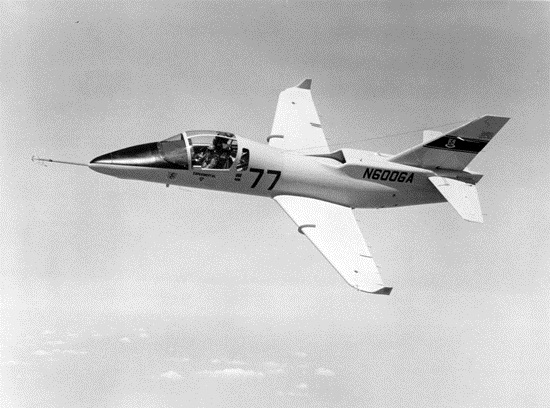
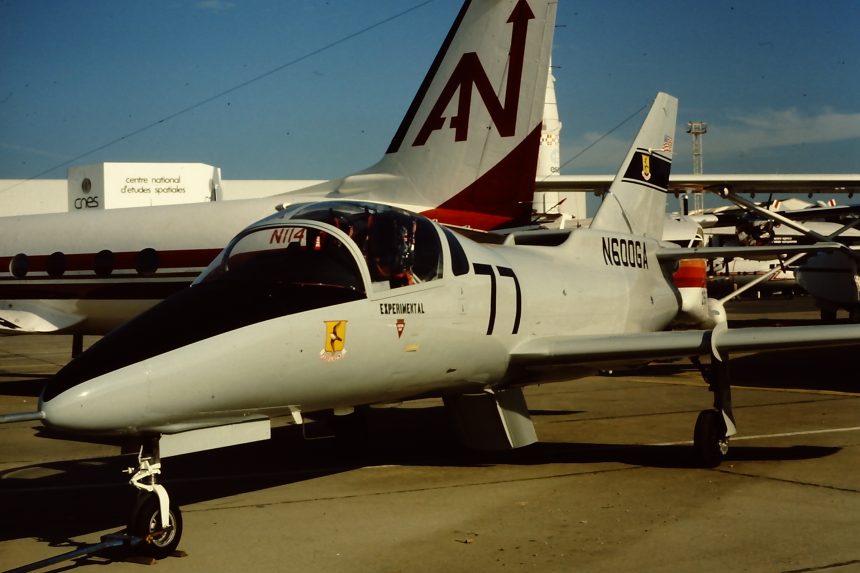

On this day in aviation history, 45 years ago (May 22, 1981), the first flight of the Gulfstream Peregrine 600 took place. The Peregrine 600 was a prototype military jet trainer developed by the United States’ aviation manufacturer Gulfstream. Known primarily for its business jet designs, Gulfstream was eager to venture into military aircraft production. When the United States Air Force’s “Next Generation Trainer” program was announced, the company decided to further develop their American Hustler prototype as a possible solution. The American Hustler was a prototype executive aircraft that used mixed propulsion via a nose-mounted turboprop and tail-mounted turbofan engines. After the airframe was modified to be a military trainer, and the first successful flight occurred on 5/22/81, the Peregrine 600 became a serious contender in the USAF Next Gen trainer race. A single prototype was built and tested. Ultimately, the 600 was passed over in favor of the Fairchild T-46, which also never saw production. In an effort to make the Peregrine 600 program take flight, Gulfstream marketed the aircraft to the Australian, New Zealand, Japanese, and Chinese Air Forces. However, their marketing efforts were unsuccessful.
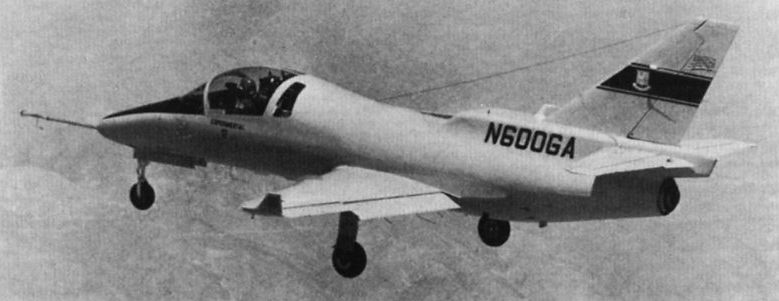
On November 23, 1983, the sole prototype of the Peregrine 600 was lost in an accident after takeoff from Wiley Post Airport. Pilot Bill Lawton was forced to eject due to a loss of control, but survived. Ultimately, after another major setback, the Peregrine project was ended in 1985. The design of the wing and rear fuselage of the 600 was incorporated into Gulfstream’s next business jet prototype, which was known simply as the Peregrine. The Gulfstream Peregrine 600 was powered by a Pratt & Whitney Canada JT15D-4 turbofan engine, with 2,500 lbf of thrust. The military trainer prototype could attain a maximum airspeed of 453 mph and had a stall speed of 76 mph. The Peregrine 600 had a range of 1,080 nmi, a service ceiling of 48,000 ft, and could climb at a rate of 5,200 fpm. Takeoff over a 50 ft obstacle was possible at 489 ft of runway, and landing over a 50 ft obstacle could be accomplished with only 639 ft of runway.