






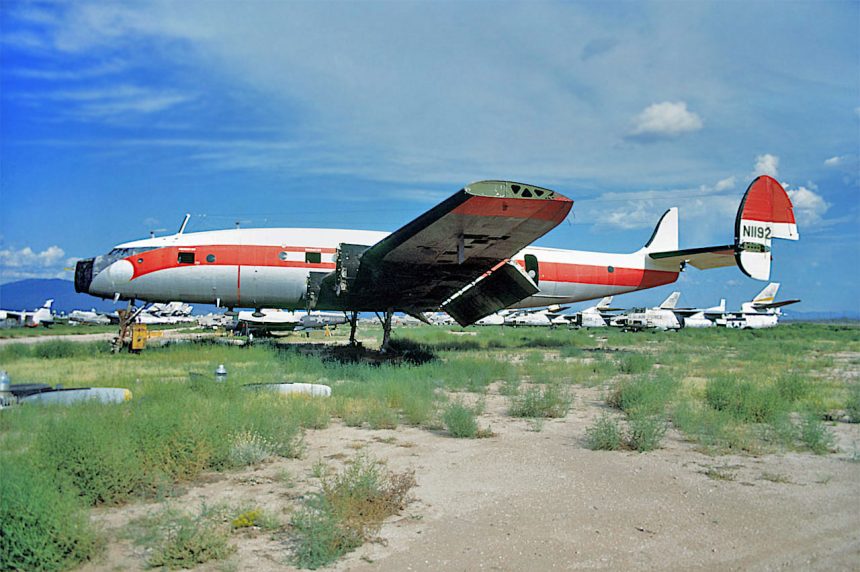

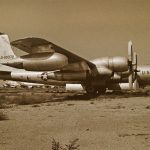
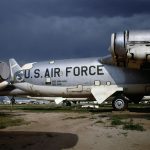
As we continue the Boneyard Files series, which showcases some of the retired aircraft resting at Davis-Monthan Air Force Base in Tucson, Arizona, in the late 1960s, today’s story features the Lockheed C-121A Constellation through the lens of Neil Aird’s “Monthan Memories” photos. In the 1940s, Lockheed tried to create a military version of the Constellation airliner, but it failed. The main issue was with the Wright R-3350 engines that powered the aircraft. After WWII, the few military Constellations built, called C-69, were updated by Lockheed for the post-war airline industry and renamed L-049.
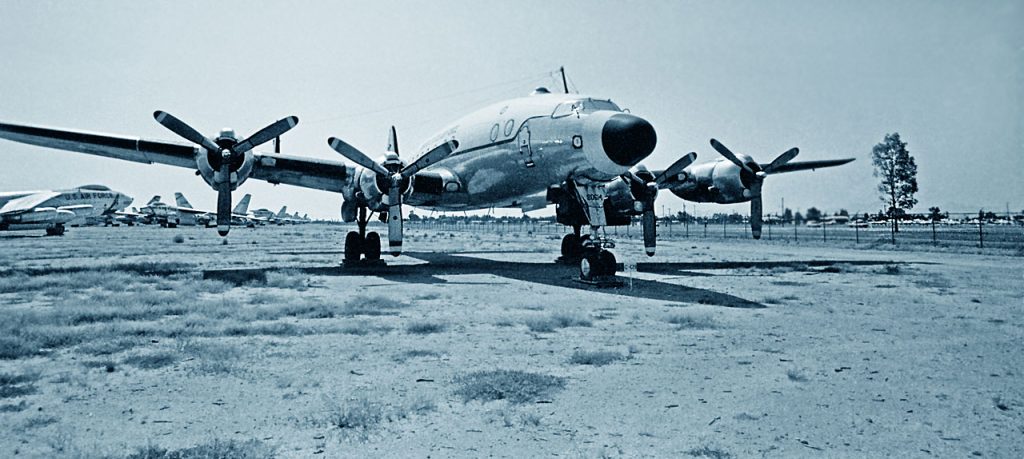
In 1947, Lockheed introduced a new, cost-effective Constellation model called the L-749, with a larger fuel capacity and a more efficient R-3350 engine. However, Lockheed faced difficulties that year, losing 1,200 workers, and by 1948, L-749 production nearly stopped. During this time, the United States Air Force ordered 10 L-749 aircraft and designated them Lockheed C-121A Constellation. The United States Navy also ordered two AWACS variants of the L-749, which it designated PO-1W (later WV-1). With a crew of five, the Lockheed C-121A Constellation could carry 44 passengers. It was 95.2 feet long, 22.5 feet high, with a wingspan of 123 feet and a wing area of 1,650 square feet. The empty weight of the Lockheed C-121A Constellation was 61,235 pounds, and the maximum takeoff weight was 107,000 pounds. The aircraft was powered by four Wright R-3350-75 Duplex-Cyclone 18-cylinder air-cooled radial piston engines, each producing 2,500 horsepower. The maximum speed of the aircraft was 334 mph, and its cruise speed was 324 mph. In 1950, six Lockheed C-121A Constellations were modified for VIP transport and renamed VC-121A. In 1951, the US Air Force ordered 33 Lockheed L-1049B Super Constellations, stretching the fuselage and designating them as the C-121C. The aircraft could carry 75 passengers, 72 fully equipped troops, or 47 stretchers. When used for cargo, seats could be stored under the floor.
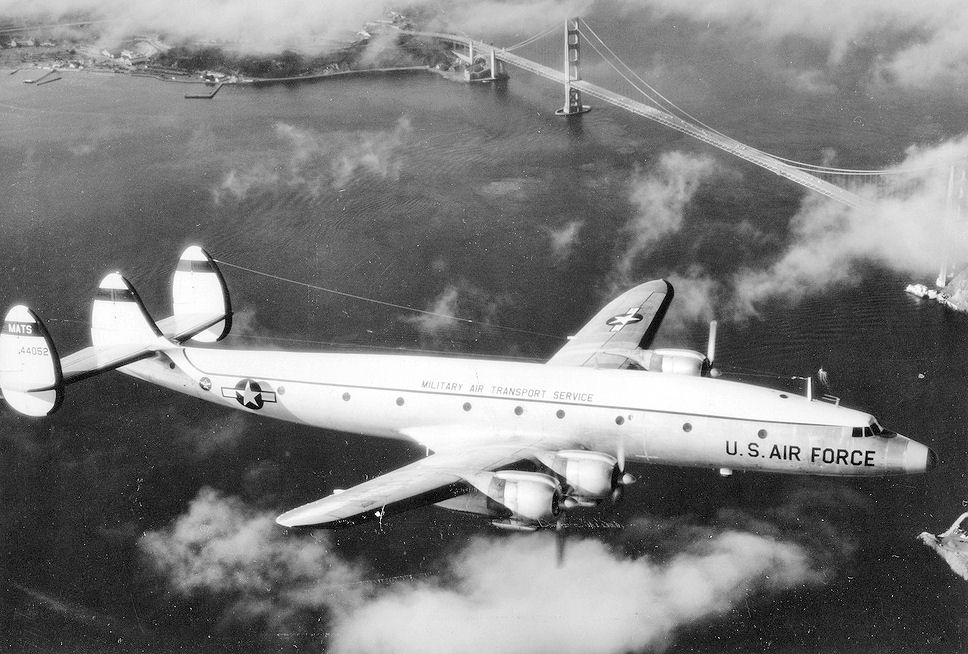
The first C-121C flew in 1955, and deliveries began in August of that year. These planes were assigned to the Military Air Transport Service’s Atlantic division and later served with the Air National Guard, retiring in 1973. Four planes were converted into VC-121C VIP aircraft, six into EC-121S systems for TV and radio broadcasting, two into EC-121C units for radio communications, and one into a DC-121C observation aircraft. After retiring from military service, some C-121 aircraft were used by civilian companies as cargo planes. The last operators were small cargo airlines in the Dominican Republic that flew to Miami with surplus military Constellations bought from Davis-Monthan Air Force Base. However, their operations ended in 1993, when the Federal Aviation Administration (FAA) prohibited them from flying into the United States due to safety concerns. One former C-121C is still flying today with the Historical Aircraft Restoration Society in Australia, while another flew until 2016 with the Super Constellation Flyers Association in Switzerland. The Swiss aircraft was put up for sale in April 2023. The US Air Force began retiring the Lockheed C-121A Constellations in the mid-1960s, with the last batch of Lockheed C-121A Constellations retired in 1968. Some of them were seen at the Davis-Monthan Air Force Base, known as “The Boneyard,” in the late 1960s. Read more Boneyard Files Articles HERE.








You have left a gaping hole,in the story of military Connies (Warning Star). Prior to the AWACs, the Navy WV-2 (WILLE VICTOR), and Air Force EC-121, spent decades flying the Dewline patrols watching for Russian bombers and Missiles flying in from the North, over the North Pole. ALso as Hurricane Hunters and Electronic Warfare platforms. The last military EC-121 Buro # 141292 was retired from VAQ-33 on 25 June 1982.
1960 I was a passengerin the constellation from Eniwetok to Wake island to Hawaii. I think it was about 15 hours. Besides crew, I was the only one on board.
Stationed in Wakannai Japan 1968-1969 and ec121 on a recon mission was destroyed by a North Korean Mig in April of 1969 while in international waters. 30 naval and a marine lost their lives..
EC121R model consisted of fleet of 30 camouflaged Connies stationed at Korat Thailand
Part of 553rd Recon Wing
Look it up
There is no “DC-121” Connie variant.