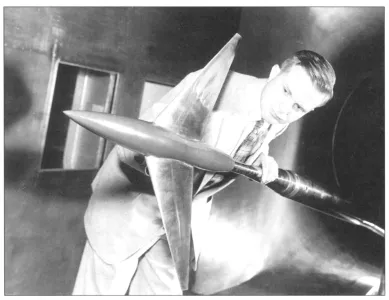

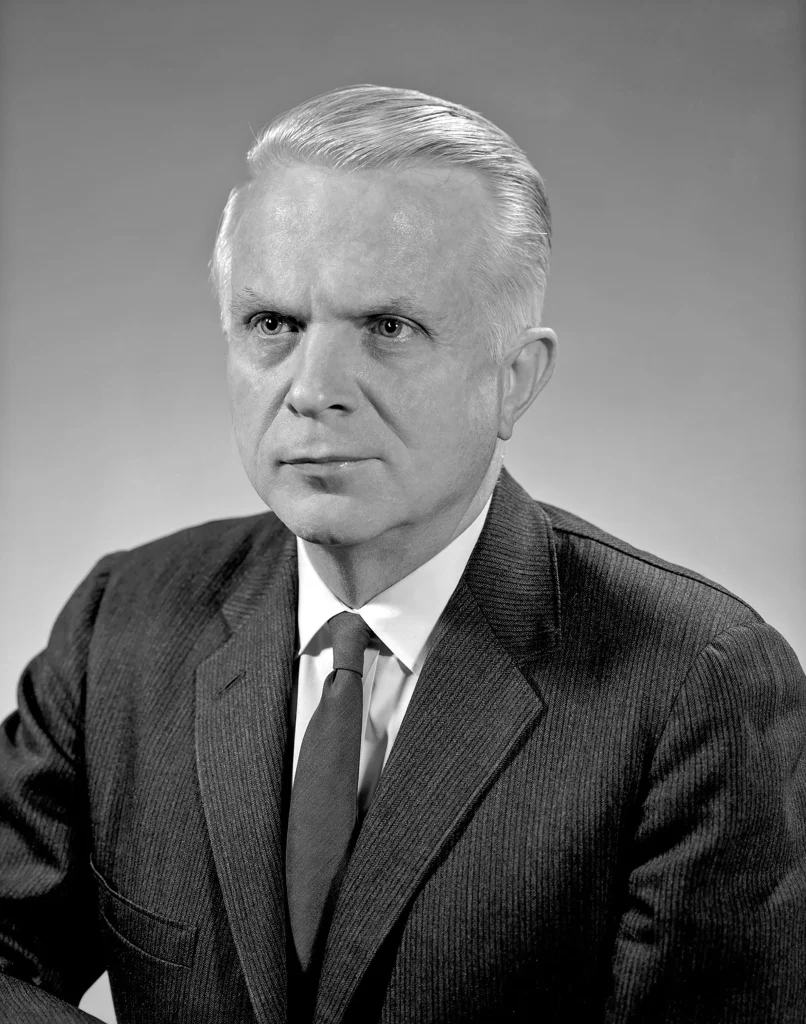
The rise of aviation we see today is the result of decades of hard work, countless hours, and days and nights spent in labs, workshops, and wind tunnels. And this success is attributed to engineers, researchers, and scientists, who worked silently behind closed doors. To honor these individuals, we launch “Pioneers of Aeronautical Engineering,” a series that will tell their stories, experiments, and showcase their valuable work. Who is a better individual to start this series, apart from Richard Whitcomb? Known as the “father of modern aeronautics,” Richard Whitcomb developed three important aerodynamic concepts that revolutionized airplane design. These innovations helped military and civilian aircraft to fly faster and farther while using less fuel. Some estimates say Whitcomb’s contributions account for one-third of the major technological achievements at the Langley Research Center since its founding in 1917. Richard Whitcomb was born in Evanston, Illinois, and grew up in Worcester, Massachusetts. He attended Worcester Polytechnic Institute and graduated in 1943. He earned a bachelor’s degree in mechanical engineering, focusing on aeronautics. He read about the NACA Langley Memorial Aeronautical Laboratory in a magazine and was very impressed. He was so eager to join that he was ready long before getting a job offer. When a recruiter contacted him, he quickly accepted a Junior Engineer position. He worked under Eugene Draley at the Langley 8-Foot High-Speed Tunnel. His early work focused on testing high-priority military aircraft for the war, including the XB-29, and by the end of his career, he became the head of the organization.
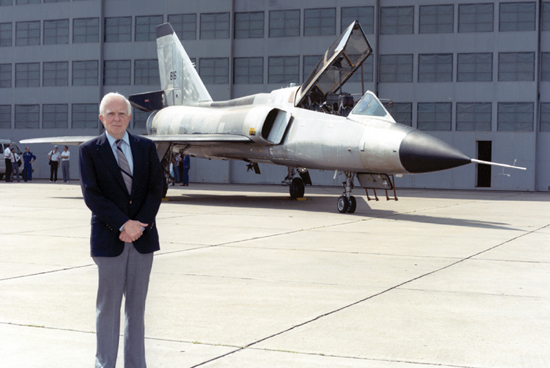
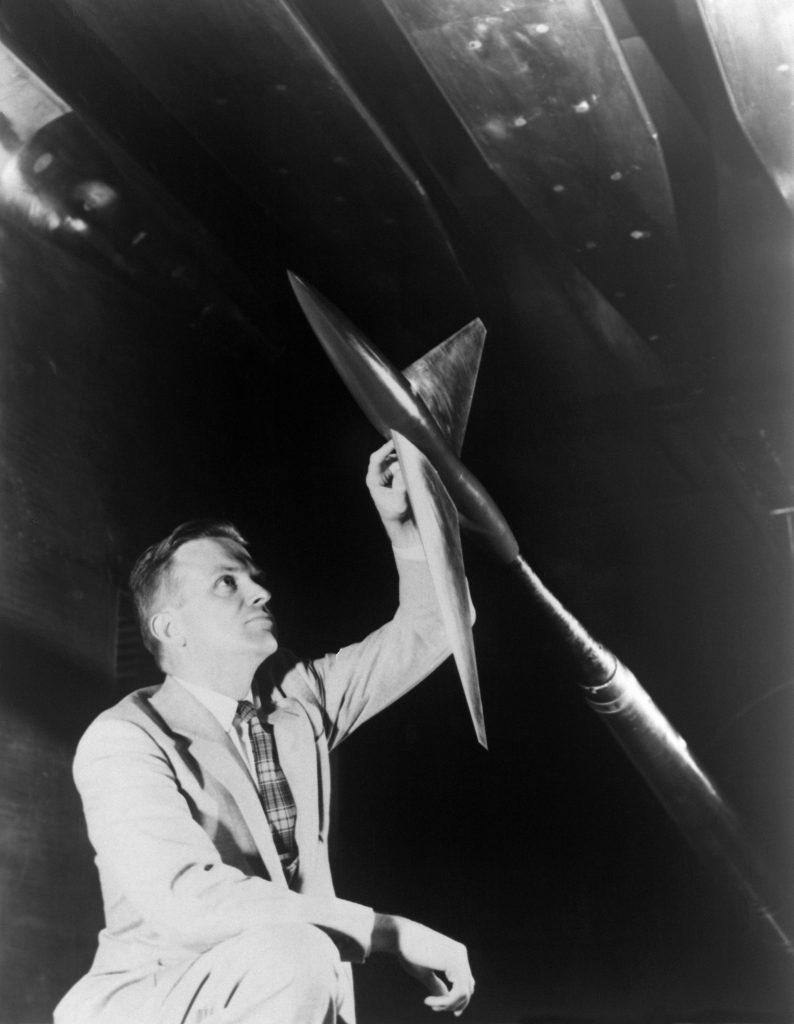
The tunnel began operating in 1936 and could reach speeds of up to 575 mph, but could not achieve transonic conditions. In 1945, the tunnel was upgraded with increased power, and in 1950, it was modified with a slotted test section. It then became known as the 8-Foot Transonic Tunnel and served as an important tool for aerodynamicists. After WWII, as demand for testing specific military aircraft decreased, Richard Whitcomb focused on basic research. He studied how to reduce the increase in aerodynamic drag that occurs for aircraft near the speed of sound. In late 1951, Whitcomb had an important idea while sitting at his desk. He was inspired by a lecture on transonic flow given by Dr. Adolph Busemann. Richard Whitcomb thought that, to reduce drag in transonic flight, an airplane’s cross-sectional area should be smooth. This idea became known as the “area rule.” When he shared his theory with Busemann and others, Busemann praised his “brilliant” idea. When Whitcomb developed the area rule, tests of a model of the F-102 fighter were underway in the tunnel. But that model was removed, and he first tested a simple wing-body model, which showed good results. When he returned to the F-102, he made changes to follow the area rule because the jet had previously experienced high drag levels that limited its ability to fly faster than the speed of sound. After applying Whitcomb’s ideas, the F-102 not only reached supersonic speeds in level flight but also improved its initial climb. The improvement increased the F-102’s speed by about 25%. The area rule is now used in nearly all high-performance military aircraft. In 1953, Langley began using a new transonic wind tunnel, the 8-Foot Transonic Pressure Tunnel. The new tunnel had better capabilities to study transonic effects and became known as “Whitcomb’s Tunnel.”
In the 1960s, after contributing to the area rule, Richard Whitcomb worked on the US Supersonic Transport (SST) program. He designed a NASA model called SCAT IV. Although it performed well aerodynamically, the estimated operating costs were too high compared to subsonic transports. Believing that a supersonic commercial airplane was not financially practical, he withdrew from the program. After the disappointment with the SST program, he focused on reducing drag for subsonic airplanes. In 1969, Richard Whitcomb created a new wing design called the “supercritical wing.” The wing had a thick, blunt leading edge and a downward-curved trailing edge, and its design reduced drag at high subsonic speeds, as successfully demonstrated in full-scale flights. Using the area rule and supercritical wing designs, he created “sonic transports” capable of flying at 99% of the speed of sound. However, the 1973-1974 Arab Oil Embargo changed airlines’ priorities, leading them to focus on efficiency over speed and to prefer thicker wings with longer spans. Today, many commercial airplanes use wing designs based on Whitcomb’s ideas, saving the industry billions of dollars in fuel costs. Whitcomb’s third breakthrough came from studying the airflow at the tips of birds’ wings. He found that adding vertical end plates, known as “winglets,” reduced drag at cruising speeds. The design quickly became popular in subsonic airplanes and business jets and is now commonly seen at major airports around the world.
In the 1970s, Richard Whitcomb started and led a successful NASA program that created advanced airfoils. These included medium-speed airfoils for business jets, low-speed airfoils for general aviation aircraft, and rotorcraft airfoils for helicopters. Whitcomb retired in 1980 but continued to work as a NASA consultant and for other aerospace companies. Richard Whitcomb received many awards throughout his career, including the Collier Trophy in 1954 for the area rule and the Air Force Exceptional Service Medal in 1955. In 1956, he was recognized as one of the Top Ten Outstanding Men of the Year by the US Junior Chamber of Commerce. He won the Sylvanus A. Reed Award in 1970 and the NACA Distinguished Service Medal in 1956. He also received the National Medal of Science in 1973 and the Wright Brothers Memorial Trophy in 1974. In 1978, he earned the Meritorious Service to Aviation Award from the National Business Aircraft Association. He received the Howard N. Potts Medal from the Franklin Institute in 1979 and the National Academy of Science Award in Aeronautical Engineering in 2000. He became a member of the National Inventors Hall of Fame in 2003 and was inducted into the National Aviation Hall of Fame in 2012. Richard Whitcomb received an honorary doctorate from Worcester Polytechnic Institute in 1956, at age 35, making him the youngest recipient. He also received an honorary degree from Old Dominion University in 1985. Richard Whitcomb died in Newport News, Virginia, on October 13, 2009, at the age of 88. In the Pioneers of Aeronautical Engineering, Richard Whitcomb is truly the father of modern aeronautics. Stay tuned for more such interesting articles.