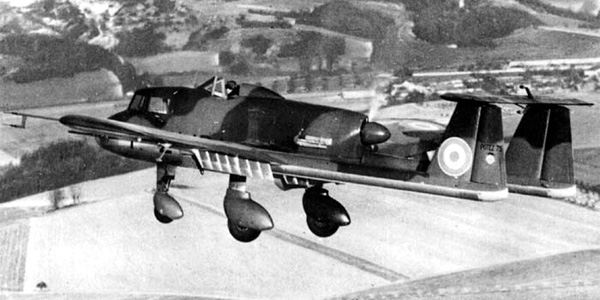
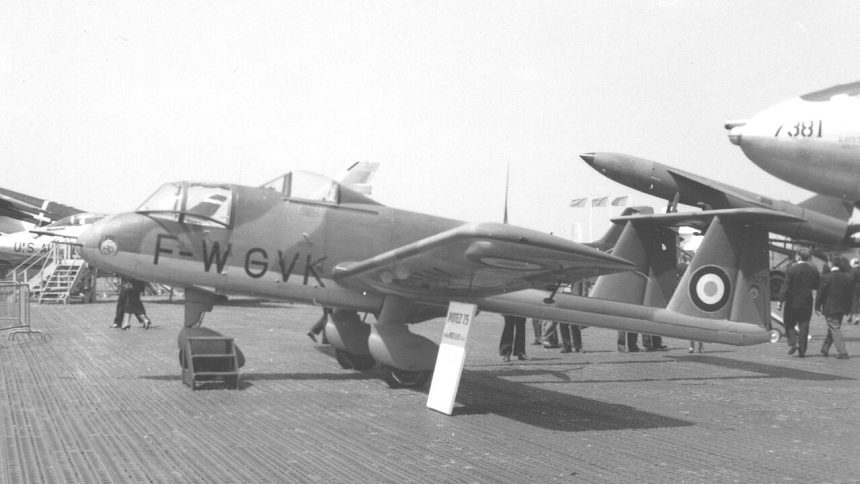

On this day in aviation history, 73 years ago (June 10, 1953), the first flight of the Potez 75 took place. Of French origin, the Potez 75 was developed to partake in colonial conflicts that were ongoing at the time. A ground-support and observation aircraft, the Potez 75 was intended to be a low-cost and simple design that could be produced with ease. Potez initiated the design of the 75 after the issuance of a specification for an aircraft that could launch new Nord SS.10 wire-guided anti-tank missiles. Potez’s resulting design was an all-metal pusher aircraft, with the single 640-hp (takeoff) Potez 8D.32 inverted V-8 engine mounted at the rear. A twin-boom tail design gave the 75 a distinctive flair; Potez equipped the new ground-support aircraft with fixed landing gear. A crew of two served aboard the Potez 75: a missile operator who sat in the nose and the pilot located in the upper cabin. The original prototype had a partially open cockpit for the pilot, but this was eventually modified to be fully enclosed.
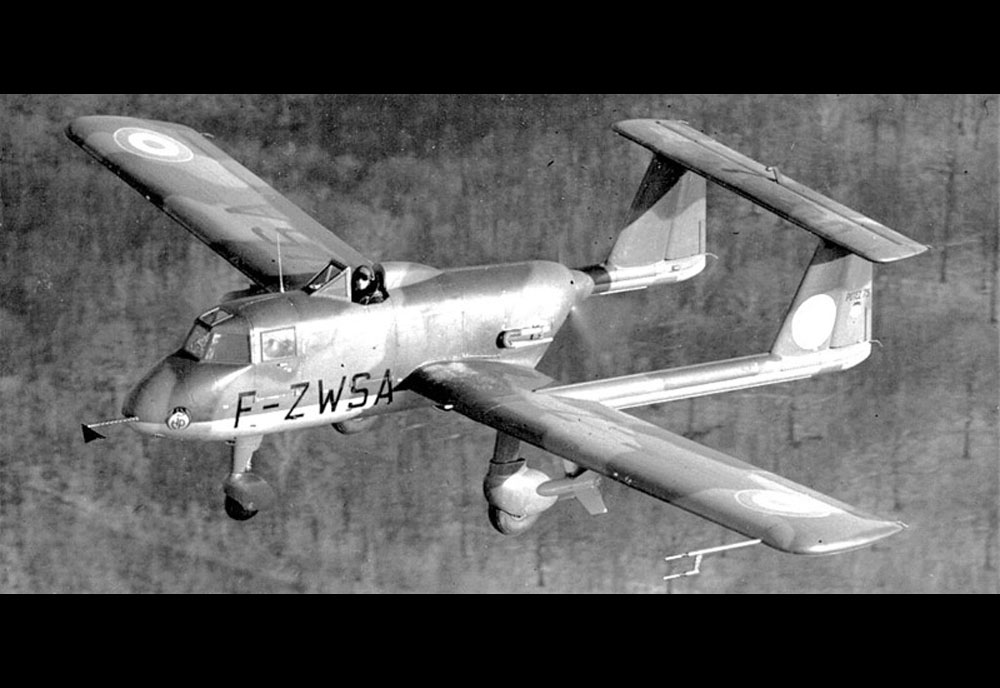
F-ZWSA was the first Potez 75 to fly, and was later renamed F-WGVK and finally as F-MAFY in military testing. Flight trials revealed the Potez 75 to be unfit as a missile-launching platform, so modifications were made for a ground-attack-only mission. The Potez 75 was tested in the role during the Algerian War, within which the aircraft excelled at its job. In 1956, an order for 15 pre-production and 100 production Potez 75s was placed. Unfortunately, this order was cancelled the following year due to budget cuts. The sole Potez 75 was flown into the late 1950s as an exhibition aircraft, and scrapped in 1958 after a crash landing. The Potez 75’s 8D.32 engine was rated for 245 hp at altitude. It could attain a maximum airspeed between 171 and 183 mph. A flight endurance of 3 hours and 20 minutes gave the 75 a reasonable window within which to carry out ground attack sorties. Service ceiling for the Potez 75 was 28,200 ft, while the aircraft’s rate of climb was 1,140 fpm. The Potez 75 could climb to 3,300 in 3 minutes, and 9,800 ft in 10 minutes. Armament came in the form of one 12.7 mm DEFA machine gun and another 7.5 mm fixed machine gun, both in the nose. Provisions for up to 8 missiles or rockets were also installed underneath the wings.