






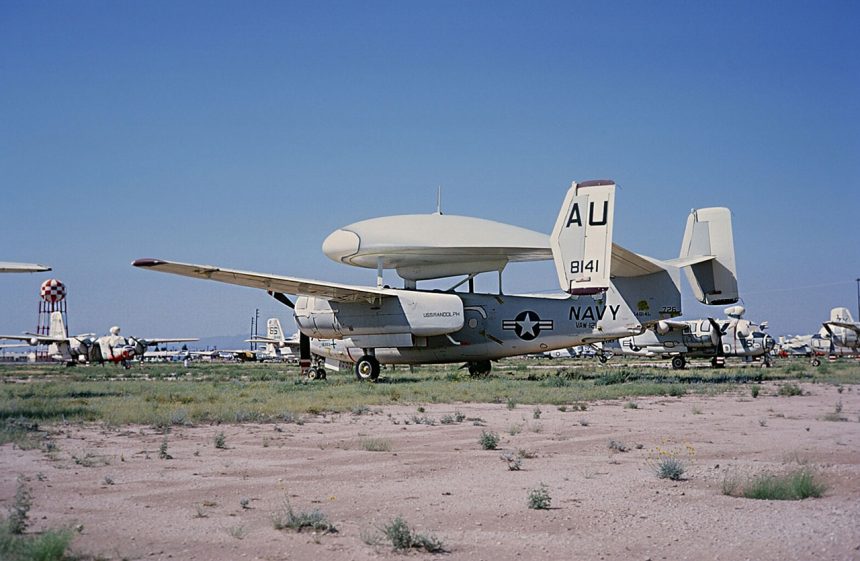

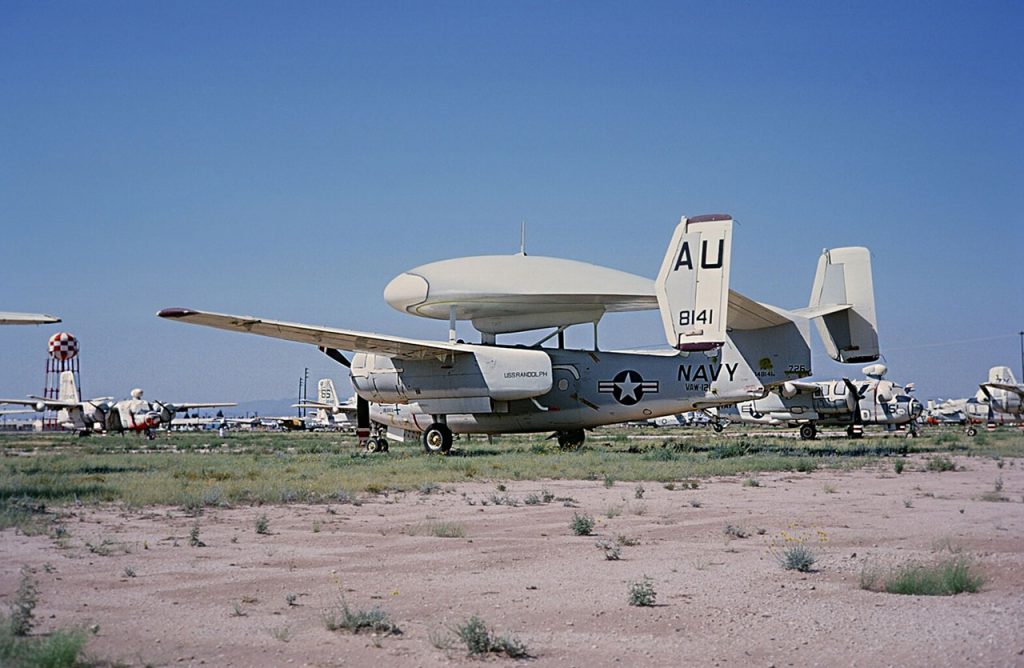
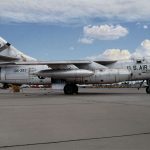
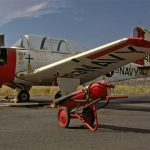
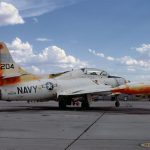
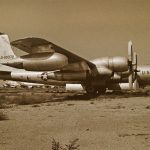
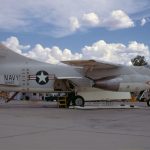
As we continue the Boneyard Files series, which showcases some of the retired aircraft resting at Davis-Monthan Air Force Base in Tucson, Arizona, in the late 1960s, today’s story features the Grumman E-1B Tracer through the lens of Neil Aird and Tom Baillie’s “Monthan Memories” photos. During WWII, radar became an important technology to detect enemy attacks. It was so successful on land and ships that military planners wanted to use it on aircraft as well. In early 1943, scientists at the Massachusetts Institute of Technology’s Radiation Laboratory started developing the APS-20 airborne early warning radar and tested it by installing the equipment on a TBM Avenger torpedo plane. The modified plane, called the XTBM-3W, had a large round antenna between its landing gear. Its bomb bay was modified to accommodate a radar operator, and the project was codenamed Project Cadillac. Testing from 1944 to 1945 showed that this radar could detect single aircraft and groups of aircraft at distances two to four times longer than shipboard radar.
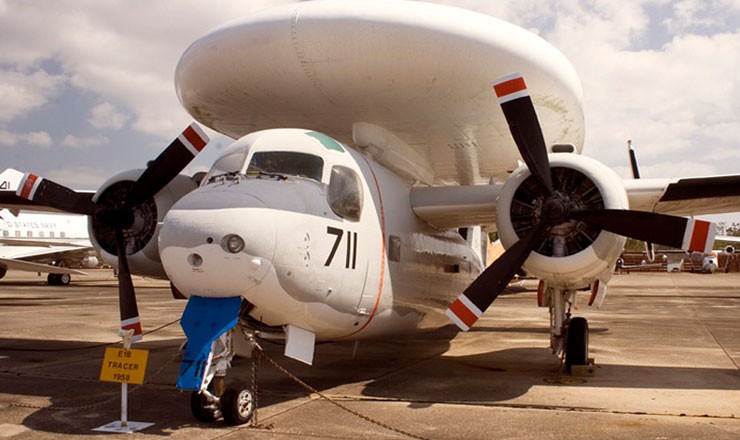
After WWII, the TBM-3W Avengers and later-modified attack aircraft, such as the AD-3W Skyraider, began serving as airborne early warning (AEW) platforms. In 1955, engineers at Grumman Aircraft Engineering Corporation wanted to develop a new AEW aircraft based on the successful S2F Tracker, which was used for antisubmarine warfare. A major part of the design was the aerodynamics of the airplane, which included a large radome on top and enough space inside for radar equipment. To achieve this, Grumman engineers selected the TF-1 Trader, a version of the S2F designed for carrier delivery, because it had a large cabin. They replaced the single tail with twin fins and rudders to fit the tear-drop shaped radome. After wind-tunnel tests, the aerodynamic prototype flew for the first time on December 17, 1956. Just over fourteen months later, the first WF-2 Tracer, redesignated as the Grumman E-1B Tracer in 1962, had its maiden flight. The Grumman E-1B Tracer was 45.4 feet long, 16.7 feet high, with a wingspan of 72.7 feet. Its empty weight was 20,638 pounds, and the gross weight was 26,600 pounds. The aircraft was powered by two Wright R-1820-82A Cyclone nine-cylinder air-cooled radial piston engines, each producing 1,525 horsepower.
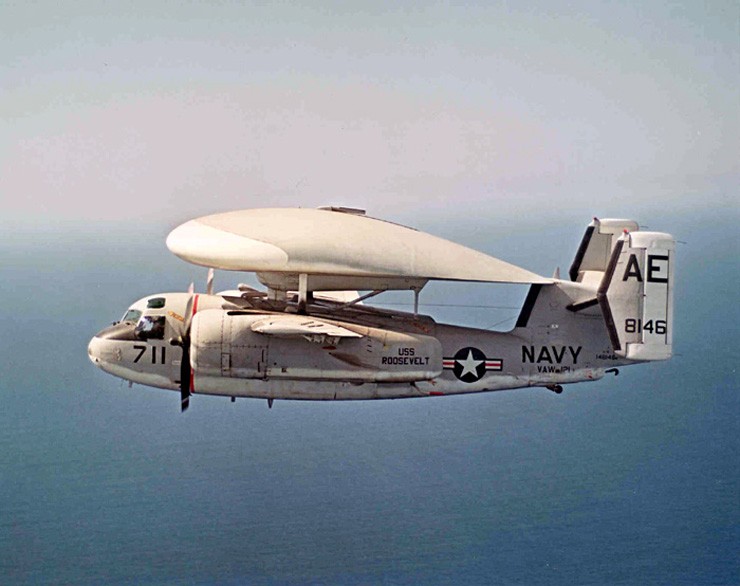
The maximum speed of the Grumman E-1B Tracer was 227 mph at 4,000 feet, and the service ceiling was 15,800 feet. When the Tracer started service in 1960, it improved the Navy’s AEW capabilities. Its APS-82 radar offered better stability, which improved height-finding and helped cancel radar returns from the sea during overwater flights. The Grumman E-1B Tracer’s first deployment was with Carrier Airborne Early Warning Squadron (VAW) 11 on the USS Constellation (CVA 64) in 1960. During the early years of the Vietnam War, Grumman E-1B Tracer helped fighter planes on combat air patrol by providing them with target directions to manage bombing missions over North Vietnam. The E-1B had a radius of 250 to 300 miles and served as an early warning system for strike aircraft, alerting to any MiG activity. In total, VAW squadrons equipped with the Tracer completed 56 deployments in support of operations over Southeast Asia. Some Grumman E-1B Tracer aircraft began appearing at Davis-Monthan Air Force Base, known as “The Boneyard,” in the late 1960s, after the more advanced Grumman E-2 Hawkeye entered service in the mid-1960s. Read more Boneyard Files Articles HERE.



The radar operators that were part of the TBM-3W’s crew were not located in the former weapons bay, instead their positions were in the fuselage, while the APS-20 Radar was housed in the former weapons bay.