
(Image credit: VAN)
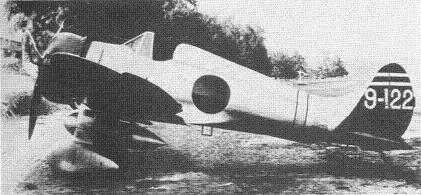
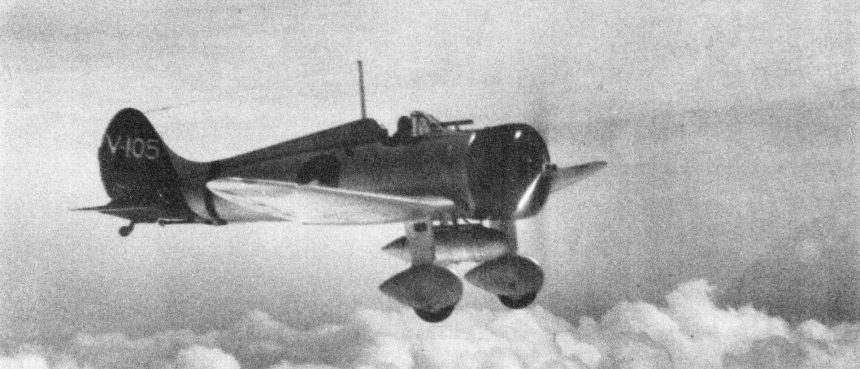
On this day in aviation history, 91 years ago (February 4, 1935), the first flight of the Mitsubishi A5M took place. Known as the Claude by the Allies, the A5M was a Japanese carrier-based fighter noted as being the predecessor of the Mitsubishi A6M Zero. The Claude had many designations during its development, also being known as the Mitsubishi Navy Type 96 Carrier-based Fighter, Mitsubishi Navy Experimental 9-Shi Carrier Fighter (while in development), and Mitsubishi Ka-14 (internally). The A5M holds the distinction of being the first low-wing monoplane shipboard fighter to enter service, as previous monoplanes of the same role had been high-wing (Dewoitine D.1ter and Wibault Wib.74). Design of the A5M began in 1934 upon the release of a Japanese specification for a new advanced fighter. This new fighter was to have a maximum speed of 220 mph at 9,800 feet, and the ability to climb to 16,000 feet in 6.5 minutes. Mitsubishi’s design efforts resulted in an all-metal low-wing fighter that utilized a thin elliptical inverted gull wing and had fixed landing gear. After the prototype aircraft’s first flight on 2/4/35, flight testing revealed that the A5M’s performance far exceeded that of the specification. The aircraft was soon ordered into production.
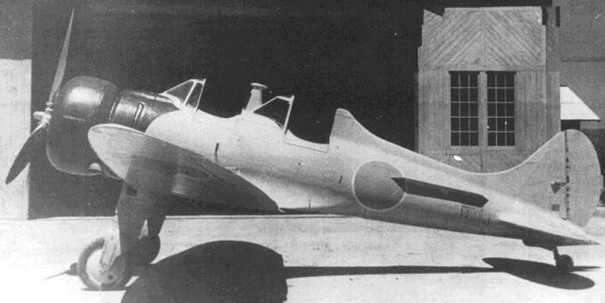
The Mitsubishi A5M4 was powered by a Nakajima Kotobuki 41/41 KAI 9-cylinder radial engine that produced 710 horsepower at take-off, and 785 hp at an altitude of 9,800 feet. A5M4s could attain a maximum airspeed of 270 mph, had a range of 650 nautical miles, and a service ceiling of 32,200 feet. The Claude could reach an altitude of 9,800 feet in 3 minutes and 35 seconds. Armament for the A5M4 came in the form of two 7.7 millimeter Type 97 machine guns, which were fuselage-mounted and synchronized to fire through the engine. Additionally, Claude could be fitted with two 66-pound Type 99 high-explosive bombs or a single 160-liter (42.27 US gallon) drop tank. Mitsubishi built 1,094 A5Ms during the aircraft’s production run. The aircraft mostly saw service in the Second Sino-Japanese War. Some A5Ms were encountered by the American Volunteer Group. The Flying Tigers successfully downed a Type 96 over Mingaladon airfield, Burma, on January 29, 1942. The A5M Claude would see its final combat action on May 7, 1942, at the Battle of the Coral Sea. Only one A5M is known to exist, underwater, the sunken ship Fujikawa Maru, in Chuuk Lagoon, Micronesia.