

(Image credit: VAN)
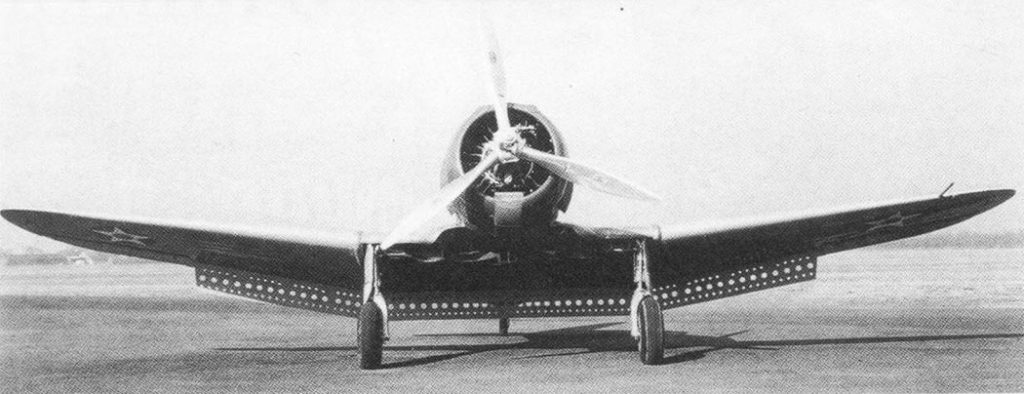
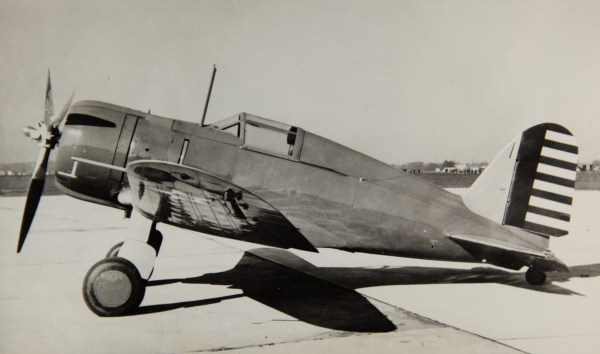
On this day in aviation history, 90 years ago (March 29, 1936), the Vought V-141 flew for the first time. The V-141, later re-designated as the V-143 after modification, was an American prototype fighter aircraft. Vought developed the V-141 from the Northrop 3A design, a previously unsuccessful design. The 3A resulted from Northrop’s XFT prototype carrier fighter program; it was a variant developed to meet a United States Army Air Corps requirement for a single-seat fighter. On July 30, 1935, the sole 3A prototype disappeared during a test flight over the Pacific Ocean. Northrop abandoned any further development of the aircraft.
The USAAC requirement for a new fighter still stood, and Vought saw an opportunity in the now-abandoned 3A design. Vought President Eugene Wright ignored the advice of his engineers and bought the 3A project from Northrop in 1936. He felt confident that his company could develop the abandoned design into a new fighter for the USAAC. With little time to work, given the upcoming USAAC fighter competition, Vought engineers set to work on designing a new fighter. The rudder was enlarged, while the undercarriage and engine cowling were also modified. Vought’s V-141 rolled out as a low-wing monoplane with a retractable tailwheel and an enclosed cockpit. The prototype Vought V-141 first flew on 3/29/1936.
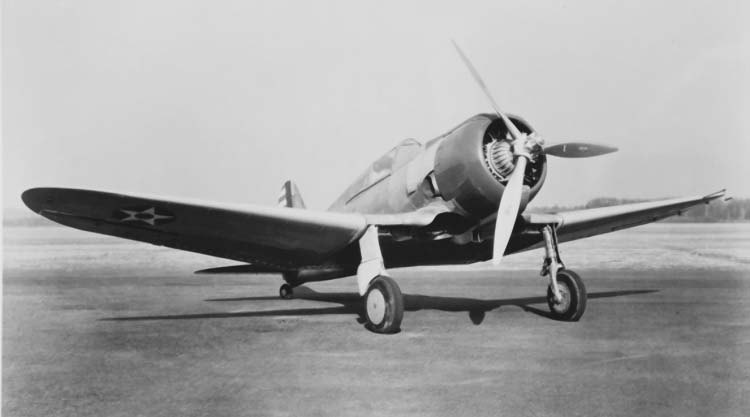
Flight testing of the V-141 revealed poor handling characteristics and a tendency to spin. Tail flutter was an additional concern for those who test flew the V-141. The aircraft was rejected by the USAAC, which opted to go with the Seversky P-35 instead. Vought would go back to the drawing board with the V-141, adding larger tail surfaces, a spin recovery parachute, and an 825-horsepower Pratt & Whitney R-1535-SB4G radial engine. The fighter prototype was renamed the V-143, and Vought sought to offer the aircraft on the export market. Turkey, Norway, Yugoslavia, and Argentina rejected the V-143, as did the USAAC a second time. The sole V-143 was eventually sold to Japan for $175,000 in July 1937. The V-143 underwent a technical evaluation by the Japanese Navy as the “Navy Experimental Fighter Type V,” although there was never an intention of flying them in service. Vought’s V-143 could cruise at 221 mph and had a maximum airspeed of 292 mph. The V-143 had a range of 702 nautical miles, a service ceiling of 30,600 feet, and could reach 10,000 feet in 3 minutes and 6 seconds. If used in combat, the V-143 would have been armed with two .30 calibre machine guns and 300 pounds of bombs.