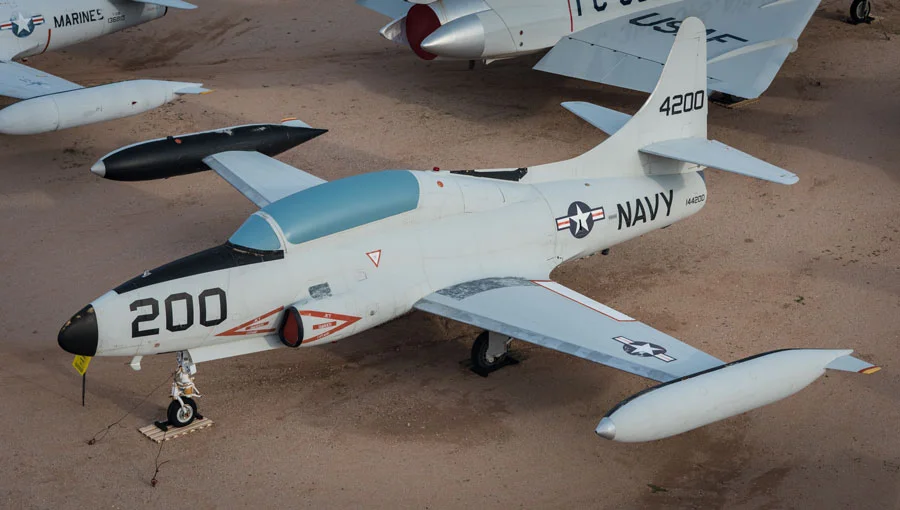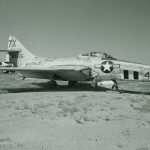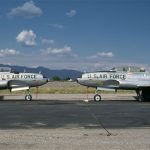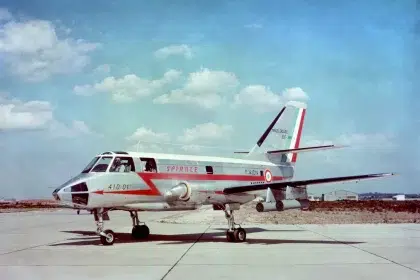
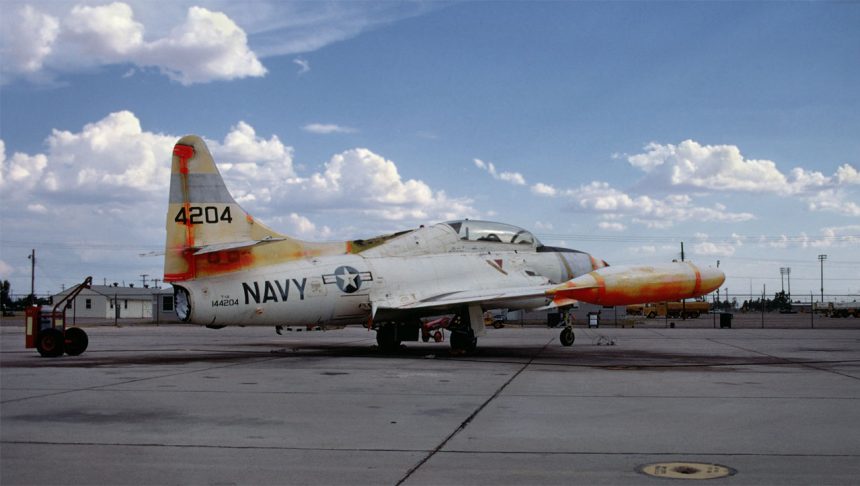

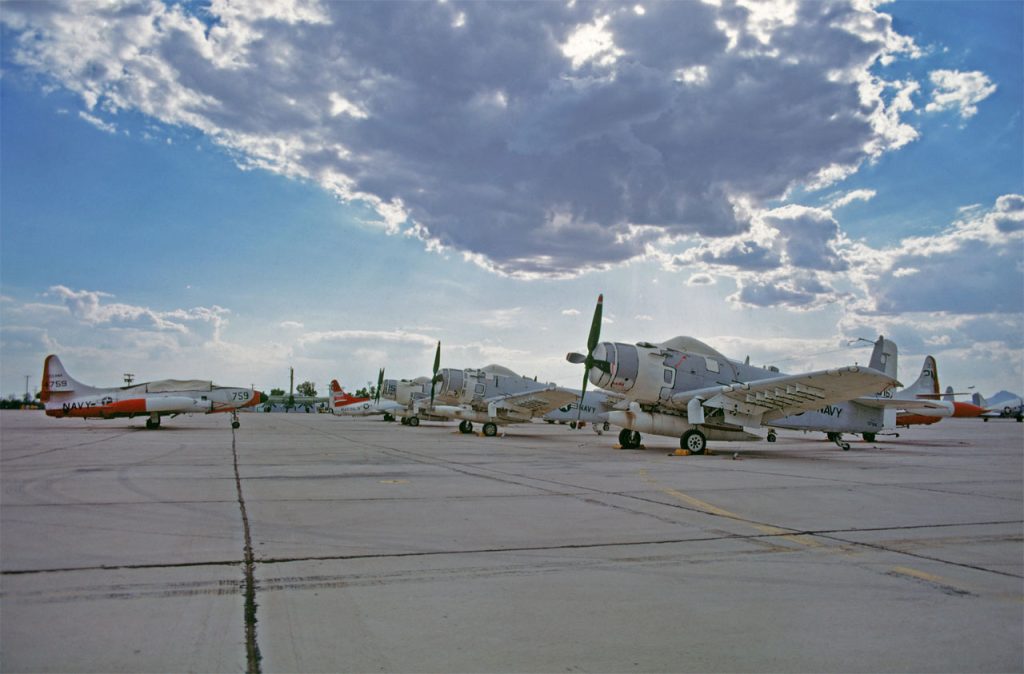
As we continue the Boneyard Files series, which showcases some of the retired aircraft resting at Davis-Monthan Air Force Base in Tucson, Arizona, in the late 1960s, today’s story features the Lockheed T-1A SeaStar through the lens of Neil Aird’s “Monthan Memories” photos. In 1949, the US Navy began using the Lockheed T-33 for pilot training in land-based jet aircraft. The T-33 was based on the Lockheed P-80/F-80 fighter. It was first called TO-2 and later TV-2 in Navy service. However, the TV-2 was not suitable for aircraft carrier operations. To meet the need for a trainer that could operate from carriers, Lockheed developed a new design based on the P-80/T-33 family. This new model was called the L-245 by Lockheed and T2V by the Navy. The L-245 first flew on December 16, 1953, and production began in 1956.
For carrier landings and sea operations, the T2V was equipped with a new tail, standard naval avionics, and a stronger landing gear with catapult fittings. The lower fuselage had a retractable arrestor hook and power-operated leading-edge flaps to increase lift at low speeds for launches and recoveries on carriers. The instructor’s seat was raised for better visibility. Unlike other P-80 models, the T2V could handle the stress of landing on a moving carrier deck. It was also better at resisting damage from seawater due to higher humidity and salt exposure. The T2V was originally called T2V-1 when it started service. It was later renamed T-1A SeaStar under the 1962 system for classifying United States military aircraft.
The Lockheed T-1A SeaStar was 38.6 feet long, 13.4 feet high, with a wingspan of 42.10 feet and a wing area of 240 square feet. The empty weight of the aircraft was 11,965 pounds, the gross weight was 15,500 pounds, and the maximum takeoff weight was 16,800 pounds. It was powered by an Allison J33-A-24/24A turbojet engine, producing 6,100 pounds of thrust. The maximum speed of the Lockheed T-1A SeaStar was 580 mph at 35,000 feet, and the service ceiling was 40,000 feet. The first test flights took place in 1953, but the Seastar didn’t enter service until 1957. It served for a short time in active duty, and most were soon assigned to support roles. Out of the 150 Seastars built, only two are still known to exist. The T-1A was replaced by the North American T-2 Buckeye, which remained in service until the 1970s. After their retirement, some of the Lockheed T-1A SeaStars were sent to Davis-Monthan Air Force Base, known as “The Boneyard” in the 1960s. Read more Boneyard Files Articles HERE.