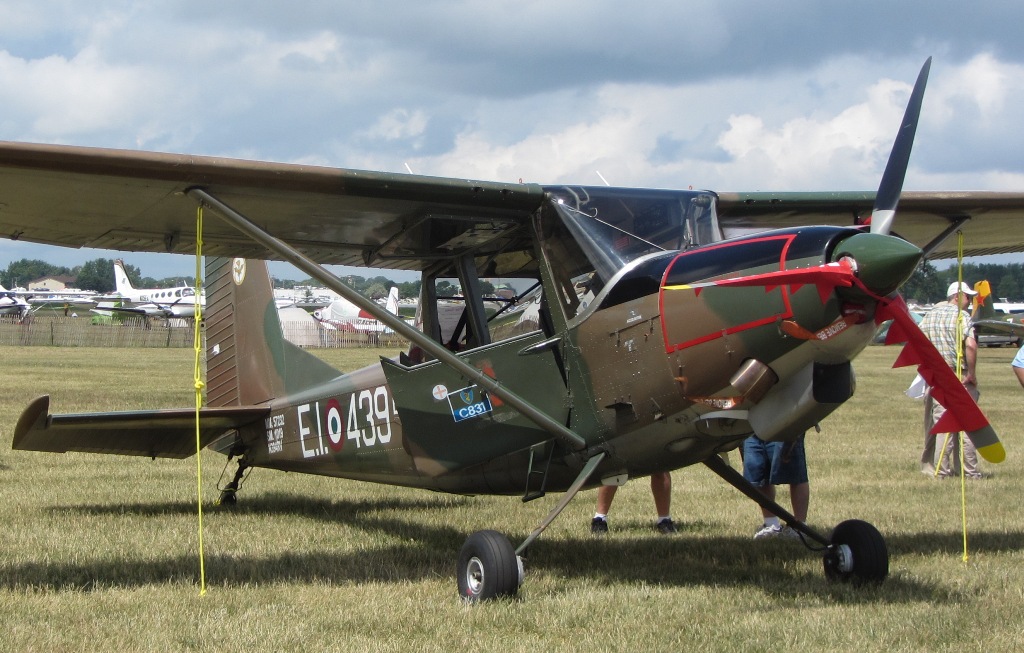
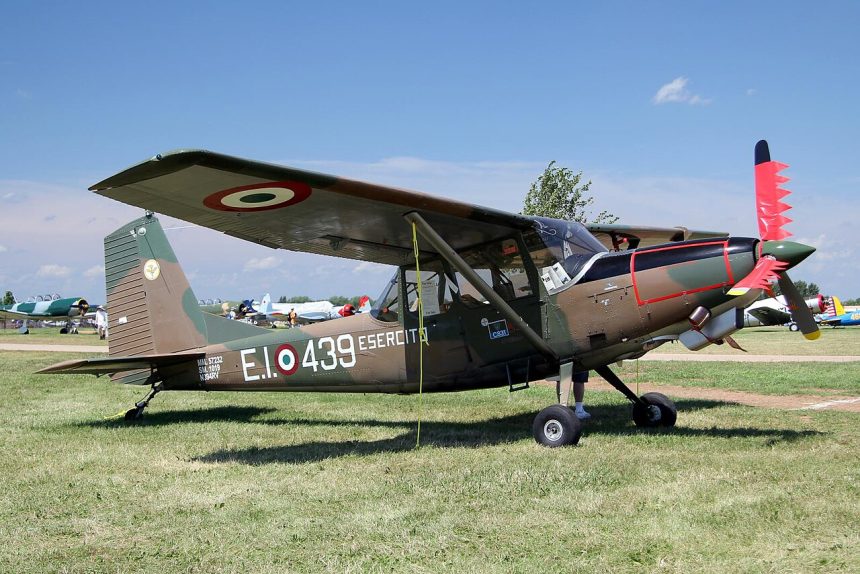

On this day in aviation history, 57 years ago (May 24, 1969), the SIAI-Marchetti SM.1019 took flight for the first time. Developed for the Italian Army by native aircraft manufacturer SIAI-Marchetti, the SM.1019 was a liaison aircraft with short takeoff and landing (STOL) capabilities. SIAI-Marchetti developed the SM.1019 as a turboprop-powered derivative of the Cessna O-1 Bird Dog, another aircraft noted for its liaison service. SIAI-Marchetti began development of the SM.1019 in response to a specification released by the Italian Army for a liaison aircraft with STOL capabilities. Rather than re-invent the wheel, SIAI-Marchetti looked towards Cessna’s 305A/O-1 Bird Dog, which had already found success as a liaison aircraft. To give the O-1 improved takeoff and landing performance on short fields, the 213-hp Continental O-470-11 air-cooled flat-six engine was swapped out for a 317-hp Allison 250-B15C turboprop powerplant.
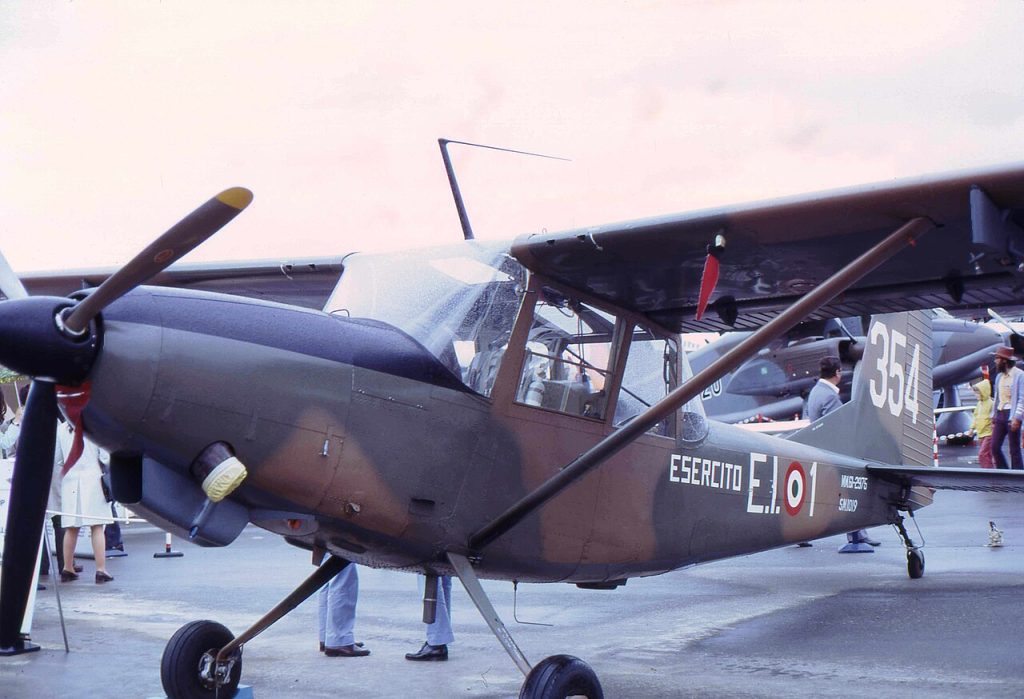
The SM.1019 faced competition under the Italian Army’s specification competition from the Aermacchi AM.3. Ultimately, the SM.1019 won the “fly-off,” earning a production order for 80 aircraft from the Italian Army. Beyond the SM.1019 prototype, 81 SM.1019A and 4 SM.1019B variants were manufactured by SIAI-Marchetti. The SM.1019B was powered by a 400-hp Allison 250-B17B turboprop engine and designated as the SM.1019E.I was in the Italian Army. The SIAI-Marchetti SM.1019 had a cruise speed of 184 mph at sea level, a Vs1 of 61 mph, and a Vs0 of 43 mph. SM.1019s had a range of 499 nmi at sea level, and a service ceiling of 25,000 ft. The SM.1019 could climb at a rate of 1,810 fpm. Short-field performance was exceptional in the aircraft; it could take off at 367 ft (720 ft to clear a 50ft obstacle) and land by 300 ft (also 720 ft to clear a 50ft obstacle).