






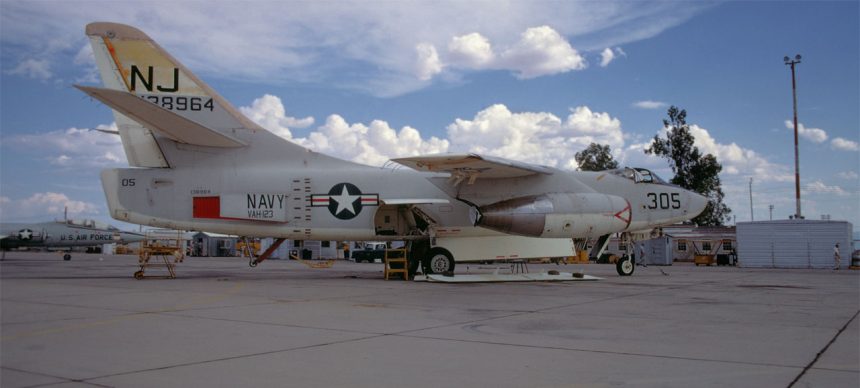

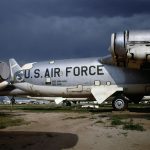
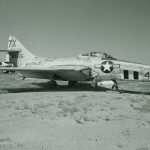
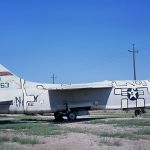
As we continue the Boneyard Files series, which showcases some of the retired aircraft resting at Davis-Monthan Air Force Base in Tucson, Arizona, in the late 1960s, today’s story features the Douglas A-3 Skywarrior through the lens of Neil Aird’s “Monthan Memories” photos. After WWII, the US Navy wanted to maintain its important role in national defense during the nuclear age. To do this, it hired a company to develop a jet-powered bomber for naval aviation, and Ed Heinemann, a well-known engineer at Douglas Aircraft Company, and his team developed the A-3 Skywarrior, initially called A3D Skywarrior. The team focused on reducing the aircraft’s weight, which helped the Skywarrior fly from modified Essex-class carriers with angled decks from WWII. The Douglas A-3 Skywarrior was developed as a strategic bomber; however, for most of its later years, it served mainly as an electronic warfare aircraft, a tactical air reconnaissance platform, and a tanker for aerial refueling. It was one of the longest-serving aircraft on aircraft carriers, starting its service in the mid-1950s and retiring in 1991. Throughout its service, it was the heaviest plane to operate from aircraft carriers, earning it the nickname “The Whale.”
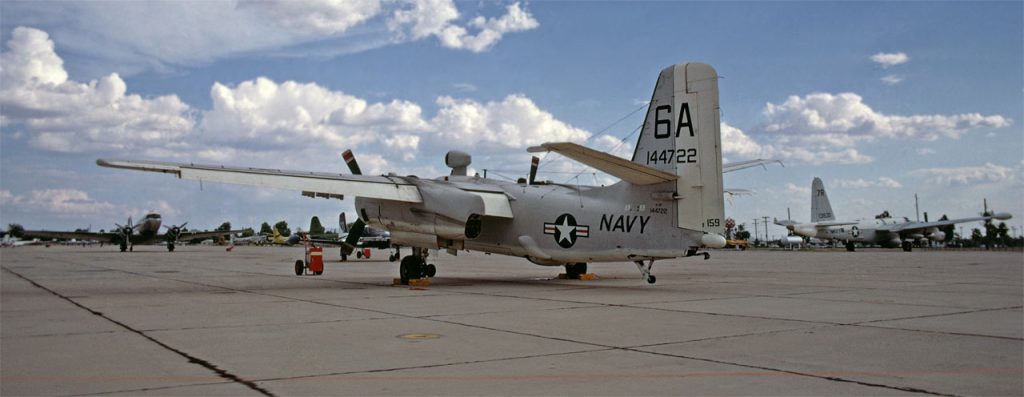
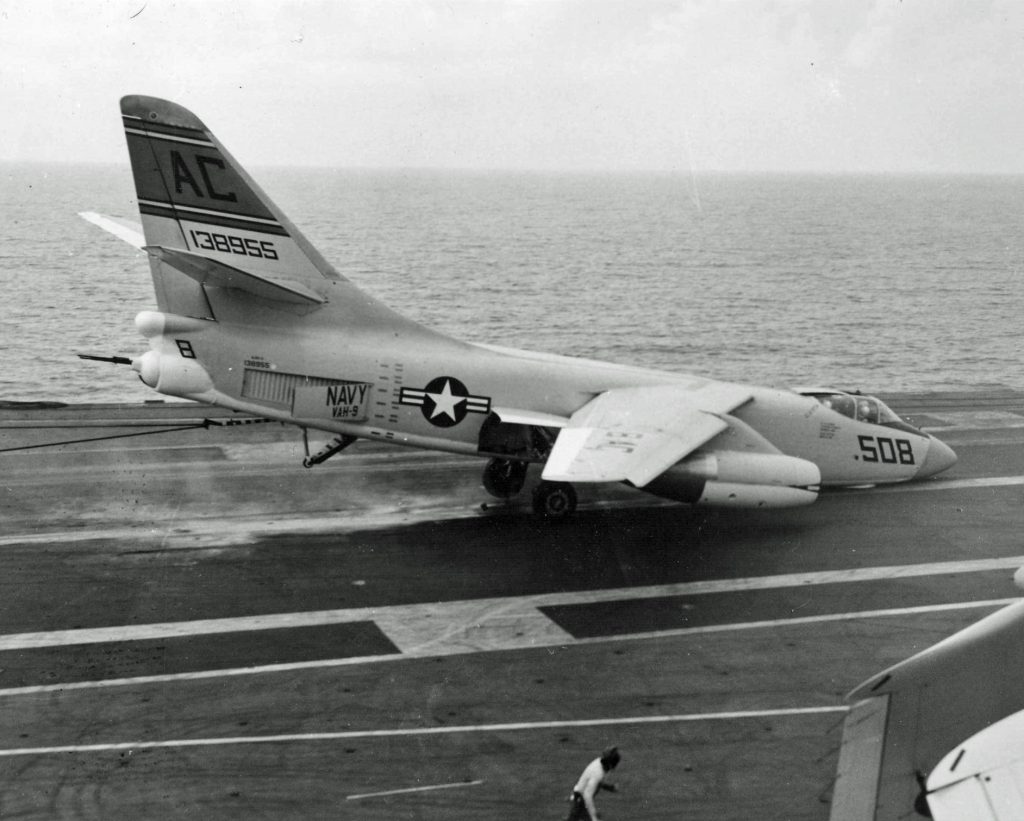
A downside of reducing the design’s weight was the removal of ejection seats. The crew had to bail out of the aircraft using an escape chute that led from the cockpit to the bottom of the fuselage. Because they couldn’t exit the aircraft quickly, Skywarrior crews gave the aircraft a nickname based on its initial designation, A3D, to “All Three Dead.” The Douglas A-3 Skywarrior was 74.5 feet long, 22.8 feet high, with a wingspan of 72.5 feet. Its empty weight was 35,999 pounds, and the gross weight was 70,000 pounds. The aircraft was powered by two Pratt & Whitney J57-P-6 turbojet engines, producing 9,700 pounds of static thrust. The maximum speed of the aircraft was 621 mph, and the service ceiling was 39,000 feet. It was armed with two 20 mm cannons in the tail and provision for 8,700 pounds of ordnance, including nuclear weapons. The new aircraft showed its capability as soon as it entered service. On July 31, 1956, a Skywarrior flew 3,200 miles without stopping or refueling, from Hawaii to New Mexico in just 5 hours and 40 minutes. The next year, two A-3s flew nonstop from one aircraft carrier to another. In 1957, the Douglas A-3 Skywarrior had its first extended deployment on the Forrestal, which was an important moment for the Navy, as its newest attack aircraft went to sea on the country’s first supercarrier. The introduction of the Polaris missile led to a decline in the Navy’s heavy attack missions from aircraft carriers.
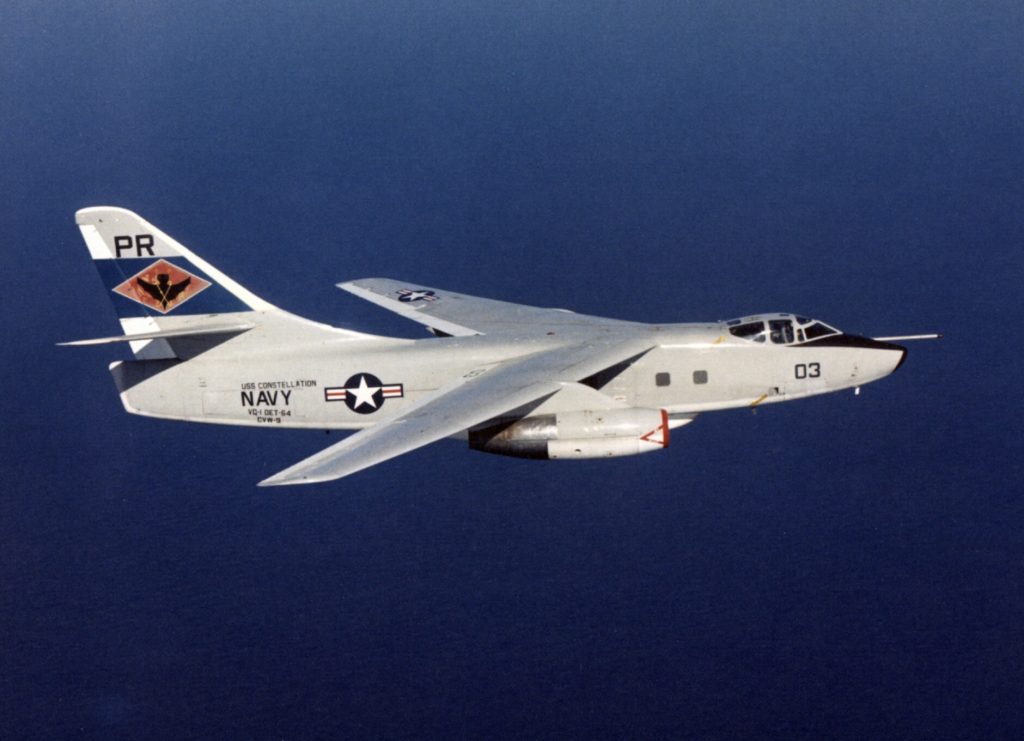
The A3D, which was renamed the Douglas A-3 Skywarrior in 1962, was converted to serve in new roles, including photo reconnaissance and electronic countermeasures. The EA-3 variant was used for electronic intelligence (ELINT) missions from aircraft carriers and on land, supporting the larger Lockheed EP-3. The EA-3B variant was modified for electronic intelligence against the Warsaw Pact. It began flying missions worldwide in 1956, similar to the US Air Force’s EB-47 Stratojet. It provided special electronic reconnaissance capabilities in various Cold War conflicts and the Vietnam War. The EA-3B Skywarrior served in the Navy long enough to take part in the Gulf War in 1991. By September 1991, the Skywarrior was retired, with the last US Navy Skywarriors leaving service on September 27, 1991. Some US Navy research and testing units, particularly at Naval Air Systems Command in NAS Point Mugu and NAWS China Lake, tried to keep their Douglas A-3 Skywarrior test planes. However, this plan failed when Vice Admiral Richard Dunleavy, who was the Deputy Chief of Naval Operations for Air Warfare and an A-3 bombardier/navigator, decided it was time to retire the aircraft. Though some Douglas A-3 Skywarriors that were not converted into special-mission aircraft were sent to Davis-Monthan Air Force Base, known as “The Boneyard” in the 1960s. Read more Boneyard Files Articles HERE.



Max gross weight of the EA-3B was 78,000 pounds.
There were at least two TA-3B aircraft.
Fleet Composite Squadron THREE (VC-3) at NAS North Island had one, which was Commander Naval Air Force Pacific Fleet’s (COMNAVAIRPAC) private plane. The other one was the Chief of Naval Operations’ (CNO) plane.
I flew as a passenger on both planes during my time at VC-3 between 1973 & 1976.
They were both fairly fancy inside for a bomber converted to an executive jet, seating 7 if I remember correctly, but the CNO’s plane was definitely fancier.
Spent some time at Alameda NAS early 70’s, A3’s refueling squad. Shortly after I transferred to Moffat one of the Squadron A/C tried to takeoff from Alameda NAS and failed to lifeoff ,wound up in the Estuary. Both pilots drowned as they couldn’t escape down that shute. Most Dangerous A/C ever.