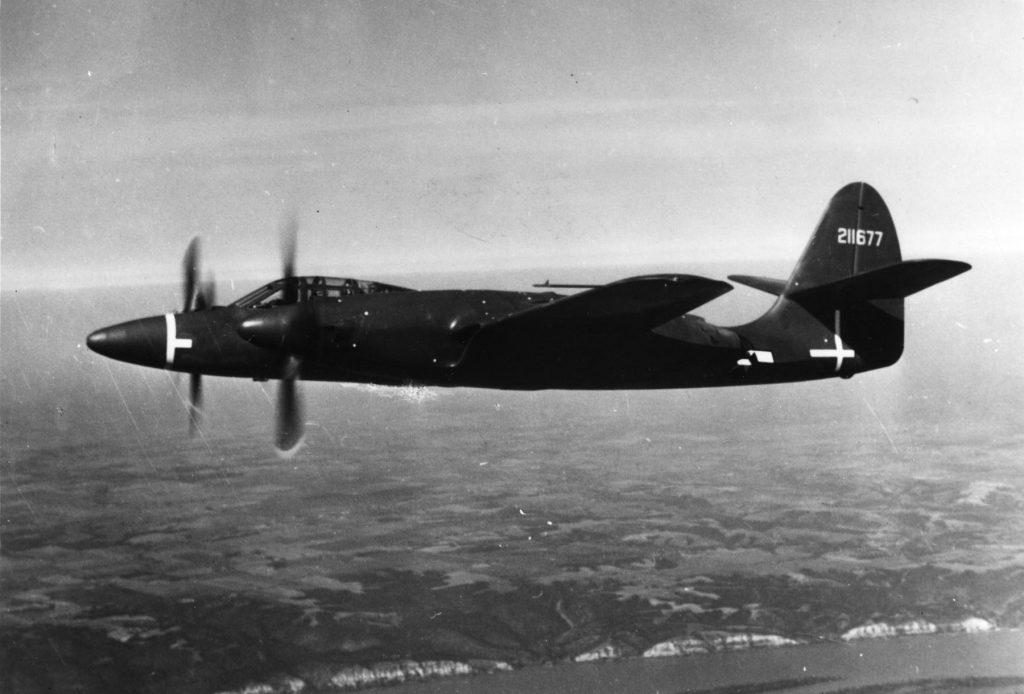
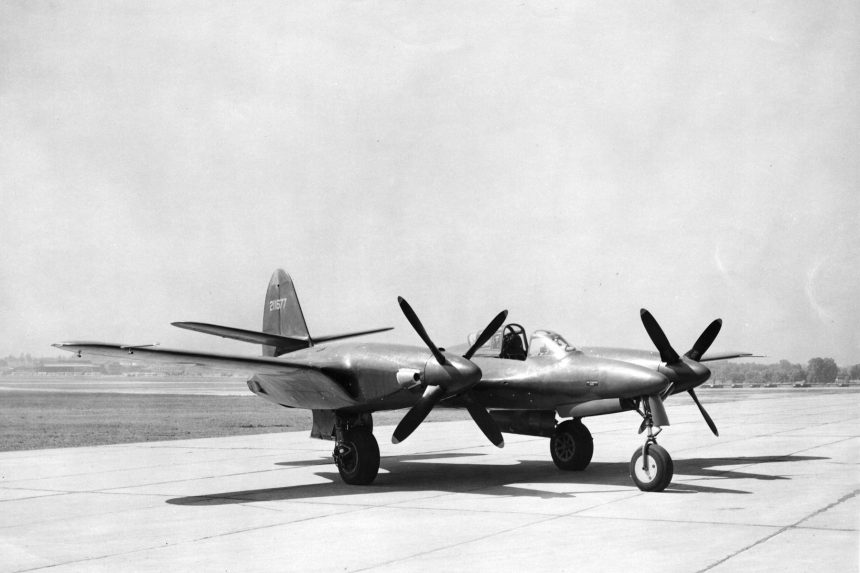


In 1940, the US Army Air Corps wanted a high-speed, long-range interceptor to target enemy bombers. As a result, the service requested industry proposals. Many companies submitted their proposals, including a new company at the time, McDonnell Aircraft, which submitted the Model 1 featuring a unique geared drivetrain and a single Allison V-3420 engine driving twin pusher propellers. However, out of 23 proposals, the McDonnell’s submission ranked in 21st place because its performance was not impressive and its design had not been tested. Despite this, the Air Corps, impressed by the efforts of a new company like McDonnell, awarded them a $3,000 contract to improve the aircraft. McDonnell engineers reworked the design and presented the Model 2 on June 30, 1940. However, this version was also rejected and was later modified into the Model 2A, presented on April 24, 1941. The Model 2A had a traditional design with engines mounted on the wings and featured four-bladed propellers. Its design aimed to reduce drag by keeping a smooth airfoil shape through the fuselage and integrating the engine mounts with the wings. It used laminar airfoil sections and promised a top speed of 472 mph at an initial gross weight of 18,600 lb, which was later increased to 20,000 lb. On September 30, 1941, the US Army Air Corps awarded McDonnell a contract worth $1,508,596, plus an $86,315 fee, to develop the Model 2A, which was redesignated McDonnell XP-67. The contract included the development of two prototypes and a wind tunnel model.
Design of McDonnell XP-67
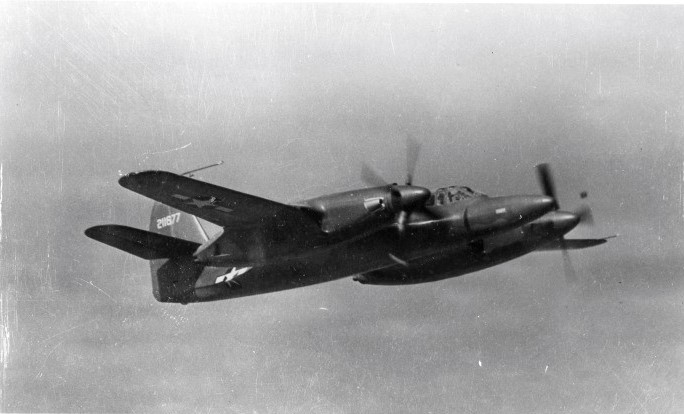
The McDonnell XP-67 was 44.9 feet long, 15.9 feet high, with a wingspan of 55 feet and a wing area of 414 square feet. Its empty weight was 17,745 pounds, and the maximum takeoff weight was 25,400 pounds. The aircraft was powered by two Continental XI-1430-17/19 twelve-cylinder liquid-cooled engines, each producing 1,350 horsepower. The production aircraft were envisaged to be armed with six 37 mm M4 cannons. The first McDonnell XP-67 was ready for ground tests on December 1, 1943. On December 8, the aircraft sustained damage to both engine nacelles from fires caused by a failure of the exhaust manifold slip rings. The damage was repaired by January 6, 1944, and the McDonnell XP-67 made its first flight, which lasted six minutes before ending due to engine issues. After making changes to the engine setup, two more test flights were conducted. During the fourth flight, the engine bearings burned out because the engines were unintentionally run too fast. By this time, it was clear that the McDonnell XP-67 had a serious power issue. The engines were delivering only 1,060 horsepower, well below the promised 1,350. Jim McDonnell, the company’s founder, became frustrated by delays in obtaining better engines and by the poor performance of the existing XI-1430 engines. He started seeking funds to replace the prototype’s engines with a pair of Allison or Rolls-Royce piston engines, along with auxiliary Westinghouse turbojets in the rear nacelles. McDonnell claimed that these new engines could achieve a top speed of 500 mph. However, the Army rejected the proposal in favor of additional testing of the current design. On March 23, 1944, flight testing resumed, and US Army Air Corps pilots flew the aircraft for the first time on May 11, 1944. They found the cockpit layout acceptable and the ground handling satisfactory. However, they deemed the aircraft underpowered because it climbed slowly, accelerated slowly, and required a long takeoff run, especially on one engine.
Problems and Cancellation
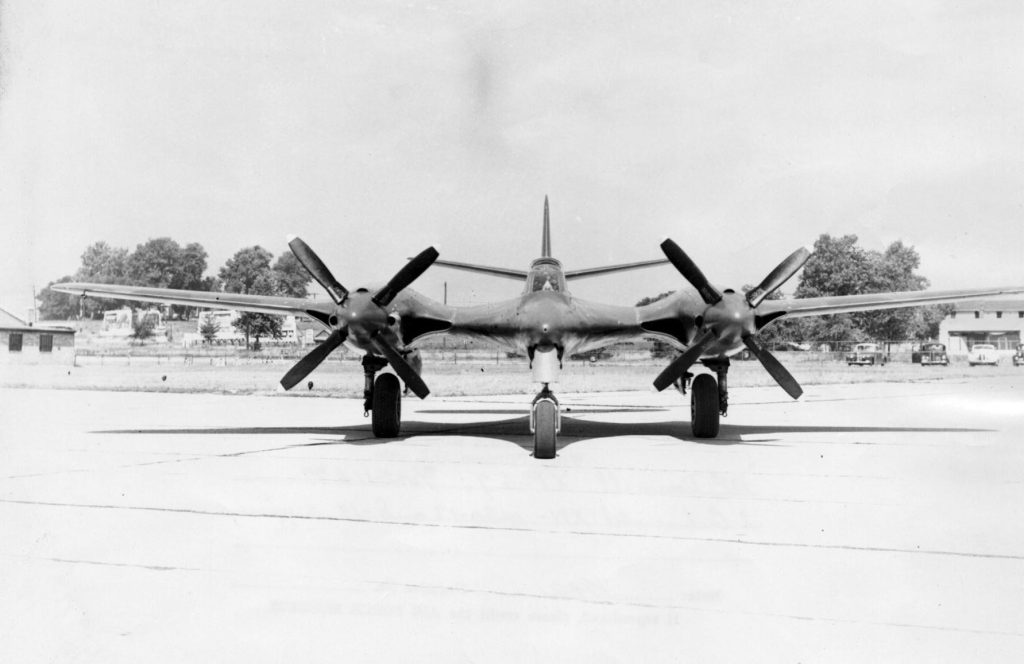
As the McDonnell XP-67 approached its stall speed, it began to shake well before reaching the actual stall speed, felt tail-heavy during fast turns, and the nose would rise during a stall. Test pilots were worried enough about these issues that they refused to test the aircraft’s spin characteristics, fearing it might not recover from a spin. The irregular and unstable stall behavior was due to complex aerodynamic issues that would not be fully resolved until electronic stability controls were developed years later. Although the final flight test report was mostly positive, the aircraft’s maneuverability was considered inferior to that of existing types, such as the North American P-51 Mustang. Later, the aircraft was sent back to McDonnell to resolve the issues. During test flights, the engineers fixed several issues, but the engines still overheated and produced low power output. The McDonnell XP-67 achieved a top speed of only 405 mph, much lower than the expected top speed of 472 mph. On September 6, 1944, an engine of the XP-67 caught fire during a test flight. Test pilot E.E. Elliot performed an emergency landing at Lambert Field in St. Louis, Missouri. He tried to park the plane facing into the wind to keep the flames away from the aircraft. However, the brakes on the right main landing gear failed, causing the McDonnell XP-67 to turn and direct the flames toward the back of the plane. Elliot escaped safely, but the fire destroyed the fuselage, engine, nacelle, and right wing, leaving the aircraft completely destroyed. Losing the only flying prototype impacted the entire program, as the second prototype was only 15% complete at the time. Army leaders decided to review the XP-67 and, on September 13, concluded that it did not offer any substantial advantages over existing fighters. As a result, the aircraft was canceled, its remains were scrapped, and work on the second prototype was halted. In the Grounded Dreams series, the McDonnell XP-67 was not a bad aircraft, but consistent problems with engines and aerodynamics, which could have been solved, led to its cancellation. Read more Grounded Dreams articles HERE.