






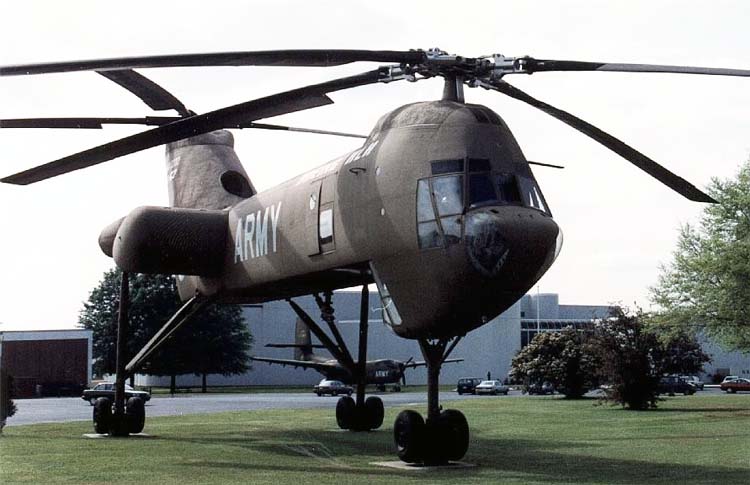


In the 1970s, the US military was operating the Boeing CH-47 Chinook heavy-lift helicopter, with a payload capacity of around 25,000 pounds. But Russia was developing new ultra-heavy-lift helicopters, such as the Mil Mi-26, with a 44,000-pound payload, and the Mil V-12, with 55,000 to 88,000 pounds of payload. For many years, Boeing and the US military wanted to surpass the heavy lifters made by the Soviets. As a result, Boeing developed designs for machines similar to the Sea Knight and Chinook helicopters, but about twice the size of the Chinook. These proposed machines included the “Model 227” transport and the “Model 237” flying crane. In November 1970, the US Department of Defense (DoD) issued a request for proposals for a Heavy Lift Helicopter (HLH). On May 7, 1971, the DoD chose Boeing Vertol to start the first phase of HLH development. In 1973, after receiving an Army contract to build HLH, Boeing began developing the helicopter and designated it Boeing Vertol XCH-62. By 1975, the Boeing XCH-62 prototype was nearly complete and was set for its first flight in 1976.
Design of Boeing Vertol XCH-62
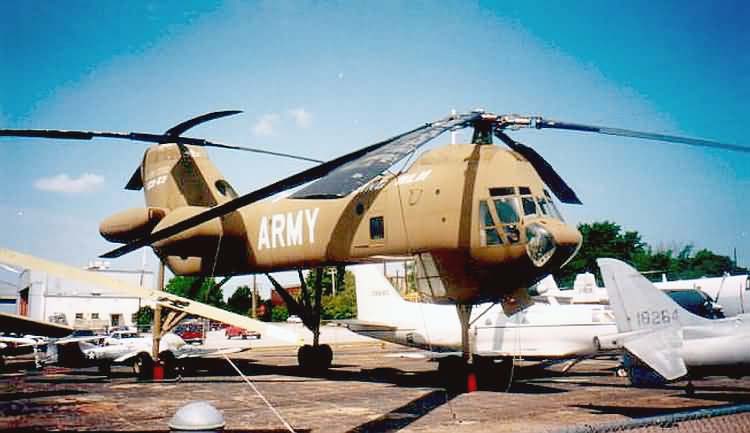
The tandem-rotor Boeing Vertol XCH-62 was designed to be operated by a crew of five, including a pilot, copilot, flight engineer, load-controlling crewman, and crew chief. It was envisioned to carry 12 troops and was 87.3 feet long and 32.3 feet high. The empty weight of the Boeing XCH-62 was 52,580 pounds, and the gross weight was envisaged at 118,000 pounds. It was powered by three Allison T701-AD-700 turboshaft engines, each producing 8,080 horsepower. The helicopter had two four-bladed rotors, each 92 feet in diameter, and a rotor area of 13,260 square feet. The helicopter’s tall fuselage was designed to provide 14 feet of ground clearance, allowing it to taxi over a container to lift it. However, later on, the need for taxiing was removed because the helicopter could hover and lift a load. As a result, a second prototype would likely have only 8.8 feet of ground clearance. The rotorcraft was designed to lift a standard 22-ton container, with widely spaced landing gear to lift heavy loads such as armored vehicles. Boeing also thought about offering a commercial version called the “Model 301.” The Boeing Vertol XCH-62 was designed to be the first helicopter to use a fly-by-wire flight control system without any mechanical backup. The maximum speed of the helicopter was envisioned to be 167 mph with external loads. It was developed to provide a combat range of 170 miles and a ferry range of 1,700 miles. On March 12, 1975, the helicopter’s T701 engine successfully passed a 30-hour test.
The Cancellation
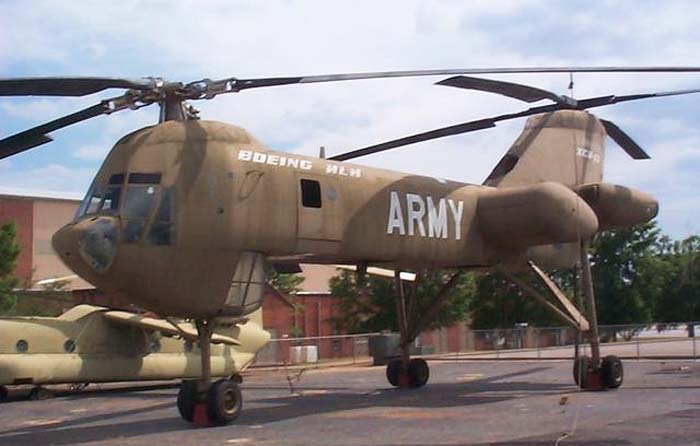
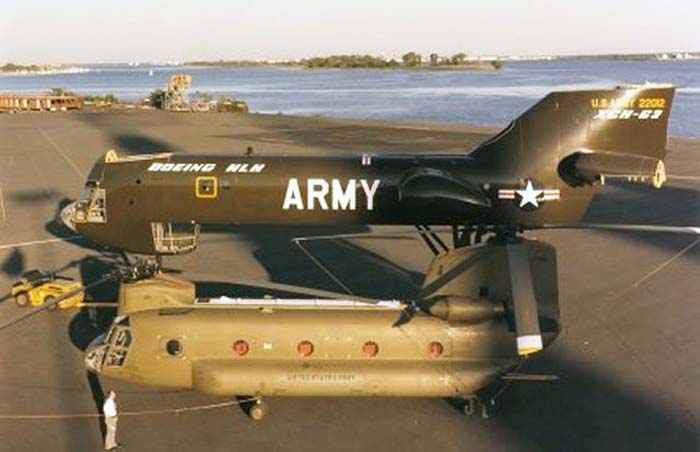
However, on August 1, 1975, the Boeing Vertol XCH-62 program was officially canceled. At that point, the prototype was 95% finished and needed about three more months for final assembly and checks before it could be rolled out for pre-flight testing. The main transmission’s spiral bevel gears had problems during tests because the analysis method did not account for rim bending. As a result, new gears with stronger rims were designed and made. Subsequently, the US Army successfully tested the Boeing Vertol XCH-62 HLH aft rotor transmission at full design torque and speed. However, in August 1975, the US Congress cut the program’s funding. The designers of the Mil Mi-26 avoided similar issues by using a split-torque transmission in the main rotor. Later, several efforts were made to complete the unfinished Boeing Vertol XCH-62 prototype. In the mid-1980s, the Army, NASA, and DARPA worked together to finish the XCH-62 for test flights. They requested a total of $71 million in funding through the end of fiscal year 1989. However, Congress did not provide the funding, so the Boeing Vertol XCH-62 stayed incomplete. The prototype was moved from storage in Philadelphia, Pennsylvania, transported by barge to Panama City, Florida, and then lifted by a CH-47D Chinook helicopter to the US Army Aviation Museum at Fort Rucker, Alabama, on December 8, 1987. The XCH-62 prototype, which was the largest helicopter ever built in Western countries, was displayed at the museum until it was scrapped in 2005. In 2008, several parts were sent to the Helicopter Museum in Weston-super-Mare, United Kingdom, for exhibition. In the Grounded Dreams series, the Boeing Vertol XCH-62 is a helicopter that didn’t fly due to cost overruns. It could have been the largest Western helicopter, but the costs of developing such a huge machine didn’t make sense to the stakeholders. Read more Grounded Dreams articles HERE.
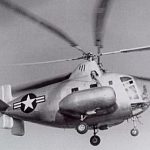






The Hughes XH-17 had a larger rotor , and presumably could lift a greater load . What say you ?
I worked on the XCH-62 when it was airlifted into Ft Rucker back in the early ’90s… Could have been a heck of a big lifter~ Too bad the WOKE people had it crushed when it didnt fit in with what Rucker wanted to do with the space it was sitting on~
Saw, this model -HLH XCh-47 @ the, Ft Rucker, Ala before the museum was even built by a storage area when was there in 1988, during my
MOS schools For Flight Operations (93P) , was quite a site took some
Pictures, which lost later, but was impressed by the size!!!
Too bad, never completed, or test flow even, there have been others
Built similar with side wings, read article supposedly not completed
Either had smaller winged struts of central bay, read article about.
Now the aircraft XCh-47 no longer exist,sadly
Saw it beside the museum several times over the years. Then, one day as I was driving to work at the hospital, I saw them pulling it apart with a backhoe. Official excuse was “It was just a prototype and had no historical value.”
My father was part of the Chinook crew that brought it to Fort Rucker. I’m pretty sure that last picture is of the Chinook my dad was on.