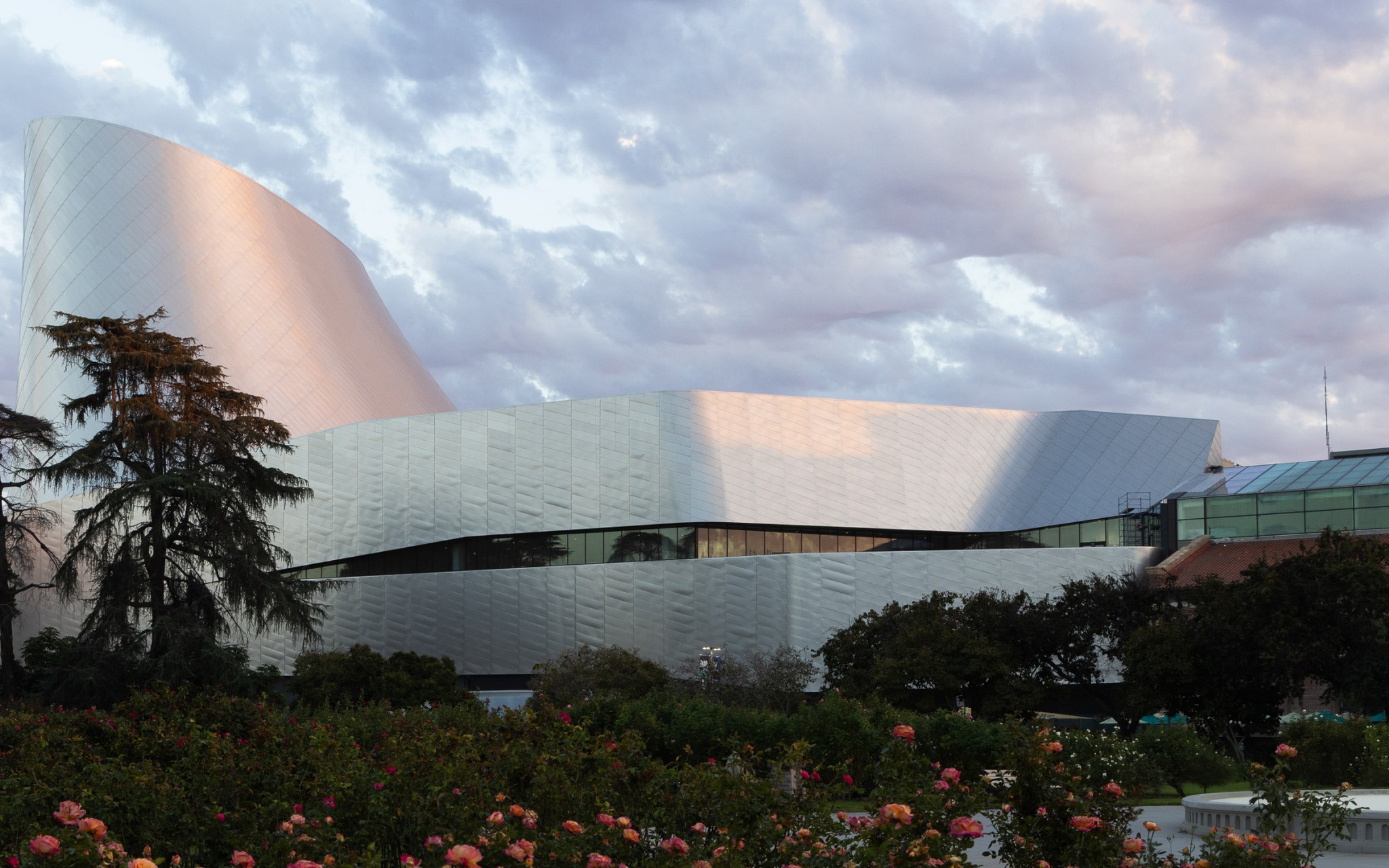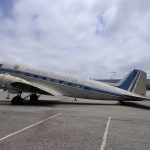
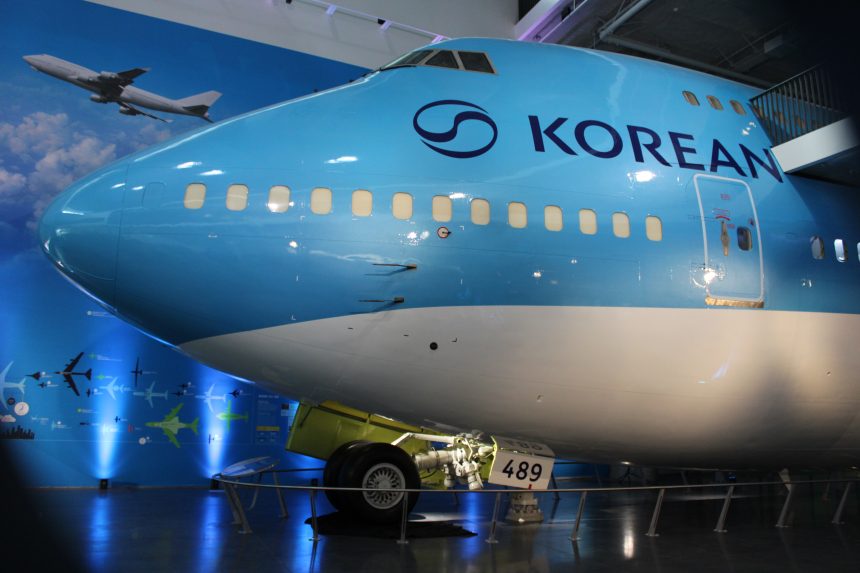

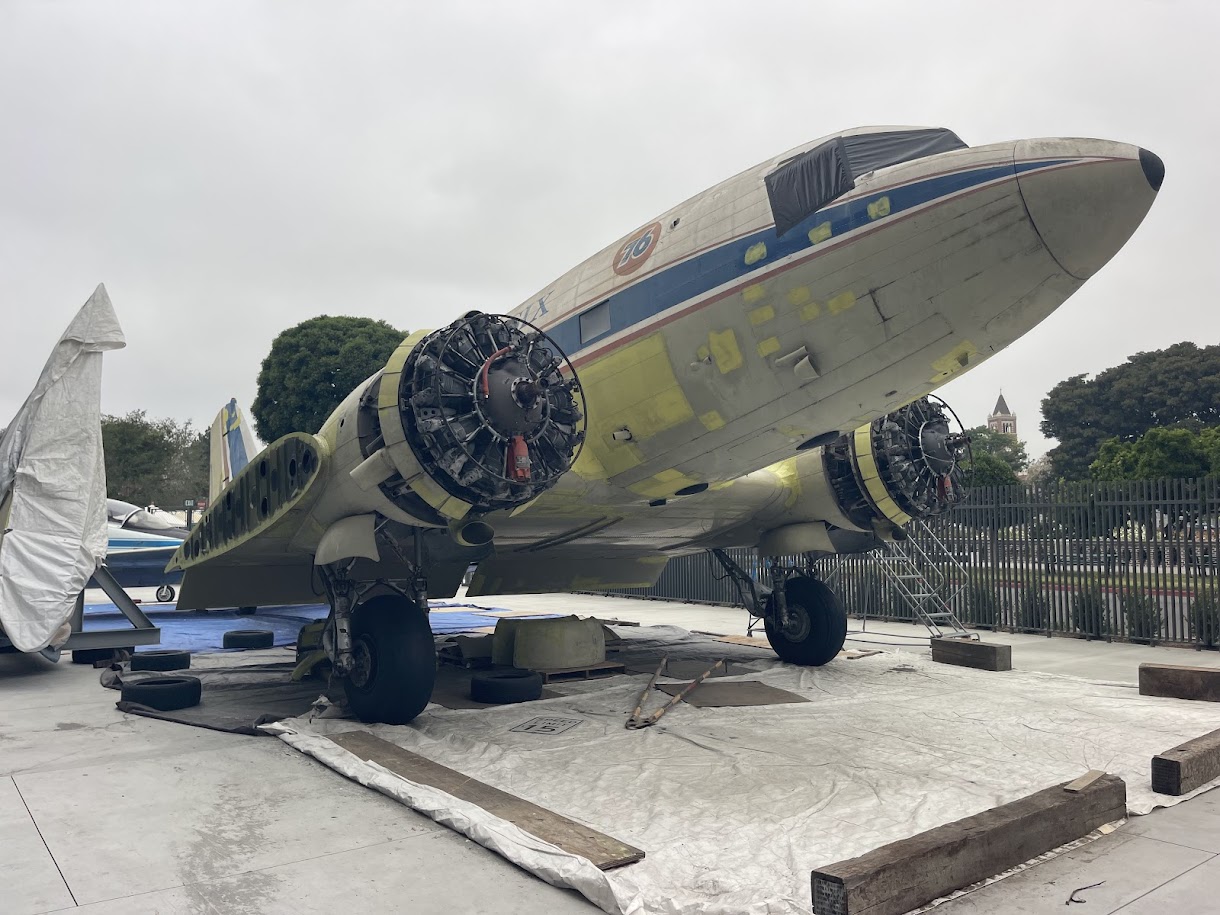
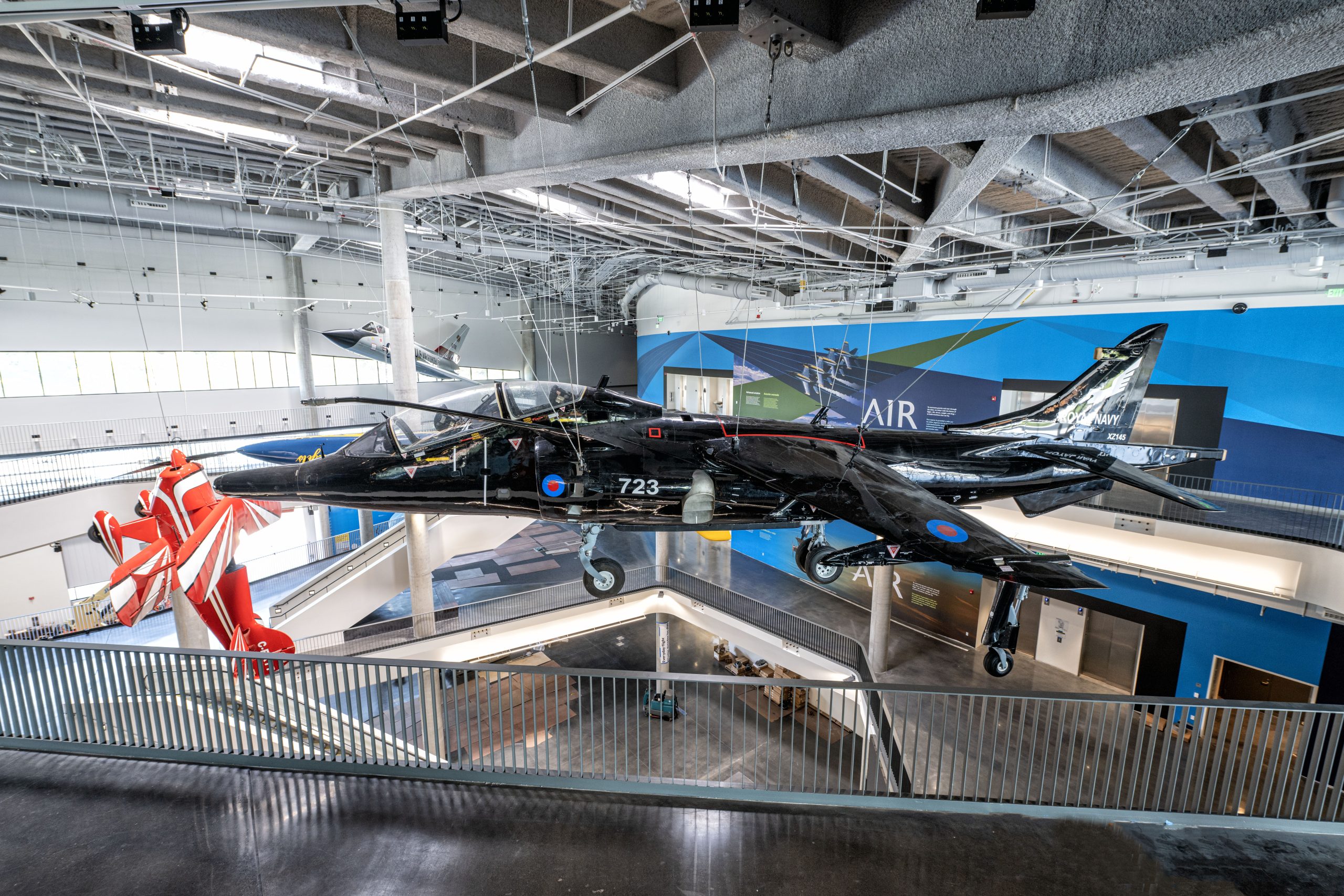
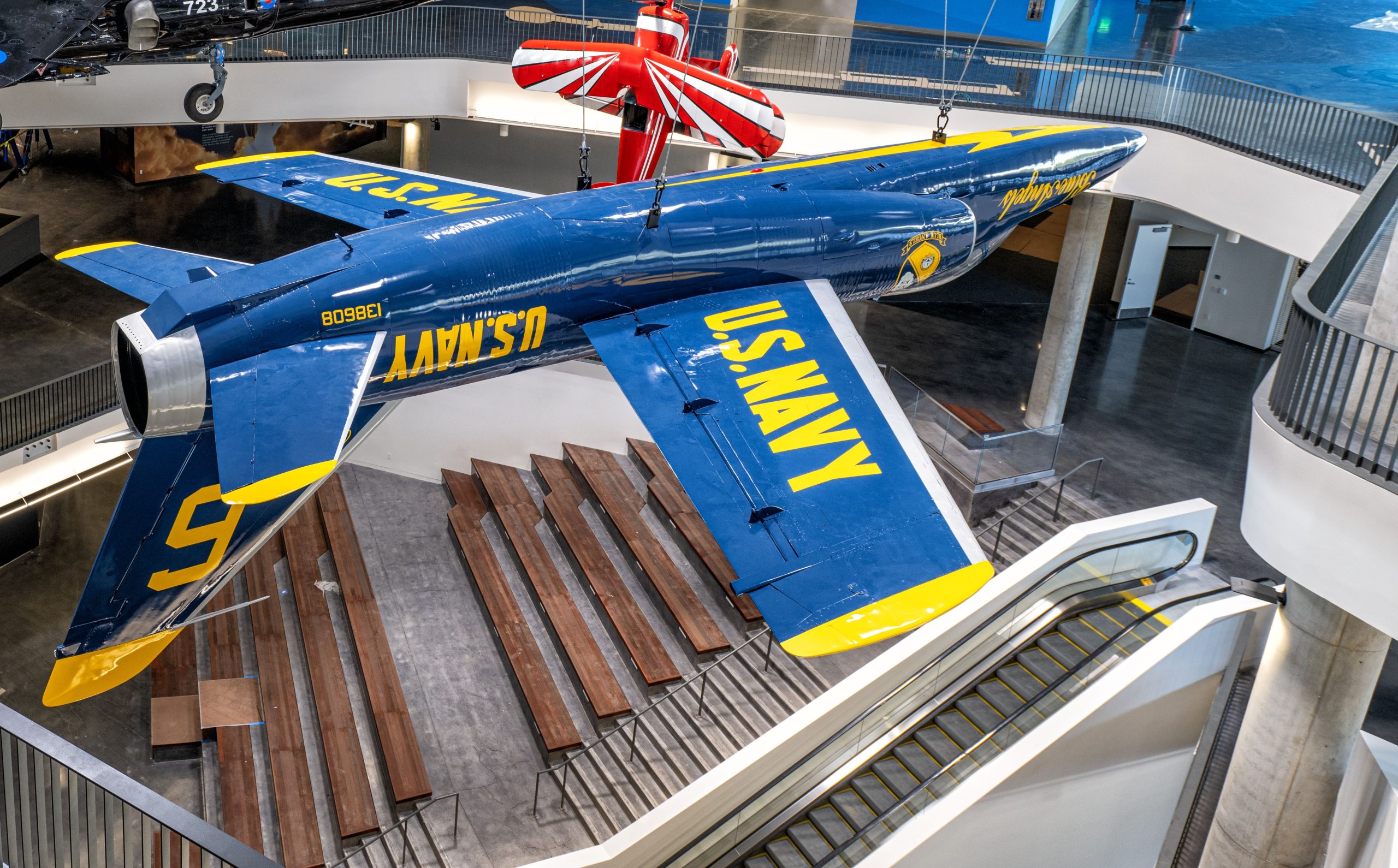
On Tuesday, May 12, the California Science Center in Los Angeles hosted a preview event for local media to get an early glimpse of the new Korean Air Aviation Gallery at the Science Center’s new Samuel Oschin Air and Space Center, which will also display the Space Shuttle Endeavour. At this event, Jeffrey N. Rudolph, President and CEO of the California Science Center, and Walter Cho, Chairman and CEO of Korean Air and Hanjin Group, each delivered a speech in front of the nose section of a former Korean Air Boeing 747-400, HL7489 (N392BC), which will be the focal point of the upcoming 747 Experience, while representatives from the California Science Center and Korean Air, along with local media members, looked up at aircraft suspended from the ceiling, such as the museum’s Grumman F11F Tiger and Hawker Siddeley Harrier T.4, and walked around aircraft current undergoing refurbishment for permanent display in the gallery, including a North American F-100D Super Sabre and de Havilland DH.100 Vampire T.35, while the CSC’s Douglas DC-3 and Northrop T-38A Talon sit outside.
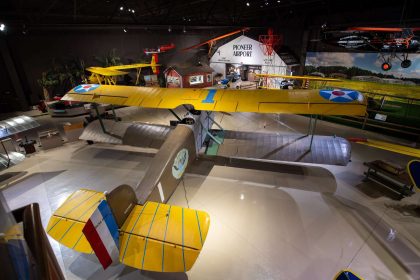
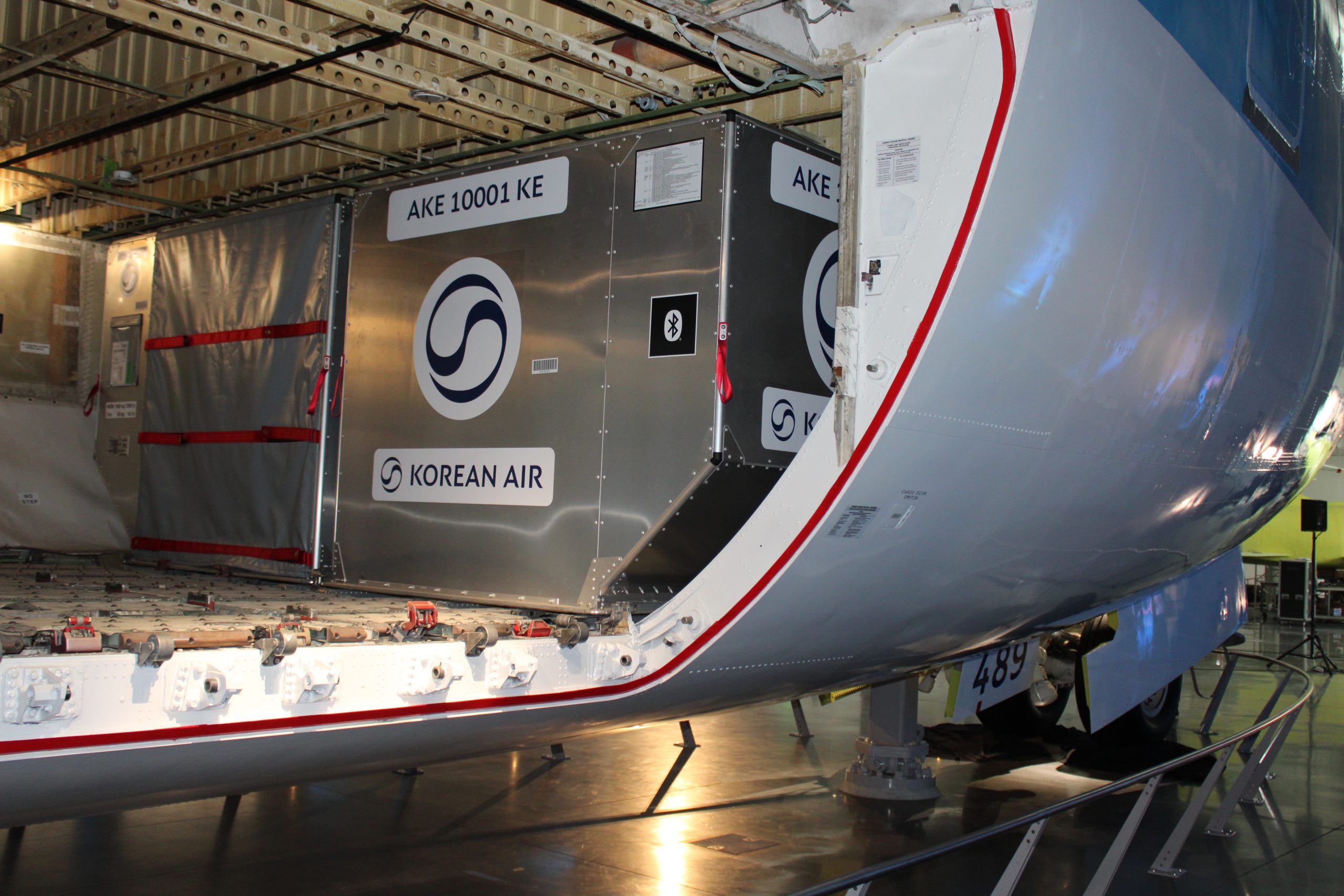
The Korean Air Aviation Gallery is the first of the three new aerospace galleries to be previewed to the media and came shortly after the California Science Center officially announced that the construction work on the building was completed (see this article HERE). The new gallery, made possible thanks to a $25,000,000 donation from Korean Air, has public entrances on both the ground floor and through a second story corridor to the existing California Science Center building and has both an indoor amphitheater with a screen to project videos and an educational classroom for science lessons geared for local youths. The gallery will also display about 20 aircraft from around the world, with many of these aircraft being suspended from the building’s ceiling, placed at eye-level with the second and third floors for guests to get a close look at. Visitors will be able to get a much closer look at the 70-foot section of Boeing 747-400 HL7489, whose forward cargo hold is left open, and both the main and upper decks will be accessible for visitors of all ages to go inside, with the main deck set to be used for the 747 Experience, which will feature a simulated flight from Los Angeles to Seoul, a flight that this vey aircraft made numerous times during its career, as well as exhibits on the science and engineering behind the development of wide-body airliners like the 747.
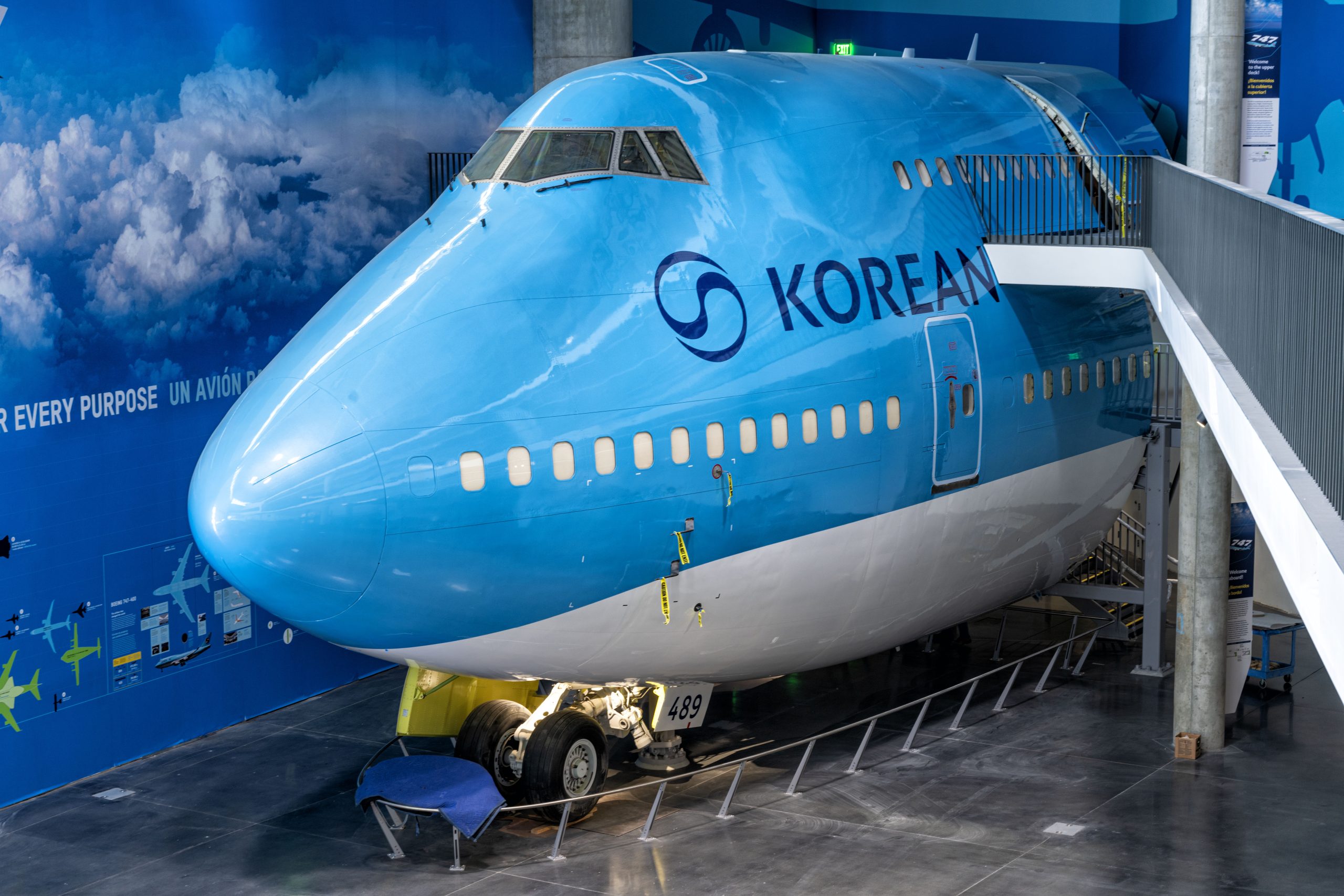
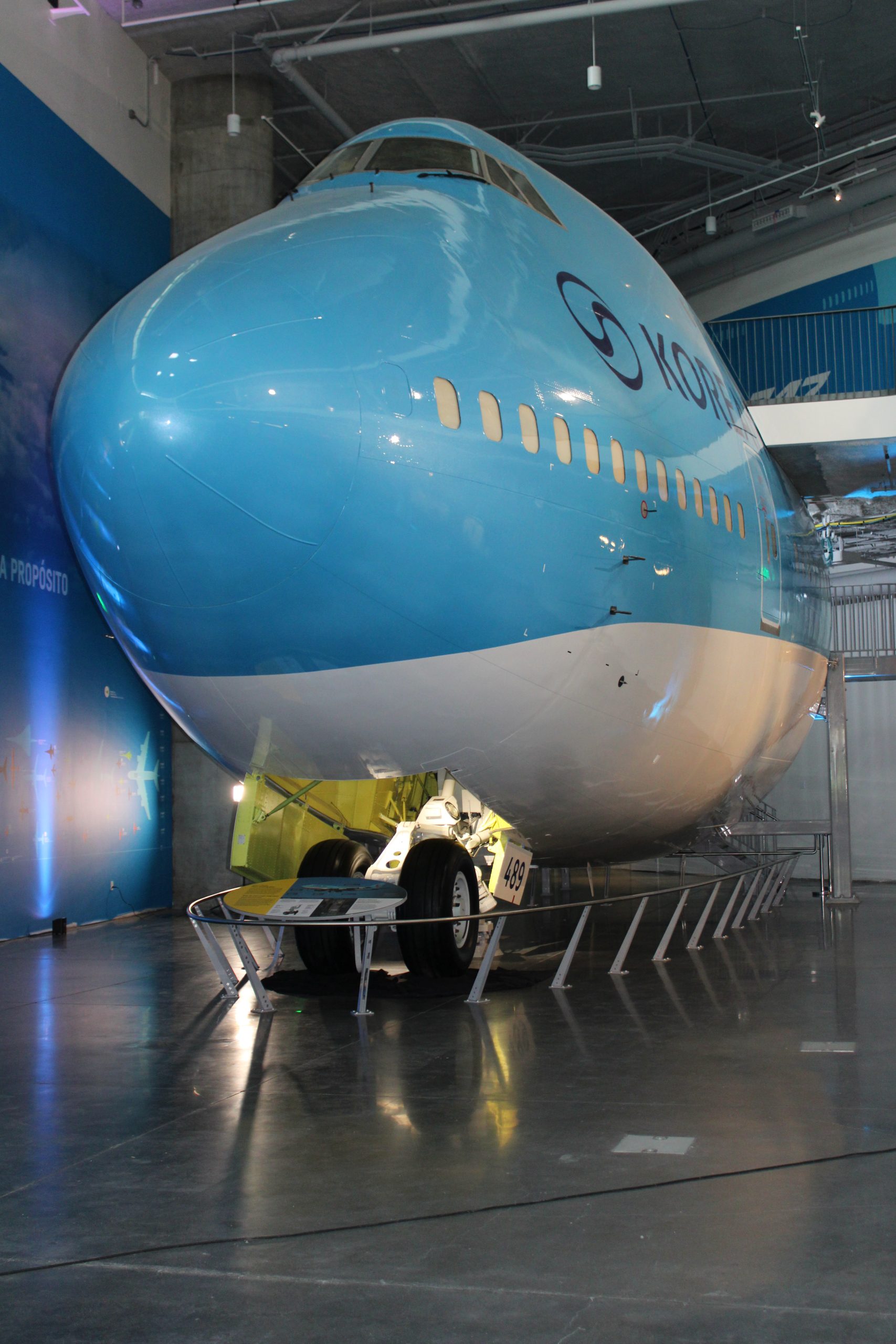
HL7489 was built in Seattle in 1993 as construction number 27072 and was the 1,013th Boeing 747 assembled by The Boeing Company and began service with South Korea’s flag carrier in January 1994. Over the next 20 years, HL7489 completed 13,857 flights around the world with Korean Air. In October 2104, HL7489 was officially retired from service with Korean Air, and after being acquired by the Boeing Aircraft Holding Company with the American civil registration N392BC, it was flown to Pinal Airpark near Marana, Arizona in 2015 to await disposal. Ten years later, a 70-foot section of the aircraft’s fuselage was removed, dismantled, and shipped to Los Angeles to be placed on display, with the aircraft receiving the new minimalist paint scheme introduced to Korean Air’s operational fleet in 2025. Besides the new paint scheme and the restored interior, the nose gear has also been preserved and is displayed partially retracted on account of the dimensions of the gallery space, while a display on the wall off the right side of the 747’s nose features graphics of various aircraft throughout history under the tagline “A Plane for Every Purpose”.
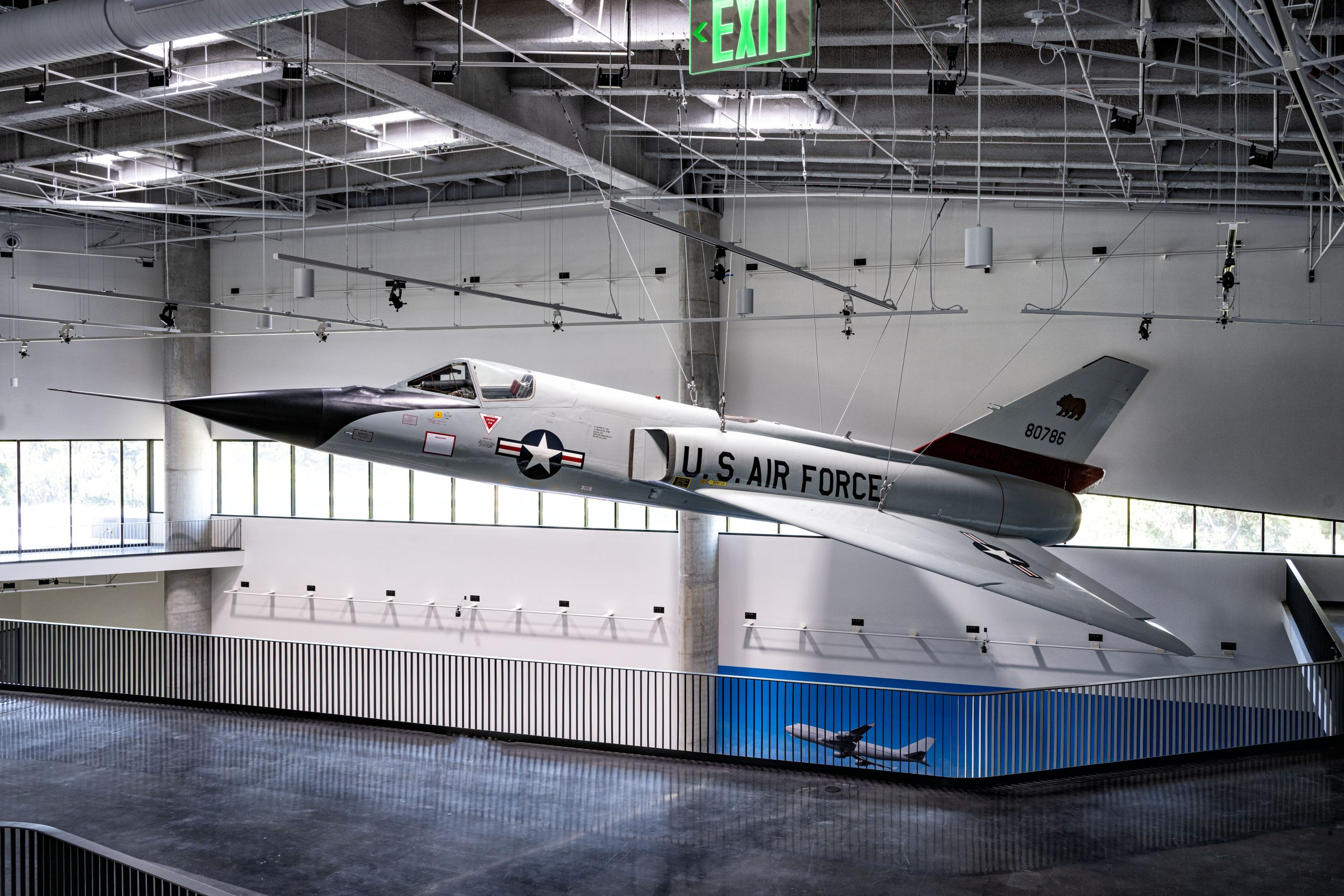
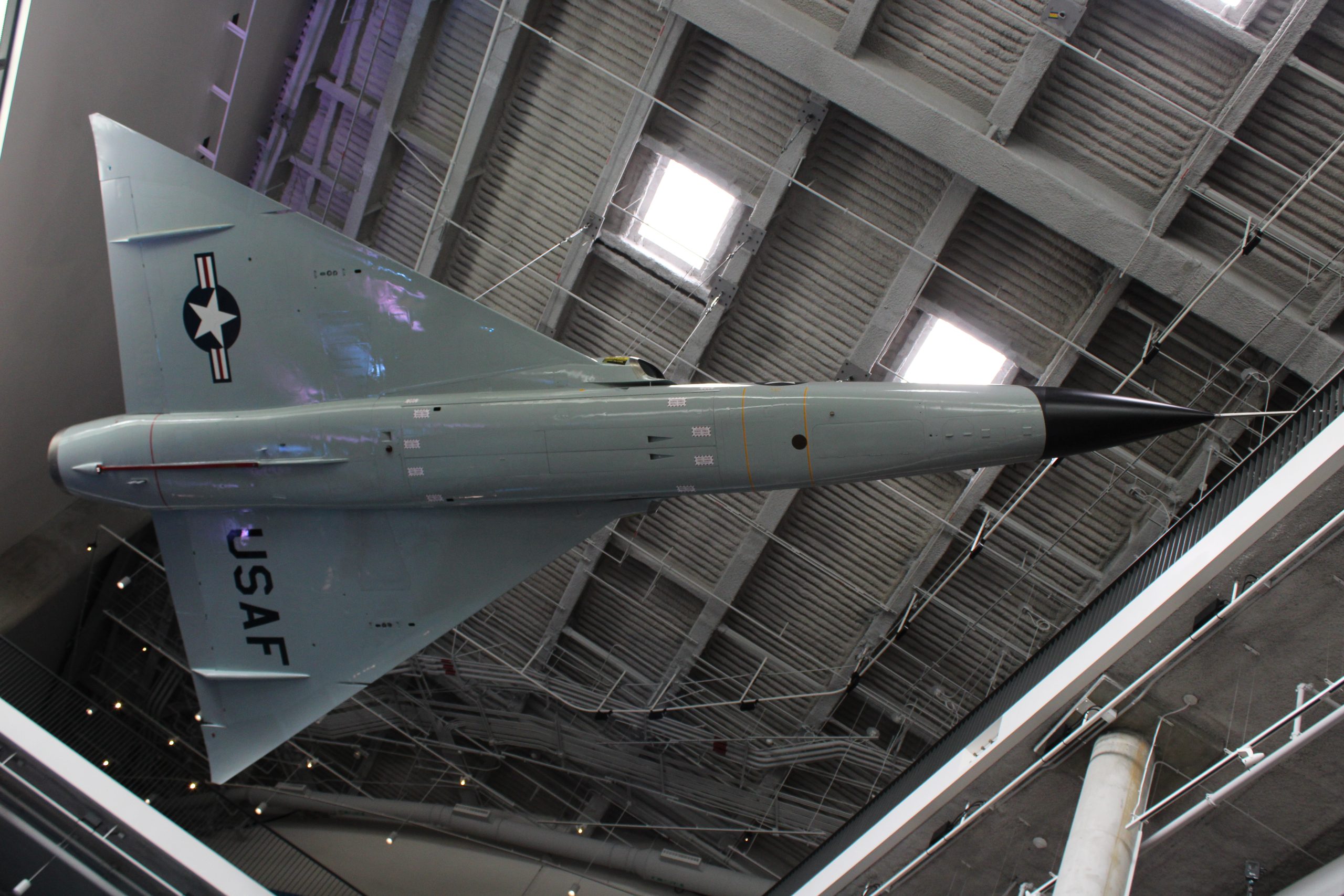
Suspended above the nose of 747-400 HL7489 is a recently restored example of a Convair F-106A Delta Dart interceptor. Built by Convair in San Diego as 8-24-117, it was delivered to the United States Air Force on October 26, 1959, and assigned to the 4750th Air Defense Wing, MacDill Air Force Base (AFB), Florida. From 1959 to 1974, the aircraft had numerous assignments across the continental United States, being assigned to units stationed at MacDill AFB, Florida, Tyndall AFB, Florida, Selfridge AFB, Michigan, Malmstrom AFB, Montana, and Grand Forks AFB, North Dakota, before being transferred to the New Jersey Air National Guard (ANG) and later the Florida ANG in 1974. While serving in the Florida ANG’s 159th Fighter Interceptor Squadron based out of Jacksonville, the aircraft took part in the 1986 William Tell aerial gunnery competition, with the aircraft’s tail being temporarily painted solid yellow for the exercise. On February 24, 1987, F-106A 58-0786 was placed in storage with the 309th Aerospace Maintenance and Regeneration Center (AMARC) at Davis-Monthan AFB, Arizona, where it stayed until June 17, 1991, when it was sent to American Electronic Laboratories in East Alton, Illinois and converted into a QF-106A target drone with the new serial number AD154 for use in air-to-air missile training. However, on August 26, 1996, the aircraft was retired from flight status after it was discovered to have a cracked wing spar, and stored at Tyndall AFB, Florida. In April 2000, the former 58-0786 was among seven retired QF-106As purchased by Westernair Inc and trucked to Fort Worth, Texas for storage, where it remained until 2015, when it was acquired by the California Science Center, and trucked to Mojave Air and Spaceport in Mojave, California until the new Air and Space Center was constructed. Today, 58-0786 is displayed in USAF colors, with the tail painted in the colors of the F-106s flown by the California Air National Guard, featuring the motif of the state flag.
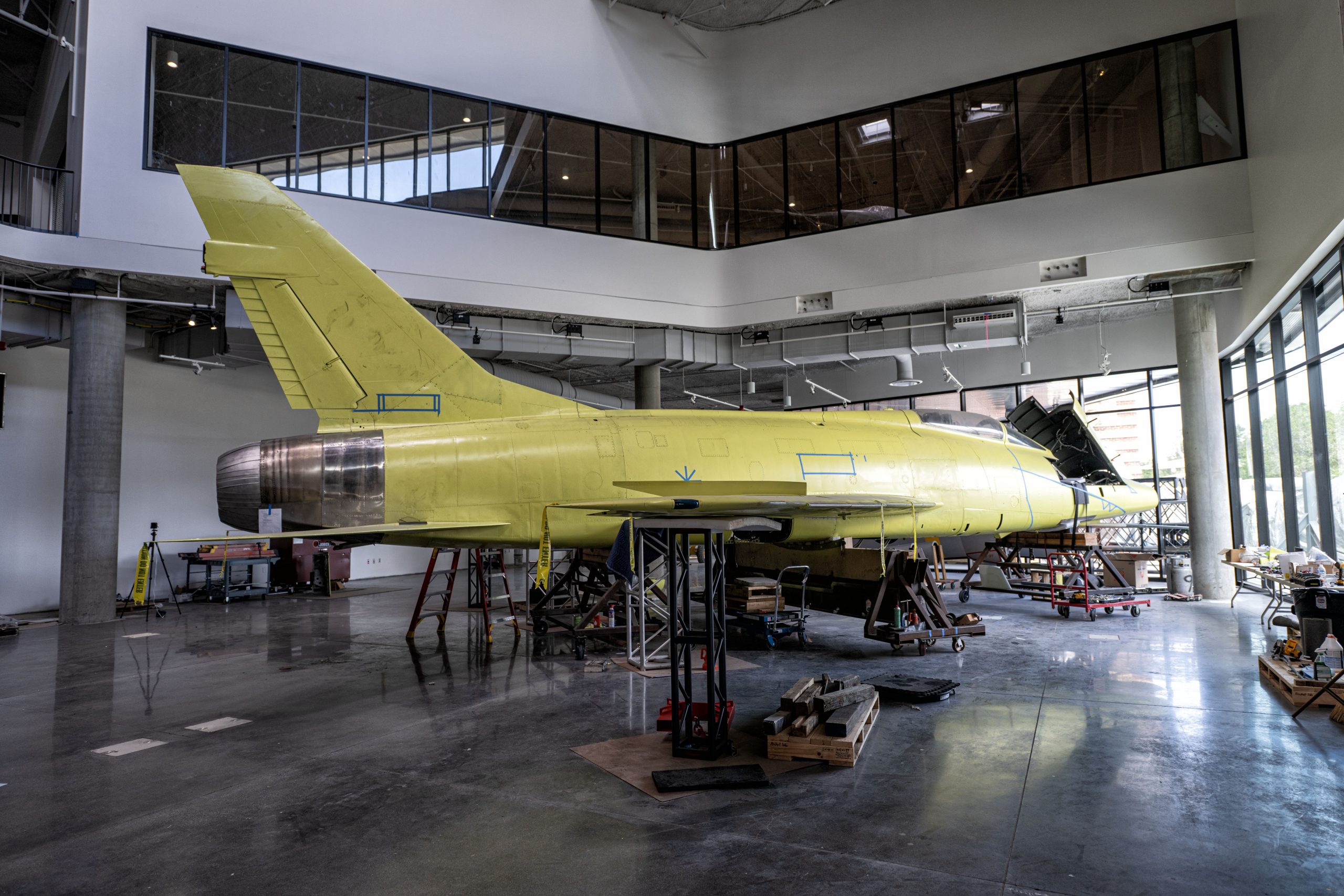
Resting in a cradle on the museum floor and coated in primer sits North American F-100D Super Sabre 54-2165, which is set to be repainted and displayed hanging from the ceiling alongside the F-106. Built by North American Aviation in Inglewood near Los Angeles International Airport as construction number 223-45, this Super Sabre was delivered to the USAF as 54-2165 on May 26, 1956. 54-2165 would serve most of its time in the USAF in Morocco, flying with the 45th Fighter-Day Squadron, 316th Air Division at Sidi Slimane Air Base and with the 494th Fighter Bomber Squadron, 48th Fighter Bomber Wing at Boulhaut Air Base, then served at Torrejon Air Base in Spain before it was transferred to the French Air Force (Armee de l’Air) under the Military Assistance Program on March 24, 1959, and was issued the French serial number 42165.
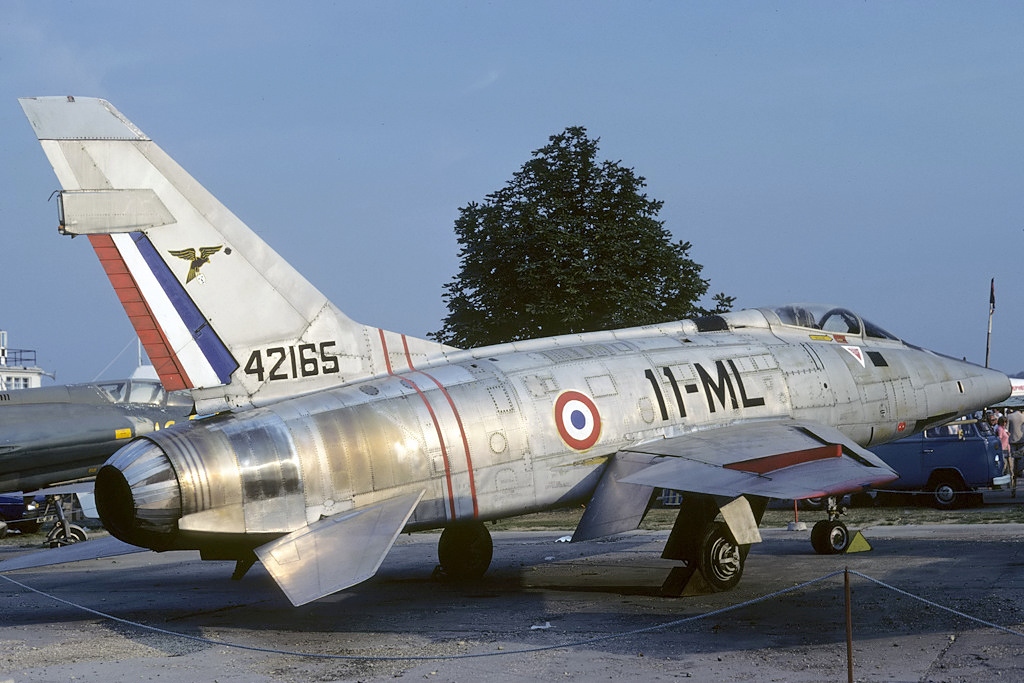
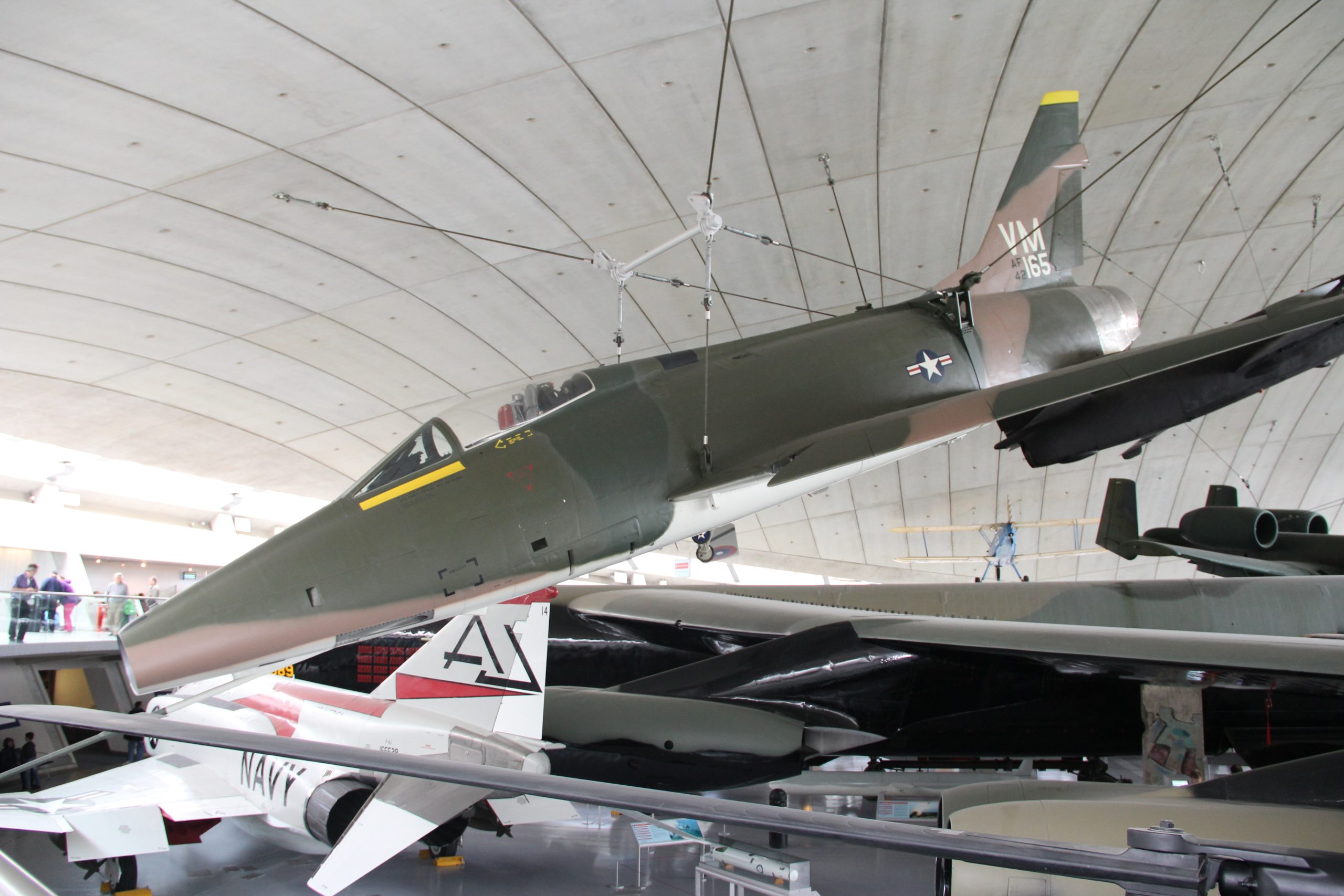
42165 remained in the Armee de l’Air for 16 years, flying out of Reims Air Base, Lahr Air Base and Bremgarten Air Base, West Germany, before concluding its French military career at Toul Rosieres Air Base, France, being officially stricken from the French Air Force on November 24, 1975, after which it was flown to RAF Sculthorpe and returned to the USAF for storage/disposal. Rather than returning to the United States, F-100D Super Sabre s/n 42165 was loaned by the National Museum of the USAF to the Imperial War Museum and displayed at the American Air Museum in Duxford, and was displayed wearing the colors of the 352nd Tactical Fighter Squadron, 35th Tactical Fighter Wing, which flew F-100s in combat during the Vietnam War. In 2017, the aircraft was reallocated by the NMUSAF to the California Science Center and was sent back to Los Angeles for the first time since it was built in 1956. According to the California Science Center’s Science & Technology curator, Dr. Perry Roth-Johnson, the F-100D will be repainted in its French Air Force colors and installed alongside the F-106A Delta Dart to make room for smaller aircraft below it.
Yet another Cold War jet aircraft on display is the museum’s de Havilland DH.100 Vampire T.35, a trainer variant of the twin-boom jet fighter with a wooden fuselage and metal wings and tail. Built by de Havilland Australia at Bankstown Airport near Sydney as construction number 4140, this aircraft (designated as the A79 in Australian service) was delivered to the Royal Australian Air Force in 1958 as serial number 79-618 and was used for flight training RAAF jet pilots. On June 17, 1970, the aircraft was decommissioned from the RAF with 2,605 flying hours and was sent to RAAF Laverton in Victoria for disposal. Shortly after being declared surplus, though, A79-618 was exported to the United States and registered with the FAA as N11924. Throughout the 1970s to 1990s, the aircraft when through multiple owners in the US, and was flown at numerous airshows, with one owner naming the aircraft “Shamu”. By 1996, it was acquired by Merle H. Maine of Ontario, Oregon and maintained in airworthy condition until his death in 2013. After being auctioned to a holding company called Boardroom Aviation LLC of Reno, Nevada in 2014, it was acquired by the California Science Center in 2015. Since then, it has been restored in its original RAAF colors as A79-618 and is set to be reassembled for the opening of the Air and Space Center.
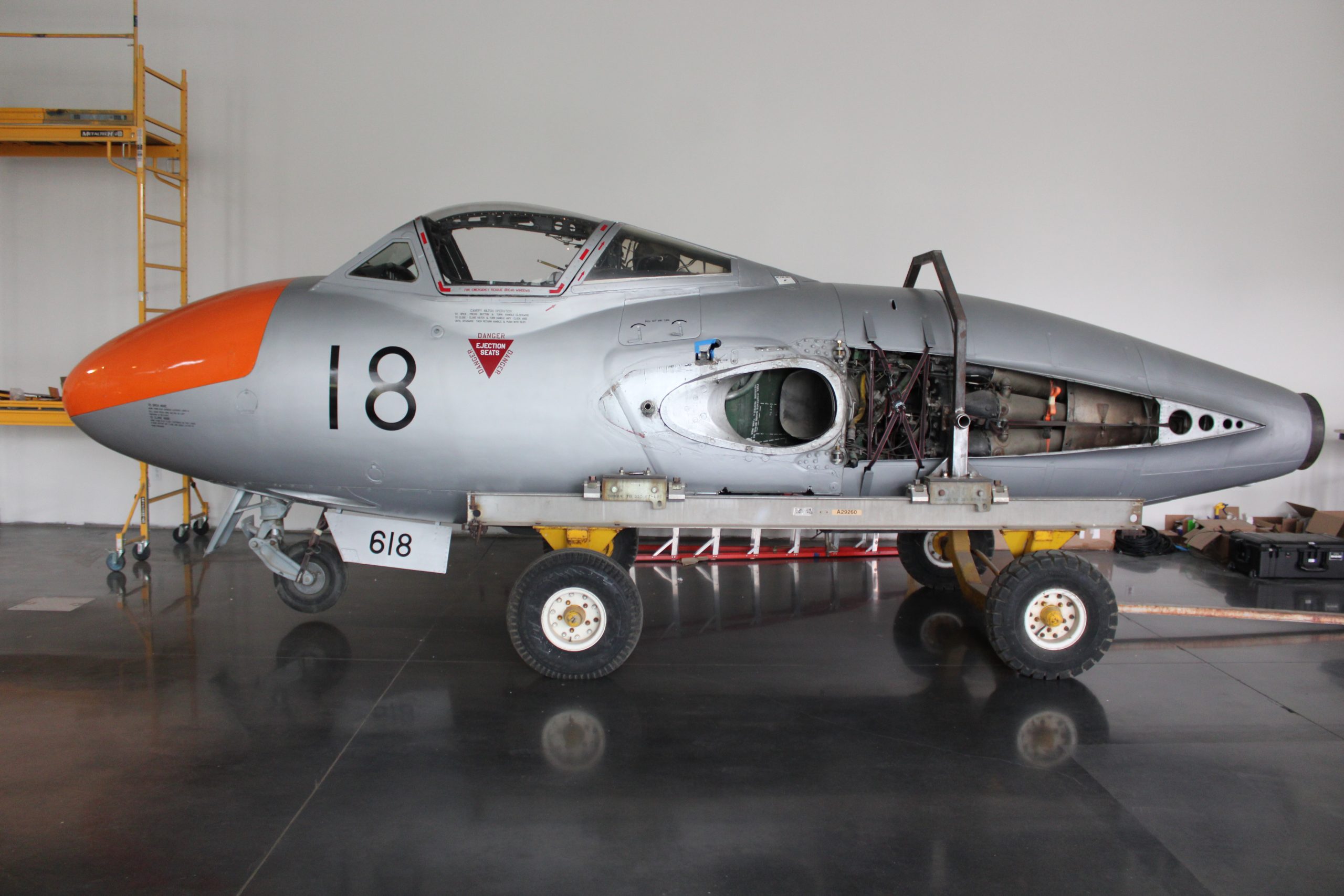
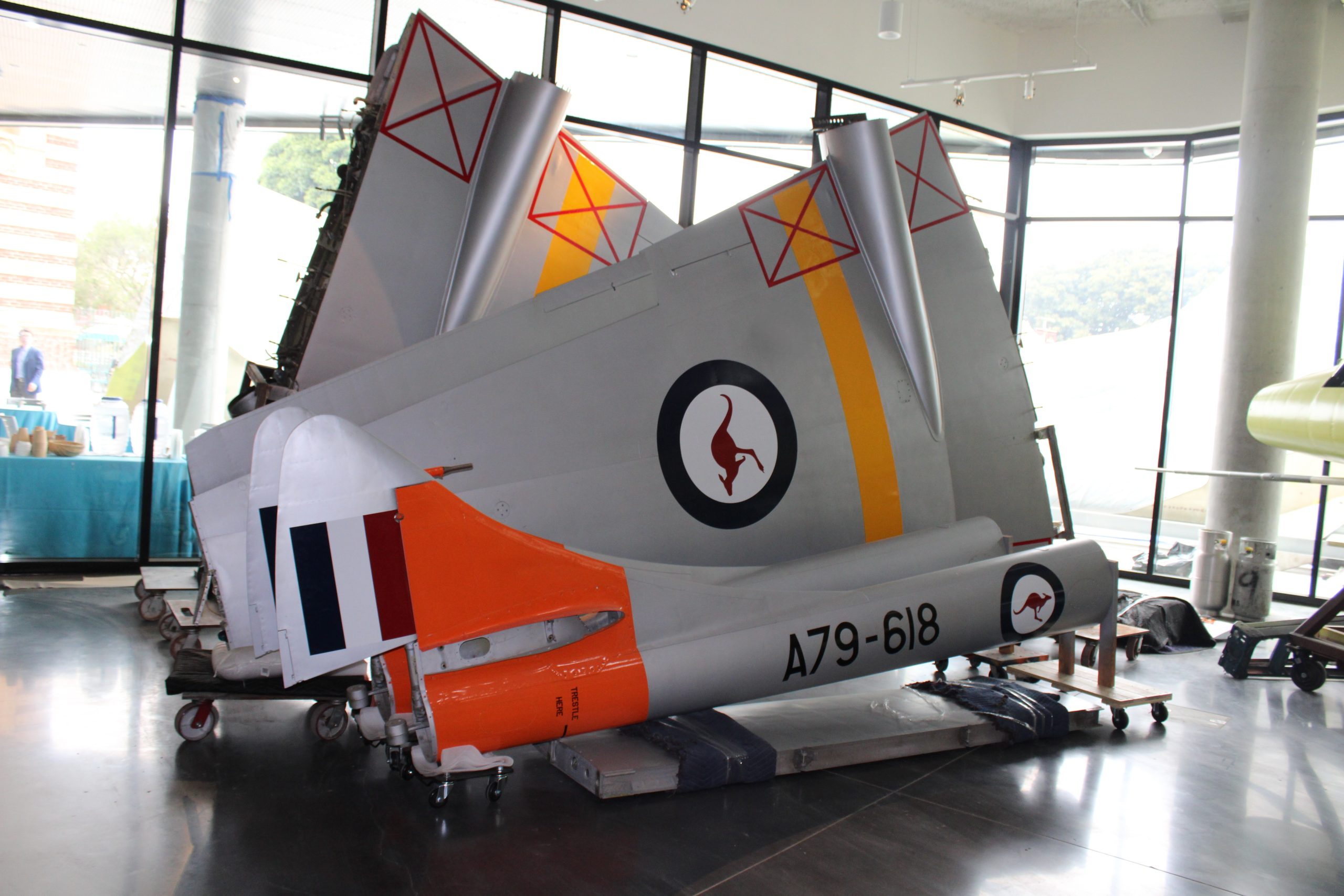
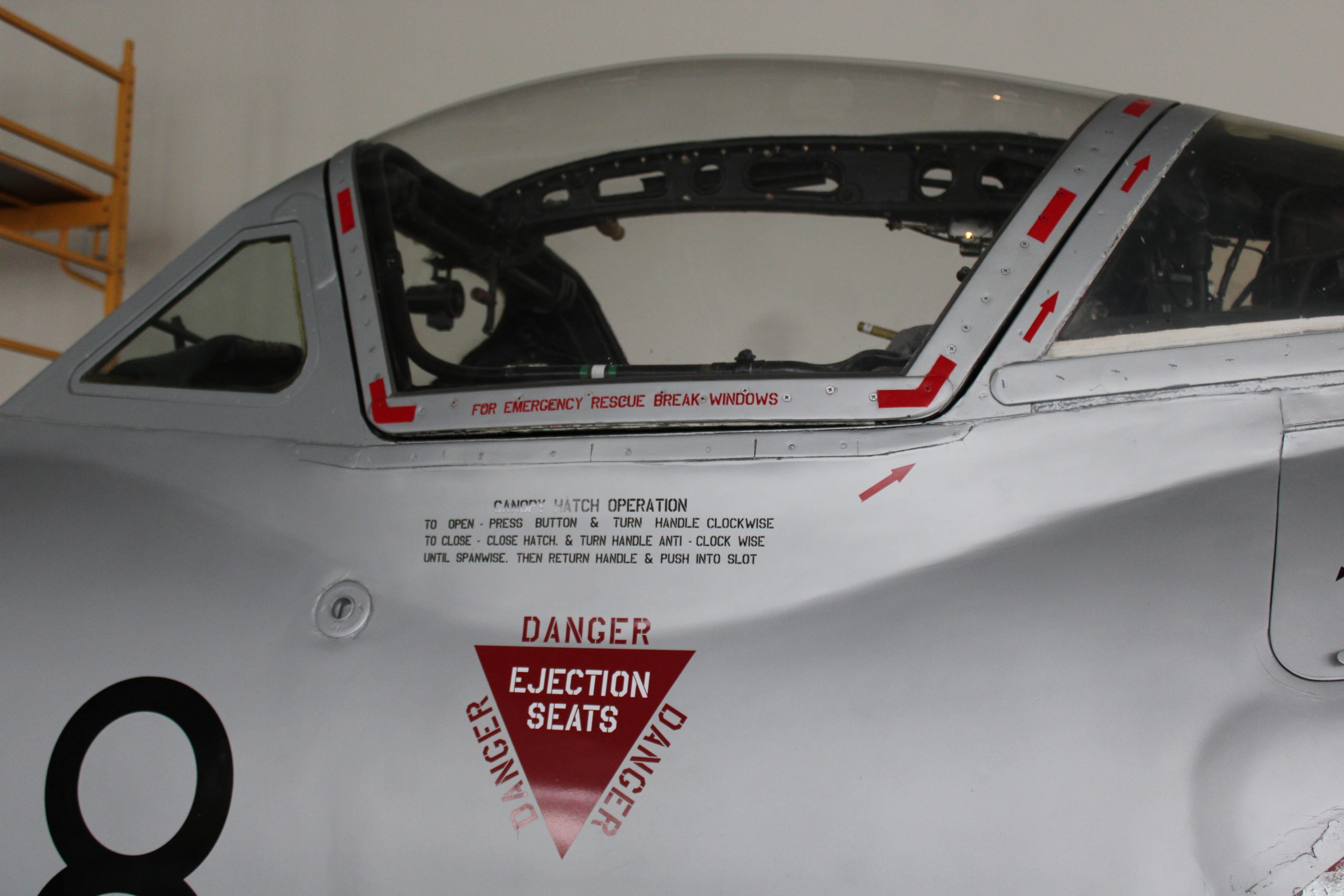
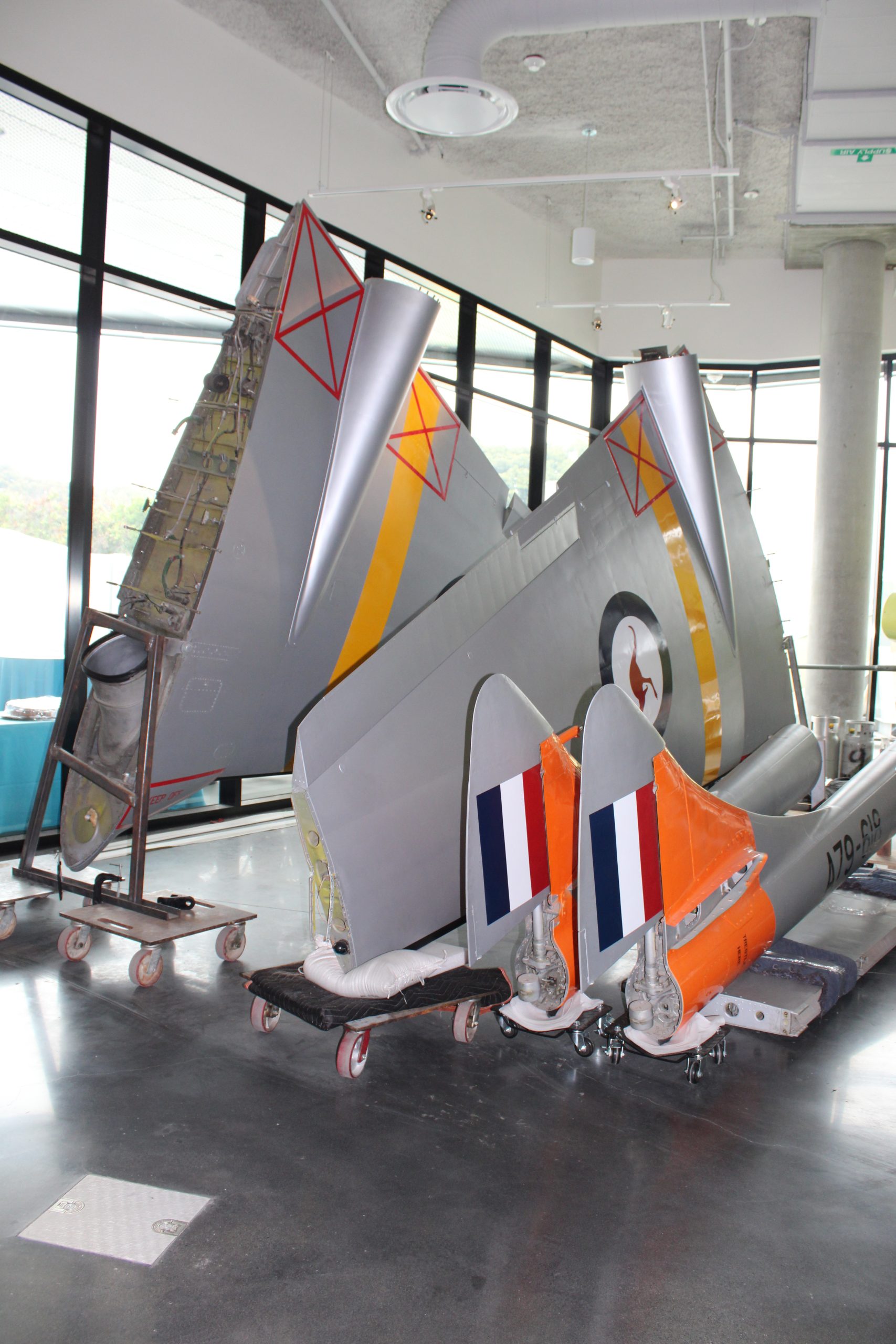
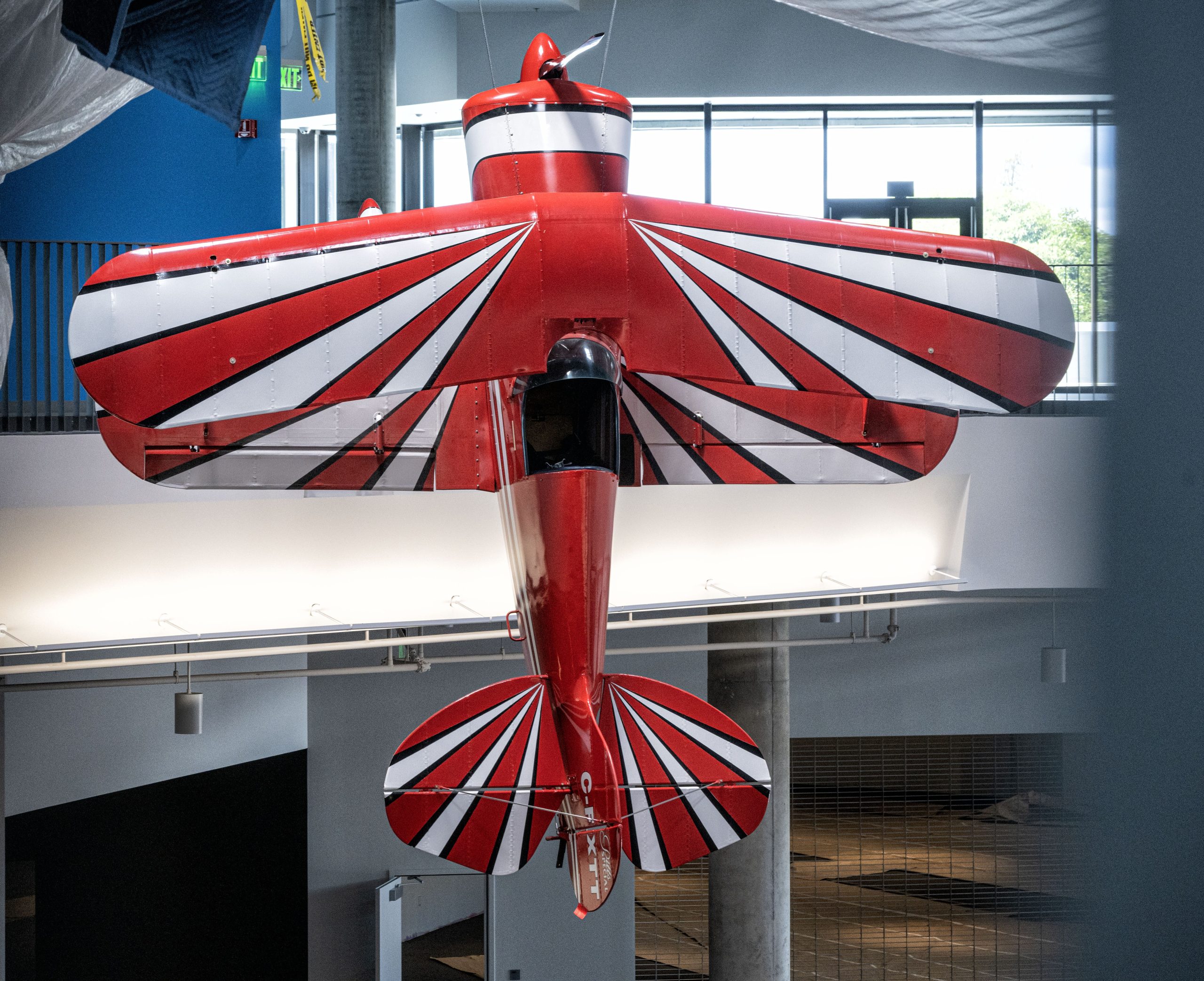
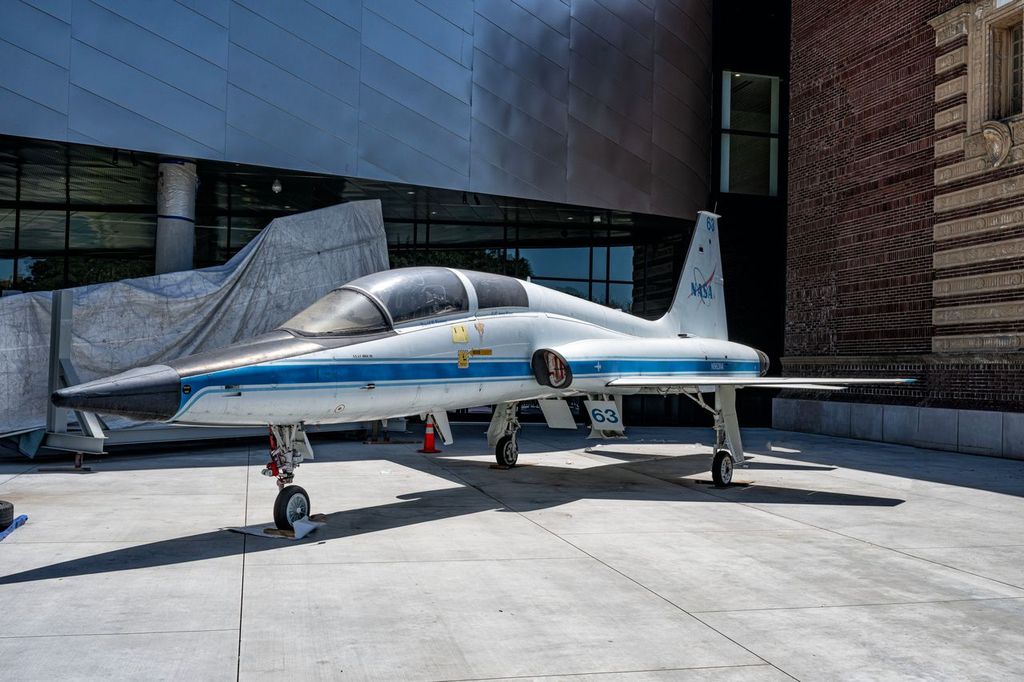
Another aircraft that has already been installed in the gallery is the museum’s Pitts Special S-1C, C-FXTT, which was built in 1970 and by 2002, it was registered to a private entity in Saint Catharines, Ontario. In 2014, the aircraft was acquired by the California Science Center, and installed alongside the Harrier and Tiger in November 2025, where it is suspended in a vertical position, as if it were executing a loop as part of an aerobatic display. In addition to these manned aircraft, a Ryan Firebee drone, formerly loaned to the Western Museum of Flight (WMOF) at Torrance Airport, has also been installed in the Korean Air Aviation Gallery, and another aircraft loaned to the WMOF is undergoing refurbishment alongside the DC-3 formerly loaned to the Flight Path Museum and Learning Center at LAX is the museum’s Northrop T-38A Talon, N963NA.
Although the California Science Center already has another T-38A, USAF serial number 58-1196, which is suspended alongside the last surviving Northrop F-20 Tigershark, 82-0064/N44671, this particular T-38A, construction number N.5116, was the 16th T-38 Talon ever built, and the first production model example of the type. Delivered to the USAF as 59-1603, it was used for flight training at Randolph AFB in Texas before being used as a chase plane at Dobbins AFB, Georgia and Edwards AFB, California before being transferred to the US Navy, being converted into a DT-38A drone aircraft (USN Bureau Number 591603) for air combat training in the Top Gun program at NAS Miramar, then used as a radar target, chase plane, and pilot proficiency aircraft at Naval Air Weapons Center China Lake, California and NAS Fallon, Nevada before being transferred to NASA in 1987 as NASA 963 (N963NA), and used for proficiency training at Ellington Airport in Houston, Texas, located near NASA’s Lyndon B. Johnson Space Center. On November 5, 2007, N963NA was retired by NASA and made its final flight from Houston’s Ellington Field to Los Angeles International Airport, with refueling stops made in El Paso, Texas, and Phoenix, Arizona. The aircraft was initially placed on display at the Northrop Grumman Integrated Systems headquarters in nearby El Segundo, but later moved to the Western Museum of Flight at Torrance Airport, where in 2015, the title of ownership was transferred to the California Science Center, but N963NA remained on loan to the Western Museum of Flight until 2024, when it was trucked to Exposition Park, and is now being refurbished alongside DC-3 N760 “Spirit of Seventy-Six” for eventual display inside the Korean Air Aviation Gallery.
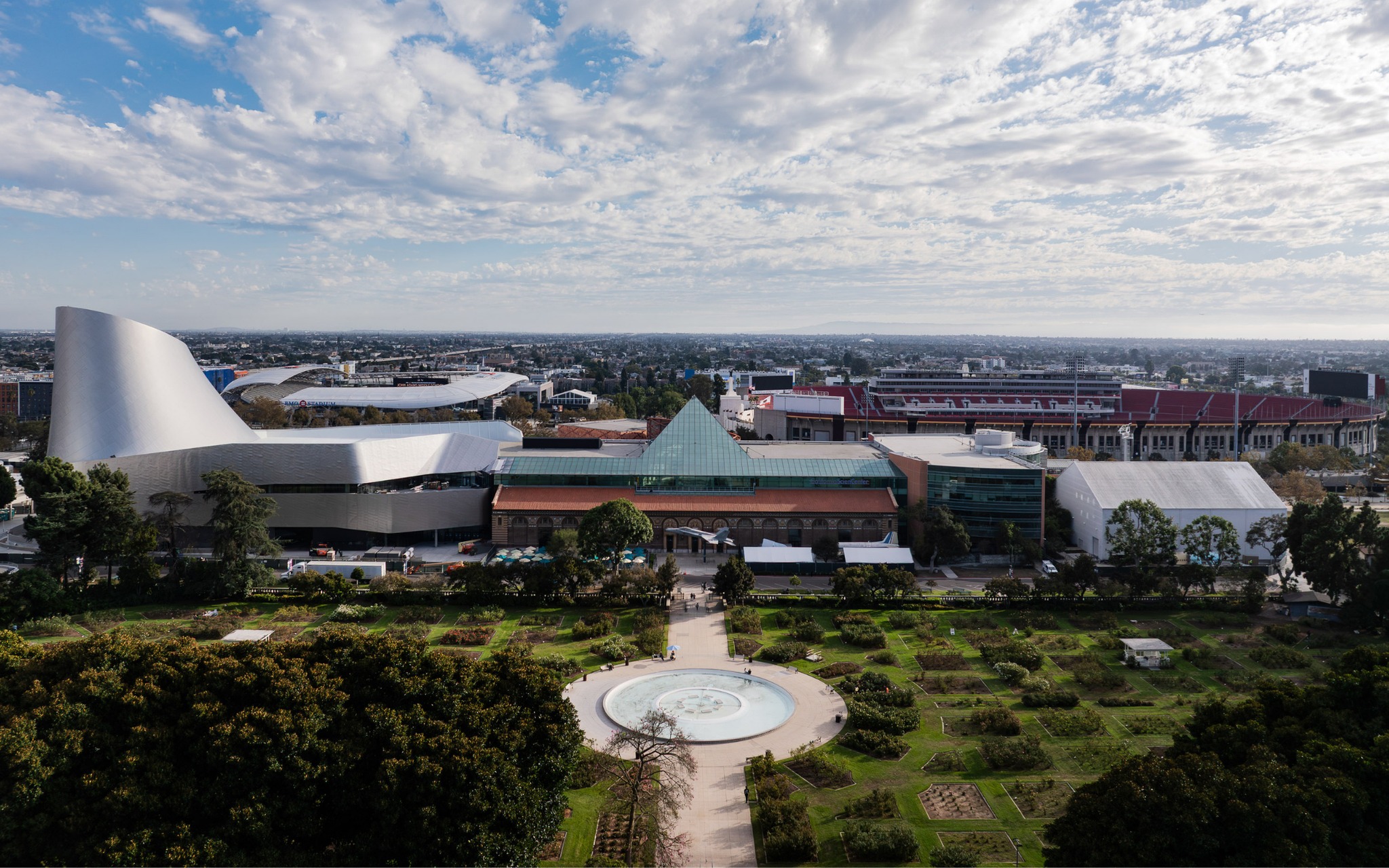
Besides these aircraft, there are several other aircraft that are set to be displayed inside the Aviation Gallery, from a replica of Otto Lilienthal’s 1893 hang glider and a Bell 47 helicopter formerly operated by the Los Angeles Police Department, to a Republic RC-3 Seabee are currently held in storage, with the museum waiting for the installation of the aforementioned aircraft before these aircraft held in storage will be brought out and placed on display. The California Science Center has also stated that it will soon announce an official date for the grand opening of the Samuel Oschin Air and Space Center, which in addition to the Korean Air Aviation Gallery, will also feature the Kent Kresa Space Gallery, with such items as the space capsules from Mercury-Redstone 2 and Gemini 11 and the Apollo-Soyuz Command Module, and the Samuel Oschin Shuttle Gallery, which will feature the Space Shuttle Endeavour (OV-105) as the only shuttle orbiter displayed in the vertical launch position with its external fuel tank and Solid Rocket Boosters. Though there is still much to be done, the result of the ongoing work will be one of the largest aerospace attractions on the US West Coast at the heart of a city shaped by the development of the aerospace industry, with the new Air and Space Center also seeking to provide local children with the inspiration to pursue careers relating to science, technology, engineering, and mathematics (STEM).

About the California Science Center
The California Science Center is a dynamic destination where families, adults, and children can explore the wonders of science through hands-on exhibits, live demonstrations, innovative programs, and awe-inspiring large-format movies. The California Science Center and IMAX Theater are located in historic Exposition Park just west of the Harbor (110) Freeway at 700 Exposition Park Drive, Los Angeles. Open daily from 10:00 a.m. to 5:00 p.m. General admission to the Science Center is FREE. The California Science Center is proud to be accredited by the Association of Zoos and Aquariums (AZA) and the American Alliance of Museums (AAM). Visit https://
About the EndeavourLA Campaign
A project of this scope and scale requires the visionary leadership of the philanthropic community, and the support of the broader public. EndeavourLA is the California Science Center Foundation’s fundraising campaign that enabled the acquisition and previous temporary display of space shuttle Endeavour and supports our work to complete the Samuel Oschin Air and Space Center and sustain ongoing exhibits, programs, and operations. The project’s lead donors are the Mr. and Mrs. Samuel Oschin Family Foundation and the State of California, joined by principal donors Korean Air and the Kresa Family Foundation, along with numerous individuals, foundations, and corporate supporters. The California Science Center Foundation is actively fundraising to complete this ambitious project with over $390 million raised toward the $450 million project budget. Everyone can help realize this exciting vision for the future Samuel Oschin Air and Space Center, and donations at any level are welcomed. To contribute or learn more, go to EndeavourLA.org.