






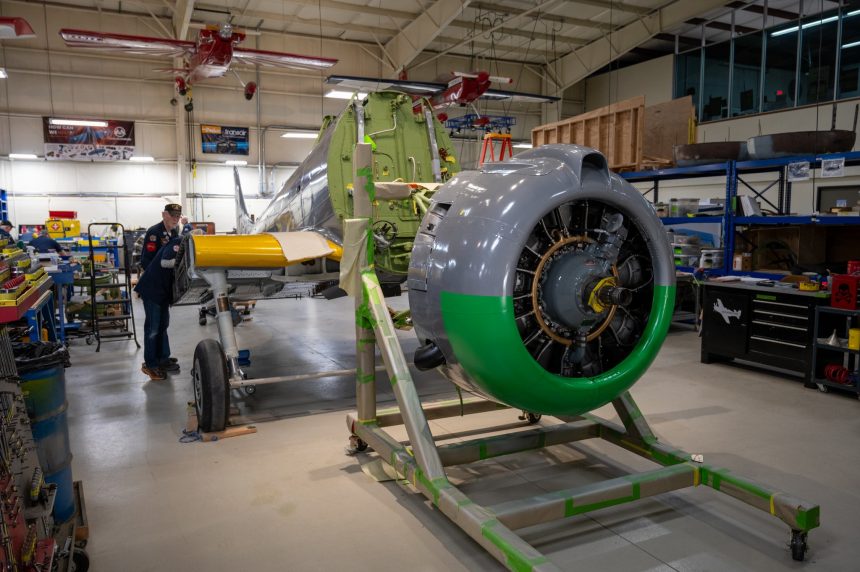

If there is one aviation museum that knows a thing or two about restoring the Douglas SBD Dauntless dive bomber, it’s the Air Zoo of Kalamazoo, Michigan, which has fully restored two examples of the type and is currently in the final stages of the restoration of a third example, Douglas SBD-1 Dauntless Bureau Number 1612, which is both the world’s oldest surviving SBD Dauntless and the last remaining example of the SBD-1, the first variant to enter operational service, and we at Vintage Aviation News have previously touched on this aircraft in prior articles (HERE and HERE). Having been recovered from the depths of Lake Michigan in 1994, the aircraft is now set to be a prime example of one of the most iconic dive bombers of WWII and will be unique among the surviving Dauntlesses for its distinctive prewar paint scheme.
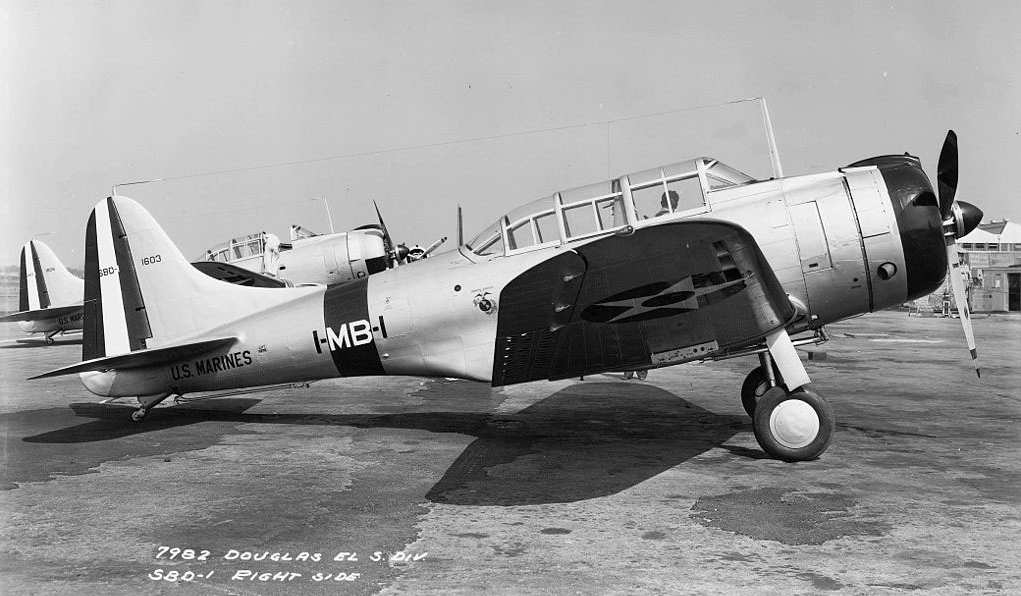
Having been derived from the Northrop BT-1 dive bomber of the mid-1930s, the SBD started development as the XBT-2 before Northrop’s El Segundo, California plant was acquired by Douglas Aircraft in 1937, with the new design being introduced in 1940 as the SBD (Scout Bomber Douglas). The SBD-1 variant had the shortest range of all the SBD variants to come, and with the U.S. Navy taking deliveries of the subsequent SBD-2, which had an increased fuel capacity, the SBD-1s were adopted into service with the U.S. Marine Corps. Both the SBD-1 and -2 replaced the final biplane dive bombers in the US Navy/Marines’ inventories, the Curtiss SBC Helldiver and the Vought SBU Corsair. However, both the SBD-1s and SBD-2s lacked self-sealing fuel tanks, and while the SBD-2s held the line after the attack on Pearl Harbor until new variants such as the SBD-3 were introduced in 1942, the SBD-1s largely remained stateside with reserve and training units, though a few examples stationed at MCAS Ewa, Hawaii were destroyed during the attack on Pearl Harbor. Only 57 examples of the SBD-1 were produced, and the example being completed at the Air Zoo, BuNo 1612, is the last remnant of the first iteration of the Dauntless family.
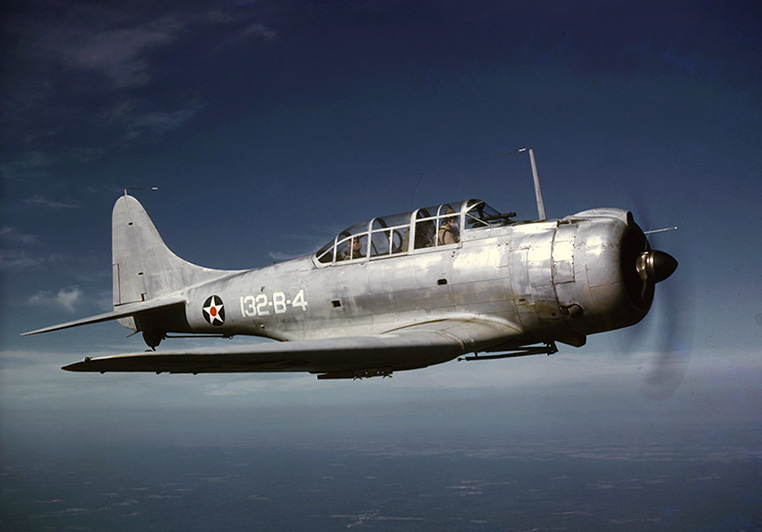
SBD-1 Bureau Number 1612 rolled off the assembly line at Douglas’ El Segundo plant as the 17th production Dauntless ever built and was delivered to the US Marine Corps from Douglas Aircraft on September 16, 1940, where it would be sent off on its first assignment, joining Marine Bombing Squadron 1 (VMS-1), stationed at MCAS Quantico, Virginia before VMS-1 was later reformed as Marine Scout Bomber Squadron 132 (VMSB-132), flying training missions along the Atlantic coast. In March 1942, BuNo 1612 was transferred to Marine Scout Bomber Squadron 142 (VMSB-142), which was stationed at Camp Kearney (now the present site of MCAS Miramar), just north of San Diego, California, where the squadron conducted further training missions along the Pacific coast. With the American victory at Midway, and preparations underway to land amphibious forces in the Solomon Islands, VMSB-142 took delivery of new SBD-4s equipped with self-sealing fuel tanks with greater fuel capacity before being deployed to Espiritu Santo in November 1942. By this point, though, SBD-1 BuNo 1612 had already been transferred in August 1942 to the Carrier Qualification Training Unit (CQTU) at NAS Glenview, just north of Chicago, where it would help newly minted naval aviators earn their carrier qualifications on the paddle-wheel training carriers USS Wolverine (IX-64) and USS Sable (IX-81), two former passenger steamers once carried passengers across Lake Erie to Buffalo, Cleveland, and Detroit.
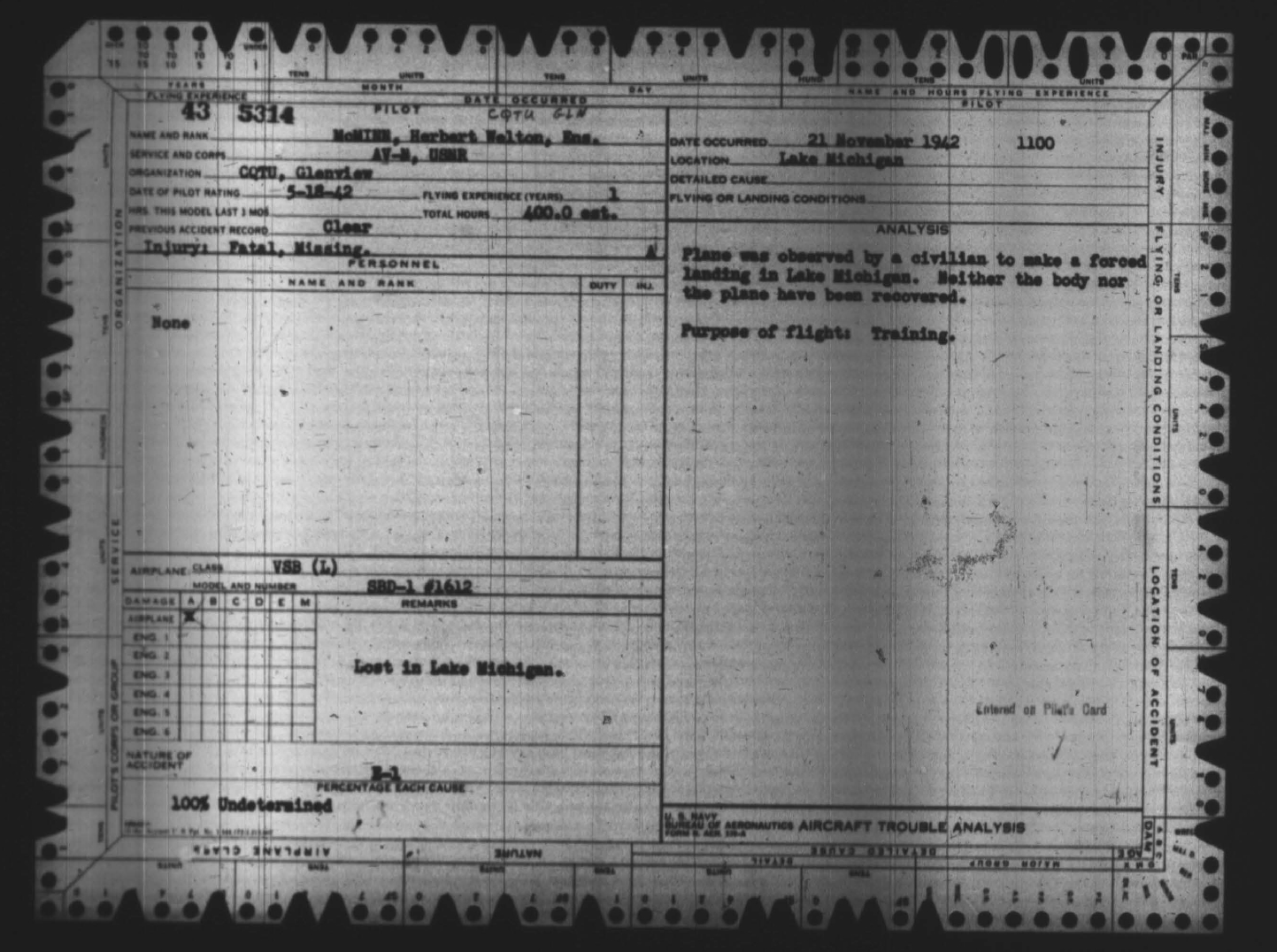
On the morning of November 21, 1942, SBD-1 BuNo 1612 took off from NAS Glenview on a training flight over Lake Michigan. At the controls that day was 24-year-old Ensign Herbert Welton McMinn of Gouldbusk, Texas. Having graduated from Texas A&M University with a degree in Animal Husbandry, he enlisted in the U.S. Naval Reserve on May 16, 1941, and earned his wings as a Naval Aviator on November 22, 1941. By 1100 hours, though, BuNo 1612 was listed as overdue. Despite an intensive search over the span of 12 days, no trace of McMinn or the aircraft was ever found. As it happened, a civilian named Albert Kleist had reported seeing a plane crash-land around five miles from where he was standing on the Chicago lakeshore. Kleist reported that he could not hear the sound of the aircraft’s engine as it descended to the lake and saw the pilot exit the airplane before being swept into the water. The Coast Guard had a Yard Patrol (YP) boat on duty, (YP-532) it had been rescuing another downed pilot, 2nd Lt. Arthur T. Wood, USMC. On that day, the water temperature of Lake Michigan was recorded as 42 degrees Fahrenheit, and an 18-knot wind from the northeast. Although McMinn’s body was never recovered, the Navy would eventually declare him legally dead, which remained a source of anguish for the McMinn family, who were left without answers to where their young son was.
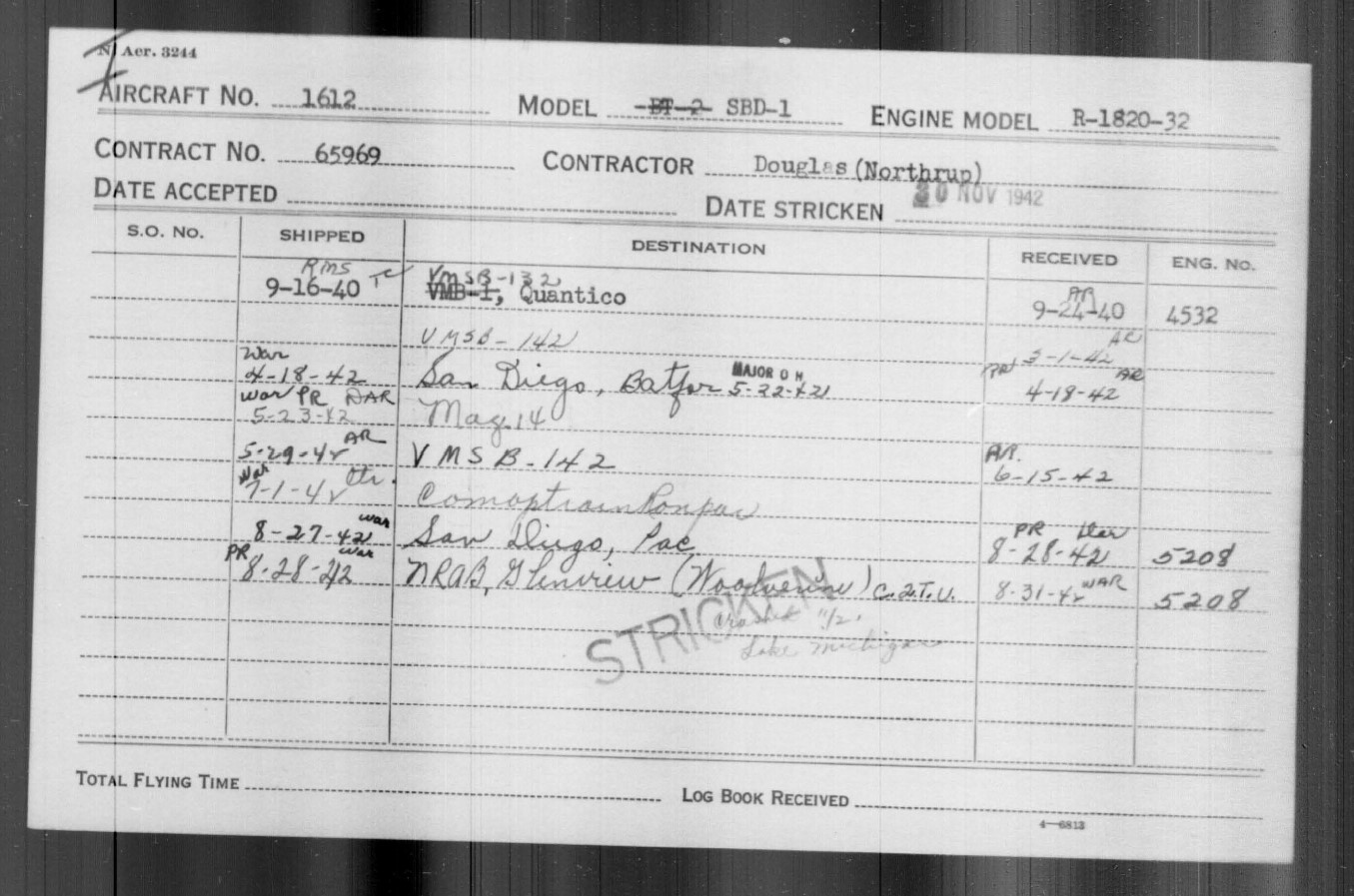
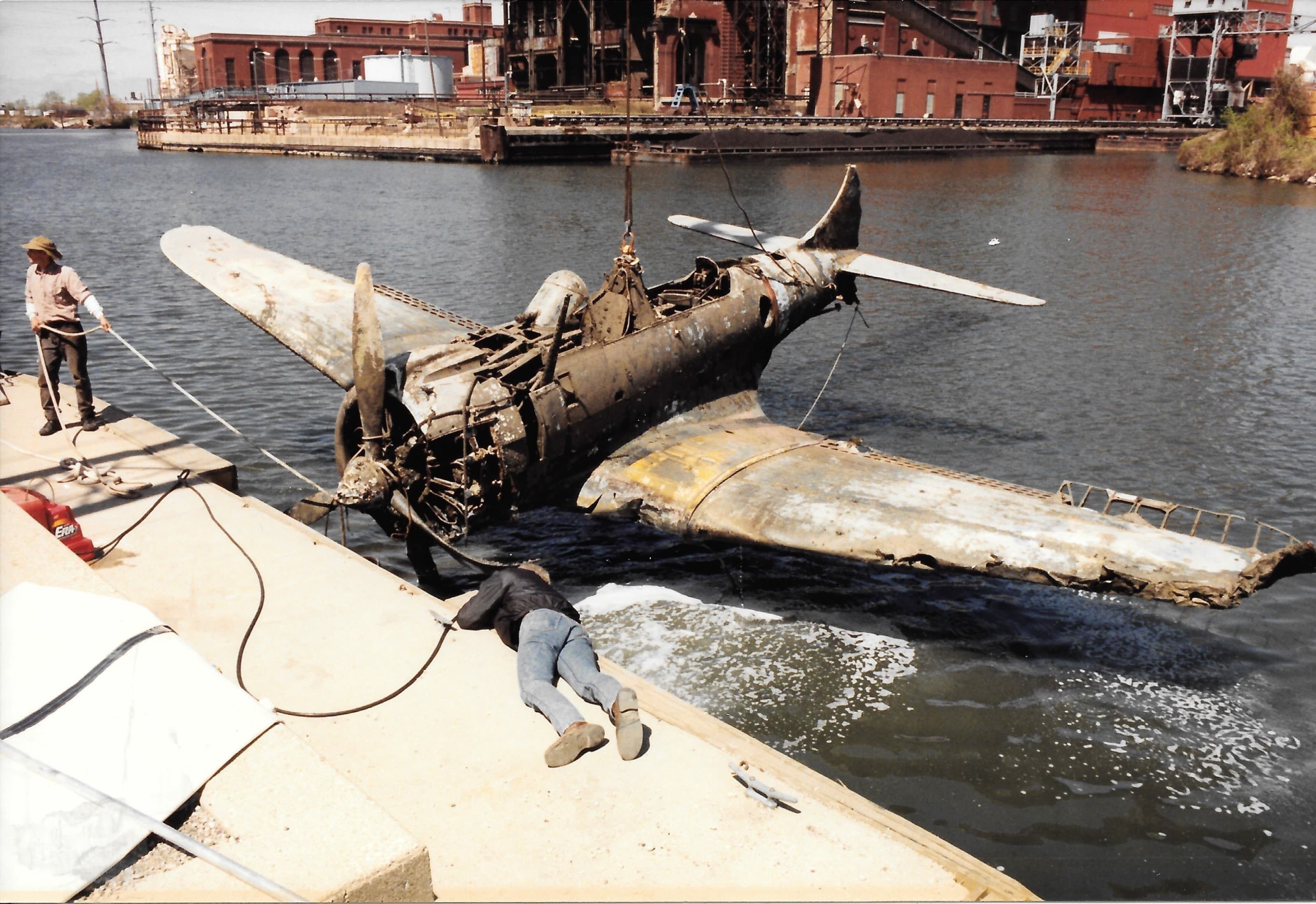
Some forty years later, during the 1980s, two scuba divers from the suburbs of Chicago named Allan Olson and Taras Lyssenko established the salvage firm A & T Recovery and began recovering wrecks of WWII naval aircraft lost during flight training operations on the USS Wolverine and the USS Sable (IX-81). Armed with archival records of the aircraft lost to Lake Michigan, and with a contract from the National Naval Aviation Museum in Pensacola, Florida, they set off on March 27, 1994, to find SBD-1 BuNo 1612, but a malfunction in their side-scanning sonar forced them to return to shore for repairs. Two days later, on March 29, they set out again, and this time they found BuNo 1612 sitting five miles from the north shore of Chicago. Lyssenko confirmed on his dive to the Dauntless that no human remains could be found in or near the aircraft, and one month later, SBD-1 BuNo 1612 was raised from the lake floor, towed submerged to a local marina, and brought back on dry land for the first time in 52 years. Almost as soon as the aircraft was recovered, it was disassembled and sent away on a truck, and it would be 13 years before Lyssenko would see SBD-1 BuNo 1612 again. Following its recovery, SBD-1 BuNo 1612 was sent to the Battleship Alabama Memorial Park in Mobile, Alabama, to be restored, but when no progress was made, the aircraft went into storage at the NNAM in Pensacola in 1997. By 2004, the National Naval Aviation Museum agreed to place the aircraft on long-term loan to the USS Midway Museum in San Diego, and on January 7, 2005, SBD-1 BuNo 1612 arrived at Hangar 805 at NAS North Island to be restored for display aboard the veteran carrier by the USS Midway Museum’s Airwing Department. However, the USS Midway Museum would receive another SBD Dauntless restoration project in July 2006, courtesy of WWII B-17 copilot and famed aircraft collector David Tallichet. This second project was a composite of several SBD airframes and had previously been loaned by Tallichet to the MAPS Air Museum in North Canton, Ohio, for restoration before sending the unfinished project to the USS Midway Museum. The Airwing Department’s volunteer staff would complete the composite SBD (painted with the Bureau Number 54654) and place it on display in the USS Midway’s hangar deck on May 29, 2007, where it remains today.
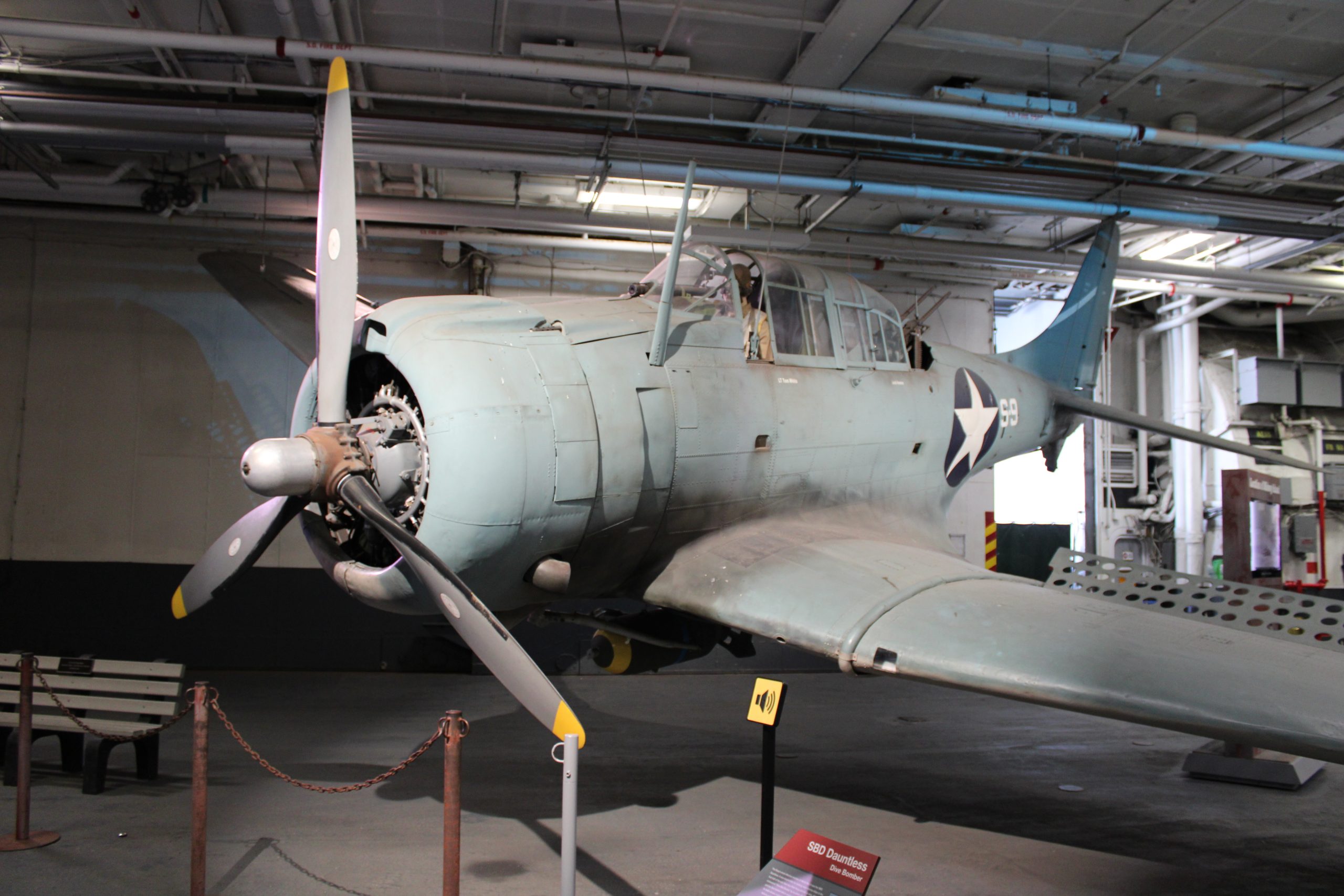
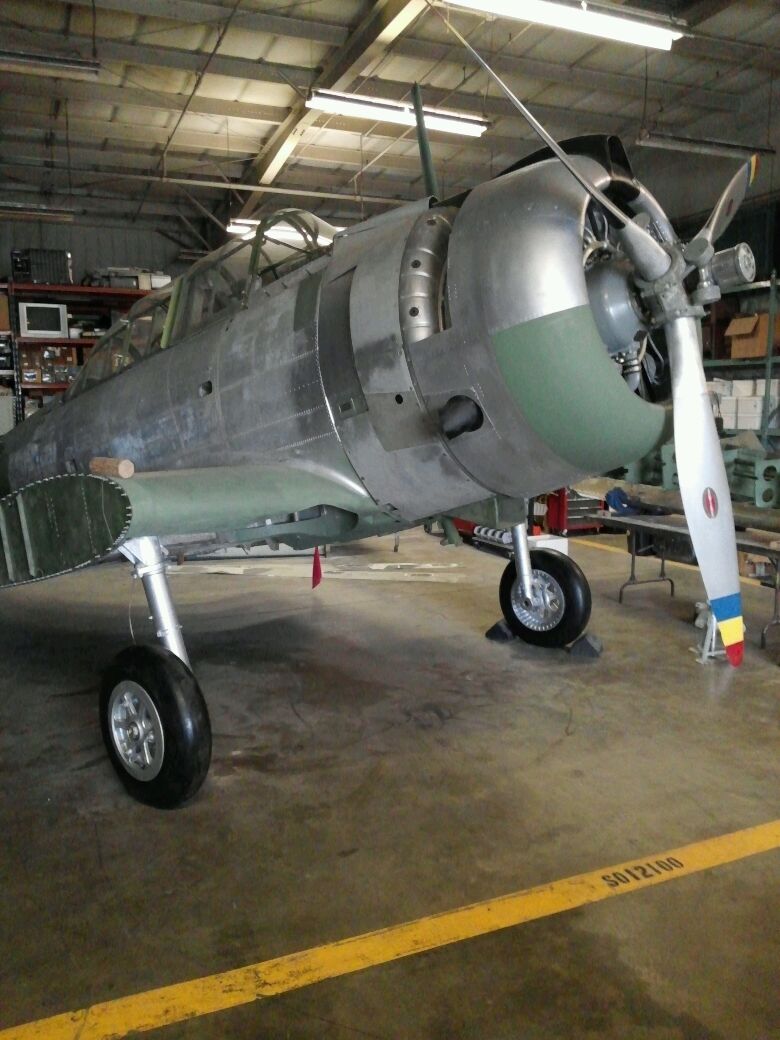
With the composite SBD on display in the ship, SBD-1 BuNo 1612 remained in storage at North Island until 2012, when it was transferred to the Flying Leatherneck Aviation Museum at MCAS Miramar, where it was a restoration project from 2012 to 2021. Over the years, the restoration of the aircraft progressed, with restorer Bob Cramise gaining press for his dedication to the project, which was visited by Taras Lyssenko in 2017, some 13 years after he had helped recover the aircraft from the depths of Lake Michigan. Given 1612’s history at MCAS Miramar when it was Camp Kearney in 1942, it would have been a fitting place for the aircraft to end up on display. Unfortunately, due to budget cuts, the Marines were forced to give up their subsidization of the Flying Leatherneck Historical Foundation, forcing the Flying Leatherneck Aviation Museum to close on March 28, 2021, with much of the collection being eventually moved to the former site of MCAS El Toro in Irvine, California, in 2024. However, the aircraft that were on loan to the FLAM from the NNAM were redistributed to other affiliate museums across the United States, and with Pensacola retaining BuNo 1612’s title, it was decided to ship it to the Air Zoo in Kalamazoo to complete its restoration, with the partially restored aircraft making a stop at the 2021 EAA AirVenture airshow in Oshkosh, Wisconsin, accompanied by representatives from the Air Zoo, A&T Recovery, the U.S. Navy, and the descendants of Ensign Herbert W. McMinn.
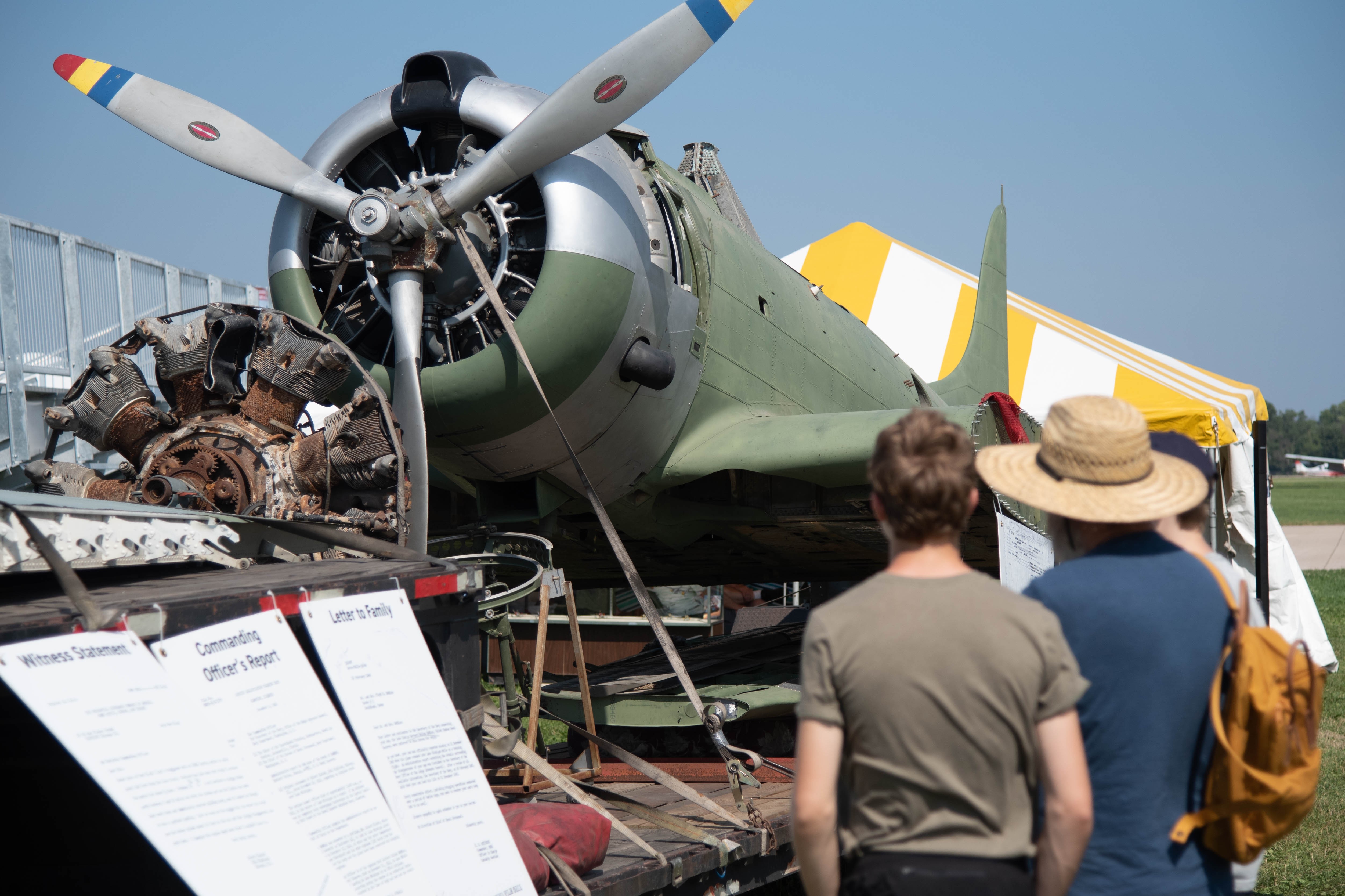
On August 2, 2021, SBD-1 Dauntless BuNo 1612 arrived at the Air Zoo just as the restoration team was finishing work on the restoration of Lockheed-Martin F-117A Nighthawk 85-0817 “Shaba” and another Dauntless recovered from Lake Michigan, SBD-2P Dauntless BuNo 2173 (now on display at the Pearl Harbor Aviation Museum on Ford Island, Hawaii). While both the F-117A and SBD-2P were completed in 2021, SBD-1 BuNo 1612 continued to share the restoration hangar with FM-2 Wildcat BuNo 57039, which was later completed in 2024 and is now on display at the American Heritage Museum in Hudson, Massachusetts. In the two years since the Wildcat was completed, work has progressed substantially on the SBD-1.
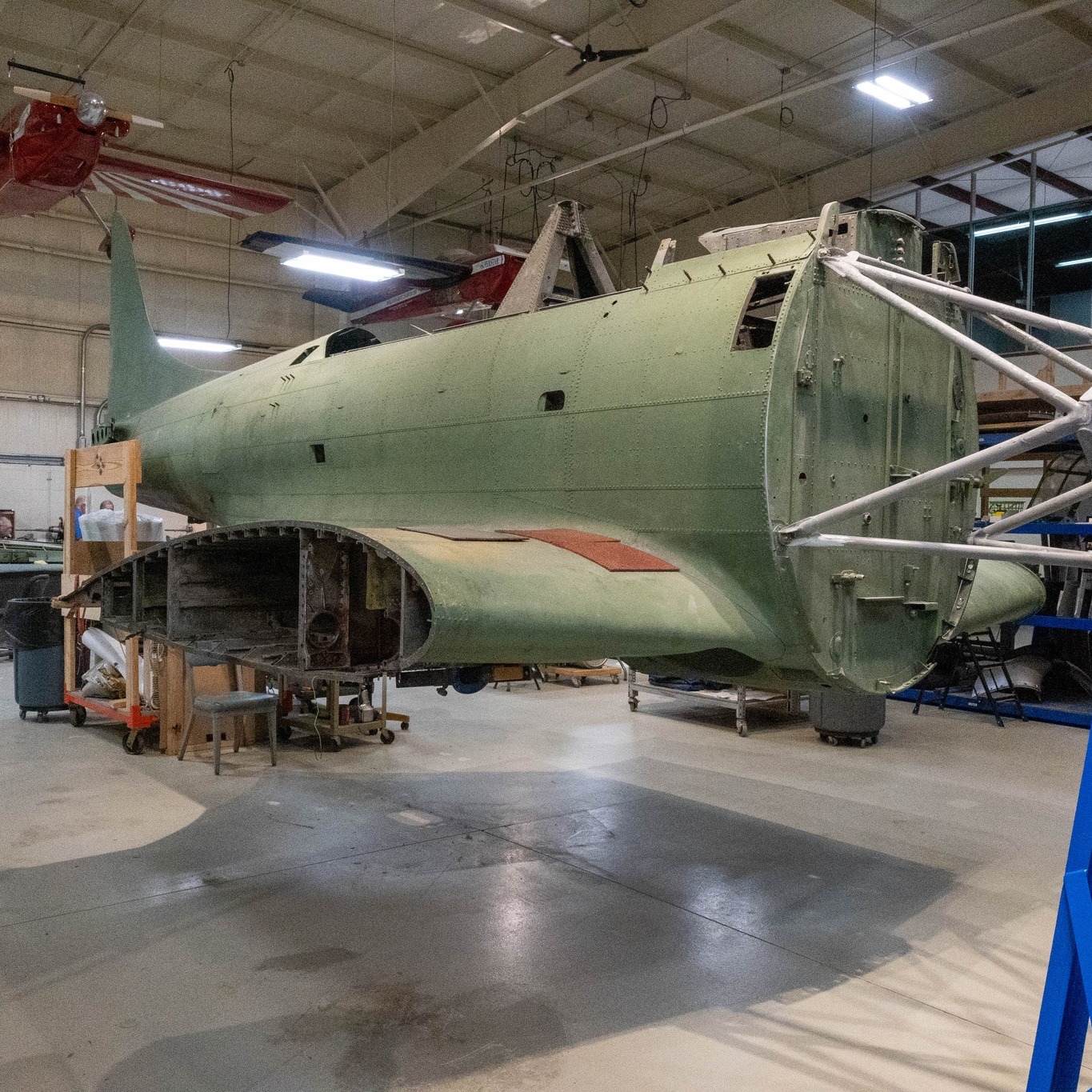
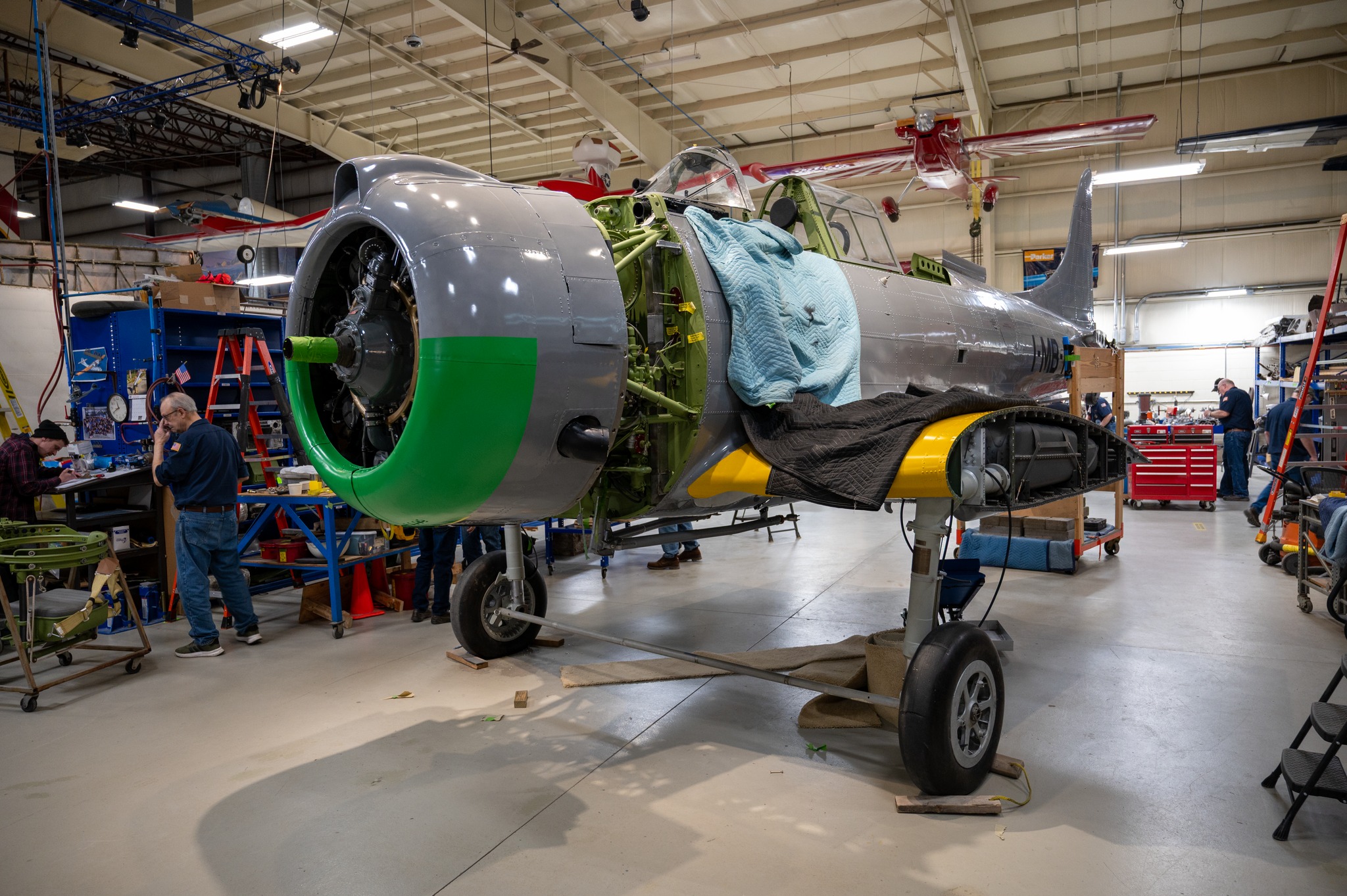
Through their experience with the SBD-2P and the FM-2, the Air Zoo assembled a rotisserie-style jig that had been used to rotate the entire fuselage of the SBD from the firewall to the tail in order for the riveters to work on the SBD-1 from every angle without working on their backs for the underside portions of the aircraft. The rotisserie jig also allowed for easier access to use soda-blasting for stripping old paint and primer to inspect the bare metal for corrosion, dings, and dents. Even as volunteers continued treating corrosion in the sheet metal, the Dauntless’s landing gear was disassembled, inspected, restored, and reassembled back on the airframe, and with the completion of the intensive sheet metal repairs on the underside, led to the Dauntless being placed out of the rotisserie jig and back to resting on its own landing gear.
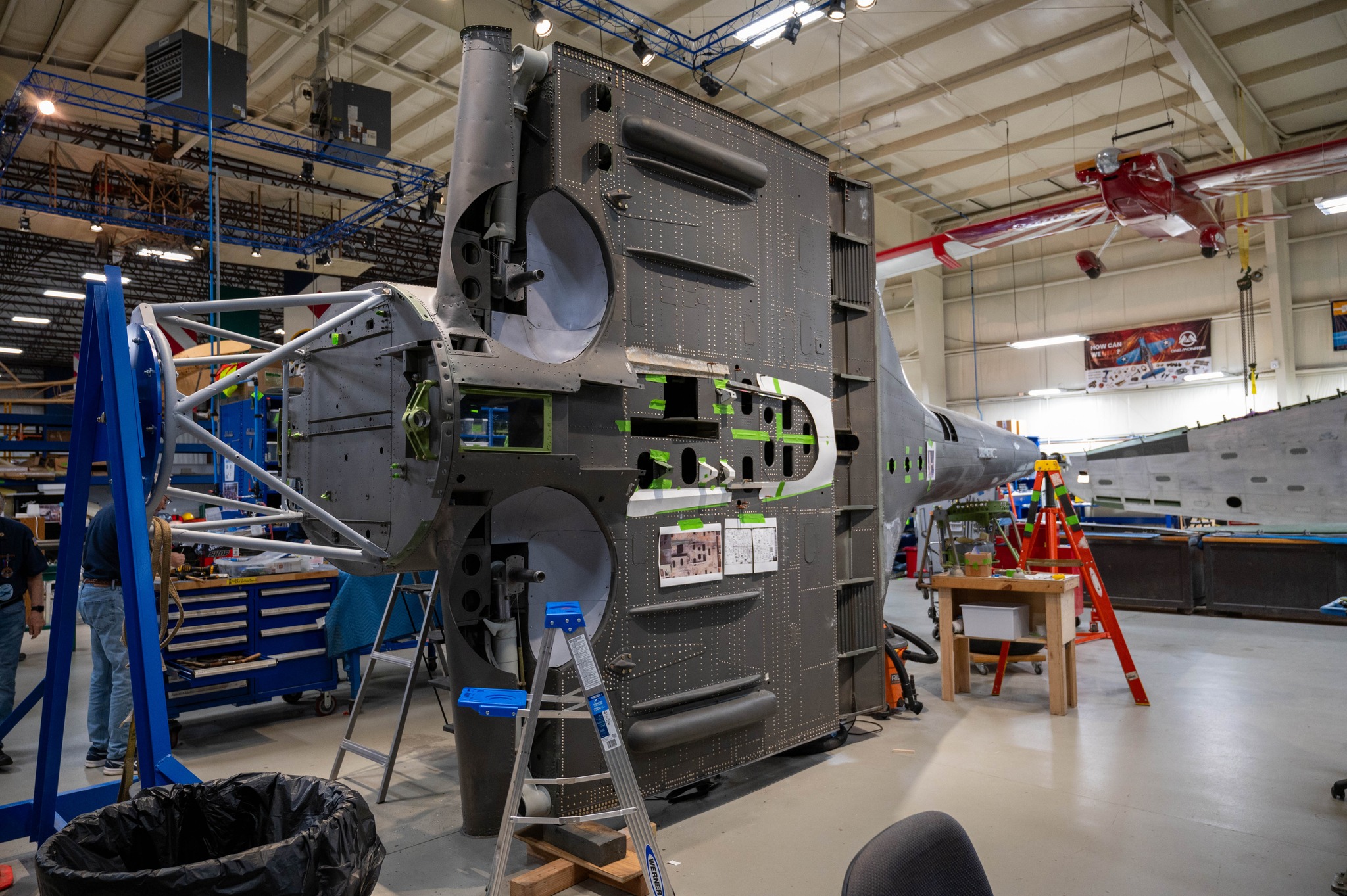
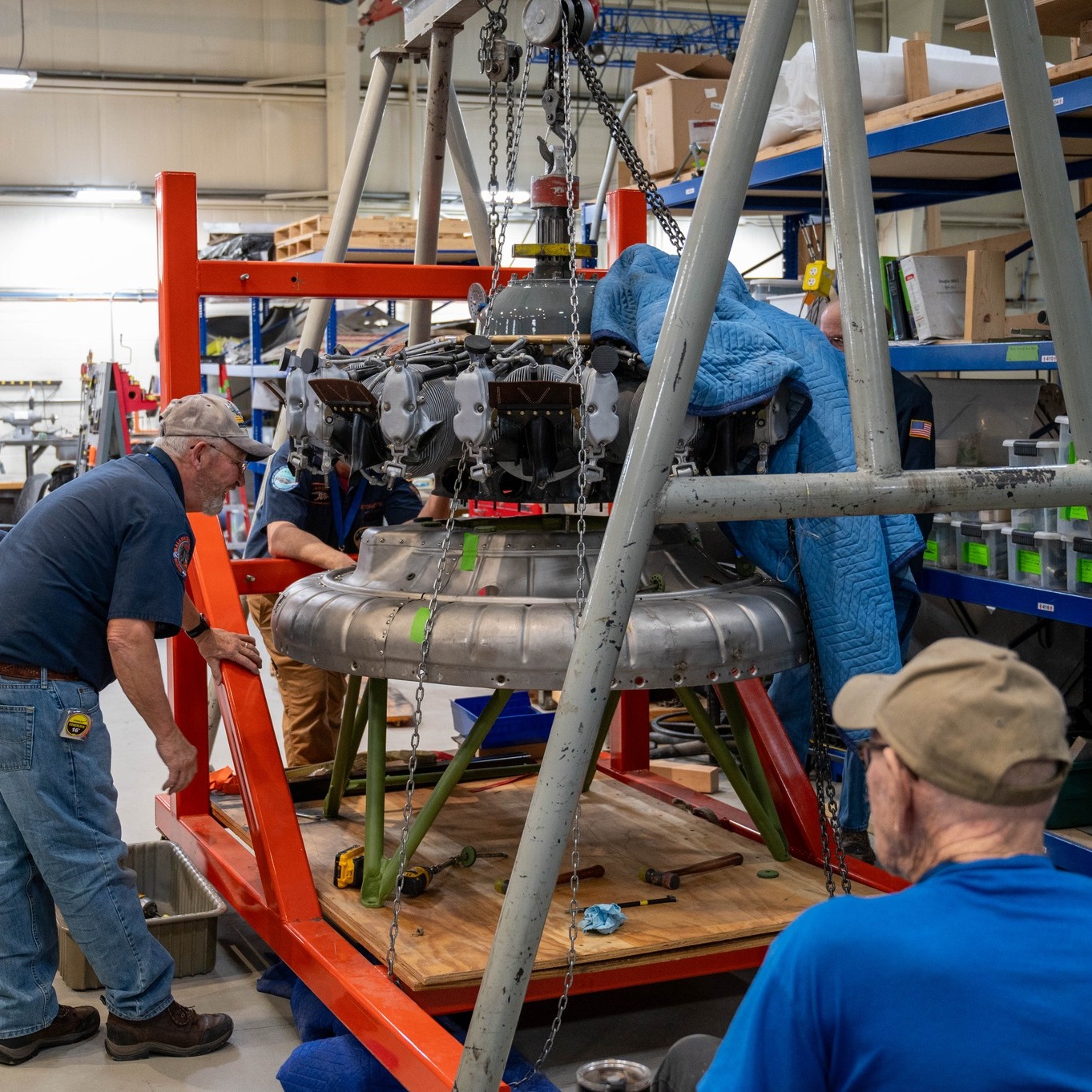
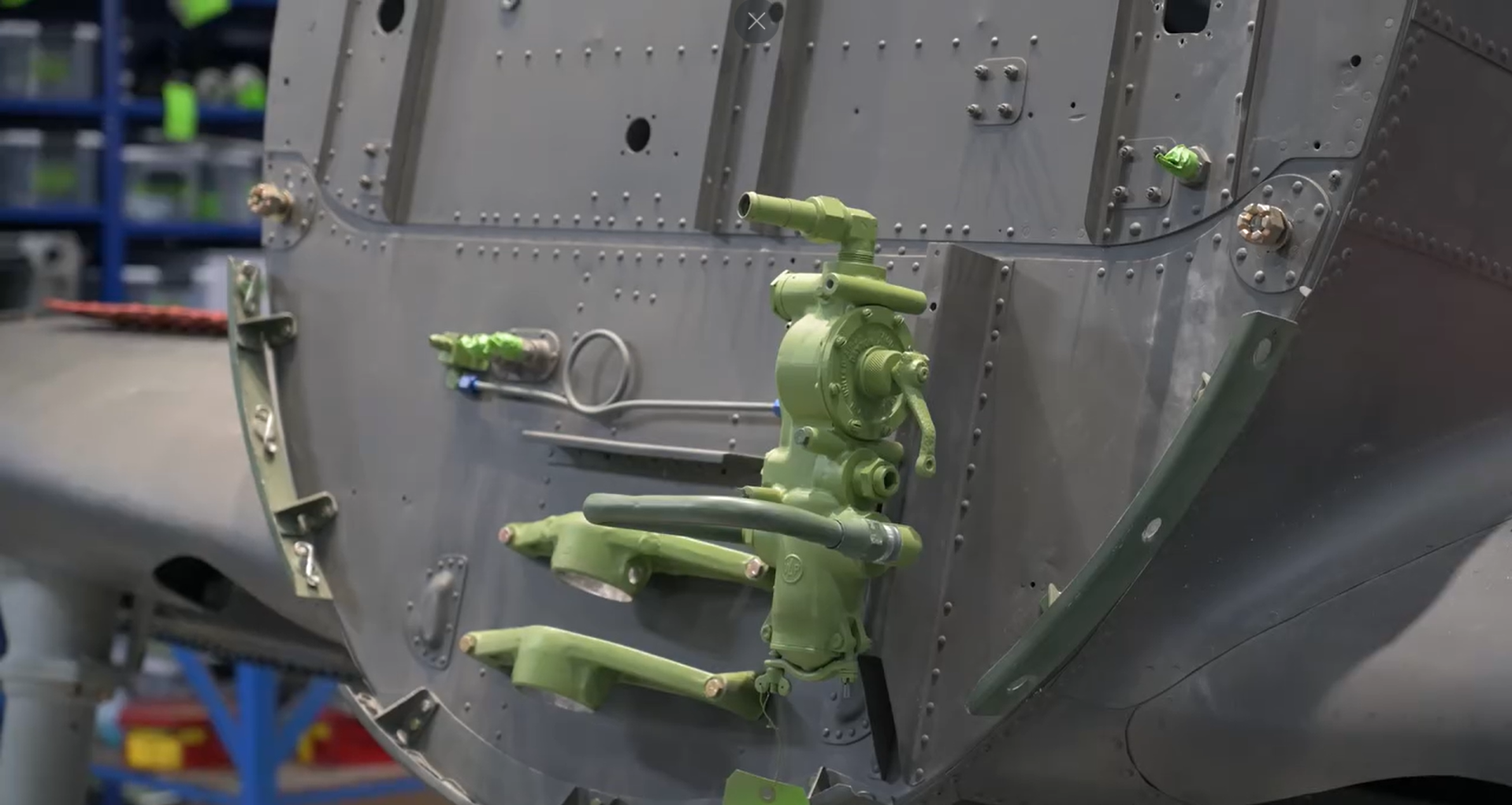
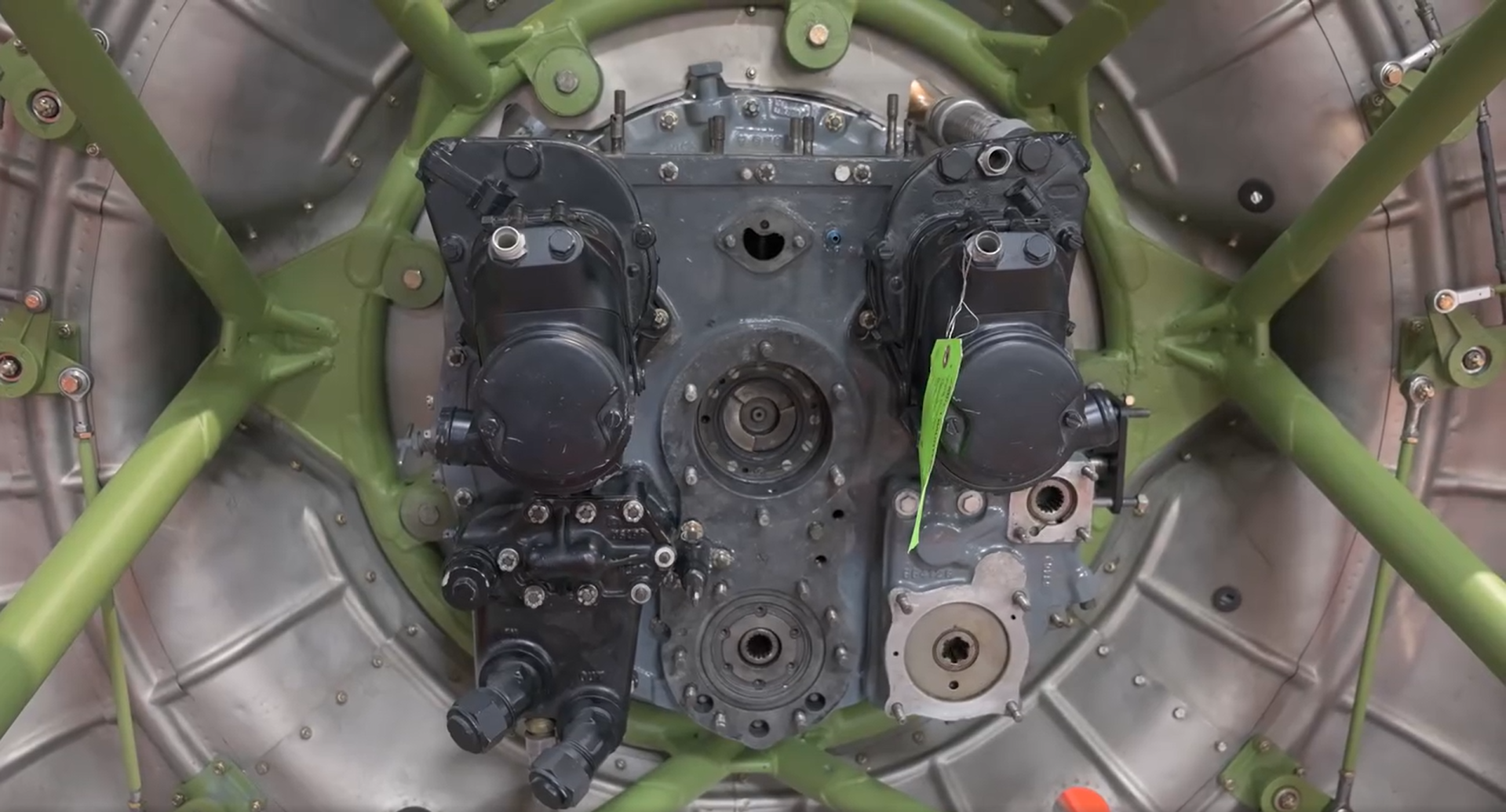
One of the distinguishing features of all variants of the Dauntless is its set of dive brakes/flaps. The SBD had no less than five panels for these brakes, with upper and two lower panels, one on each wing, and a lower panel for the fuselage. With these panels having been damaged during the ditching in 1942 or having gone missing entirely, the Air Zoo’s “DiFlap” team relied on spare flaps provided to them through the National Naval Aviation Museum as reference guides. Additionally, the team meticulously restored and reproduced the iconic dive flaps on the Dauntless. Having completed the fabrication work, the team has test fitted the dive brakes and painted these panels before final installation. Another big part of the restoration has been the restoration of the SBD-1’s Wright R-1820 Cyclone radial engine. Although the aircraft will be on static display, the Air Zoo’s restoration volunteers want to ensure that the engine is fully restored. The engine was disassembled down to the crankcase, cleaned, repaired, and reassembled, with the carburetor, magnetos, generator, starters, and other vital components placed at the rear of the engine, similarly disassembled, restored, and reinstalled.
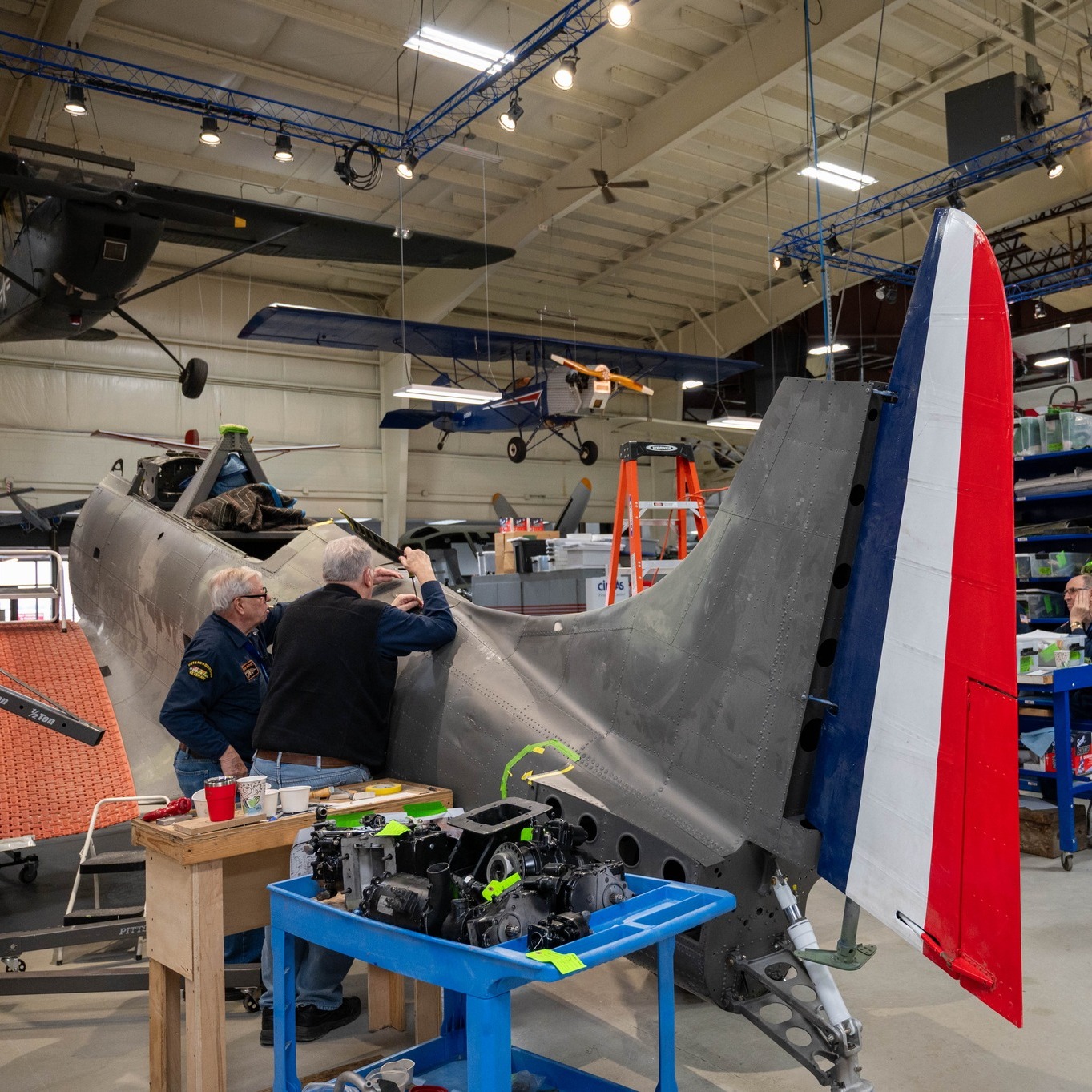
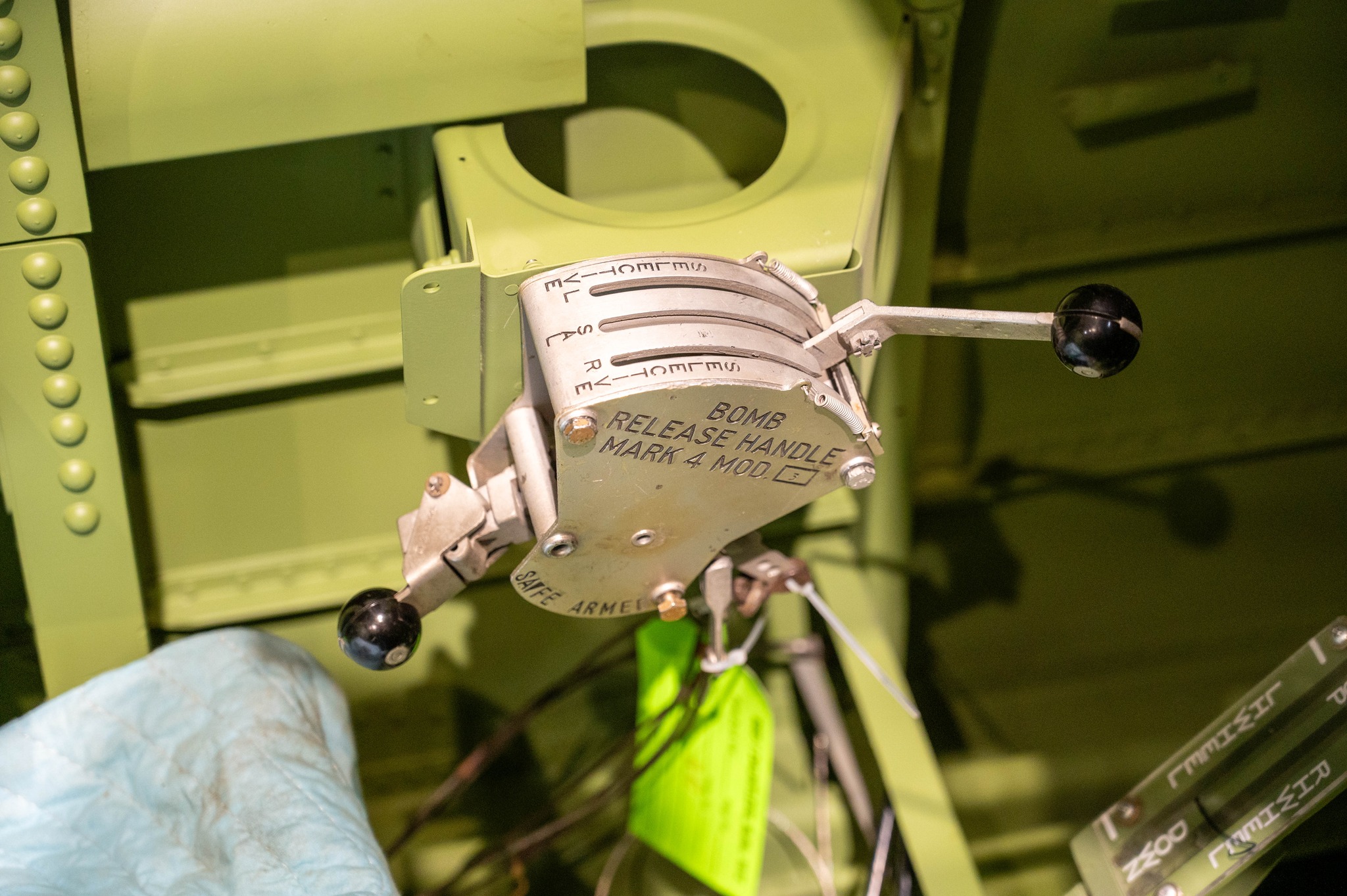
While the SBD-1’s rudder had been recovered prior to leaving Miramar, it was decided to remove the fabric from the metal frame and inspect it for corrosion before recovering the rudder frame with new fabric and repainting the rudder with the red, white, and blue stripes present on the aircraft’s 1940 paint scheme. With the aircraft having been stripped of all paint and placed back in its landing gear, the SBD-1 was brought into the restoration shop’s paint booth, and the interior of the cockpit and rear fuselage was coated in primer, and with the completion of this coating, the Dauntless has been moved back to the restoration team’s workspace, and the Air Zoo volunteers will begin adding all the furnishings seen in the cockpit for both the pilot and the rear gunner. Since the cockpit had been stripped of much of its instruments prior to its arrival at Kalamazoo, missing items were replaced either by original parts collected by the museum or were fabricated by the restoration team, with one of the most significant parts to be refabricated being the Dauntless’s telescopic sight, placed through the pilot’s windscreen to sight a target when carrying out a dive bombing run.
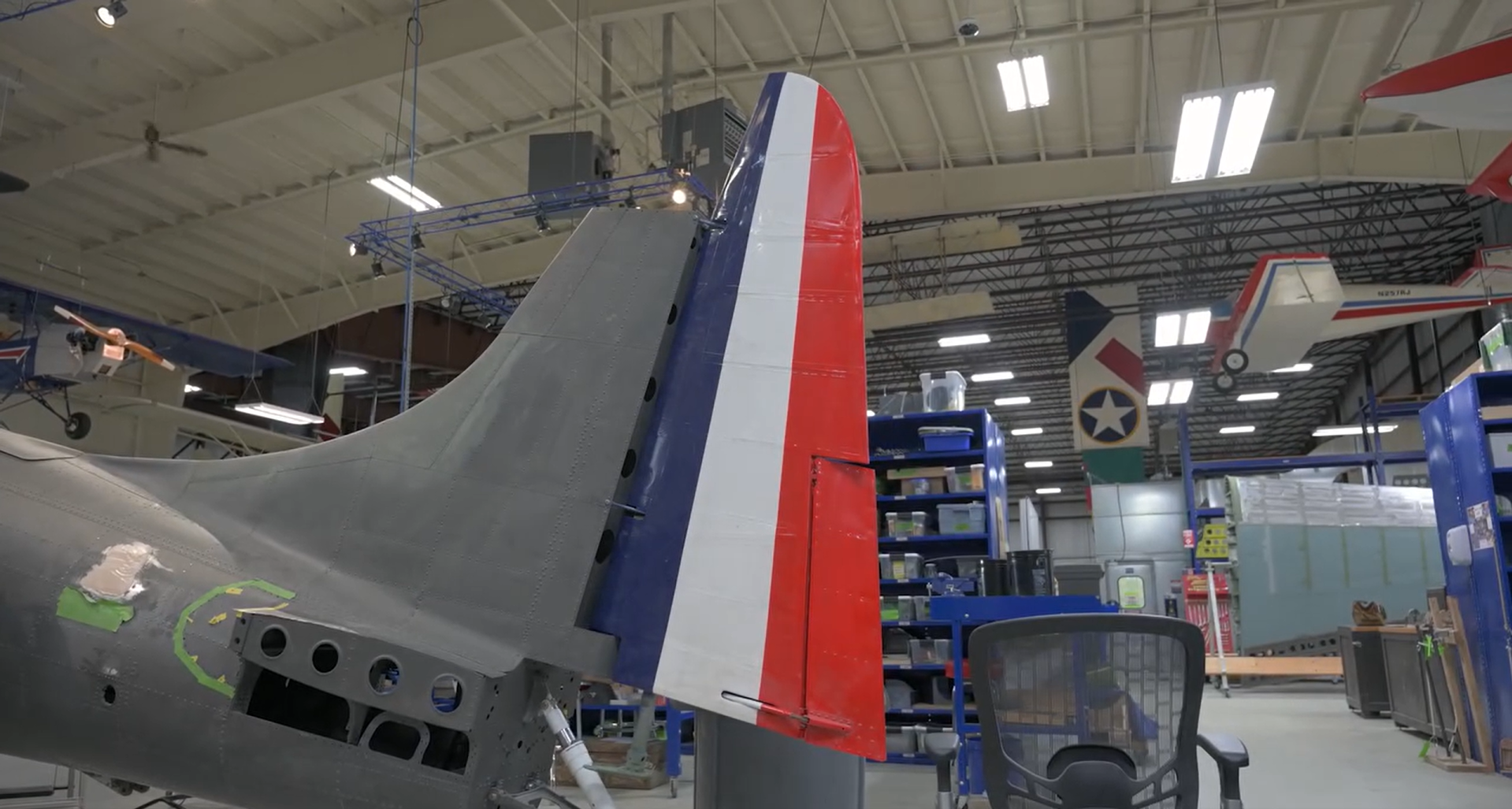
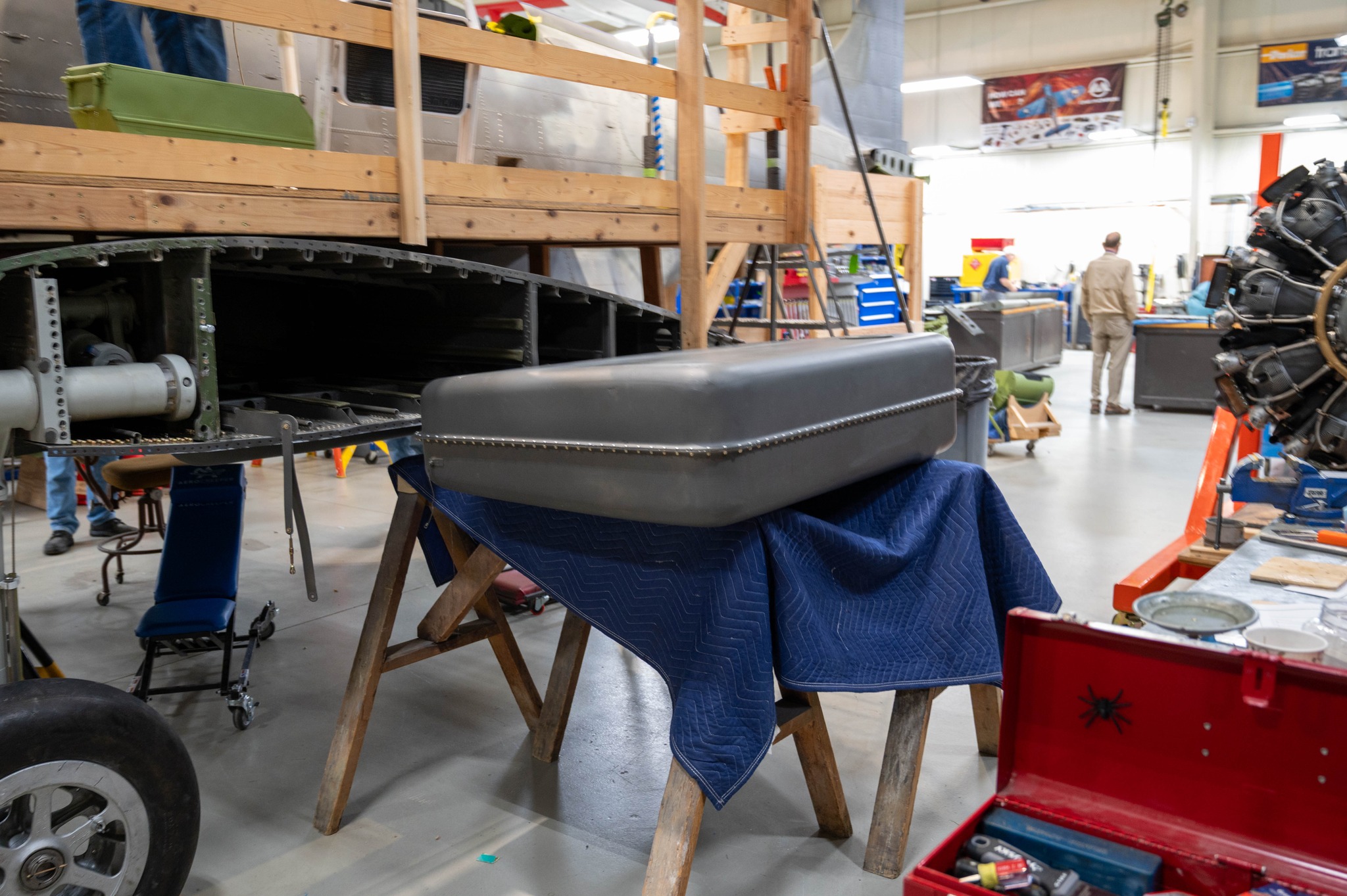
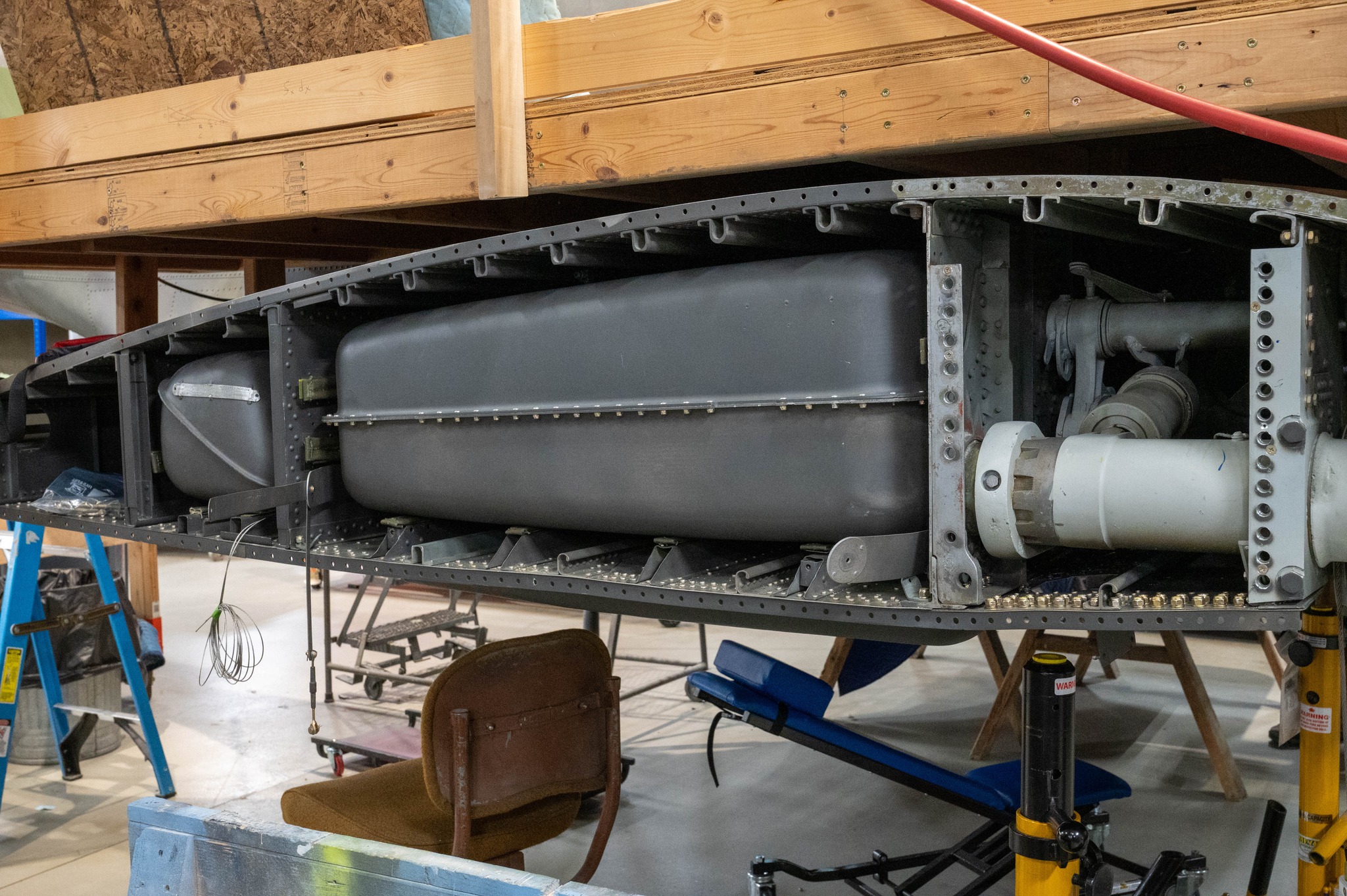
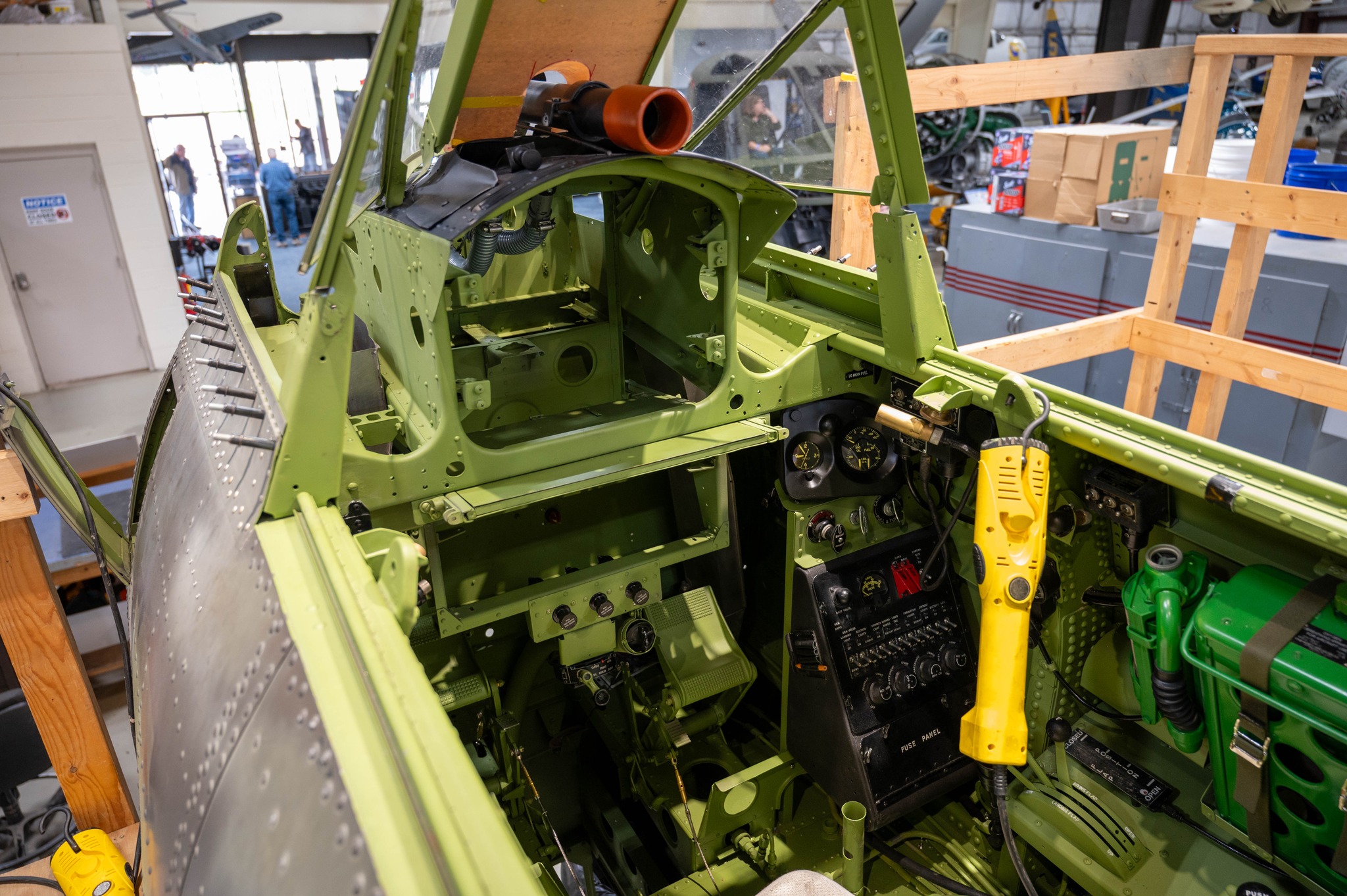
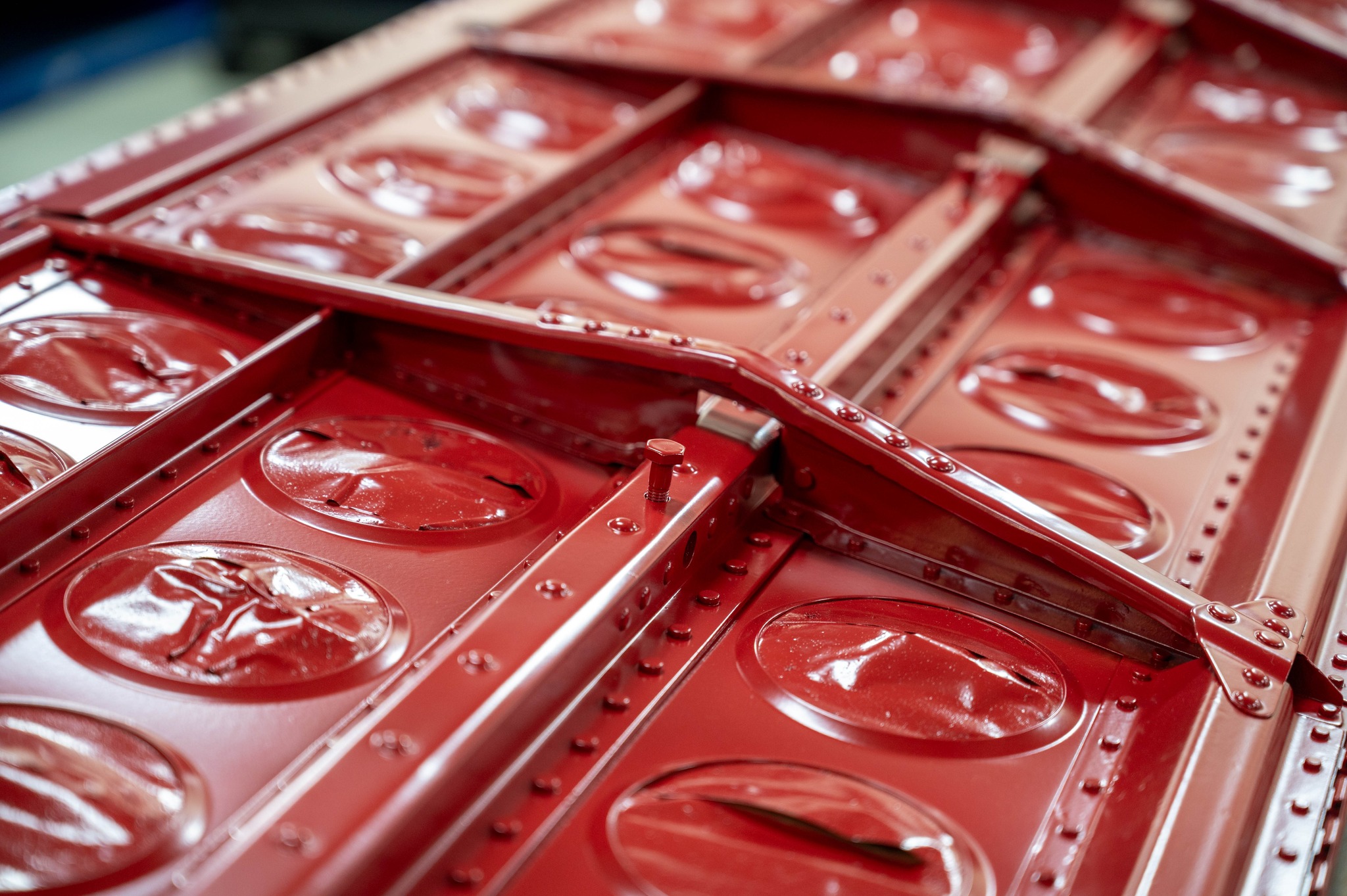
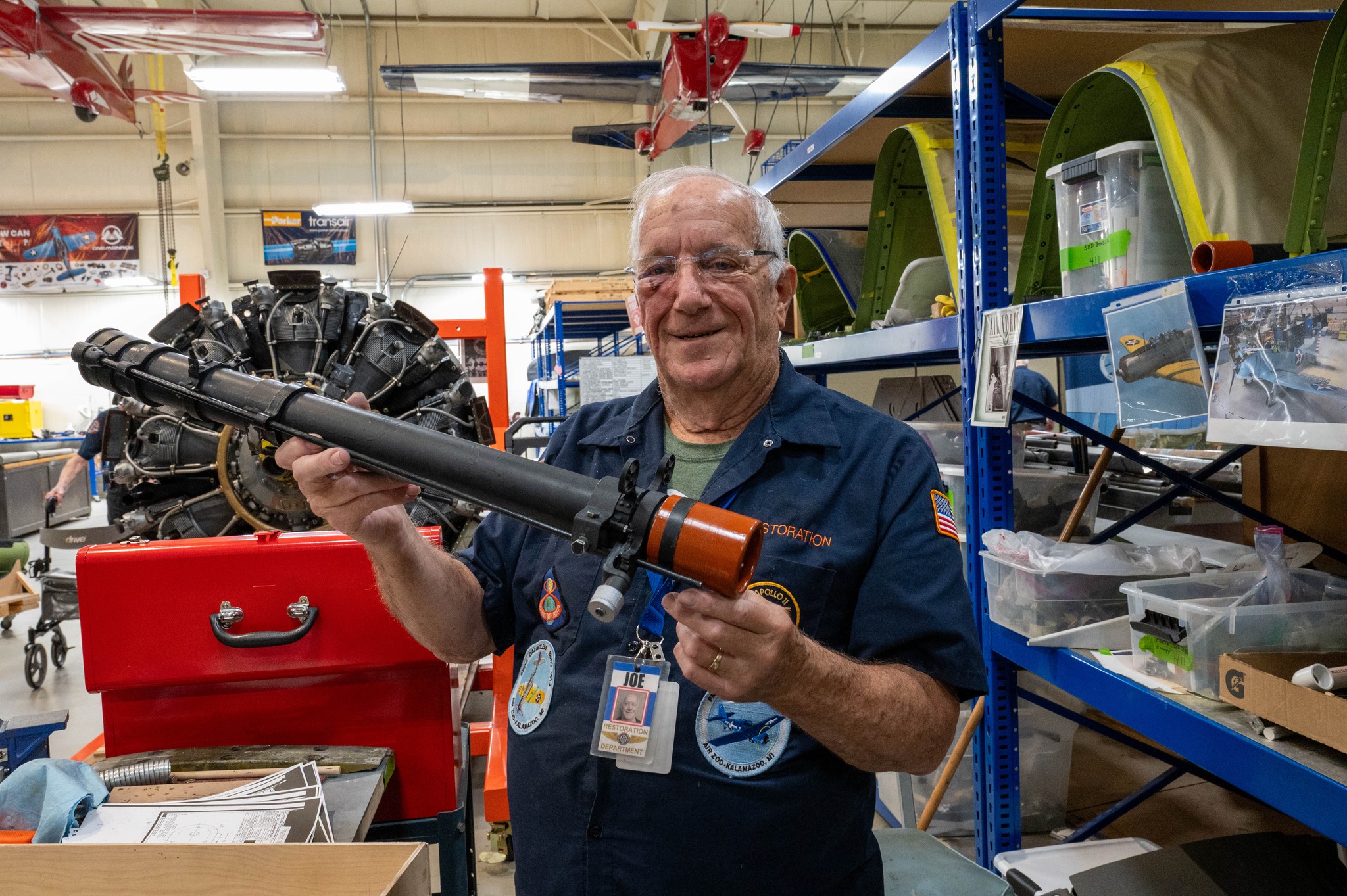
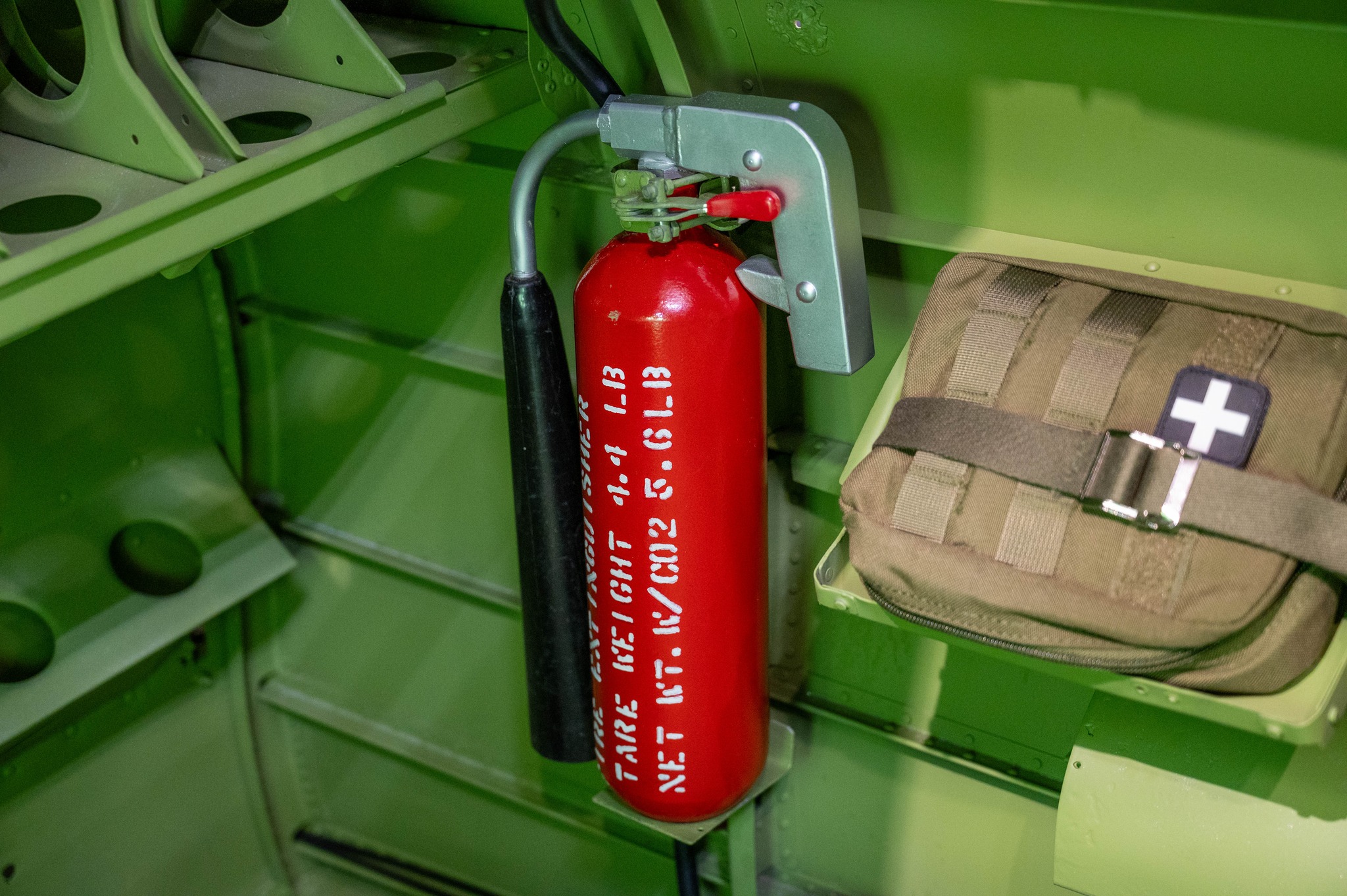
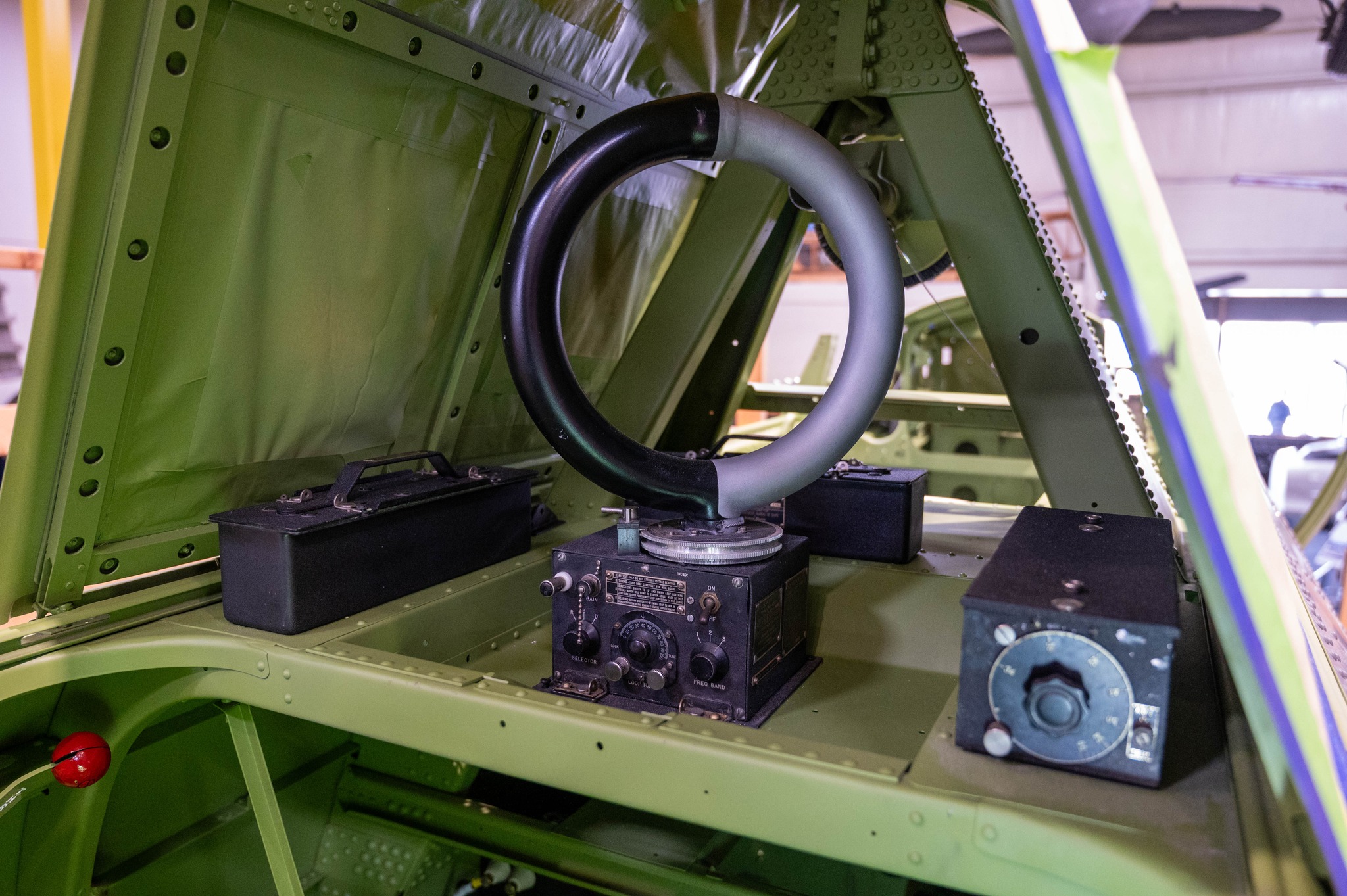
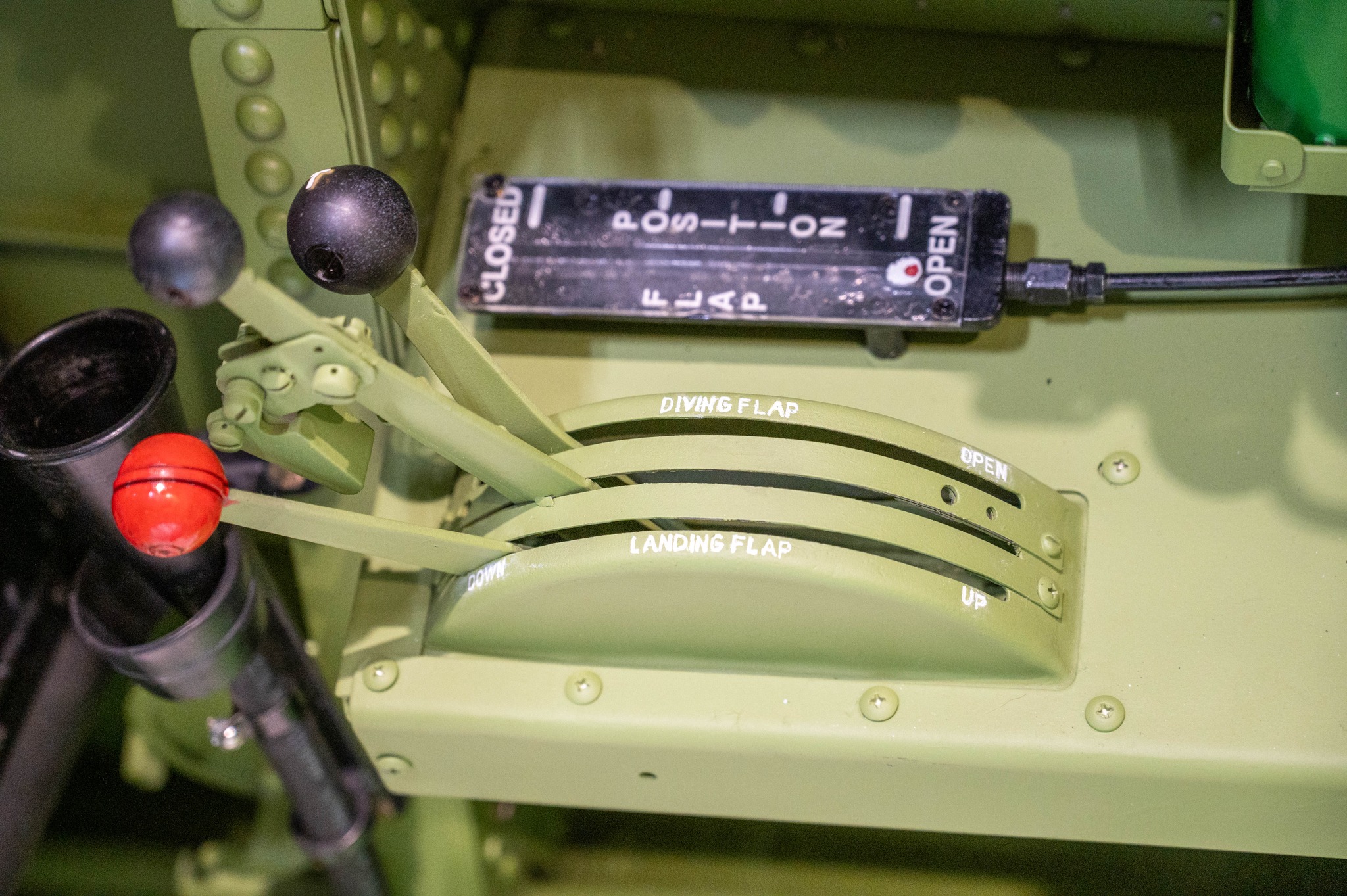
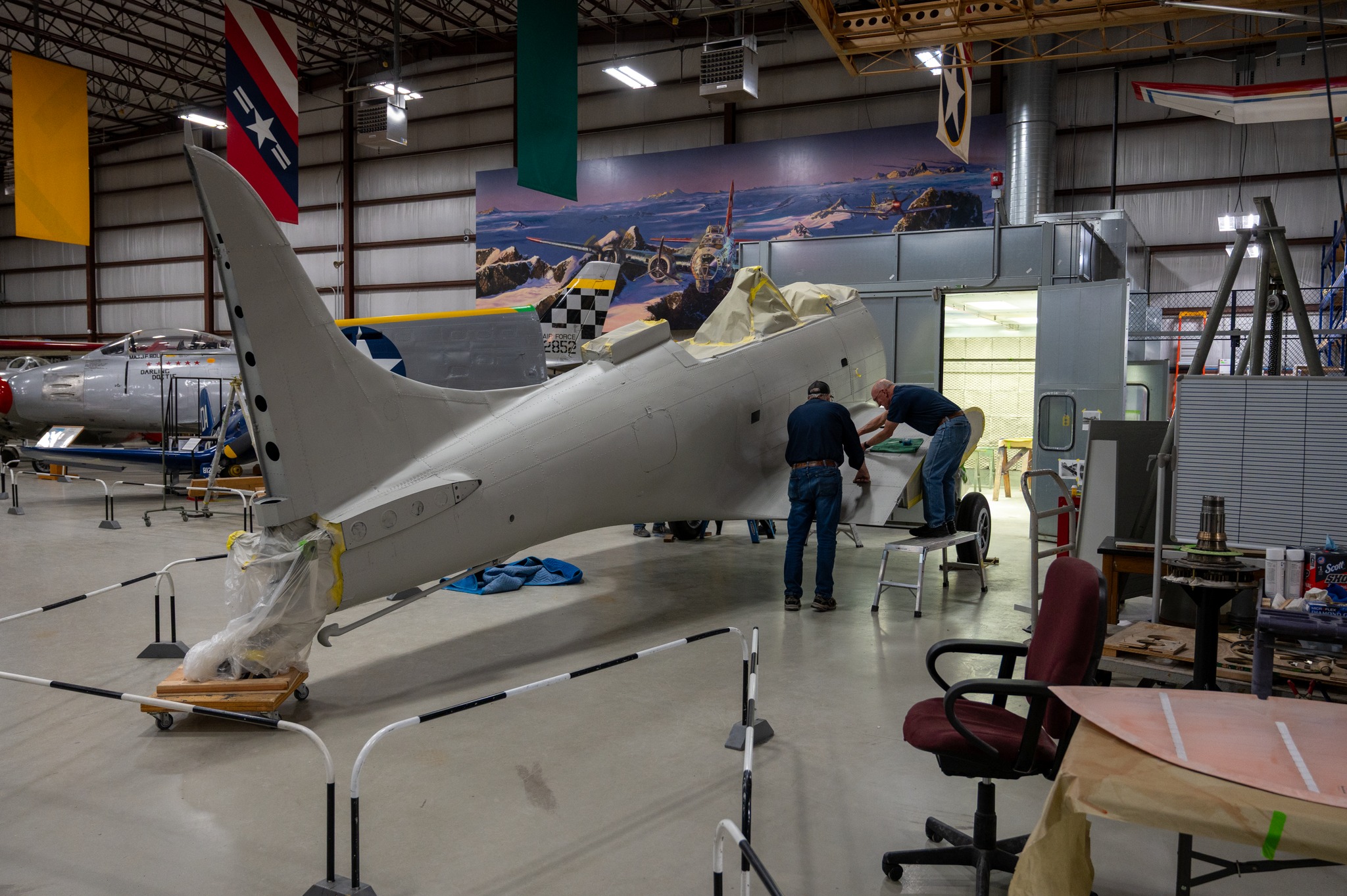
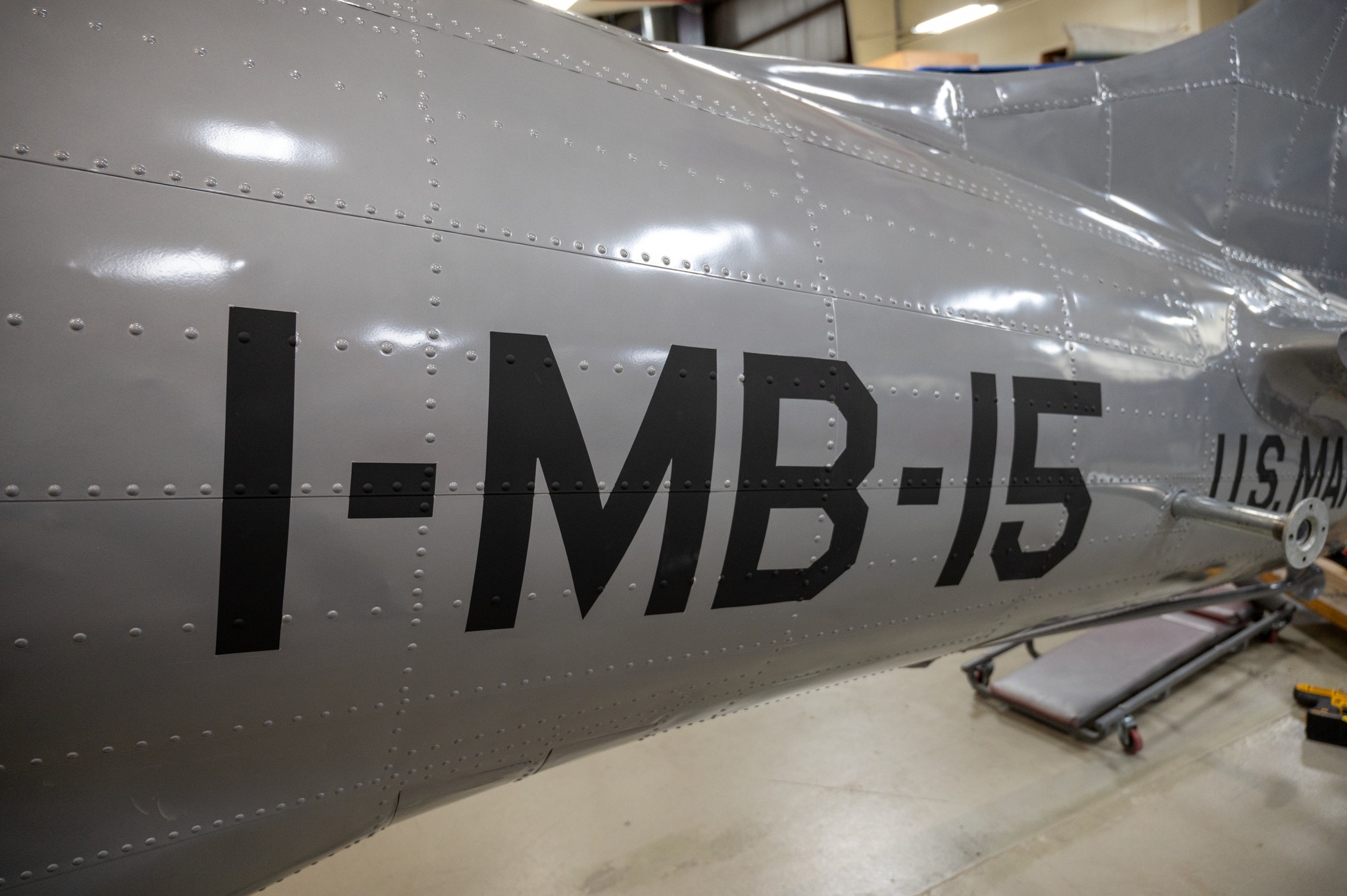
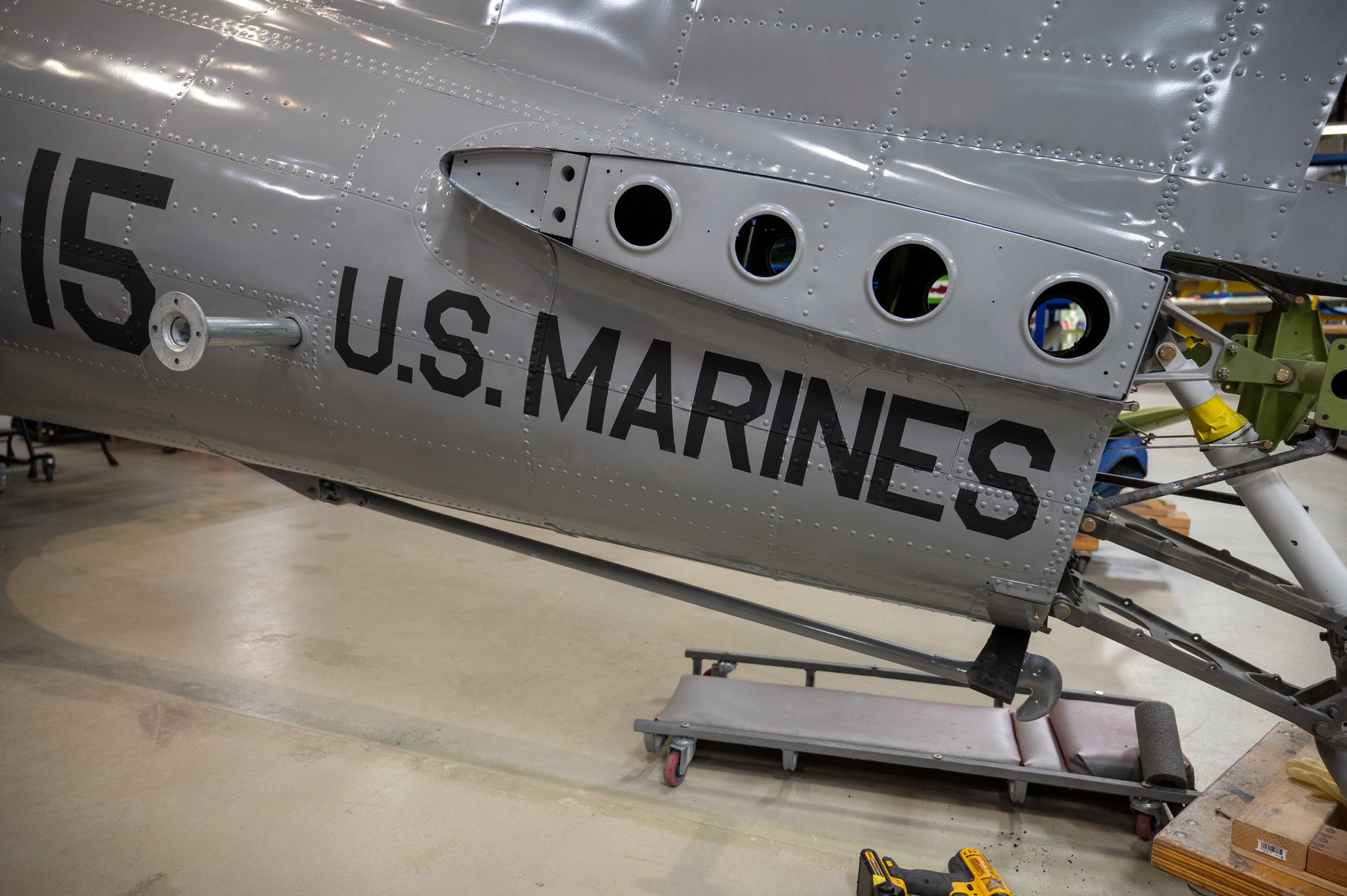
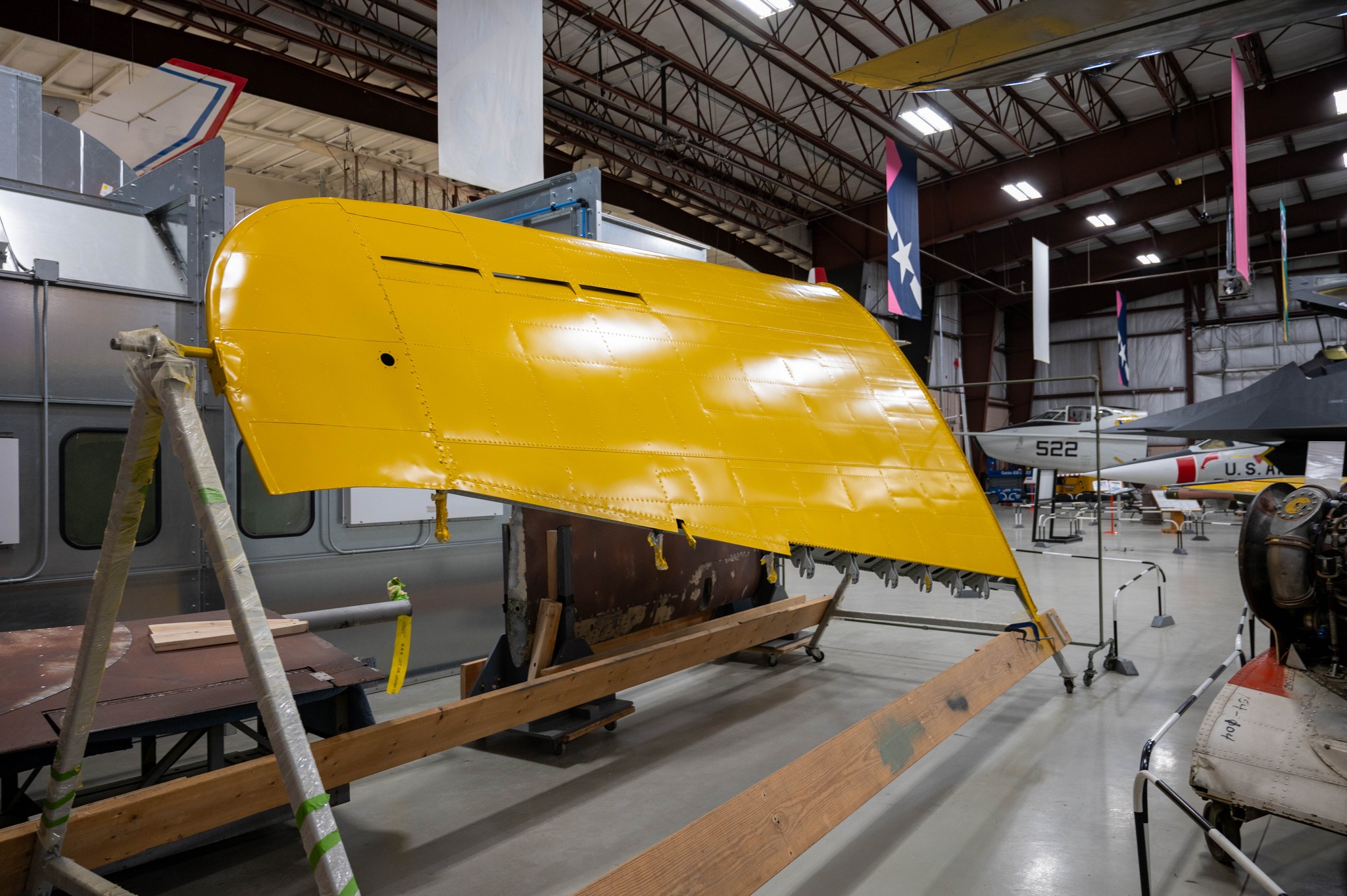
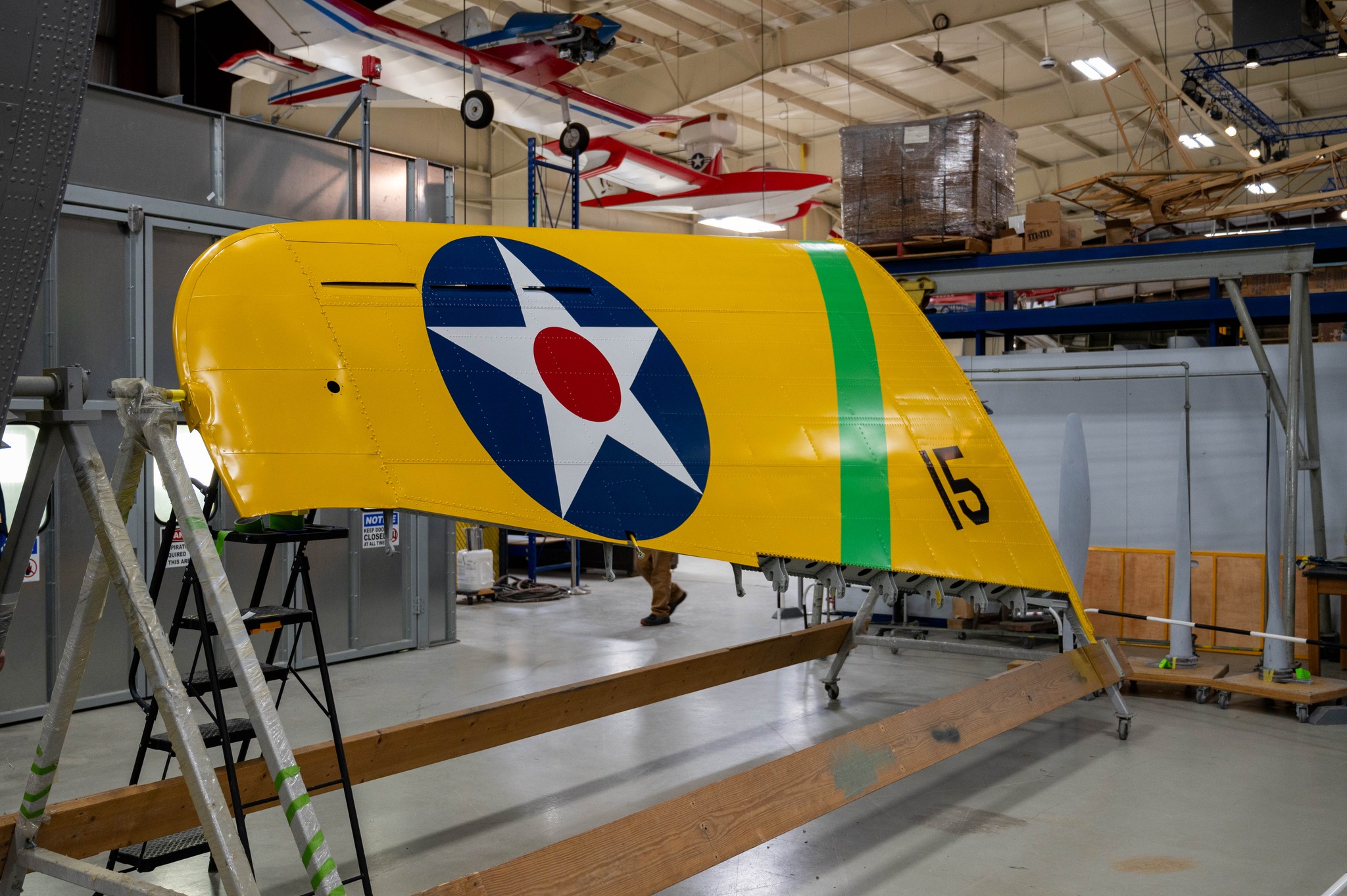
Following this, the internal cockpit areas were wrapped and protected by masking paper as the fuselage was wheeled back into the paint booth in early this spring. While SBD-1 BuNo 1612 would have originally flown a mostly bare metal scheme, the aircraft has been painted grey to help protect the aircraft’s aluminum skin from further corrosion. Additionally, the wings were also painted, this time with the topsides receiving a brilliant yellow scheme with the underside being painted the same color as the fuselage. As of May 2026, the project is now nearing completion, with the dive flaps being installed on the wings, the fuselage receiving its last stencils and its propeller blades and cone being painted. The aircraft is set to return to the colors it wore as part of VMB-1 at Quantico, when it given the fuselage code 1-MB-15.
With the world’s oldest surviving Douglas SBD Dauntless being loaned by the National Naval Aviation Museum in Pensacola, it is ultimately up to Pensacola to determine where the aircraft will be sent following its completion. Since the Air Zoo is already home to SBD-3 Dauntless BuNo 06624, the first SBD to be restored at the Air Zoo, and another Dauntless restored by the Air Zoo, SBD-2P BuNo 2173, has since been shipped to the Pearl Harbor Aviation Museum in Hawaii, it is likely that SBD-1 BuNo 1612 will also depart Kalamazoo. Back in California, the Flying Leatherneck Aviation Museum has moved its collection to the Orange County Great Park (on the former site of MCAS El Toro) and has been eager to welcome back the Dauntless should the opportunity present itself. Though the Air Zoo itself has yet to make any official statement regarding the disposition of BuNo 1612, it is more than likely that the aircraft will be fully assembled at Kalamazoo to ensure all components properly fit, host a public celebration of the completion of the restoration, then disassemble the aircraft for shipment, as was done with SBD-2P BuNo 2173 when it was shipped to Hawaii.
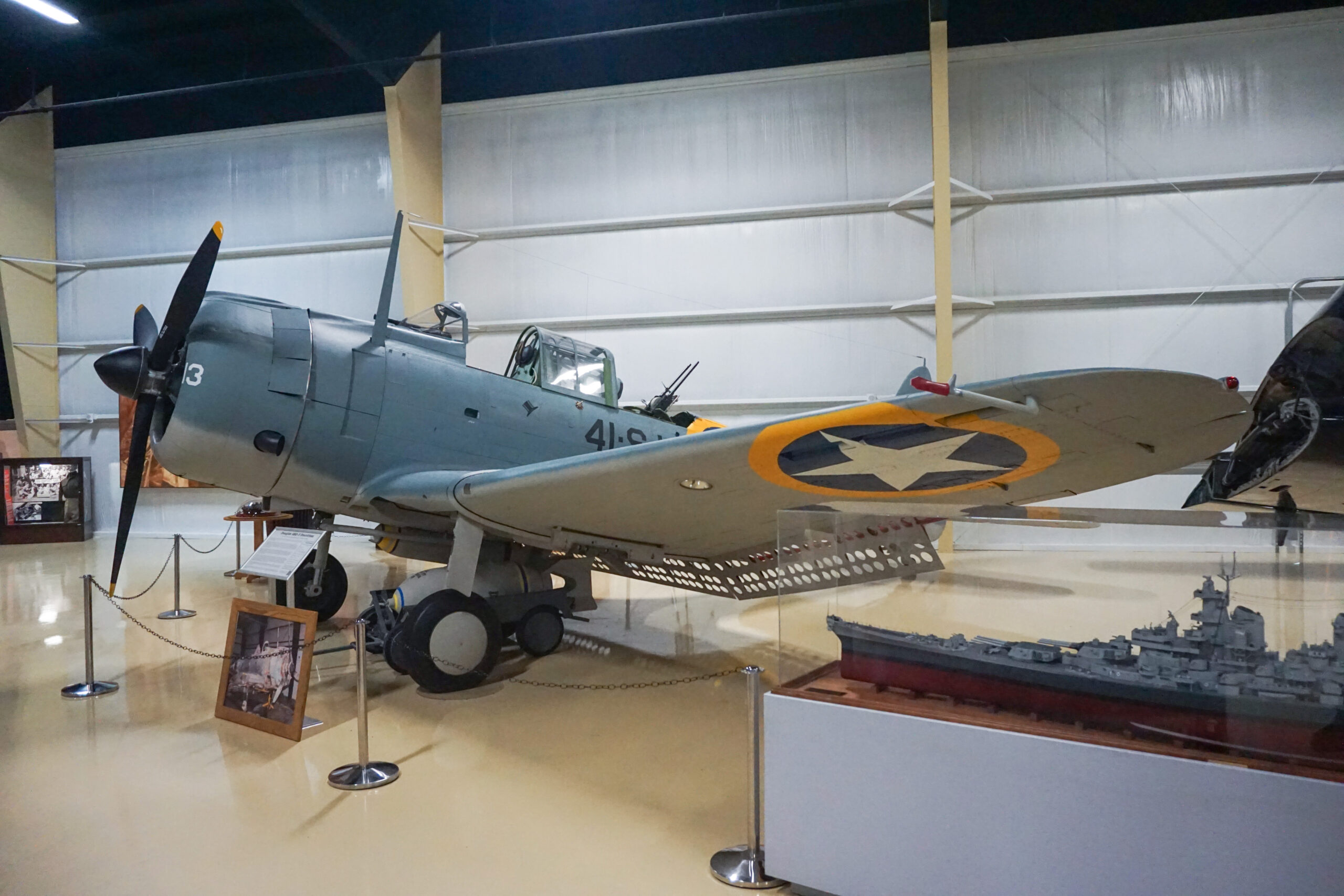
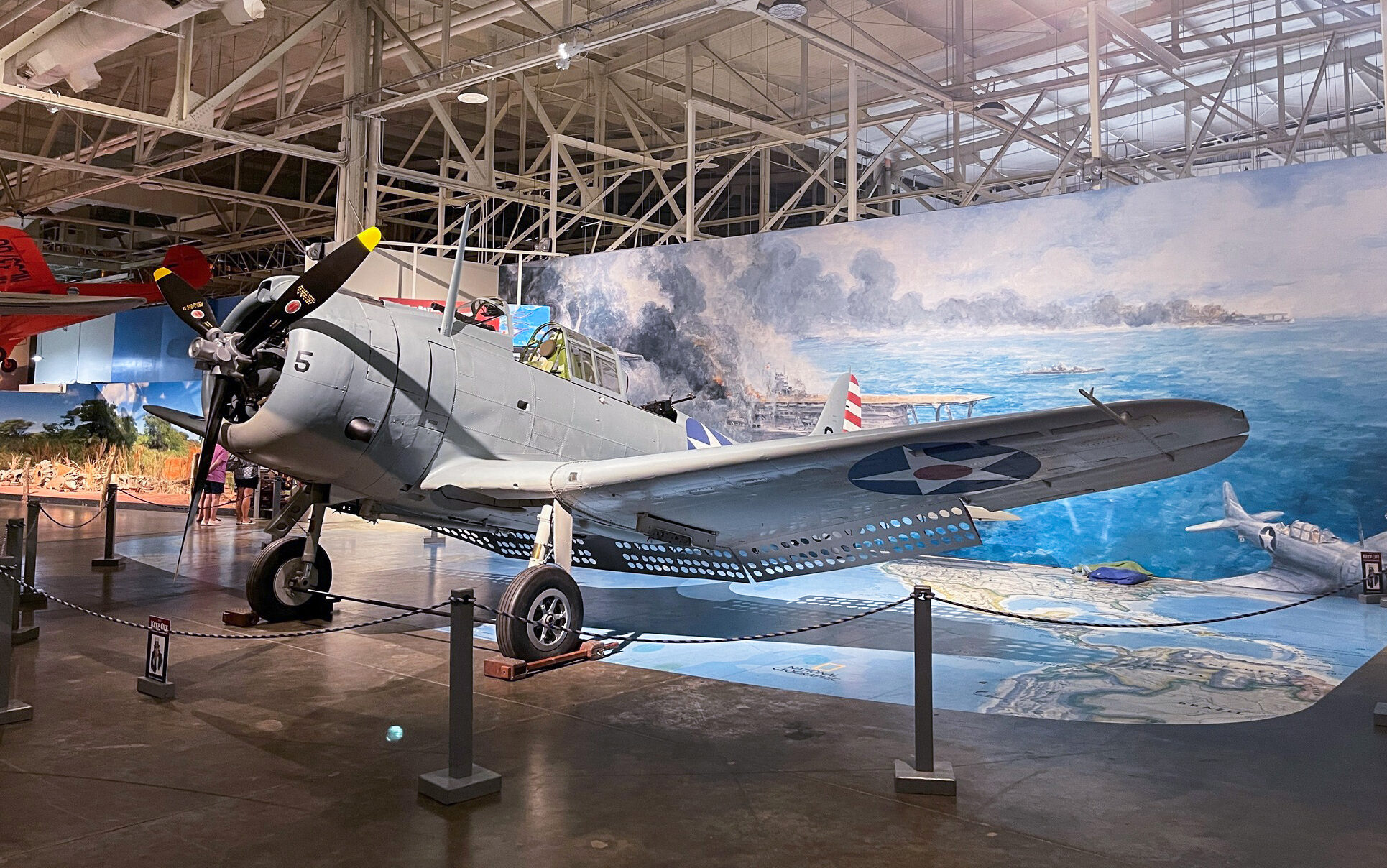
The completion of SBD-1 BuNo 1612 will also enable the Air Zoo restoration team to focus on another restoration project that arrived last year, Consolidated PBY-5A Catalina, Bureau Number 46602, which was shipped from Pensacola in April 2025, as mentioned in our article HERE. The Catalina represents the largest aircraft ever to be restored by the Air Zoo’s volunteers, and like the SBD-2P project, it is also destined to be shipped to the Pearl Harbor Aviation Museum in Hawaii while remaining on loan from Pensacola. With estimates of the completion of the restoration of SBD-1 BuNo 1612 being as soon as this summer, we look forward to following the return of the world’s las remaining SBD-1 to its former glory, and to see where it will come to rest. For more information, visit the Air Zoo’s website HERE.
For more information, visit the Air Zoo’s website HERE.









Is this SBD going to fly again?
It will not. It is to be restored to static display.
VMB-1 stands for Marine Bombing Squadron-ONE, not Marine Scout Bombing Squadron-ONE. The Scout Bombing Designation appeared in mid 1941.