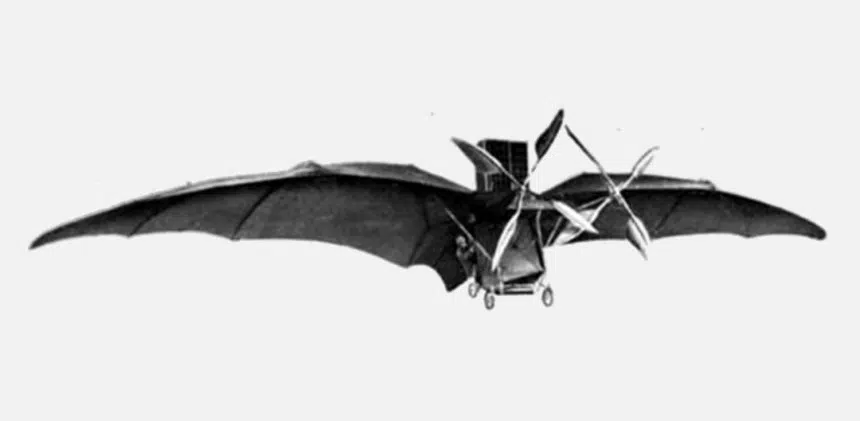


On this day in aviation history, 136 years ago (October 9, 1890), French inventor Clément Ader made a pioneering flight in his steam-powered Éole, also known as Avion I. From the grounds of Château d’Armainvilliers near Paris, the bat-like aircraft reportedly left the ground and traveled approximately 50 meters while reaching a height of around 20 centimeters. The event occurred nearly 13 years before the Wright brothers made their historic flights at Kitty Hawk.

Ader developed the Éole between 1882 and 1889, naming the aircraft after Aeolus, the Greek god of the winds. Its unusual design was inspired by bats, with large silk-covered wings supported by a wooden structure. Unlike many other experimental flying machines of the period, the Éole did not use flapping wings. Instead, a lightweight steam engine powered a four-bladed bamboo propeller mounted at the front of the aircraft.

The October 1890 flight remains the subject of historical debate. Although generally accepted as having occurred, it was not officially recorded. The Éole rose from the ground under its own power while carrying Ader, but lacked an effective means of controlling its direction in flight. The achievement nevertheless attracted the attention of the French military, which funded Ader’s continued experiments and the development of his later Avion II and Avion III aircraft.

The Éole had two bat-like wings spanning approximately 46 feet and weighed around 660 pounds with its pilot aboard. A steam engine weighing just over 110 pounds produced approximately 20 horsepower and drove the four-bladed propeller. Despite its limited flight on October 9, 1890, Ader’s Éole remains one of the earliest heavier-than-air machines known to have left the ground under its own power.