





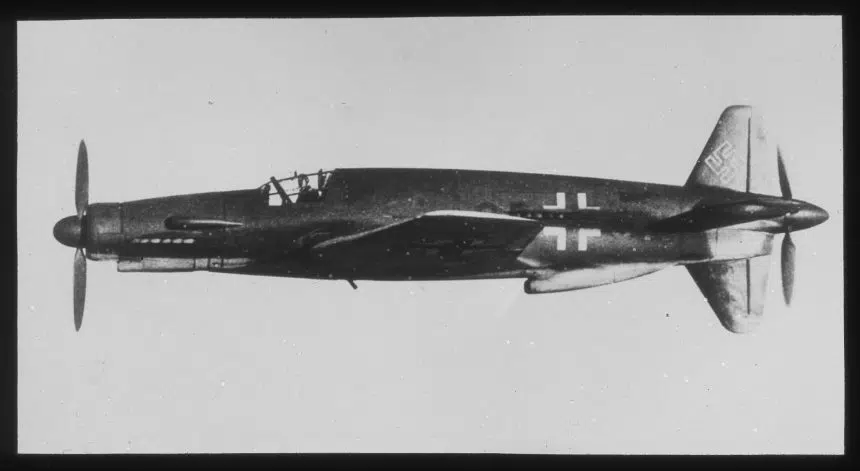

On this day in aviation history, 83 years ago (October 26, 1943), the Dornier Do 335 took flight for the first time. Test pilot Hans Dieterle was at the controls of prototype Do 335 V1, CP+UA. Known as the Pfeil, or “Arrow,” the unusual German aircraft used two powerful piston engines arranged in a distinctive push-pull configuration, with one propeller at the nose and another behind the tail. The Do 335’s configuration traced its origins to Claude Dornier’s earlier work with tandem-engine aircraft. Placing both engines along the aircraft’s centerline reduced aerodynamic drag compared with conventional twin-engine fighters and eliminated asymmetric thrust following an engine failure. The concept was tested with the smaller Göppingen Gö 9 before Dornier developed what eventually became the Do 335 as a high-speed bomber and heavy fighter.

The V1 demonstrated impressive performance, although early testing revealed problems with the landing gear and wheel-well doors. Development nevertheless continued, and the Do 335 became one of the fastest piston-engine aircraft of WWII. Ten pre-production A-0 aircraft were constructed, but delays and the deteriorating German war situation prevented large-scale production. Only 37 Do 335s were completed before the end of the war, and the aircraft never saw confirmed combat. A single Do 335 A-0 survives today, on display at the Udvar-Hazy location of the Smithsonian’s National Air & Space Museum in Chantilly, Virginia. The Do 335 measured 45 feet 5 inches in length with a wingspan of 45 feet 3 inches. Later versions were powered by two Daimler-Benz DB 603E inverted V-12 engines producing approximately 1,800 horsepower each. The aircraft could approach 475 mph and carried a 30 mm MK 103 cannon firing through the forward propeller hub along with two 20 mm MG 151 cannons. Its rear propeller and dorsal fin could be jettisoned with explosive charges before the pilot used the aircraft’s ejection seat.











Random history fact: After the war a Do 335A-12 (two seat trainer version) was taken to Farnborough in the UK for test flights. Sadly it developed a fault and crashed into Cove Junior school with the loss of Group Captain A F Hards (the pilot). By pure chance it crashed a few minutes before the end of school for the day – meaning the loss of life was limited to the pilot only. To this day the school is missing the part of the building that that was destroyed in the crash – visible only by the fact that one end of the classic red brick building is now finished off with concrete rendering. Both of my children went to this school and all of the classrooms are still named after different aircraft types.
Earlier this year, I saw the Do335 at Udvar-Hazy.
Definitely get to that museum! Not only was I impressed with the rare and unique aircraft there, but I was also amazed at how large the Do335 is!