
(Image credit: VAN)
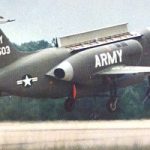
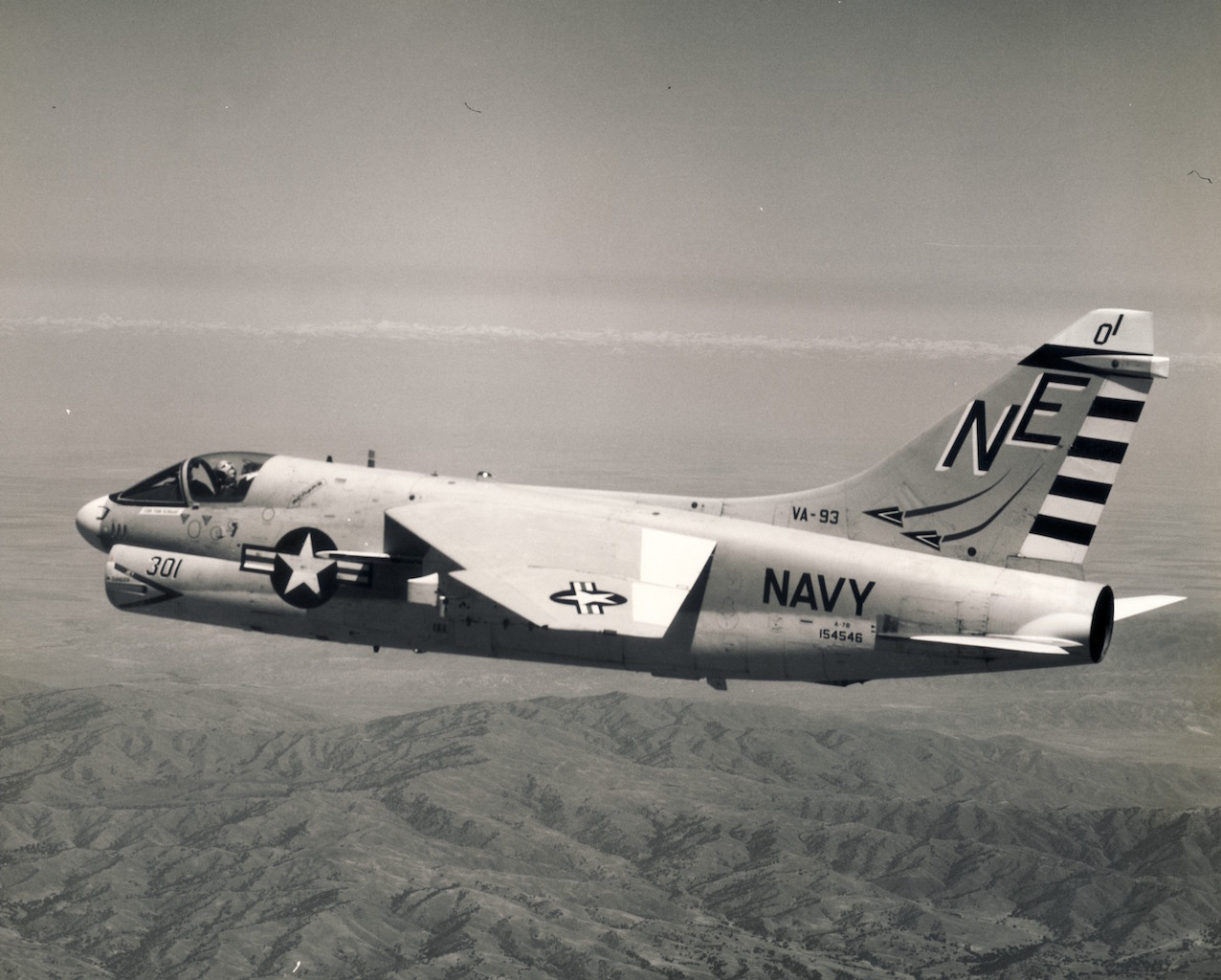
Sixty years ago today (September 26, 1965), the LTV A-7 Corsair II took to the skies for the first time. This American carrier-based light attack aircraft became one of the most effective strike platforms of the Vietnam War and beyond. Designed by Ling-Temco-Vought (LTV), the A-7 paid homage to Vought’s legendary F4U Corsair fighter by adopting its name. Development began in the early 1960s to provide the U.S. Navy with a modern, subsonic replacement for the Douglas A-4 Skyhawk. Drawing on the design of the supersonic F-8 Crusader, the A-7 featured a shorter fuselage, broader wing, and an emphasis on payload capacity and range over raw speed.

Vought’s design won the Navy’s VAL (Heavier-than-Air, Light Attack) competition, and the first operational A-7s entered service in early 1967. By 1972, Corsair IIs were flying combat missions over Southeast Asia, where they quickly earned a reputation for accuracy and dependability. In the “Sandy” role — typically flown by the A-1 Skyraider — the A-7D provided close air support during combat search and rescue missions. Over the course of the Vietnam War, A-7s flew 12,928 combat sorties with the loss of only six aircraft — an impressive achievement given the punishing heat and humidity of the region, which sapped engine performance and reduced overall thrust.
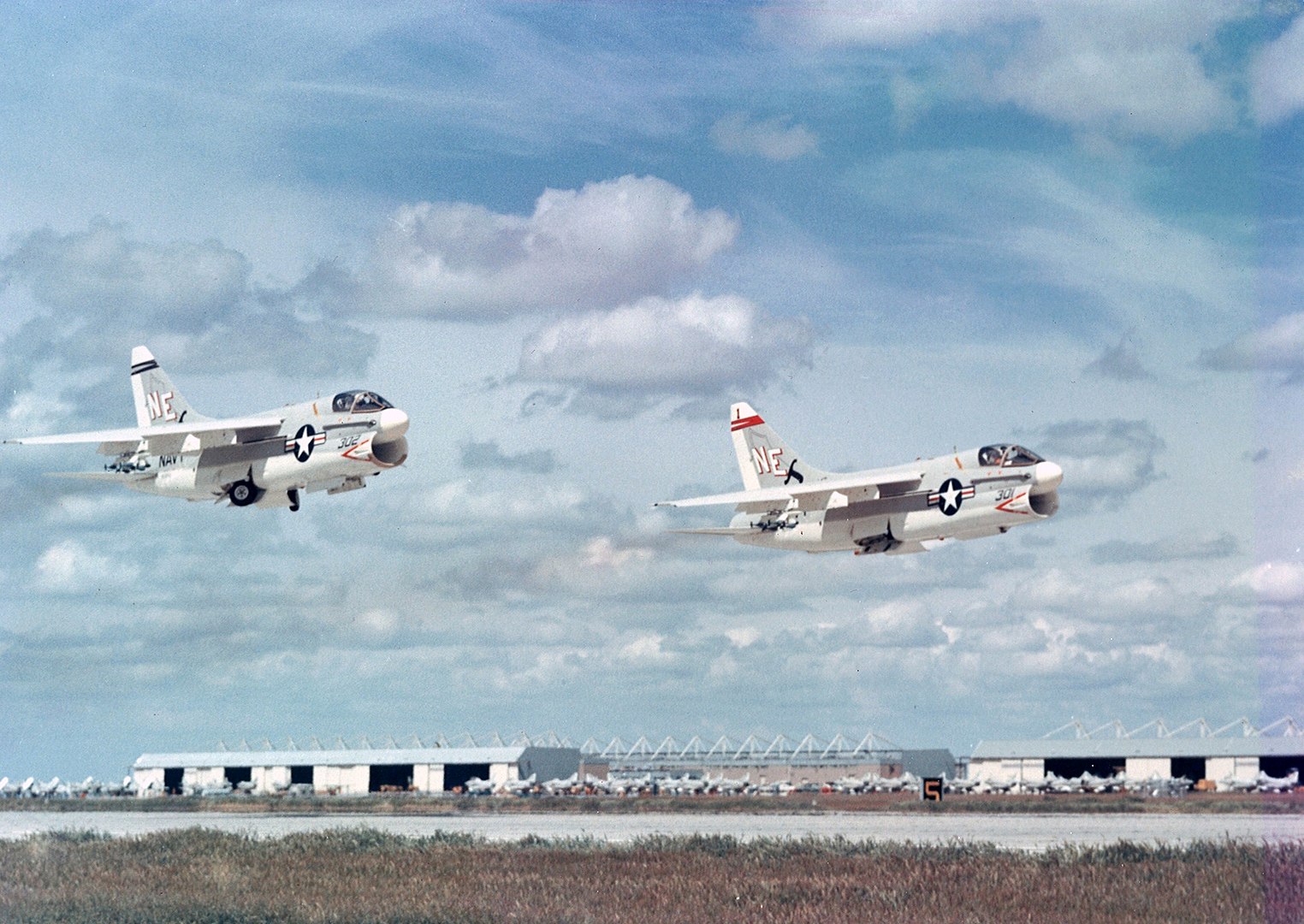
The A-7E was powered by a 15,000-pound-thrust Allison TF41-A-2 turbofan engine, enabling a top speed of about 690 mph at sea level, a range of 1,070 nautical miles, and a service ceiling of 42,000 feet. Agile for its size, the Corsair II could sustain a 4.3G turn at 580 mph with a 5,300-foot radius. Its armament centered on a powerful M61A1 Vulcan 20 mm rotary cannon with 1,030 rounds, supplemented by six underwing and two fuselage hardpoints that could carry a wide array of ordnance — including rockets, missiles (AIM, AGM, GBU), conventional and laser-guided bombs, and even nuclear weapons if required.

Between 1965 and 1984, LTV produced 1,545 A-7s. The aircraft served with distinction in the U.S. Navy and U.S. Air Force until the early 1990s, and with the Air National Guard until 1993. Remarkably, the Hellenic Air Force flew its Corsair IIs until 2014, underscoring the type’s durability and combat value. Today, numerous examples of the A-7 are preserved in museums and airparks around the world. In Richardson, Texas, A-7E BuNo 156801 is currently under restoration to flying condition — and when it takes to the air again, it will no doubt remind spectators of this rugged and capable strike fighter’s proud legacy.