






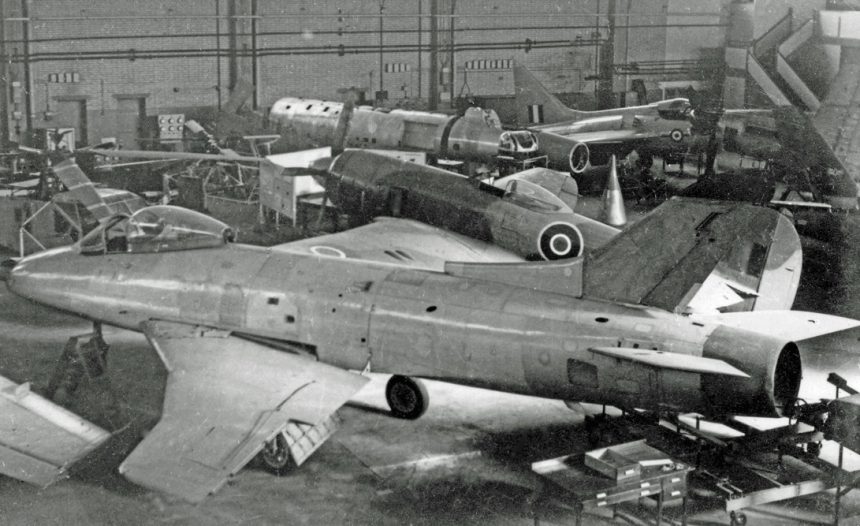


In the early 1950s, Britain was trying to move beyond the sound barrier. The war was over, but the pressure to stay ahead in fighter design had not eased. The Royal Air Force (RAF) wanted an aircraft that could fly in the transonic region comfortably and push into supersonic speeds. Supermarine, still known for the Spitfire, was already building the Swift. On paper, the Swift was meant to be a modern swept-wing fighter, but in practice, it struggled. Before those struggles became public, Supermarine proposed something more ambitious, and that aircraft went on to become the Type 545.
Type 545: Mach 1.3 Interceptor
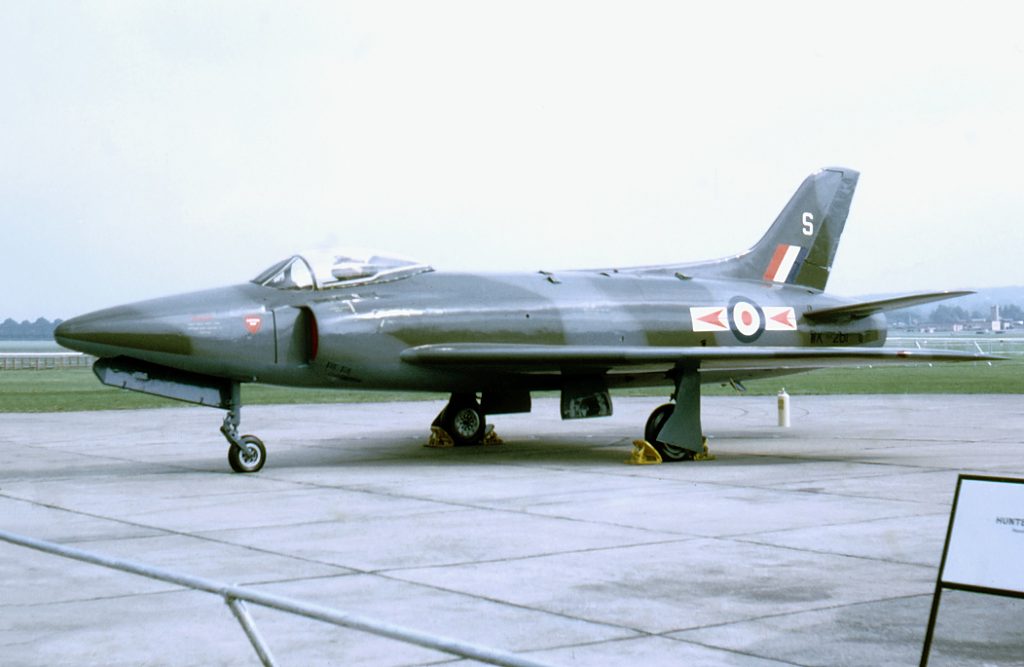
At first glance, the Type 545 looked like a development of the Swift. The idea was to take the existing airframe and give it a more aggressively swept wing, around 50 degrees, to improve high-speed performance. But as the design evolved, it moved much further away from its parent. The Type 545 adopted a crescent-shaped wing with the inner section swept at 50 degrees, the middle at 40, and the outer at 30. This unusual plan was chosen to manage airflow at high subsonic and supersonic speeds. The fuselage was reshaped as well. It was given an area ruling to smooth the airflow along its length. The lower fuselage was flattened where it met the wing to avoid some of the low-speed handling problems that had troubled the Swift. Air entered through a single elliptical intake in the nose, feeding a reheated Rolls-Royce Avon turbojet. With reheat, the engine was expected to deliver around 14,500 pounds of thrust.

Supermarine claimed the aircraft could reach Mach 1.3 at altitude. In February 1952, Supermarine received an order for two prototypes from the British Air Ministry. At that moment, the Swift’s deeper problems were not yet widely known. That timing helped the Type 545 gain approval. The aircraft was designed as a single-seat interceptor. It would have carried four 30 mm ADEN cannon and was expected to operate at altitudes above 50,000 feet. With a length of 47 feet and a wingspan of 39 feet, it was not a small aircraft, and its gross weight was just over 20,000 pounds. It was exactly the kind of transonic fighter the RAF believed it needed. However, by 1954 and 1955, the Swift had become a national embarrassment. It suffered from serious handling and performance issues. Its operational record was poor, and confidence in Supermarine’s ability to deliver a reliable front-line fighter began to fade.
Cancelled Before Taking a Flight
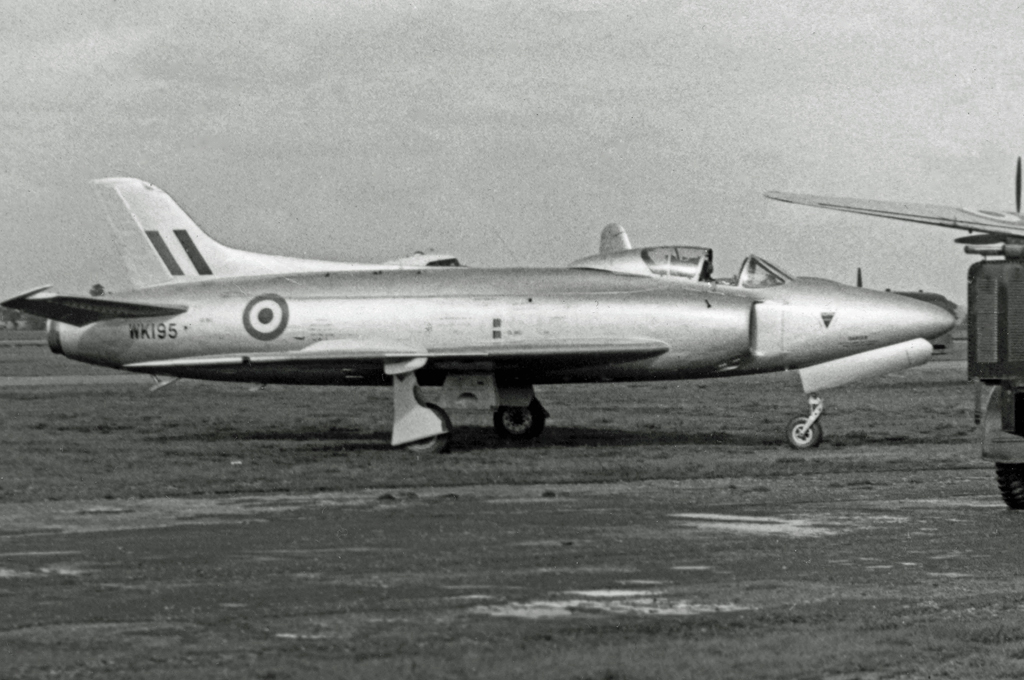
Because the Type 545 was closely linked to the Swift, it suffered by association. Even though it had been heavily redesigned, it was still seen as part of the same lineage. At the same time, Britain’s defense budget could not support every advanced project. The RAF was looking ahead to more capable supersonic designs, and the Type 545 began to look like a stopgap that would arrive too late. In 1955, the programme was cut back. Only the first prototype, serial XA181, was allowed to continue toward completion. The second, XA186, which would have carried a more powerful Avon engine, was cancelled before construction began. On 25 March 1956, just as XA181 was preparing for its first flight, the contract was formally cancelled. The aircraft had been built, but it had never flown.
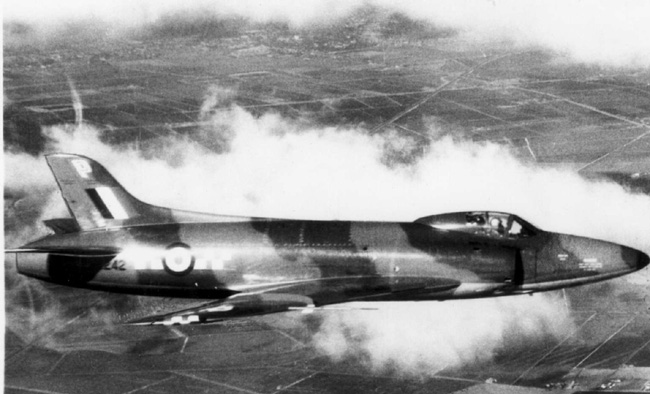
After cancellation, the completed prototype was placed in storage. A few years later, it was donated to the College of Aeronautics at Cranfield. There, it served as an instructional airframe for engineering students, and in 1967, it was scrapped. By then, Supermarine itself no longer existed as an independent company, having been absorbed into what became the British Aircraft Corporation. The Type 545 was not cancelled because it failed in flight. It never had the chance to prove itself. It was cancelled because the climate around it changed. The Swift’s difficulties damaged trust. Budgets tightened. Newer and more advanced supersonic fighters were already on the horizon. At 858 miles per hour, or Mach 1.3, it would have been one of Britain’s early supersonic-capable interceptors. Its crescent wing was an attempt to solve real aerodynamic problems of the transonic age. Its structure and area-ruled fuselage showed that British designers understood the direction high-speed flight was taking.
But the timing did not support it, and the Supermarine Type 545 remains a mystery that could have filled the gap between the first generation of jets and the true supersonic era. It stood ready on the runway and was set aside. Like many aircraft in the Grounded Dreams series, it was not defeated in the air but was stopped on the ground. Check our previous entries HERE.





Apparently at the time of cancellation, the aircraft, despite looking complete was still some way from first flight. It was thought by the time it flew and was ready for service entry, the, English Electric P1b (Lightning) would be nearly ready for service. The GB Government in the mid 1950s was desperate to reduce defence spending and programmes were being cut (Vickers V1000, Thin Wing Javelin etc)
This was partly behind the 1957 Defence White paper to replace manned aircraft with ‘cheaper’ mi