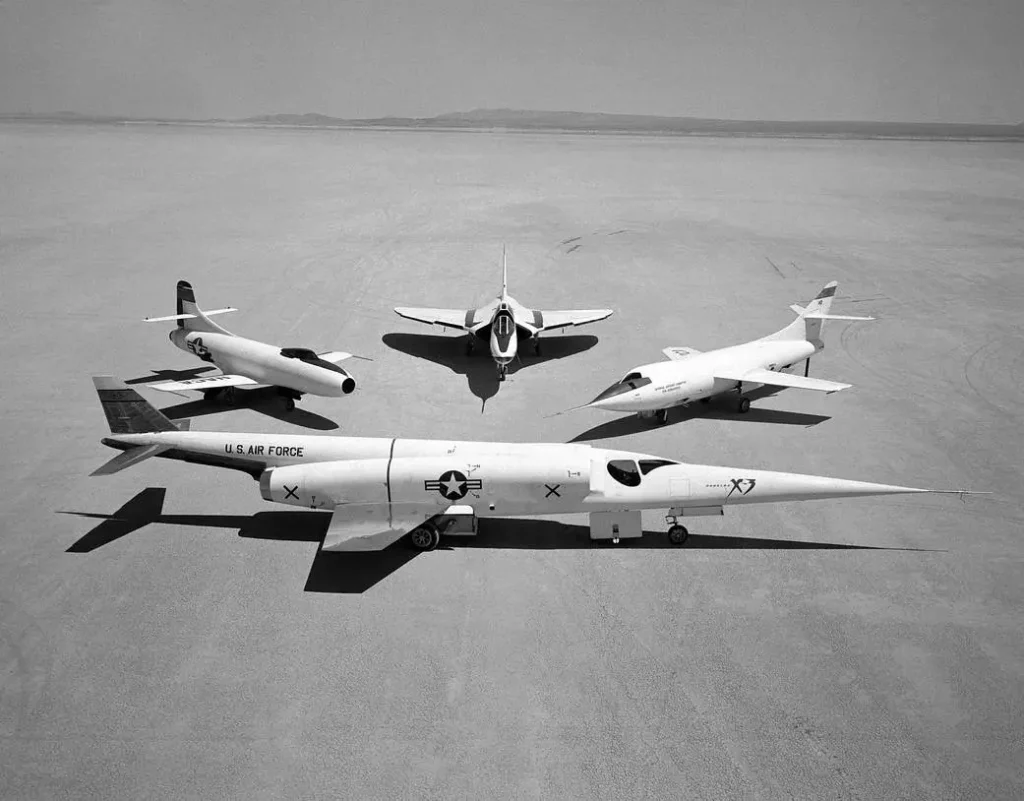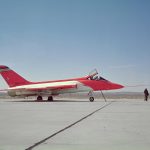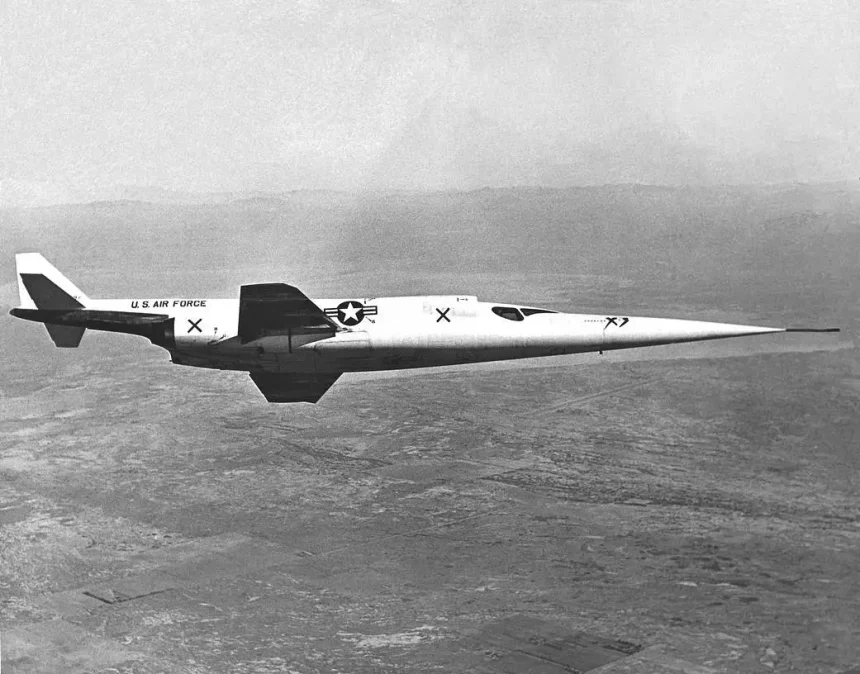

During the late 1940s and early 1950s, supersonic flights were still a new idea. The US Air Force and NACA (now NASA) engineers wanted to study supersonic flight, not only at Mach 1 but also at Mach 2. As a result, the Douglas X-3 Stiletto was designed to take off from the ground under its own power, climb to high altitude, maintain a sustained cruise speed of Mach 2, then land under its own power. It was also supposed to test the feasibility of very short, low-aspect-ratio wings and the large-scale use of titanium in aircraft structures. On June 30, 1949, the program was approved with a contract to build two X-3s. However, during development, the original engines failed to meet their thrust and weight requirements, and lower-thrust Westinghouse J34 turbojets were installed. The first aircraft arrived at Edwards Air Force Base on September 11, 1952, while the second aircraft was never completed and its parts were used as spares. On October 15, 1952, Douglas test pilot Bill Bridgeman made the first short “hop” of the airplane. During a high-speed taxi test, the plane took off by mistake, flew about a mile, and landed back on the dry lakebed. The first official flight took place on October 20 and lasted about 20 minutes. By December 1953, Bridgeman had made 26 flights, including the hop, and the aircraft was found to be underpowered and difficult to handle. Its takeoff speed was about 260 knots, unusually high for its size, and it also failed to meet its planned performance. The X-3 Stiletto’s fastest flight came on July 28, 1953, when the aircraft reached Mach 1.208 in a 30-degree dive, which was way less than Mach 2.
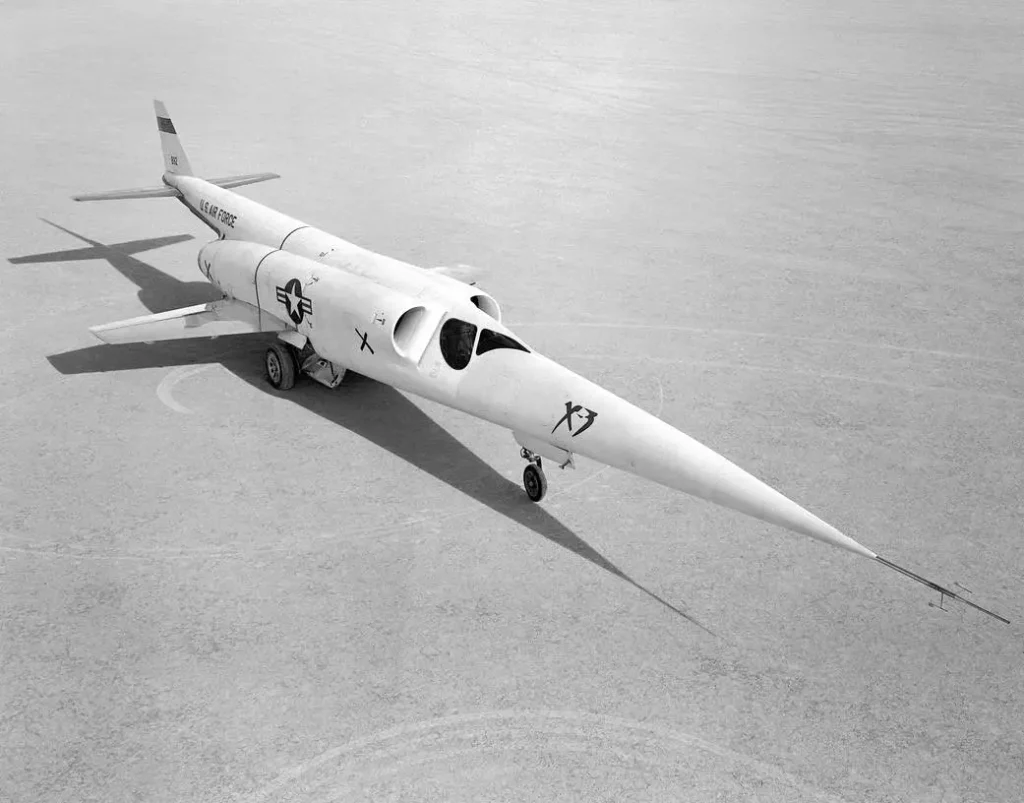
After contractor testing ended in December 1953, the aircraft was sent to the US Air Force. As the X-3 performed poorly in contractor testing, the service kept the research program short to understand its low-aspect-ratio wings better. In July 1954, NACA planned a limited series of research flights with the X-3 to examine its longitudinal stability and control, wing and tail loads, and pressure distribution. NACA test pilot Joseph Walker made his first X-3 Stiletto flight on August 23, 1954. He completed eight more research flights in September and October. Later, the program expanded to include studies on lateral and directional stability. The X-3 was well-suited for this work as most of its mass, engines, fuel, and structure were concentrated in its long, narrow fuselage. The wings were short and stubby, which meant the airplane was “loaded” along the fuselage rather than across the wings. Many new fighter designs of the period shared this general mass distribution. On October 27, 1954, Walker conducted a roll test at Mach 0.92 and 30,000 feet. When he applied an abrupt left roll, the aircraft responded as expected, but also pitched up about 20 degrees and yawed 16 degrees. The motion lasted several seconds before he regained control. He then set up for another test point. During a dive to Mach 1.154 at 32,356 feet, he again applied an abrupt roll, and this time the aircraft pitched down sharply to –6.7 g, then pitched up to +7 g. It also sideslipped, producing about 2 g of lateral force, although Walker recovered and landed safely. Post-flight inspection showed the fuselage had reached its structural load limits, and a slightly higher load could have caused structural failure. The phenomenon experienced was later identified as roll coupling. In a roll coupling, a rolling motion produces unexpected simultaneous pitching and yawing. Around this period, F-100 fighters were encountering similar events. The X-3 Stiletto flight helped raise awareness of the problem and led to focused research into its causes. After this event, the aircraft was grounded for nearly a year. Walker returned to the X-3 in September 1955 and completed 10 more flights before the final flight on May 23, 1956.
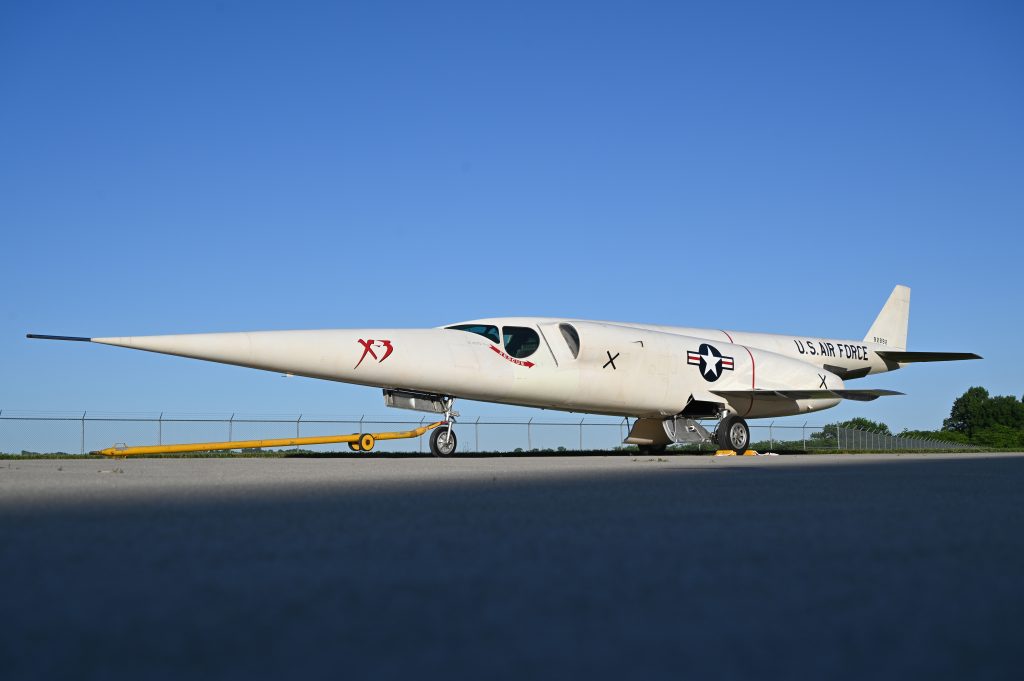
The X-3 Stiletto never reached Mach 2, never provided sufficient aerodynamic data at Mach 2, but data from the X-3 program benefited the F-104, X-15, SR-71, and other high-performance aircraft. The wing platform from X-3 was later adopted for the F-104. It became the first aircraft to use titanium, and all modern commercial and military aircraft now use it. It also proved valuable to improve tire technology. Finally, the X-3 Stiletto, with its unusually sleek body, a length of 66 feet, and a wingspan of nearly 23 feet, did not achieve the intended result but provided far more valuable data that is still useful today. In the Flight Test Files series, the X-3 Stiletto, like many other aircraft, reshaped aviation as we know it today. To read the stories of other aircraft that changed the aviation world, click HERE.