







By Lorenzo Baer
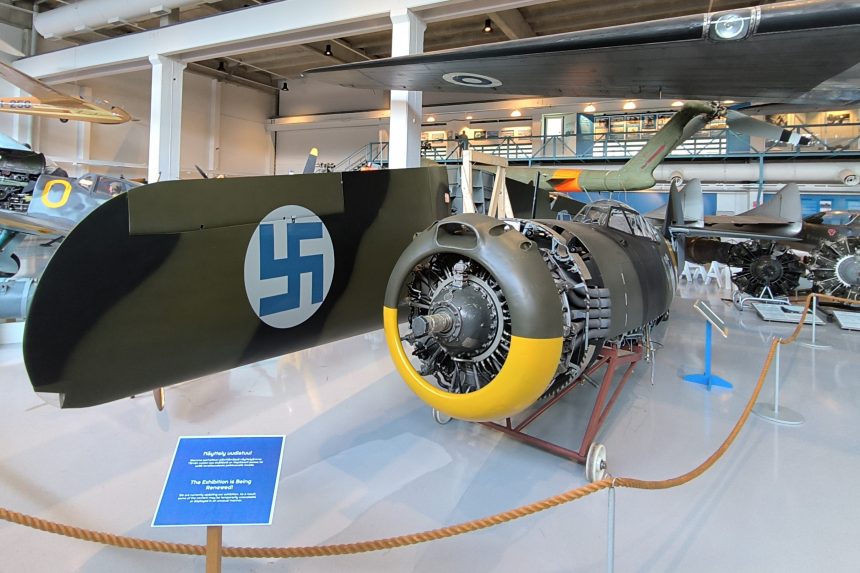
Built as a low-cost and reliable wartime fighter, the Myrsky II remains the only military aircraft fully designed and serially produced in Finland. Just 50 were made — and now a small team of Finnish restorers is racing to bring one back to life. For 13 years, a group of enthusiasts and craftsmen have been working on one of the most ambitious aeronautical restoration projects in the Nordic countries, just a few meters away from Helsinki International Airport. The group, known as the ‘Tuesday Club’ (in Finnish, Tiistaikerho), has spent the last decade working to restore a true workhorse and a symbol of Finnish aeronautical ingenuity: the VL Myrsky II, an all-wood, high-performance fighter-bomber that served on the front lines of Finnish aviation during the Continuation and Lapland Wars. The project is being carried out as a consortium between the Aviation Museum Society, Finland (Suomen Ilmailumuseoyhdistys), the Finnish Air Force Museum (Suomen Ilmavoimamuseo), and the Finnish Aviation Museum (Suomen Ilmailumuseo). The idea to restore a Myrsky II came about for a number of reasons: first, due to the model’s rarity, as only 50 Myrsky IIs were manufactured between 1943–45; but also owing to the fact that the machine became a metaphor for Finnish unity in the face of the great logistical and military constraints that the above-mentioned conflicts placed upon the country.

But despite this symbolism, the aircraft could not withstand the ravages of time, and by the early 1960s, there was no trace left of the Myrsky II’s passage through the Finnish Air Force (Suomen Ilmavoimat), as all the remaining planes had deteriorated to such an extent that they were simply scrapped by Finnish Air Force personnel. It was not until mid-2013 that the name Myrsky would resurface in Finnish aviation circles, when a dozen volunteers took on the task of rebuilding one example of the aircraft. But where to start? During an inspection of the Finnish Air Force Museum, employees of the institution showed him not one, but three rusty VL Myrsky II airframes, later identified as parts of the MY-5, MY-9 and MY-14 aircraft. After carefully studying the structures, they concluded that MY-14 had the greatest potential for restoration, with the whole project taking on the identity of this model. In the autumn of 2013, a team led by Matti Patteri (former car builder) and Kai Mecklin (director of the museum) officially launched the project, with the aim of restoring the MY-14. The original plan stipulated that first the ‘resto squad’ would collect and catalog all remaining drawings and photos of the plane, creating a database that could be used during the restoration per se. The second step would involve visiting every aviation museum and private collector in Finland to track down original Myrsky parts, with the Finnish Aviation Museum proving critical in this stage; for example, the institution provided the support plates and aileron hinges from wings, a single elevator, and most of the cockpit, including the windshield, canopy and guide rails.

Another institution, the Hallinportti Aviation Museum (Hallinportti ilmailumuseo) , also proved critical in the MY-14’s reconstruction, ceding an originalPratt & Whitney R-1830 SC3-G Twin Wasp as well as a VLS 8002 three-blade wooden propeller for the project. The Finnish Air Force Museum subsequently complemented these donations, with the most significant case being the transfer of period-accurate VKT 12.70 LKk/42 (.50 BMG) machine guns to arm the plane. But from the outset, the project was faced as a large blank canvas. Patteri’s initial estimates placed 95% (later reduced to 85%) of the aircraft’s construction in the hands of the Tuesday Club (responsible for the aircraft’s wooden parts) and the Finnish Air Force Museum (assigned to the project’s metal structures), simply due to the lack of original spare parts that could be used for the rebuild. 2019 was the first important deadline for the project, during the celebrations of the 75th anniversary of Myrsky’s operational debut with the Finnish Air Force. Despite some mid-course turbulence, the goal was achieved: the model’s fuselage made it to the Finnish Aviation Museum just in time for the jubilee. But that would only be the first milestone, as much work still remained to be done on the project.

With steady progress since then, the last year has brought a series of encouraging news items about the MY-14 project, starting in mid-2025, when the project’s official website confirmed that the aircraft’s wings finally went to the paint shop. Talking to Vintage Aviation News, Reino Myllymäki, vice chairman of the Finnish Aviation Museum Society and current PR representative of the VL Myrsky II restoration project, affirmed how this phase essentially wrapped up one of the most time-consuming parts of the effort: “At the beginning of the construction of the wings, we only had at hand the original flaps and some parts of the aileron and landing gear mechanism. So all the missing parts had to be reproduced by both the Tuesday Club and the Finnish Air Force Museum specialists.” But the challenges didn’t stop there: “In our early research, we found three different drawing sets for the Myrsky II, but none of them were complete. So a lot of thinking and doing was needed, with the aim of giving the project a final form while remaining faithful to the Myrsky’s original design.”

With these steps concluded, Myllymäki stated that the focus of the team has now shifted to the engine bay, with the production of the missing engine shrouds and dampers. Another major challenge faced by the team in recent months has been the reconstruction of the NACA-type cowling fairing. Improving both engine cooling and fuel consumption, the NACA cowling helped the Myrsky II become one of the fastest and most fuel-efficient fighters propelled by the venerable P&W Twin Wasp powerplant. Despite the work ahead, Myllymäki commented that the next major milestone of the project is right around the corner: “In May (2026) we hope to finally join the fuselage with the wings. If the connection process works out as planned, the next step will be the fitting and installation of the wing root fairings.” After that, it will be just a question of time before the fully assembled MY-14 becomes the newest acquisition of the Finnish Air Force Museum collection.
A Brief History of MY-14

The MY-14 can be considered a perfect specimen of the standard VL Myrsky II. The machine was the 13th Myrsky II to roll out of the Finnish State Aircraft Factory (Valtion Lentokonetehdas), and the 10th serial production aircraft of the model. This specific machine had its first flight recorded on July 31, 1944, and was handed over to Reconnaissance Squadron (Tiedustelulentolaivue) 12 on August 2, 1944. The MY-14 amassed an interesting record with the Finnish Air Force, accumulating approximately 115 hours of operational service and taking part in actions against the USSR during the Continuation War (1941–44) and against Nazi Germany throughout the Lapland Conflict (1944–45). The aircraft was decommissioned on February 3, 1947, after a collision with Myrsky II serial MY-41. In 1952, the aircraft was finally removed from military inventory and sold for scrap shortly thereafter. After lingering in a house backyard for three decades, a man named Pete Virtanen bought the remains of MY-14, donating them to the Central Finland Aviation Museum (now the Finnish Air Force Museum). After that, the machine was once again stored until being rediscovered by Patteri in 2013.










Now, this would be a sight worth seeing … and I’ve never been to Finland.
How to tell my Wife … and Live?!!!
An ingenious Race of People – and tough, ‘Hard As Nails’ Fighters … ask the Russians!
Question. With the amount of work done, please tell an anxious public whether or not the beautiful aircraft will take to the skies instead of spending all remaining time as a hangar queen.
Unbelievable how the Finnish air force,using planes considered obsolete by other countries, totally destroyed some many Russian aircraft. The Brewster Buffalo was a disaster with US forces, the Finns loved it, and used it to great affect.