






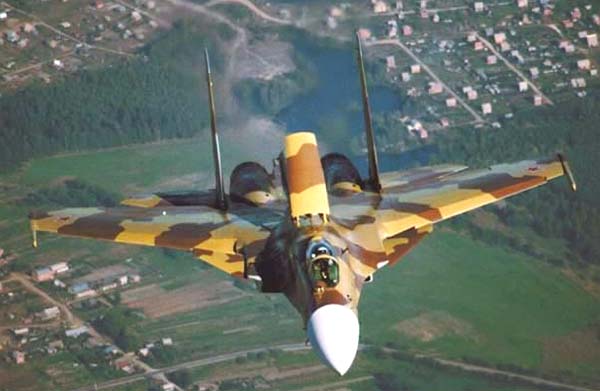

In the early 1980s, the Soviet Union initiated development of a new aircraft, the Sukhoi Su-27M, later known as the Su-35. At the same time, the Sukhoi Design Bureau, the developer of the aircraft, began studying thrust vectoring to develop the Su-27M. Mikhail Simonov, the chief designer of the Su-27, insisted that Sukhoi and the Siberian Aeronautical Research Institute focus on axisymmetrical vectoring nozzles, unlike the two-dimensional nozzles used in the West. In 1985, Lyulka, which later became Lyulka-Saturn, also started working on thrust-vectoring engines. By the late 1980s, Sukhoi was testing its research using flying test beds. During test flights of the Su-27M, which began in 1988, engineers found that pilots were struggling to control the aircraft at high angles of attack because the flight control surfaces were inefficient at low speeds. To solve this, engineers added thrust-vectoring engines to the eleventh Su-27M, and designated it Sukhoi Su-37. After completing the development of the aircraft in early 1995, the aircraft was sent to the design bureau’s experimental plant near Moscow for nozzle installation.
Design of Sukhoi Su-37
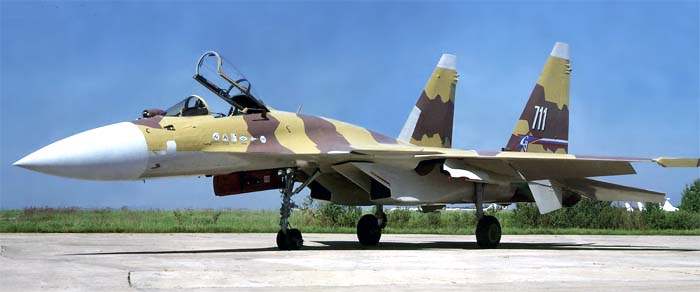
Sukhoi planned to use the Lyulka-Saturn AL-37FU engine for the aircraft, but it was not approved for flight at the time. Therefore, the aircraft was temporarily fitted with the less powerful AL-31FP engine, based on the AL-31F with AL-100 vectoring nozzles from the AL-37FU. However, two months later, the temporary engines were replaced with two Saturn AL-37FU afterburning turbofan engines, each producing 19,000 pounds of dry thrust with axisymmetric thrust-vectoring nozzles and 32,000 pounds with afterburner. The nozzles could only move 15 degrees up or down in the pitch axis, either together or separately. In addition to the nozzles, the Sukhoi Su-37 looked similar to the Su-27M, but engineers improved the plane’s electronics instead. The Su-37 used a digital fly-by-wire flight control system, unlike the Su-27Ms, and this system connected directly to the thrust-vectoring control. The weapons-control system included the N011M Bars radar, which could track 20 aerial targets and engage 8 of them at the same time. In comparison, the Su-27M’s N011 radar could only track 15 targets and engage 6 simultaneously.
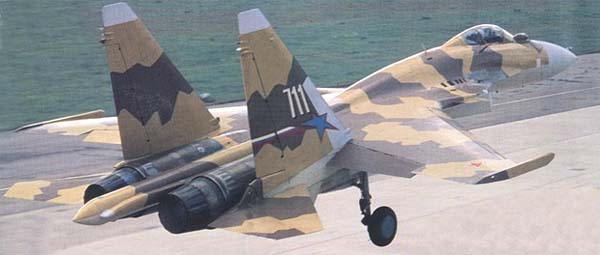
The Sukhoi Su-37 also had the N012 self-defense radar mounted on the tail boom, similar to the Su-27M. The aircraft was 72 feet long, 19.6 feet high, with a wingspan of 48.3 feet and a wing area of 670 square feet. The empty weight of the aircraft was 40,786 pounds, and the maximum takeoff weight was 74,957 pounds. The maximum speed of the aircraft ranged from Mach 1.14 to Mach 2.5, depending on altitude. It had a range of 860 to 2,100 miles, depending on takeoff weight and altitude, and a service ceiling of 61,700 feet. The aircraft was equipped with a 30 mm internal cannon and had 12 hardpoints, including 2 wingtip rails and 10 wing and fuselage stations, with a capacity of 17,630 pounds of ordnance. The Su-37 cockpit included a head-up display and four color liquid crystal displays arranged in a “T” shape. The Sukhoi Su-37 flew for the first time on April 2, 1996, from Zhukovsky Airfield near Moscow. During the first five flights, the nozzles were fixed, and the aircraft was later that year shown to the public at Zhukovsky.
The Crash
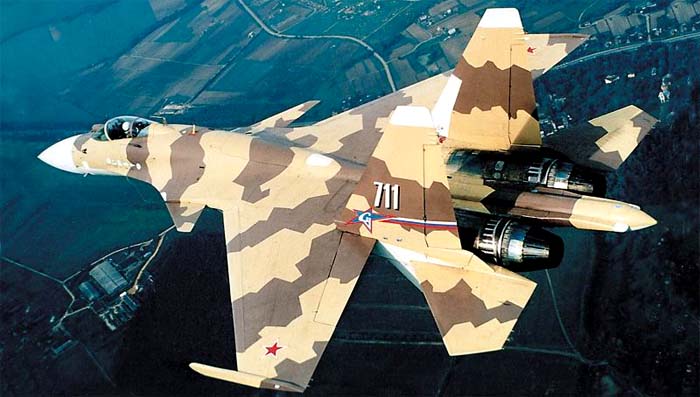
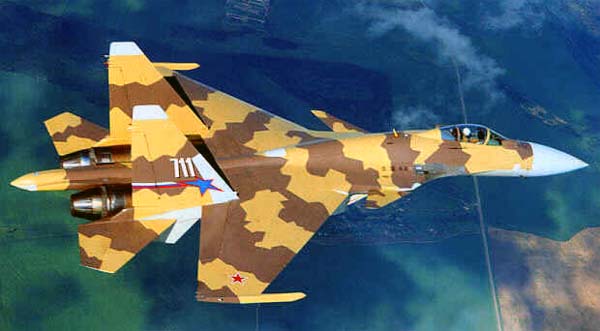
Some reports mentioned that Sukhoi had to fund the Sukhoi Su-35 project with its own money because the Russian Air Force did not provide sufficient funding. During flight tests, the Su-37 performed well in terms of maneuverability because of its thrust-vectoring controls. The feature helped pilots create new combat moves and tactics, making the aircraft more effective in dogfights. One of these moves is the Super Cobra, a twist on Pugachev’s Cobra, which was shown during the Su-37’s first appearance at the Farnborough Airshow in September 1996. During the move, the aircraft climbed 180 degrees and briefly held a tail-first position, helping it to fire a missile at an opponent. Test pilots of the aircraft noted that thrust vectoring would give the aircraft a significant edge in close dogfights; however, some critics doubted the practical value of these maneuvers. Later, the Sukhoi Su-37 was displayed at the Paris Air Show in 1997, and organizers named the Su-37 the best performer of the event. After that, the aircraft took part in the MAKS air show in Moscow, the International Defence Exhibition in Dubai, and the FIDAE air show in Santiago, Chile.
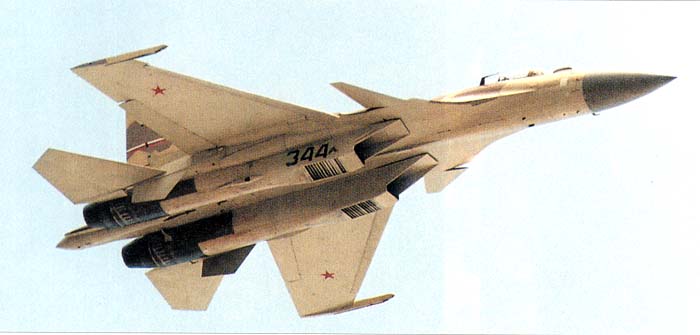
Later, the Sukhoi Su-37 engines reached the end of their service life, so the engineers replaced the AL-37FUs with standard AL-31F engines without movable nozzles. The flight-test program ended on December 19, 2002, when the aircraft’s left tailplane broke off during a maneuver, resulting in a crash near Moscow. The structural failure happened because the aircraft’s design load was repeatedly exceeded during six years of testing. Although the Su-37 entered fighter competitions in Brazil and South Korea, it did not attract any foreign buyers. In the mid-1990s, India funded the development of the Su-30MKI, a two-seat fighter design featuring canards, the N011M radar, and thrust-vectoring technology tested on the Sukhoi Su-37. Engineers found that thrust vectoring could help maintain maneuverability even without canards, which added weight to the aircraft. In the Grounded Dreams series, despite a crash, the aircraft had proved what it promised and helped design future aircraft. No other Sukhoi Su-37 was ever made again, despite an unconfirmed claim that Sukhoi built a second Su-37 using another Su-27M airframe. Read more Grounded Dreams articles HERE.


Just checking I’ve always thought the f18 was the pioneer in thrust vectoring the pioneer in thrust vectoring technology
The NATO Name of this fighter is FLANKER-F, and I own a toy replica of this plane that was released by MAISTO, as part of their Tail Winds aircraft collection.