






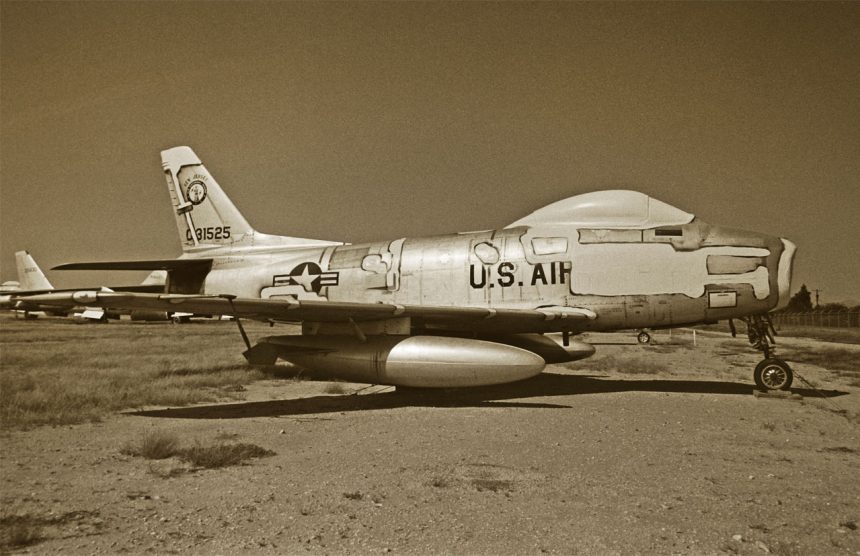

As we continue the Boneyard Files series, which showcases some of the retired aircraft resting at Davis-Monthan Air Force Base in Tucson, Arizona, in the late 1960s, today’s story features the North American F-86A Sabre through the lens of Neil Aird’s “Monthan Memories” photos. In mid-1944, the U.S. Army Air Forces ordered three prototypes of a jet that was designed for the Navy, the North American FJ-1 Fury. The new model was redesignated the XP-86. The design team quickly developed the initial mock-up, but by the summer of 1945, it became clear that the fighter would not reach the required top speed of 600 mph. However, after Germany’s surrender in WWII in May 1945, the designers used aerodynamic research gathered from Germany to develop swept-wing fighters. Germany used swept wings in various fighters during WWII, including Messerschmitt Me 262 and Junkers Ju 287. The information showed that swept wings could help delay compressibility issues at high subsonic speeds. Aircraft with swept wings could maintain control at higher speeds than those with straight wings. However, swept wings created stability problems at low speeds. After testing scale models in a wind tunnel, the designers chose a wing with a 35-degree sweep angle and added automatic leading-edge slats to improve stability. The resulting aircraft became the North American F-86 Sabre, the first swept-wing jet fighter of the U.S. Air Force. It made its first flight in October 1947, powered by an Allison J35-C-3 engine producing 3,750 pounds of thrust. In April 1948, the aircraft achieved a speed of Mach 1 in a shallow dive.
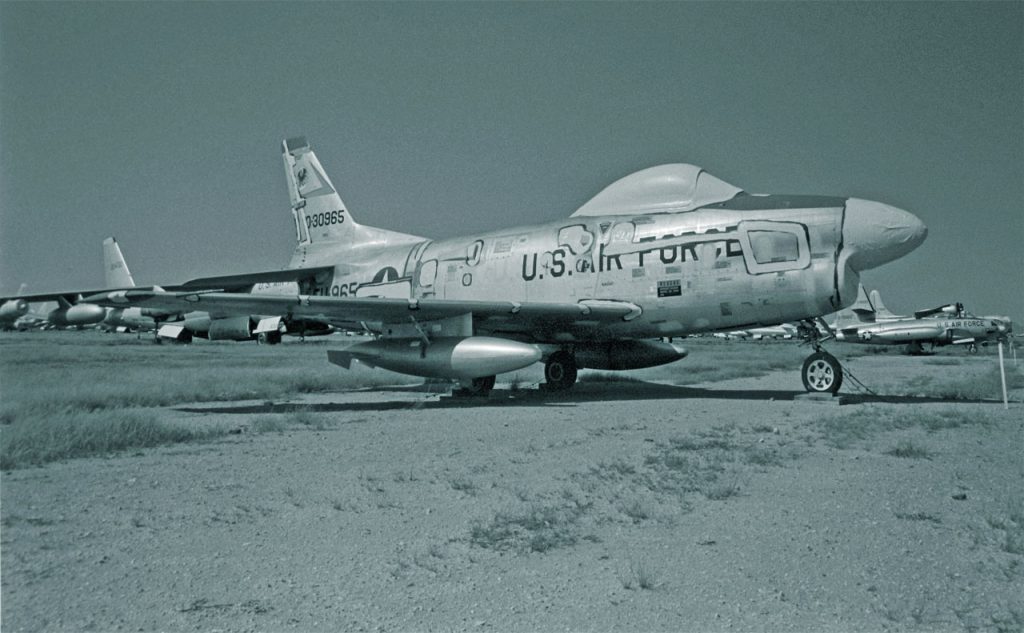
On December 28, 1947, the U.S. Air Force ordered 221 F-86A jets, powered by the General Electric J47-GE-1 engine producing 4,850 pounds of thrust. The first production model of the North American F-86 Sabre flew in May 1948, and just four months later, an F-86A set a world speed record of 670.9 mph. The F-86A became popular among pilots for its high performance and good handling capabilities. It had six .50-caliber M3 machine guns in the nose. In later models, the Mark 18 manual gun sight was replaced by the A-1CM sight, which used radar to aid aiming. The North American F-86 Sabre was 37.6 feet long, 14.8 feet high, with a wingspan of 37.1 feet. The maximum speed of the aircraft was 685 mph, with a loaded weight of 13,791 pounds. Its range was 1,200 miles, and its service ceiling was 49,000 feet. In December 1950, the U.S. Air Force’s 4th Fighter Interceptor Wing, one of the Air Force’s first North American F-86 Sabre units, arrived in Seoul to combat the Soviet-built MiG-15 jets, which also had swept wings, that appeared in Korea in November. On December 17, Lt. Col. Bruce H. Hinton shot down a MiG-15, marking the first known battle between swept-wing fighters. By the end of the Korean War, the North American F-86 Sabres had destroyed nearly 800 MiG-15s, while losing fewer than 80 F-86s. The Sabres were also used by the Republic of China (Taiwan) Air Force during the Second Taiwan Strait Crisis in 1958. The aircraft helped Taiwan to gain air superiority and battle Chinese MiG-17s. Some estimates suggest that Taiwan’s Sabres shot down nearly 30 Chinese MiG-17s.
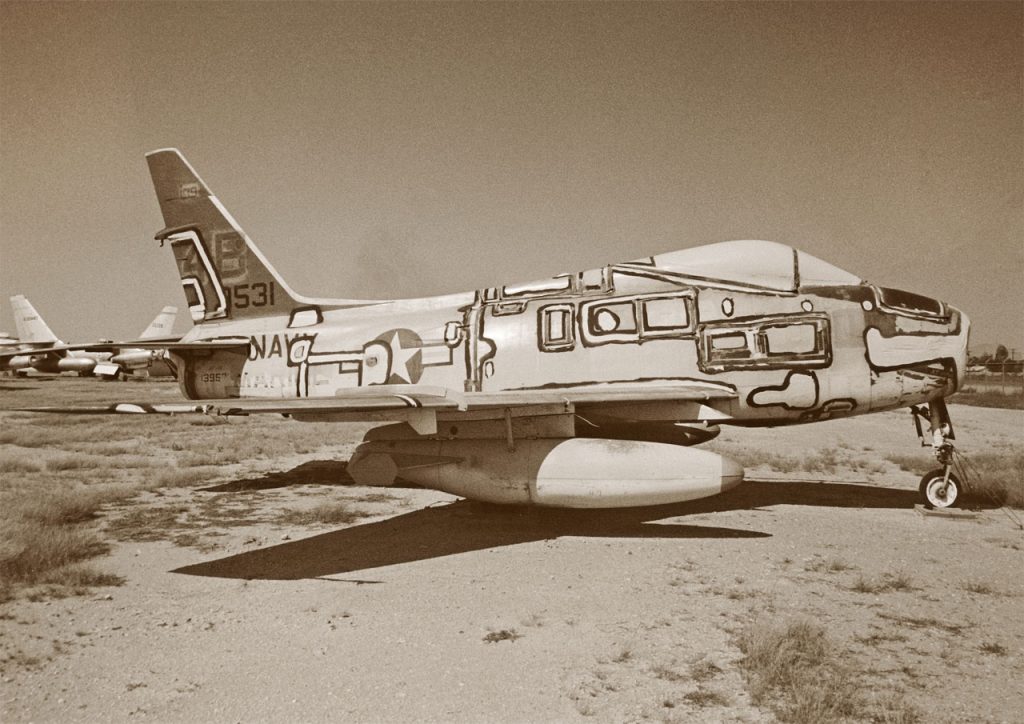
The F-86 had several variants, including the F-86E, F, H, D, and K. Most changes included better weapons, more powerful engines, and updates to the control systems. The F-86D was designed as an all-weather interceptor and was equipped with a radar system. It was also equipped with rockets instead of machine guns. The F-86K was similar to the D model but used 20-mm machine guns instead of rockets. In addition to being made in California and Ohio, F-86s were also built under license in Canada, Japan, and Italy. Out of the 8,443 Sabres produced, 554 were F-86As. Air forces from 20 other countries, including Pakistan, Japan, West Germany, Spain, Great Britain, Australia, and so on, also used the Sabre. The U.S. began phasing out its North American F-86 Sabres in 1957, and some were spotted in the late 1960s at Davis-Monthan Air Force Base, commonly known as “The Boneyard.” Read more Boneyard Files stories HERE.
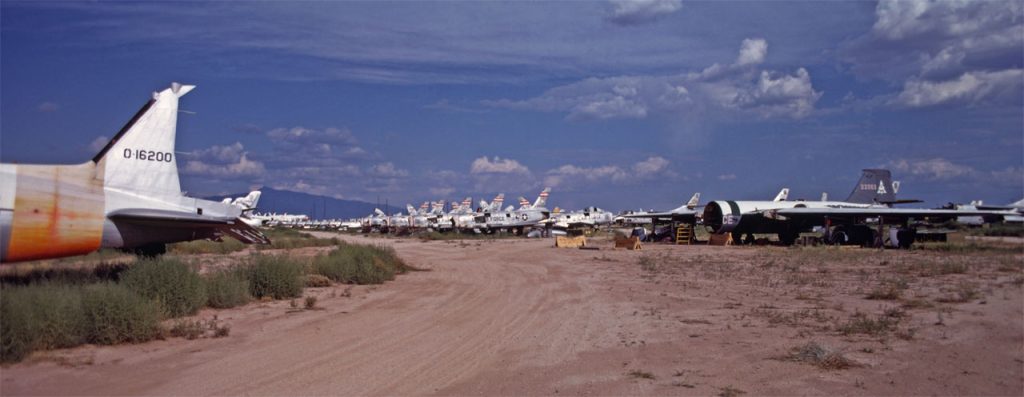
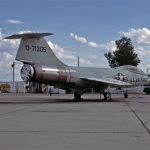
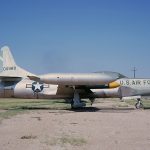
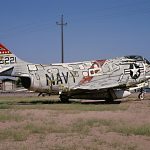
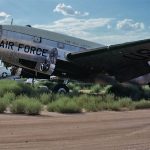
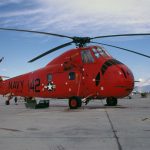
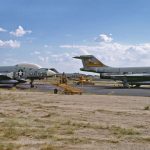











As was mentioned, the three a/c shown in the article were part of the display line along Golf Links Rd. until the early ‘70s. Most of them became the core of the Pima Air Museum, including these birds. I had the privilege of photographing all of them in Aug of 1969. Also, what is the reference to “Mojave” in the title? That desert is in Southern California, not Arizona. Think Edwards AFB! Cheers
I have read that the restaurant phrase “86 the roast beef!” and other similar “86” phrases we hear in restaurants to indicate that item is no longer available, comes from the U.S. Korean War Sabre 86 pilots who would refer to the MiG jets they shot out of the sky as “86ing” the MiGs. I wonder if this is true or just an old wives tale as to where that restaurant phrase comes from. Does anyone know?