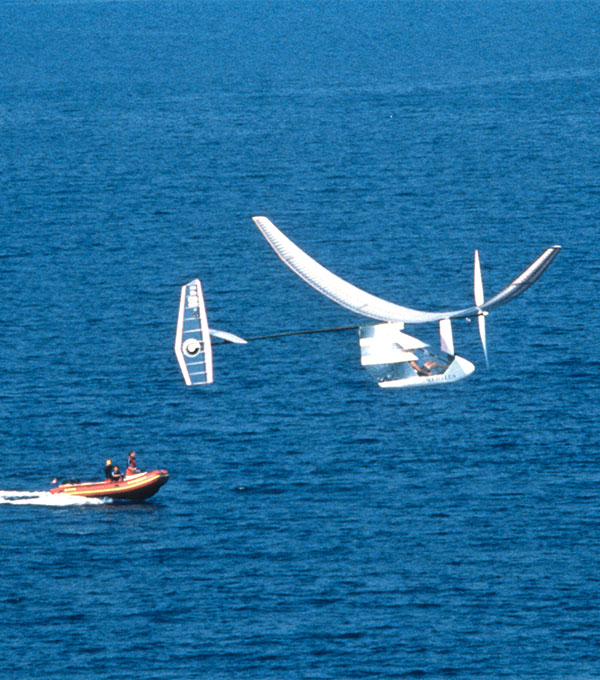
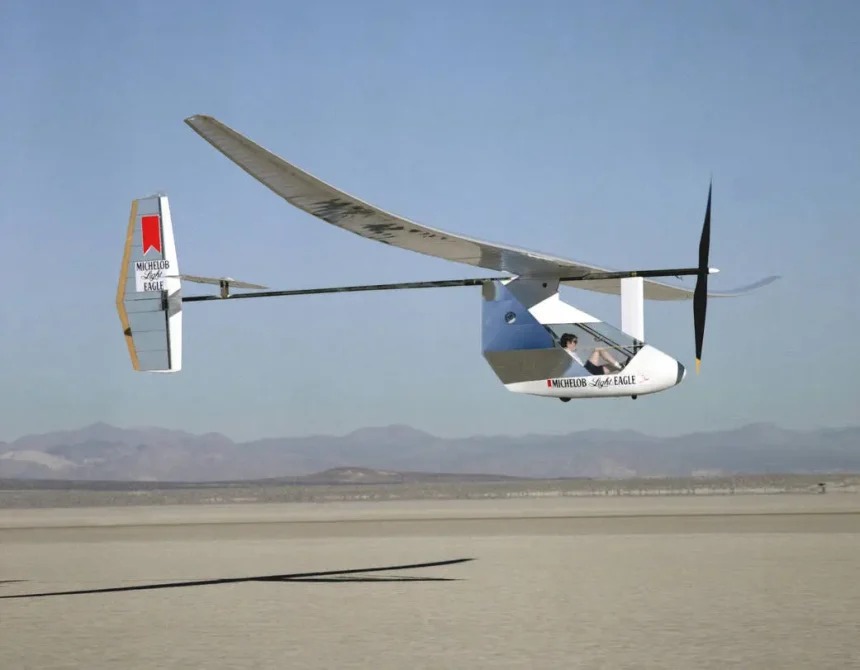

In the late 1980s, the Massachusetts Institute of Technology (MIT) developed a human-powered aircraft to conduct one of the longest flight tests to test low-speed aerodynamics. The project, called Daedalus, combined academic design work with flight support from NASA’s Dryden Flight Research Center. The goal was to develop and test a human-powered aircraft that could fly 115 km (around 71.5 miles) from the Greek island of Crete to Santorini. The Daedalus used bicycle pedals and a chain to power a large, slow-moving propeller. Constructed mostly of Mylar and carbon-fiber composites, the Daedalus weighed just 69 pounds. The MIT Daedalus project was inspired by the Greek myth of Daedalus, who made wings from wax and feathers to escape King Minos. To honor this story, the project built three aircraft, with the first prototype, called the Light Eagle, weighing 92 pounds. On January 22, 1987, it set a closed-course distance record of 59 km (36 miles), which still stands today.
In January 1987, Lois McCallin flew the Light Eagle, setting world records in the female division for straight distance, closed-circuit distance, and duration for human-powered vehicles. After this success, the team built two more aircraft, named the Daedalus 87 and Daedalus 88. At NASA Dryden Flight Research Center, the testing for the Daedalus program took place from January 1987 to March 1988. The engineers wanted to study how the Light Eagle aircraft moved, both as a stiff object and when flexible. The testing focused on evaluating sensors for an autopilot, suitable for high-altitude or human-powered aircraft. It also aimed to find out how much power the MIT Daedalus aircraft would need to fly. NASA’s research flights on the MIT Daedalus began in late December 1987 and focused on testing the Light Eagle instruments and data transfer systems. At the same time, the Daedalus 87 aircraft also had its first flight.
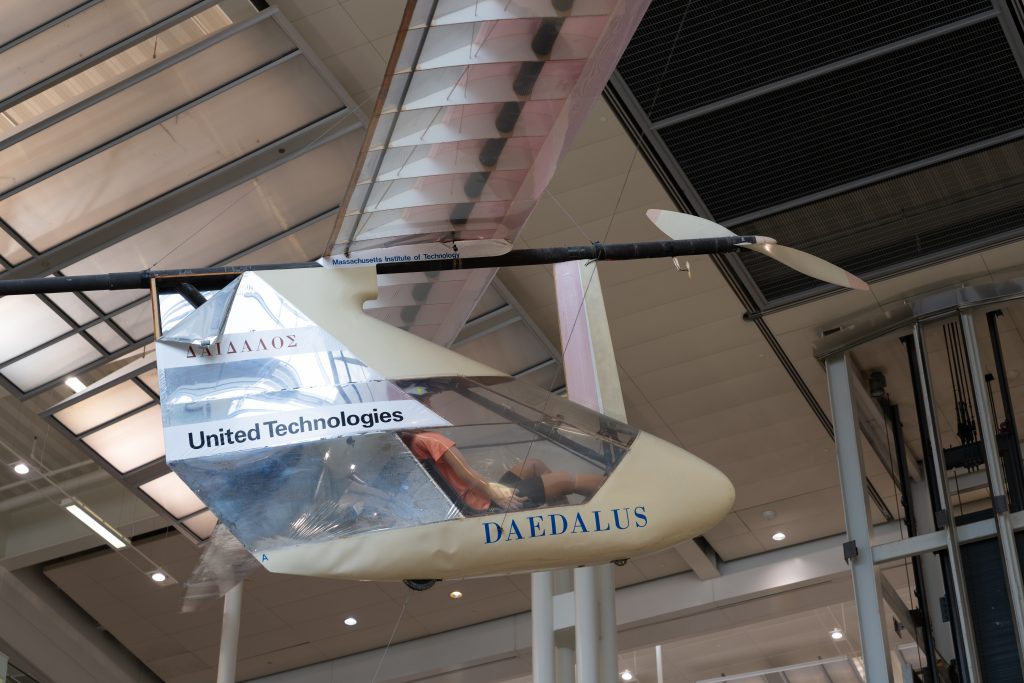
On February 7, 1988, the MIT Daedalus 87 crashed on Rogers Dry Lakebed. To continue the research, MIT sent the Daedalus 88, which was similar to Daedalus 87, to NASA. However, the crash delayed the testing by four weeks, extending the program until mid-March 1988. Despite this, the project achieved its main goals by investigating the aeroelastic behavior of lightweight aircraft and exploring the dynamics of low Reynolds number aircraft. The record-breaking and final flight of the Daedalus 88 took place on April 23, 1988, in which the aircraft took off from Iraklion Air Force Base in Crete. Piloting the MIT Daedalus aircraft was champion bicyclist Kanellos Kanellopoulos, who flew the entire flight by himself. The Daedalus flew 115 kilometers (about 71.5 miles) from the Iraklion Air Force Base on Crete to the island of Santorini. The flight took 3 hours and 54 minutes and set new records for both distance and time in human-powered flight.
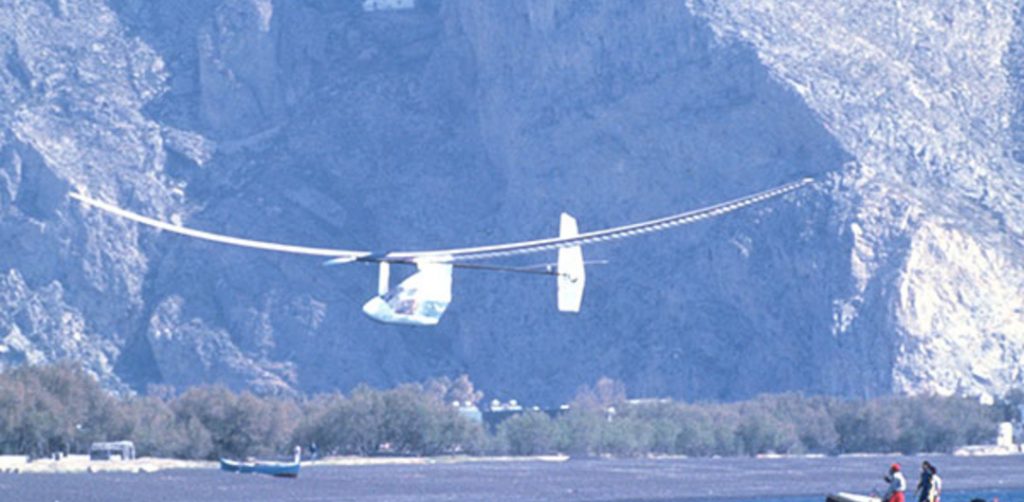
Toward the end of the flight, the Daedalus aircraft encountered wind disturbances, causing damage to the tail. It landed in the water about 7 meters from Santorini’s shore; however, the pilot got out safely. Generally, the MIT Daedalus set a world record by flying farther than the previous record of just under 36 kilometers, which the Gossamer Albatross set during a crossing of the English Channel in 1979. In the Flight Test Files series, the findings from the MIT Daedalus program later helped in designing high-altitude, long-endurance aircraft. NASA research on lightweight structures, such as Daedalus, further helped develop unmanned aircraft and endurance platforms. The work on sensors and controls also helped in maturing flight control systems for slow-moving aircraft. Read more Flight Test Files articles HERE.