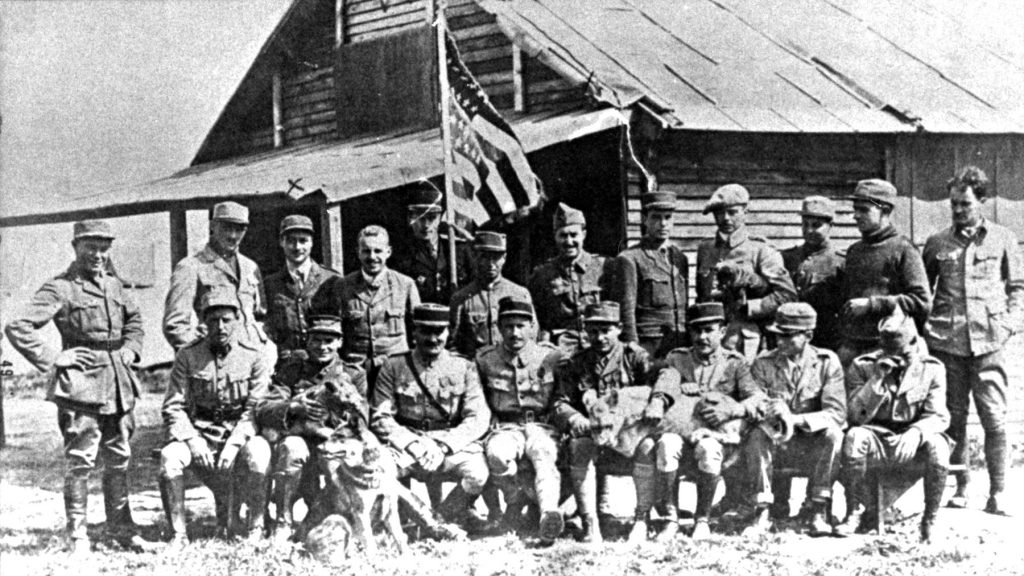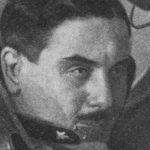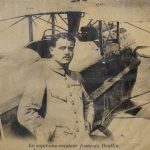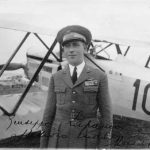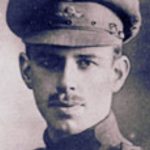


During WWI, there were very few aces who had fought for two different countries. One such ace was Raoul Lufbery, born on March 14, 1885, in France to American parents. His family moved back to the U.S. when he was six. He joined the US Army in 1907 and served for two years in the Philippines. After his discharge, he traveled through Asia before becoming a mechanic for Marc Pourpe, a French aviator, in 1912. When WWI started, both Pourpe and Lufbery were in France. Pourpe joined the French Air Service, and Lufbery, as an American, enlisted in the French Foreign Legion but went to the front with Pourpe as his mechanic. When Pourpe was killed in December 1914, Lufbery applied for the French Air Service. Lufbery joined the pilot training program and flew reconnaissance missions with Escadrille VB 106. Later, he asked to switch to fighter planes and trained on the Nieuport. In 1916, a group of American volunteers in France formed the Escadrille Américaine, which was later renamed N-124 Escadrille Lafayette, to support France in its fight against Germany. The squadron changed its name at the request of the American Secretary of War, due to Germany’s objections to an American squadron as a breach of US neutrality. Lufbery joined the unit on May 24, 1916, and was given a Nieuport fighter.
Ace Journey of Raoul Lufbery
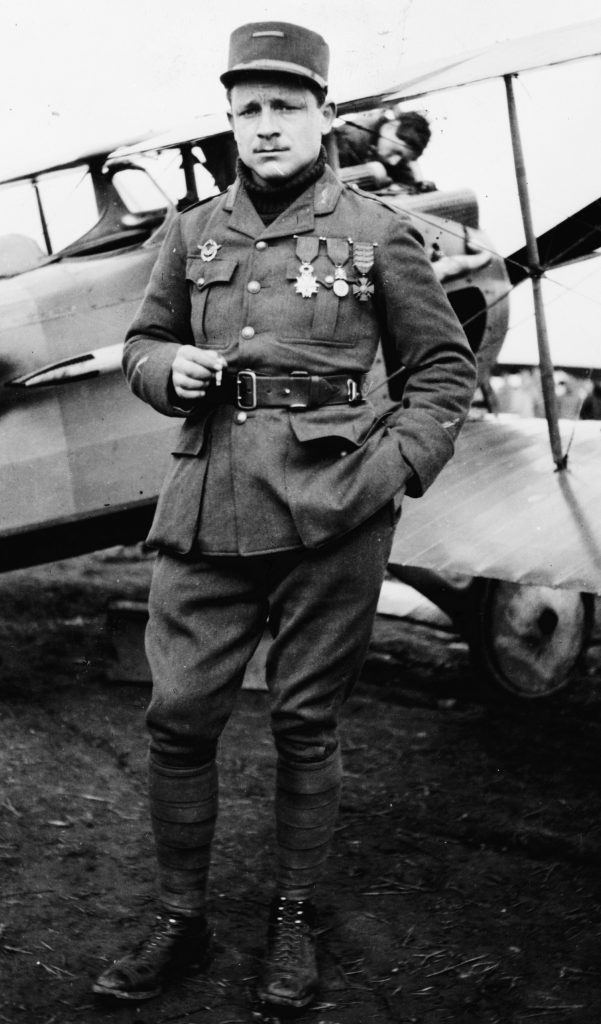
After struggling initially, Raoul Lufbery’s first victory came on July 30, 1916, when he shot down a German two-seater aircraft, followed by another victory on July 31. He claimed his third victory on August 4 and was awarded the Médaille Militaire, with a citation, “A model of skill, sangfroid and courage. He has distinguished himself through the numerous long-distance bombardments and by the daily combats in which he has engaged enemy planes. On July 31 [1916], he never hesitated to attack at close range a group of four enemy planes. He downed one of them near our lines. He succeeded in downing another on August 4, 1916.” Raoul Lufbery’s fourth victory came on August 8, followed by another victory on October 12 to become an ace officially. He scored one more victory in December 1916 to end the year with a personal score of six. For this feat, he was awarded the Légion d’Honneur, with a citation, “He enlisted under the French colors for the duration of the war. Has given proof as a pursuit pilot of remarkable audacity and has downed up to December 27, 1916, six enemy aircraft.” Lufbery’s first victory in 1917 came on April 13, though he shot down an aircraft on April 8 too, which was uncounted. He scored one more victory in April, followed by one in June, and two each in September, October, and December, to reach a personal score of 16. In late 1917, as the U.S. had officially entered WWI, Lufbery was commissioned as a Major in the United States Army Air Service. In the spring of 1918, Lufbery was appointed as the commanding officer of the new 94th Aero Squadron with the rank of major. His main job was to teach new pilots, like Eddie Rickenbacker, how to fight in combat.
The Death
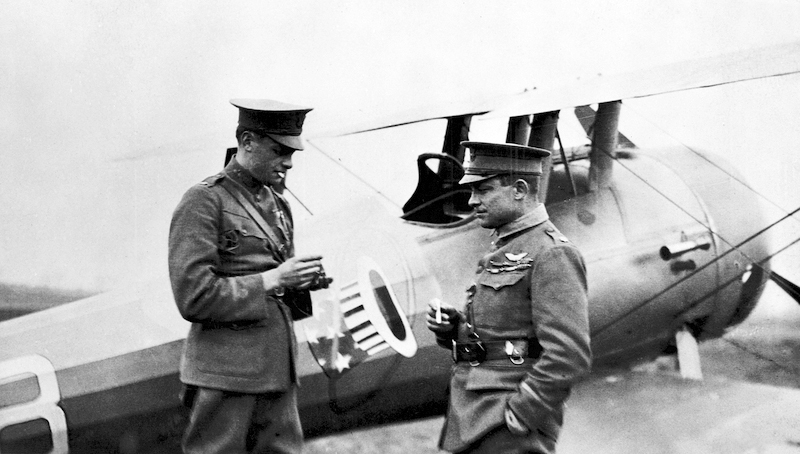
The United States Army Air Service used Nieuport 28 fighters, but many aircraft lacked weapons due to supply issues. On March 6, 1918, the 94th completed their first combat patrol, with Lufbery leading Rickenbacker and fellow pilot Doug Campbell in unarmed planes. In April 1918, Lufbery claimed to have shot down enemy planes on the 12th and the 27th while leading the squadron, both uncounted. Admired by his subordinates and respected by his peers, on May 19, 1918, while trying to shoot down a German Rumpler aircraft, Raoul Lufbery’s Nieuport 28 was hit by enemy fire. It caused the aircraft to flip over, and Lufbery fell from the plane, leading to his death. The next day, hundreds of people attended his funeral, which was recorded on film. He was buried at the cemetery of the Sebastopol Hospital. In the village of Maron, near the Moselle River, a bronze plaque marks the spot where he fell. Later, his remains were moved to the Lafayette Memorial at Parc de Garches in Paris. In 2004, Raoul Lufbery was awarded the Purple Heart, 86 years after he was killed in action. He received this medal for wounds he suffered during his last air combat on May 19, 1918. The citation said, “The President of the United States of America has awarded the Purple Heart, established by General George Washington August 7, 1782, to Raoul Lufbery, then a major in the Army of the U.S., 94th Aero Squadron, 1st Pursuit Group, American Expeditionary Forces, France, for wounds received in action on May 19, 1918 in Maron, France, a small town north of Nancy.” In the Aces series, Raoul Lufbery was not a natural pilot, but he made his way by hard work. His final score remained 16, but his legacy was far too large for that. Read stories about more Aces HERE.