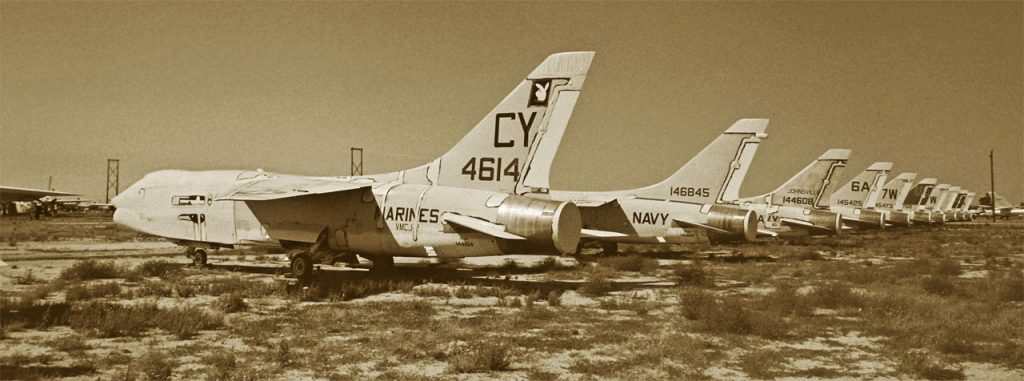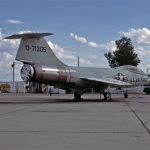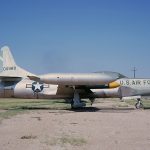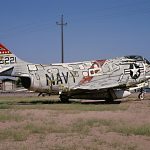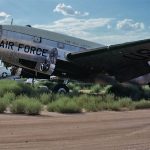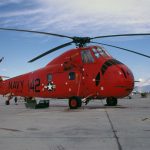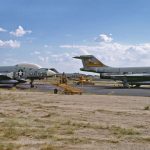
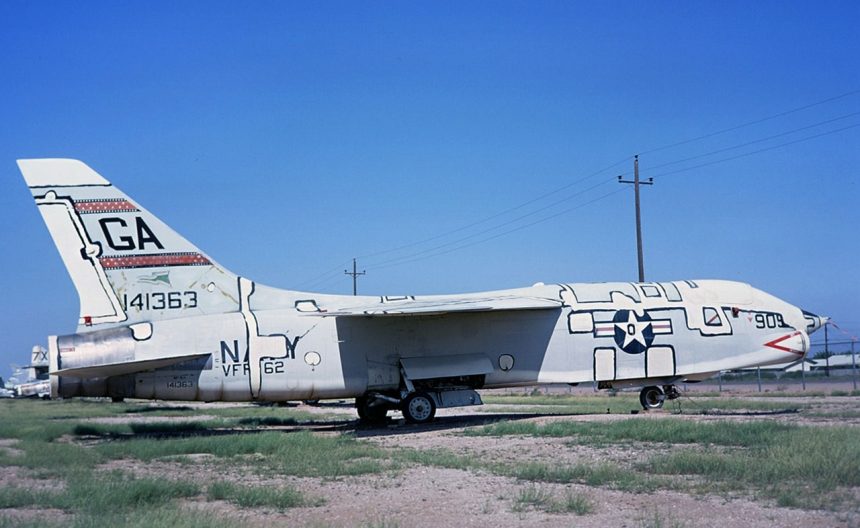

As we continue the Boneyard Files series, which showcases some of the retired aircraft that once rested at Davis-Monthan Air Force Base in Tucson, Arizona, in the late 1960s, today’s story features the Vought F-8 Crusader through the lens of Neil Aird and Tom Baillie’s “Monthan Memories” photos. In September 1952, the Navy wanted a new fighter jet that could fly faster than the speed of sound. Vought won the contract with its design, the F8U Crusader, which was later renamed the F-8. The Vought F-8 Crusader was designed in 1953 and first flew on March 25, 1955. It started serving with the U.S. Navy in 1957. The F-8 Crusader was one of the most advanced fighters of the post-WWII era. Unlike many fighters that depended on missiles, the Crusader had a 20 mm cannon, leading its pilots to call it the “Last of the Gunfighters.” On August 21, 1956, Commander Robert Windsor set a national speed record by reaching 1,015.428 mph flying the Vought F-8 Crusader. With this flight, the F-8 became the first operational jet to fly faster than 1,000 mph. Then, on July 16, 1957, Major John H. Glenn, Jr., who would later become an astronaut, flew a reconnaissance version of the F-8 on a record-breaking trip across the country. He took off from Los Alamitos, California, and landed at Floyd Bennett Field, New York, in just 3 hours, 22 minutes, and 50.05 seconds. The F-8 was designed with several new features. One of them was its variable-incidence wing, which could be tilted up at the back to give the pilot better visibility. The leading edge of the wing and the ailerons could also be lowered to increase lift, helping with slower landing speeds.
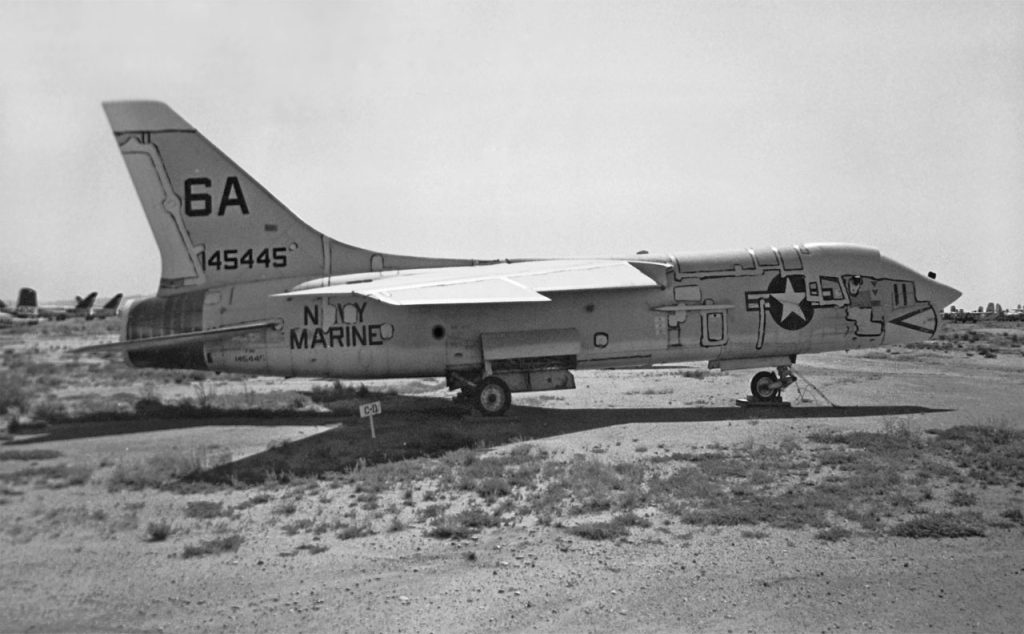
The wings’ tips of the Vought F-8 Crusader could fold for easier storage on aircraft carriers. The aircraft used as much titanium as possible in its construction, and all control surfaces had backup hydraulic power systems. With fuel tanks in the wings and fuselage, the plane could fly for about three hours. The Crusaders could be armed with cannons, rockets, and missiles. Later, improvements were made to the aircraft’s engines and fire control systems, and ventral fins were added under the tail to improve stability. Several variants of the Vought F-8 Crusader were developed, including the RF-8A reconnaissance version. In 1964, a program began upgrading these RF-8As with stronger wings, additional pylons, ventral fins, and new electrical and navigation systems. After these upgrades, the RF-8As were known as RF-8Gs. The Vought F-8 Crusader was nearly 56 feet long, 15.9 feet high, with a wingspan of 35.8 feet and a wing area of 375 square feet. The empty weight of the aircraft was 18,800 pounds, the gross weight was 29,000 pounds, and the maximum takeoff weight was 34,000 pounds. The aircraft could carry 1,348 US gallons of fuel, providing a combat range of 453 miles and a ferry range of 1,734 miles with external fuel loads. The aircraft was powered by a Pratt & Whitney J57-P-20A turbojet engine that produced 11,400 pounds of dry thrust and 18,000 pounds of thrust with afterburner. The maximum speed of the aircraft was Mach 1.8, and the service ceiling was 58,000 feet. During the Cuban Missile Crisis in October 1962, Crusaders flew their first combat missions using cameras instead of weapons for photo-reconnaissance flights over Cuba.
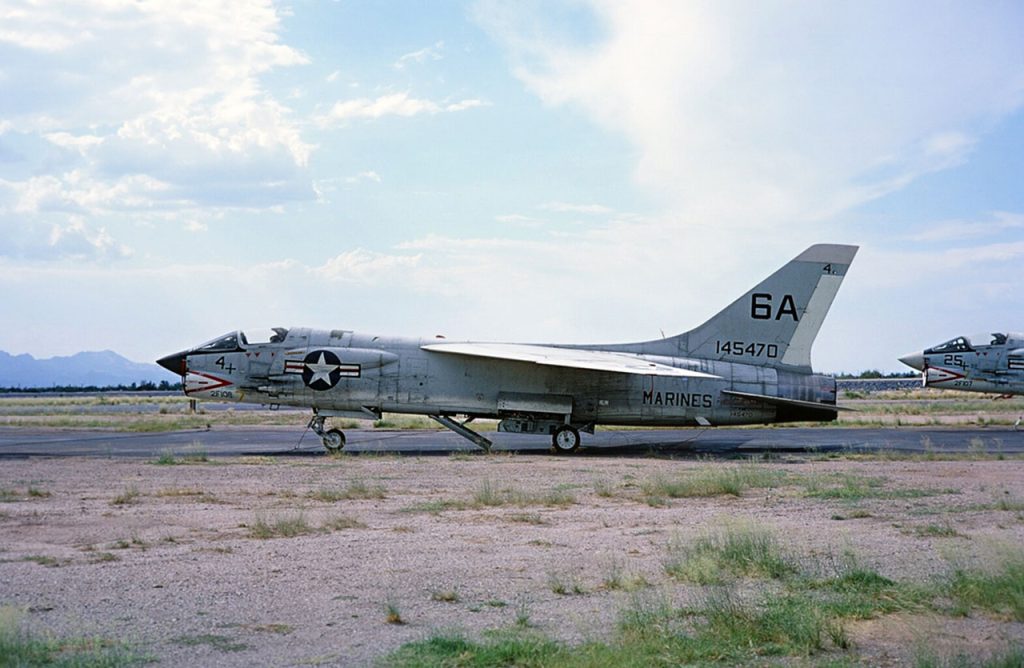
In one of its most important missions, the Vought F-8 Crusader flew strike and combat air patrol missions throughout the Vietnam War. In the early days of the Vietnam War, the Vought F-8 Crusader was the most successful US fighter. It shot down 18 enemy aircraft while losing only three of its own, giving the F-8 a kill ratio of 6:1, which was much better than other US fighters, including the newer McDonnell-Douglas F-4 Phantom II. In addition to serving in the U.S. Navy and Marine Corps, Crusader planes were also used by the Philippine Air Force and the French Navy. The French continued to use their Crusaders into the 1990s, making them the last active F-8s. In total, 1,261 Crusaders of all types were produced. The Vought F-8 Crusader underwent 11 overhauls and served 28 years in Naval Service. It was operational for 21.7 years and flew for a total of 7,475 hours, making it the F-8 with the most flight hours in history. The aircraft spent its initial years with the Marine Corps, First with VMCJ-3 in California and later with VMCJ-1 in Southeast Asia, where it flew 200 combat hours. It completed 8,896 landings, 689 carrier landings, and 714 catapult launches. The F-8’s last carrier landing was in October 1986, and it flew for the last time on March 30, 1987, before being delivered to the National Air and Space Museum. In the late 1960s, some of the Vought F-8 Crusaders were spotted at Davis-Monthan Air Force Base, commonly known as “The Boneyard.” Read more Boneyard Files stories HERE.