






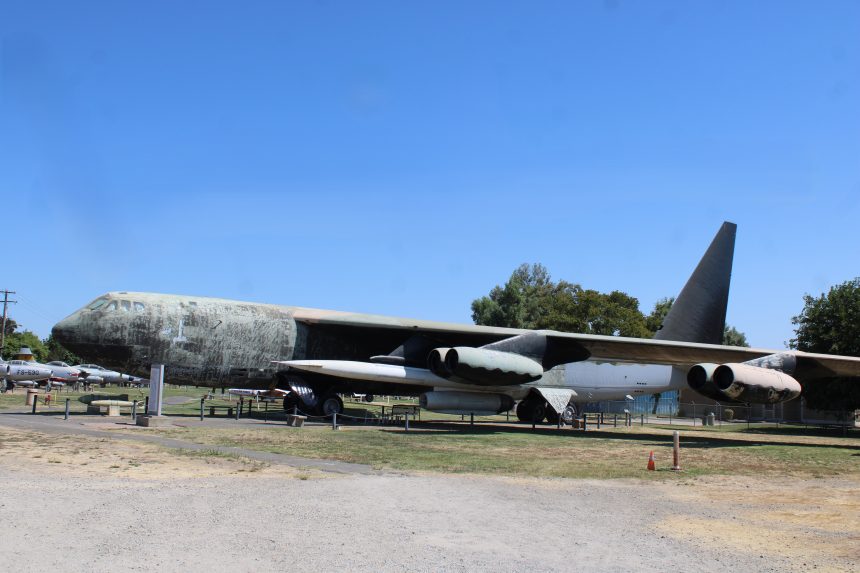

For much of its history, Castle Air Force Base in California’s Central Valley served as a hub for Boeing B-52 Stratofortress bombers assigned to the U.S. West Coast to serve as a key component in the United States’ nuclear triad defense system during the Cold War. Although Castle AFB has been deactivated since 1995 and turned into the Merced-Castle Airport, one B-52 remains on display at the Castle Air Museum. However, the decades of outdoor display have taken their toll on the aircraft, which is now being completely repainted by a team of volunteers to return the aircraft to its former glory.

The B-52 Stratofortress on display at the Castle Air Museum was originally constructed by Boeing’s Seattle plant in 1957 as a B-52D model, with the construction number 17295. On September 26, 1957, the aircraft was accepted into the United States Air Force’s inventory as serial number 56-0612 and subsequently assigned to the 28th Bombardment Wing at Ellsworth Air Force Base, South Dakota. From April 1960 to April 1966, the aircraft was operated out of Sheppard Air Force Base, Texas, first with the 4245th Strategic Wing, then with the 494th Bomb Wing before the B-52 was transferred to the 509th Bomb Wing at Pease AFB (now Pease Air National Guard Base/Portsmouth International Airport), New Hampshire. B-52D 56-0612 has subsequent assignments at Fairchild AFB, Washington, Westover AFB, Massachusetts, Dyess AFB, Texas, Ellsworth AFB, South Dakota, and Carswell AFB, Texas, before being briefly assigned to the 93rd Bombardment Wing at Castle Air Force Base from July 31, 1971, to June 26, 1972, before returning to the 7th Bombardment Wing at Carswell AFB.

Many of the wings 56-0612 served with had sent their complement of B-52s to combat deployments during the Vietnam War, flying long-range missions over Vietnam primarily from Andersen Air Force Base on Guam. In fact, the aircraft was officially transferred to Andersen AFB when it was attached to the 43rd Strategic Wing on February 21, 1974, before being officially assigned to the 307th Strategic Wing at U-Tapao Royal Thai Navy Airfield in Thailand from March to September 1974 and later made its way back to the continental U.S. via Andersen AFB.

By the start of the 1980s, the B-52Ds were being retired from service, and B-52D 56-0612 was serving with the 22nd Bomb Wing at March Air Force Base (now March Air Reserve Base) in Riverside, California. Around this time, local aviation enthusiasts had established the Castle Air Museum at Castle AFB in Atwater, with active-duty personnel at the base spending much of their free time assisting the museum in gaining new acquisitions. One of these would become B-52D 56-0612, which was flown in from March AFB in 1982 and officially stricken from the USAF’s inventory to be placed on permanent display at Castle. Moving the bomber even required the vertical stabilizer to be removed and strapped over the horizontal stabilizer to fit under the base’s power lines. Additionally, an AGM-28 Hound Dog cruise missile was fitted to the left wing of B-52D 56-0612 at the Castle Air Museum.

As the base itself was deactivated in 1995 following the end of the Cold War, the Castle Air Museum remained and expanded. However, being primarily an outdoor aviation museum, time and the elements always take a toll on the aircraft, requiring constant maintenance to be in display quality. Readers familiar with other articles focused on aircraft at the Castle Air Museum will be familiar with the work of Greg Stathatos, who has been a key figure in organizing the restoration of aircraft at Castle, as well as his work with the March Field Air Museum down in Riverside. Since January of 2025, Greg and other restoration volunteers at Castle have been hard at work sanding the old paint off the B-52 and preparing it to be repainted. This can be a challenging job for the volunteers, as not only does it require the use of a mobile lift platform, especially for work on the vertical stabilizer, but with the summer heat often going up to 90-100° F, work is often carried out in the morning, not only avoid the risk of overheating the volunteers, but also to allow the paint a better chance to set correctly.


Much of this work has been planned in stages, and as of August 2025, the final coat of paint has been applied to the vertical and horizontal stabilizers, though the serial number will be applied later. Additionally, the aft portion of the fuselage has been repainted up to the rear wheels of the aircraft. The paint on the fuselage’s forward section has also been sanded to receive a new coat of paint. The Castle Air Museum reports that volunteers spent 151 hours sanding, 50 gallons of gas to run the compressor, and 2,500 sanding disks to sand the fuselage of the B-52. The museum plans to have sanding work on the Stratofortress’ massive wings begin by Christmas. Volunteer Greg Stathatos is also hoping to get many of the museum’s Vietnam War-era bombs kept in storage, refurbished, and displayed next to the B-52 to showcase to visitors just how much ordinance the BUFF could carry on a combat mission. For more information on the Castle Air Museum, visit their website HERE.


For more information on the Castle Air Museum, visit their website HERE.






Just as an FYI, the vertical stabilizer wasn’t “removed”. All B-52 aircraft have hinged vertical stabilizers that can be flopped over to the right. You just don’t see it don’t very often because it requires a crane to lower and raise it. It was originally to allow the tail of the aircraft to fit in a hanger where it could be worked on out of the weather.
I was the operator of the bulldozer that put the B-52 on its stands . Good to see that you are still working to keep her looking nice
When I was a kid on a quiet mid week day. One of the volunteers let me get up into the cockpit of this b52.