
by Shunji Nakai
Following the publication of the article “Sorahaku: Exploring Japan’s Gifu-Kakamigahara Air and Space Museum,” considerable interest was generated around one of the museum’s most remarkable exhibits—the Shin Meiwa UF-XS. To provide deeper insight into this unique aircraft, we reached out to the original author, Shunji Nakai for a detailed examination.
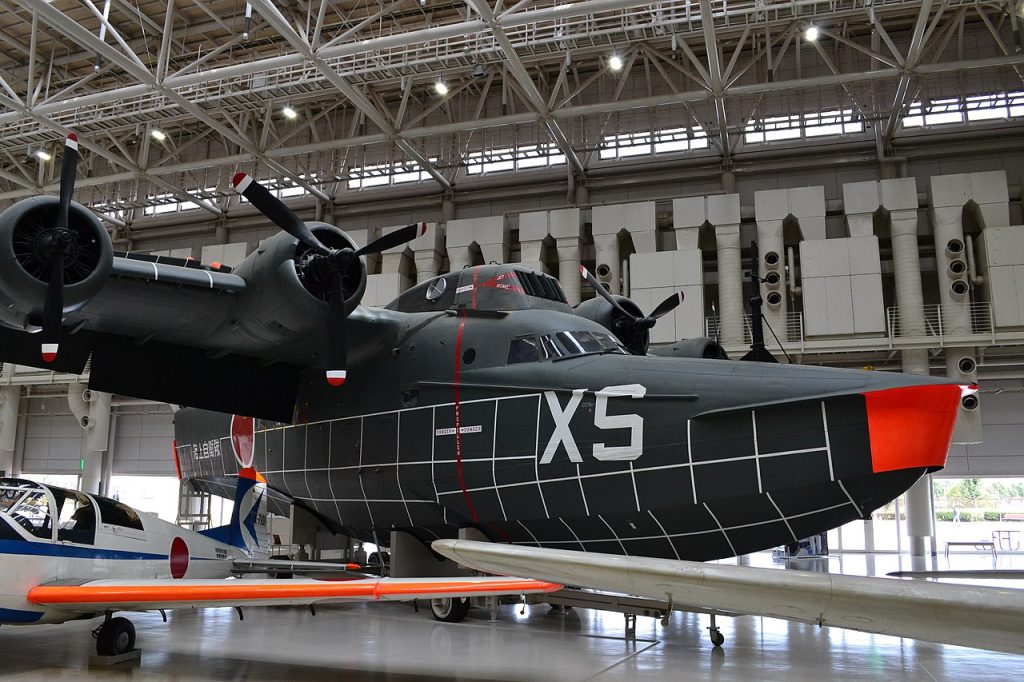
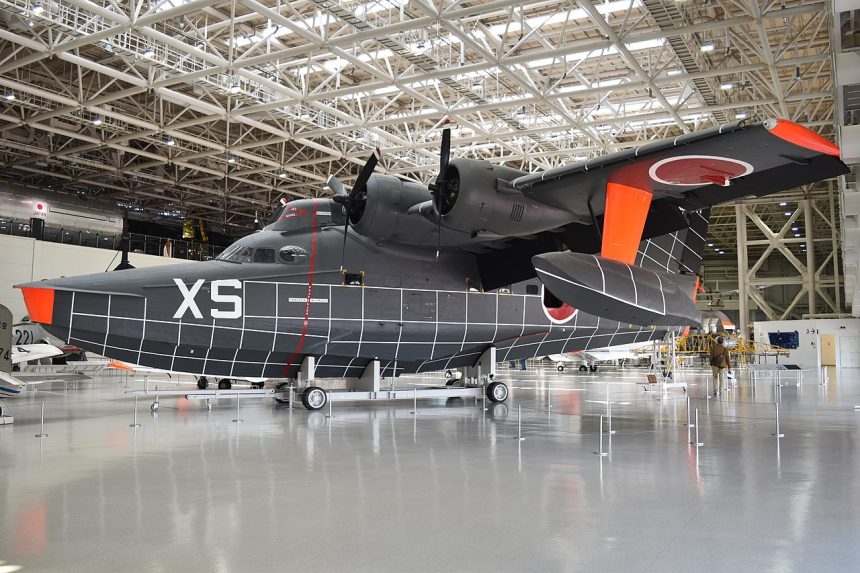
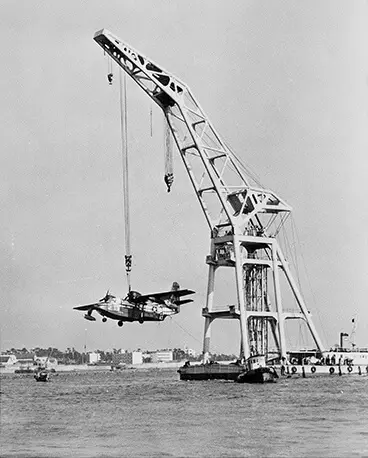
Originally constructed for the United States Air Force as a standard Grumman SA-16A Albatross (construction number G-153, military serial 51-0472), the aircraft was later reassigned to the U.S. Navy with Bureau Number 149822. Subsequently, it was sold to Japan, reportedly as a UF-1. Undergoing extensive modifications by Shin Meiwa, the aircraft was transformed into the UF-XS experimental flying boat to support development testing for the PS-1 patrol flying boat.
The UF-XS project, led by Shizuo Kikuhara (1906–1991), former chief designer of the wartime Type 2 Flying Boat, involved extensive modifications to the original aircraft. These included a newly designed hull with innovative wave suppression devices that enabled safe operations in ocean waves up to approximately three meters high. The aircraft’s configuration was changed from its original twin-engine layout to a more powerful four-engine setup. Additionally, two turboshaft engines were installed internally to power a blown high-pressure air system, which directed airflow over the wing flaps, ailerons, elevators, and rudder to significantly enhance Short Takeoff and Landing (STOL) capabilities and low-speed handling. The UF-XS was also equipped with automatic stabilization equipment to improve stability and control during slow flight. This advanced design allowed the aircraft to conduct flight testing from 1962 until 1964 before its retirement at Shimofusa Air Base in 1967.
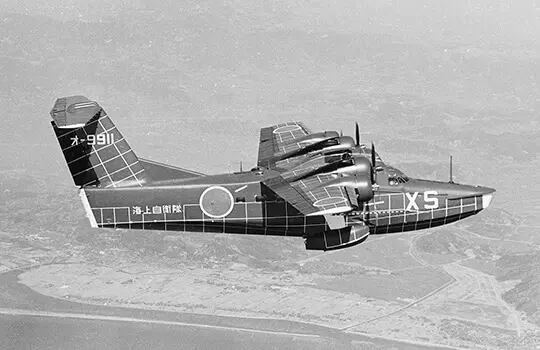
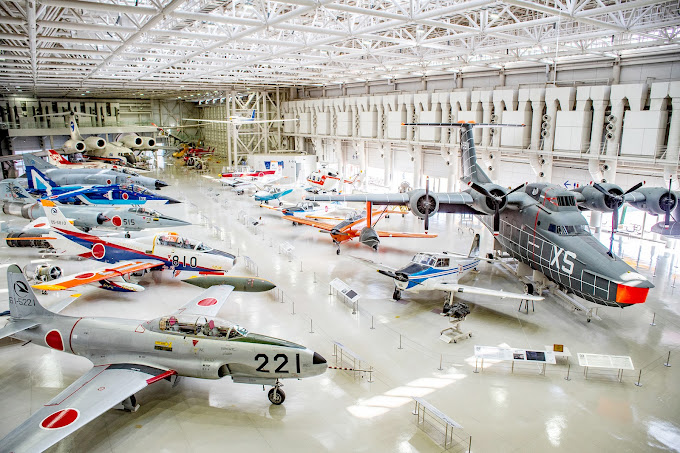
Between 1975 and 1993, the aircraft was displayed outdoors at Tokai University in Shimizu City. Later, it was returned to Shin Meiwa for restoration, before finding its permanent home inside the Gifu-Kakamigahara Air and Space Museum in Kakamigahara City, Gifu Prefecture, Japan.
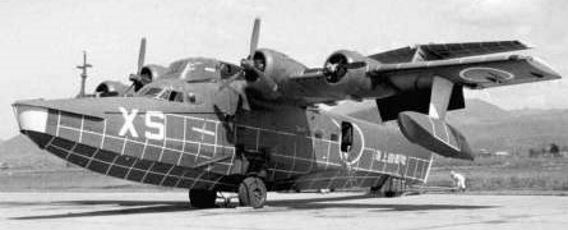
By the time it arrived at the museum, the UF-XS was missing the two turboshaft engines and associated ducting crucial to its high-pressure air system. Years of outdoor exposure had caused notable corrosion, and previous modifications, including an access opening and steel passageway for visitor entry, had altered the aircraft’s original configuration. ShinMaywa Industries, the original modifying company (formerly Shin Meiwa Industry Co., Ltd.), undertook meticulous restoration based on original manufacturing blueprints. During the process, replacement parts were clearly marked to differentiate them from the original components.
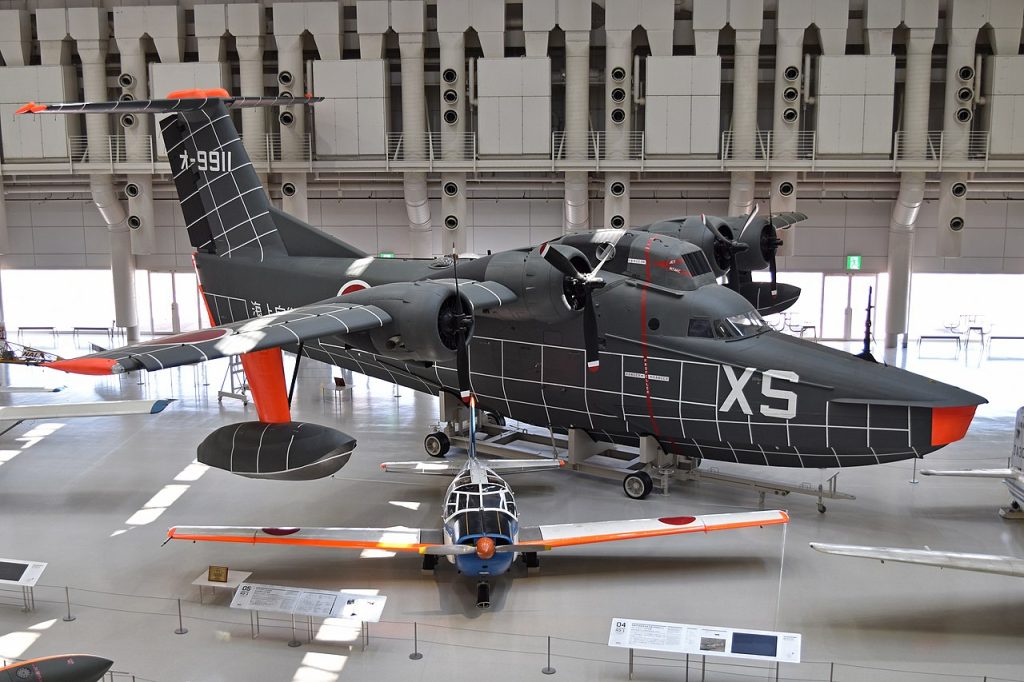
As the sole aircraft produced specifically for the PS-1 development program, the UF-XS holds a unique place in Japan’s postwar aviation history. It represents the foundation of Japan’s modern flying boat lineage culminating in the US-2 amphibian. Restored to its original testbed condition, the UF-XS is now preserved as an invaluable cultural and technological asset. The Aviation Heritage Archive recognizes the UF-XS, owned by Japan’s Ministry of Defense and displayed at the Gifu-Kakamigahara Air and Space Museum, as an important aviation heritage artifact that vividly illustrates the progression of Japan’s flying boat development.