
For viewers who grew up watching The Six Million Dollar Man, the opening sequence was unforgettable: an experimental aircraft crashed, a test pilot lay critically injured, and advanced technology offered the promise of rebuilding him with extraordinary abilities. The television drama was fiction, but the accident footage was real. Behind those images was NASA research pilot Bruce Peterson, whose career extended far beyond the crash that made him familiar to millions. Lee Majors portrayed Col. Steve Austin, a test pilot and astronaut fitted with bionic limbs and an enhanced eye after a devastating accident. Working as a secret agent, Austin used his superhuman strength, speed, and vision to carry out dangerous missions. The show became a fixture of 1970s television, with its opening sequence linking the fictional character to a real chapter in experimental aviation.
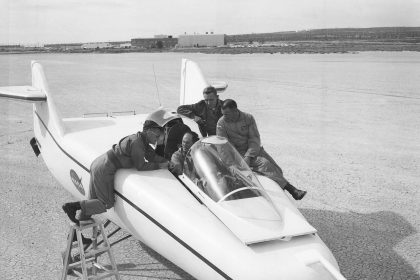
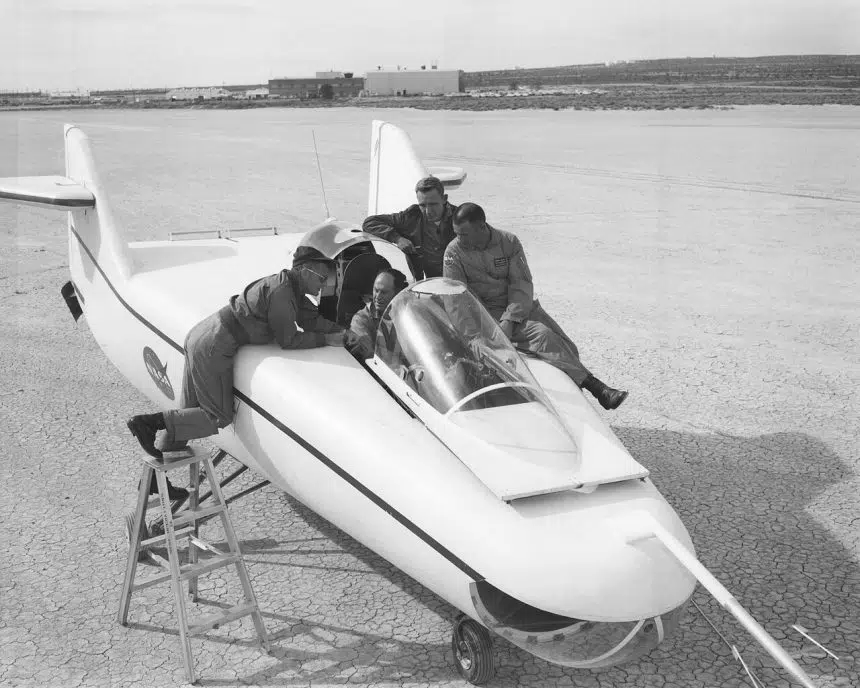
The aircraft seen crashing was the Northrop M2-F2, a heavyweight lifting body developed from research at NASA’s Ames and Langley research centers. Unlike a conventional airplane, a lifting body relied on the shape of its fuselage to generate lift. The program explored how a wingless vehicle could be controlled and landed, contributing to research into the return of spacecraft from orbit.

On May 10, 1967, Peterson was at the controls of the M2-F2 during a glide flight at Edwards Air Force Base, California. As he approached Rogers Dry Lake, the vehicle began rolling from side to side. He regained control, but a rescue helicopter that appeared to pose a collision threat distracted him. The M2-F2 drifted away from the marked landing area, making its height above the lakebed difficult to judge. Peterson fired the landing rockets, but the aircraft struck the surface before its landing gear was fully down and locked. NASA estimated its speed at approximately 250 mph. The M2-F2 tumbled six times and came to rest upside down. Rescue crews pulled Peterson from the wreckage, and he underwent extensive treatment for his injuries. Although he survived and recovered, Peterson lost vision in his right eye because of a secondary infection contracted during his hospitalization. Years later, footage of the accident appeared in the opening credits of The Six Million Dollar Man, bringing the crash to an audience far larger than the flight research community.

Peterson was born on May 23, 1933, in Washburn, North Dakota. He attended the University of California, Los Angeles, from 1950 to 1953, working as an aircraft assembler for Douglas Aircraft Company while studying. He entered naval aviation training in 1953 and was commissioned a second lieutenant in the U.S. Marine Corps in November 1954. After leaving active duty in 1957, he continued his education at Cal Poly in San Luis Obispo, earning a bachelor’s degree in aeronautical engineering. In August 1960, he joined NASA as an engineer at its Flight Research Center at Edwards, later named the Dryden Flight Research Center and now known as the Armstrong Flight Research Center.

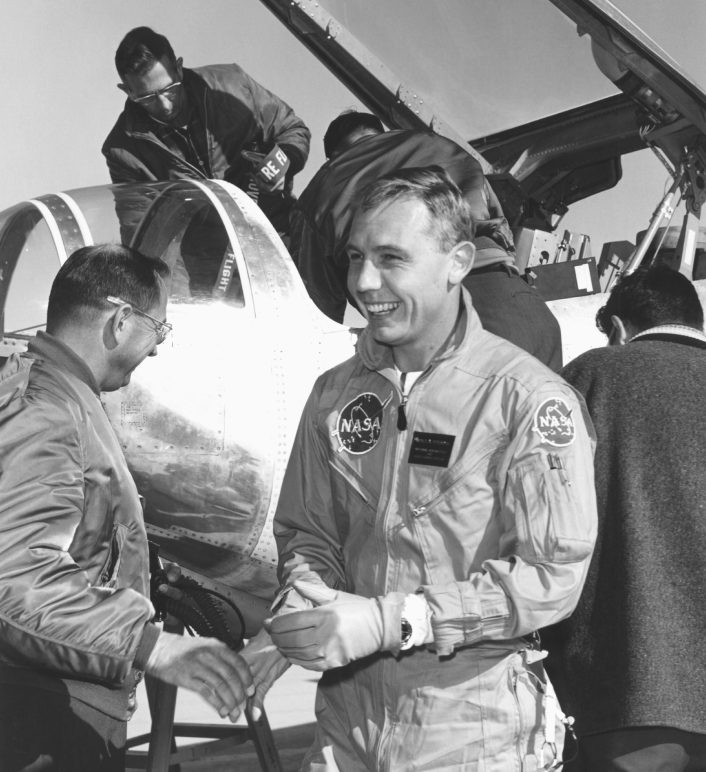
Peterson transferred to flight operations in March 1962 and was assigned to the Rogallo Paraglider Research Vehicle, or Paresev, program. The unusual craft was used to investigate flexible wings as a possible means of recovering crewed spacecraft. He also graduated from the U.S. Air Force Test Pilot School at Edwards as a member of Class 62C. As a NASA research pilot, Peterson flew aircraft ranging from the F5D-1 and F-100 to the F-104, F-111A, B-52, and NT-33A variable-stability trainer. His experience also included general aviation airplanes, helicopters, sailplanes, and the experimental lifting bodies that would become closely associated with his name. Peterson flew the lightweight M2-F1 and the heavier M2-F2, as well as the Northrop HL-10. On December 22, 1966, he piloted the HL-10’s maiden flight. The flight revealed serious lateral-control problems, but he brought the vehicle safely back to the lakebed. The findings led to modifications before the HL-10 continued its research program.
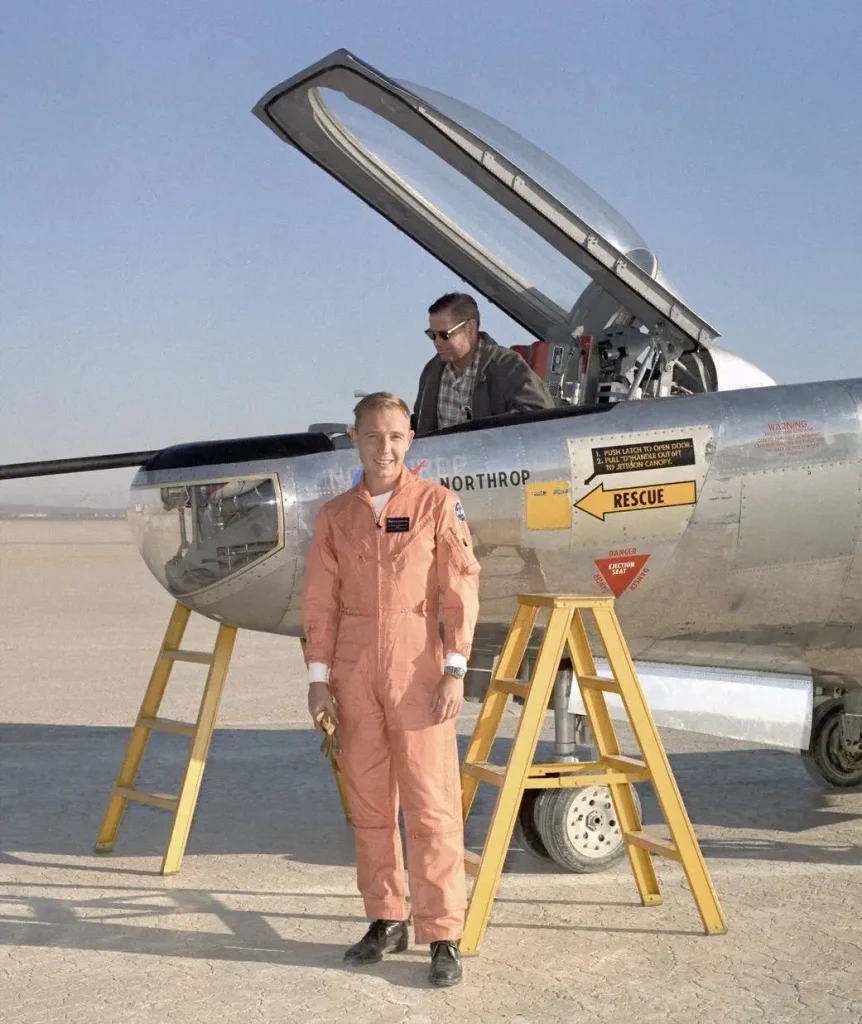
The May 1967 accident did not end Peterson’s flying career. He returned to NASA support missions and occasional research flights, continuing to fly for the agency until 1971. He also remained active in Marine Corps Reserve aviation. Over his career, he accumulated more than 6,000 flight hours in nearly 70 types of aircraft. His engineering work continued alongside his flying. Peterson served as a research project engineer on the F-8 digital fly-by-wire program during the late 1960s and early 1970s, then assumed responsibility for safety and quality assurance at Dryden. He retired from NASA in 1981. Peterson subsequently joined Northrop, working on safety and quality assurance for the B-2 Advanced Technology Bomber. Between 1982 and 1994, his work with the B-2 division included assignments at Air Force Plant 42 in Palmdale and at Edwards, and he became manager of system safety and human factors. Peterson died on May 1, 2006, at age 72. Television audiences may remember the tumbling M2-F2, but his aviation career also encompassed flight research, engineering, and safety work on some of the most demanding aircraft programs of his era. The pilot behind the opening credits had a story that went well beyond the screen.
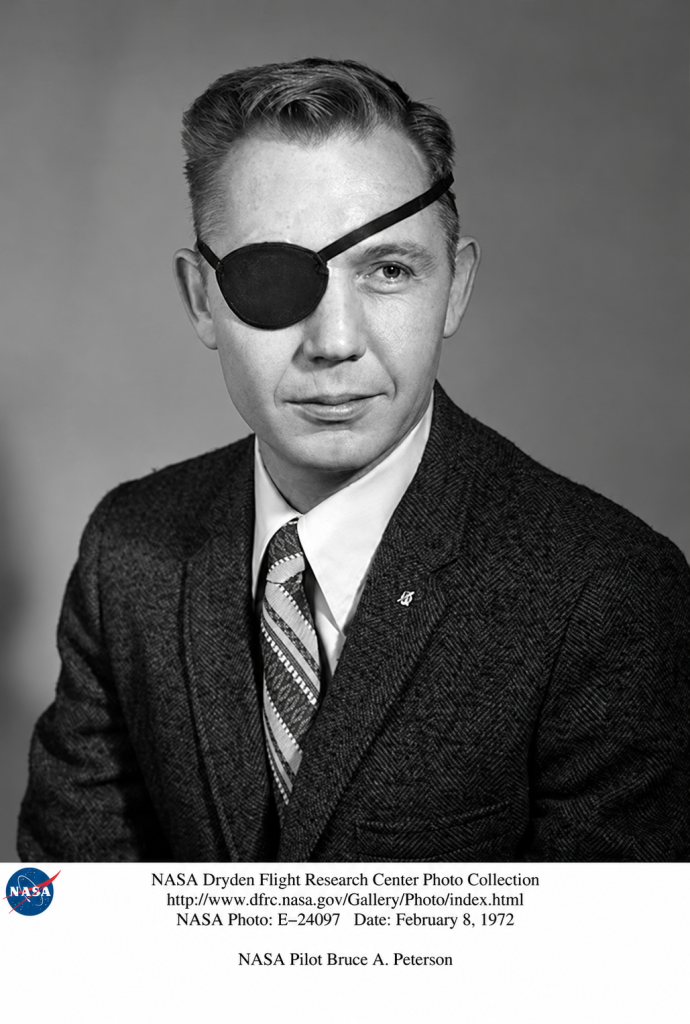
(Image credit: NASA)