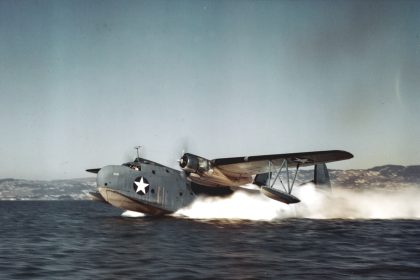
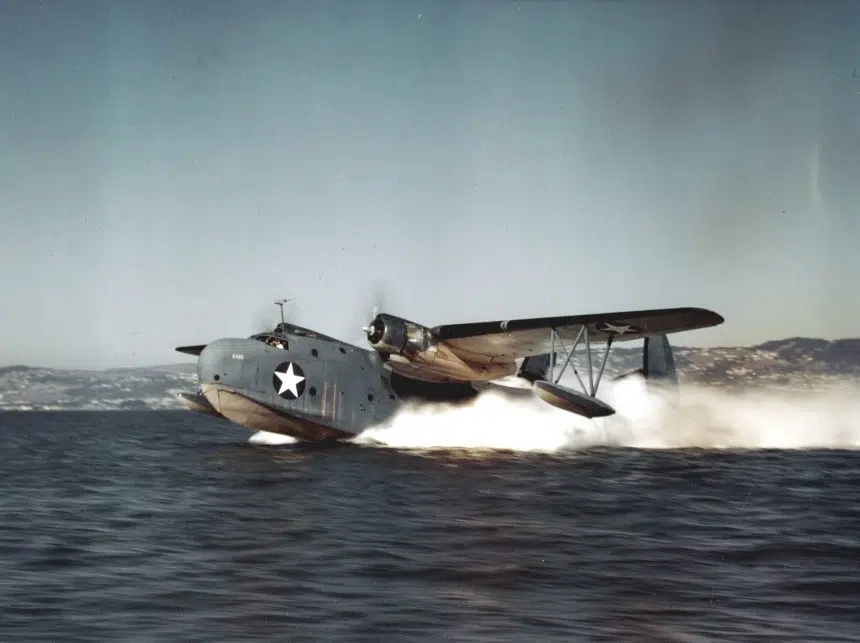

Patrol Squadron 41 (VP-41) was a US Navy seaplane unit that operated from the end of WWII into the early postwar years. The Navy established it as Patrol Squadron 21 (VP-21) on March 1, 1944. The squadron underwent several name changes before becoming VP-41 in September 1948. The crew flew Martin PBM Mariners and conducted various missions including anti-submarine warfare, reconnaissance, anti-shipping patrols, search operations, and air-sea rescues across the Pacific. VP-21 was created as a seaplane squadron using the PBM-3D Mariner planes. Soon after, the squadron moved to NAS Harvey Point, North Carolina, for ground and flight training under Fleet Air Wing 5. By May, it relocated to NAS Key West, Florida, for more anti-submarine warfare training. After finishing training in June, the squadron flew its planes across the United States to NAS Alameda, California, to get ready for a longer trip across the Pacific. On June 22, 1944, the Mariners started their flight to NAS Kaneohe Bay, Hawaii. By the end of the month, VP-21 began patrols and advanced combat training with Fleet Air Wing 2. The squadron began combat operations in August 1944 and deployed to Parry Island Seaplane Base at Eniwetok. From there, the Mariners conducted patrols and searches around the Pacific and sometimes attacked Japanese positions on Ponape Island.

In October 1944, the squadron, redesignated Patrol Bombing Squadron 21 (VPB-21), moved to Kossol Passage in the Palau Islands. It carried out daily search missions with help from the seaplane tenders USS Chandeleur and USS Mackinac. Two months later, it moved to Ulithi Atoll, taking over from VPB-17 and adding daytime anti-shipping patrols and hunter-killer missions to their tasks. One of the squadron’s most important actions happened on the night of January 21, 1945. Lieutenant (jg) Richard L. Simms and his crew found a Japanese Kaiten midget submarine trying to attack ships in Ulithi Lagoon. It dropped four depth charges on the submarine, sinking it and killing its two crew members. A few days later, VPB-21 relocated to Tanapag Harbor on Saipan before heading to Kerama Retto in March to support the Battle of Okinawa. During this time, one of the squadron’s Mariners spotted the Japanese battleship Yamato and its escorts heading toward Okinawa on April 7, 1945. The sighting alerted parts of the US Fifth Fleet, which moved to intercept the Japanese ships. As the Okinawa campaign went on, the squadron expanded its patrols. Its aircraft flew over the Ryukyu Islands, the East China Sea, the southern coast of Korea, and the China coast. It also attacked targets found at sea or on land. Later patrols reached the Yellow Sea and Sea of Japan. The squadron began conducting weather flights and Dumbo air-sea rescue missions as part of their responsibilities. In July 1945, VPB-21 moved to Chimu-Wan on Okinawa. The squadron conducted daytime search and reconnaissance missions until August 6, when it relocated to Eniwetok.

After the war ended, the squadron continued its operations. It took some time to rest and relocate before starting routine patrols. The squadron then moved to Ominato and later to Hong Kong. In January 1946, it moved its headquarters to the old Imperial Japanese Navy air base in Sasebo, Japan. Meanwhile, detachments stayed in Hong Kong and Okinawa. Later that year, the squadron operated from Qingdao, China, with detachments in Hong Kong and Shanghai. Eventually, the Shanghai detachment moved to Yokosuka, Japan. The squadron remained active in the western Pacific during the immediate postwar period, though its identity and structure changed. In November 1946, it became Medium Patrol Squadron (Seaplane) 11 (VP-MS-11). In September 1948, it was renamed Patrol Squadron 41. By November 1947, Patrol Squadron 41 moved its base to NAS San Diego. Its last major overseas deployment began in September 1948, when VP-41 returned to Qingdao, China, to take over from another patrol squadron. Nine PBM-5 Mariners gathered there, and three aircraft were sent to Yokosuka. The squadron carried out postwar patrol and training duties, including anti-submarine exercises off Okinawa. However, the deployment faced accidents and dangers. In November 1948, an explosion at a Chinese Nationalist Army ammunition dump next to the Qingdao seaplane ramp damaged two aircraft. The next month, another PBM-5 sank during a rough landing off Qingdao, but its crew survived. Patrol Squadron 41 returned to NAS San Diego on March 26, 1949. Less than a month later, on April 23, Patrol Squadron 41 was disbanded.