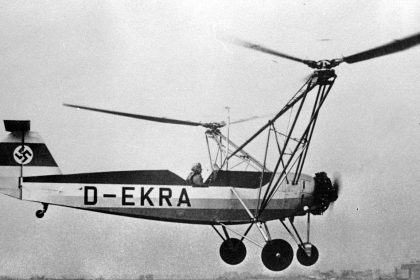
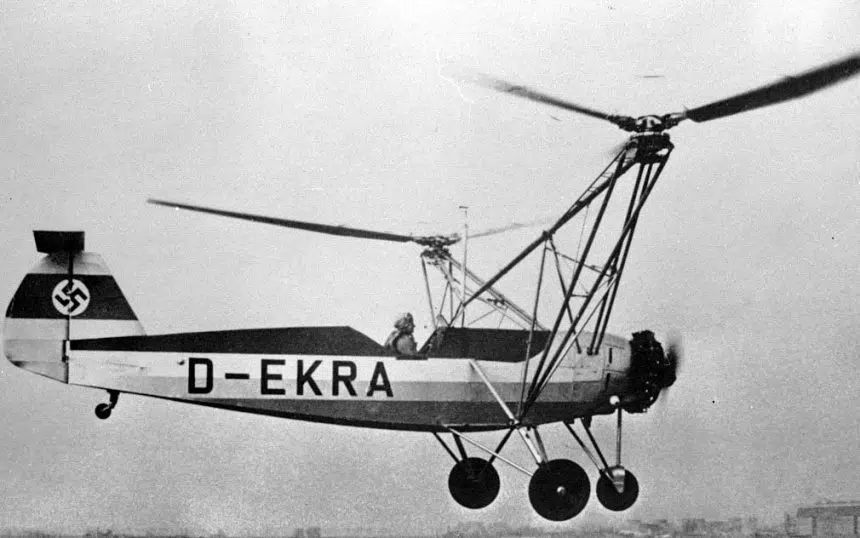


On this day in aviation history, 89 years ago (October 25, 1937), German aviator Hanna Reitsch established a world distance record flying the Focke-Wulf Fw 61 helicopter. Covering approximately 67 miles between Berlin and Stendal, Reitsch demonstrated the rapidly advancing capabilities of an aircraft widely regarded as the first practical helicopter. The Fw 61 had first flown in 1936 and was developed under the direction of Heinrich Focke. Although its fuselage closely resembled that of a conventional Focke-Wulf Fw 44 biplane trainer, lift was provided by two large three-bladed rotors mounted on outriggers extending from either side of the fuselage. A single radial engine drove both rotors through a system of shafts and gears, while the small propeller mounted on the nose primarily provided cooling airflow for the engine.

The Fw 61 quickly established several helicopter records. In June 1937, test pilot Ewald Rohlfs set records for altitude, endurance, speed, and distance. Reitsch subsequently extended the straight-line distance record on October 25, covering approximately 109 kilometers. She became even more closely associated with the Fw 61 the following year when she famously flew it inside Berlin’s Deutschlandhalle during public demonstrations, dramatically displaying the controllability of the new type of aircraft. The Fw 61 measured approximately 24 feet 3 inches in length and had two rotors measuring 23 feet 7 inches in diameter. It was powered by a 160-horsepower Bramo Sh 14A radial engine and could reach approximately 76 mph. The aircraft had a range of around 140 miles and could climb to more than 11,000 feet. Only two Fw 61 prototypes were constructed, but their record-setting flights helped demonstrate the practical potential of rotary-wing flight.