







By Dan Rivera
In the annals of World War II aviation, few stories capture both the peril and the ingenuity of the air war over Europe as vividly as that of the 8th Air Force. His life was marked by courage, resilience, and a touch of unorthodox inventiveness that earned him and his crew a place in wartime lore.
Training a Pilot
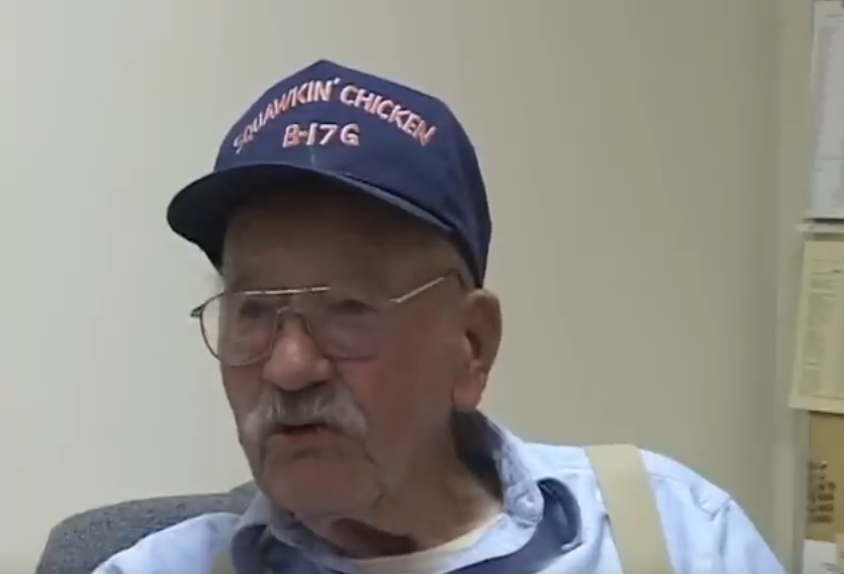
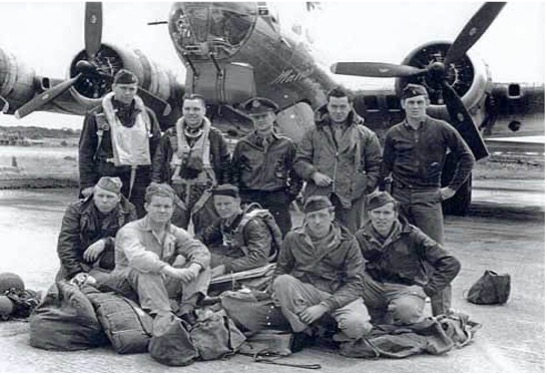
Bennett’s journey began like that of many young airmen of his generation. After pre-flight training in Santa Ana, California, he progressed through the Army Air Forces’ rigorous pilot program: Primary at Thunderbird II in Phoenix, Basic at Marana near Tucson, and Advanced at Douglas, Arizona. He trained in the Stearman, the BT-13 “Vultee Vibrator,” and the UC-78 “Bamboo Bomber” before earning his wings in August 1943 as part of Class 43-H. Sent to Roswell, New Mexico, for B-17 transition training, Bennett spent nine intense weeks mastering the Flying Fortress before being assigned as first pilot. In Salt Lake City, he assembled his crew—nine young men who would become his brothers in arms, including co-pilot Paul Spiers, bombardier Eugene Burcham, engineer Jim Holland, and radio operator Mike Perrone. Together, they were entrusted with a brand-new B-17G, christened the Squawkin’ Chicken.
Schweinfurt: April 13, 1944
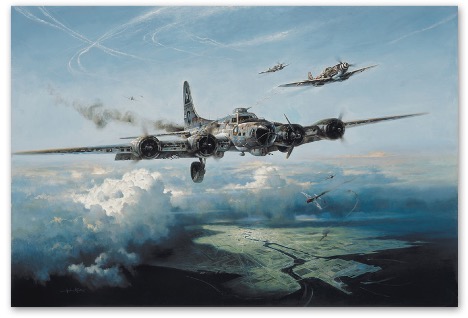
Daylight bombing raids over Germany in 1944 were among the most dangerous missions of the war. On April 13, Bennett’s squadron of the 384th Bomb Group was dispatched to strike the heavily defended ball-bearing factories at Schweinfurt, a target notorious among bomber crews. “The fighters came in straight ahead and above,” Bennett later recalled. “They rolled upside down, firing at nearly 500 miles per hour, then split-S’d back to attack again.” Within minutes, the Luftwaffe’s FW-190s and Me-109s tore into the formation. Flak over the target added to the carnage. One by one, B-17s were shot down in flames. By the time the bombs were released, Bennett looked around and realized that his was the only Fortress from the 545th Squadron still flying. For more than two hours, Squawkin’ Chicken fought its way back to England, battered and alone, fending off repeated attacks and witnessing the loss of comrades all around. Near the Channel coast, a wingman exploded in mid-air from a direct flak hit—a vision that haunted Bennett for the rest of his life. Somehow, he and his crew survived, returning to base as the “last men standing.”
The “Toilet Stool Ace”
Bennett’s wartime service was not only marked by survival but also by unconventional ingenuity. German fighters often exploited damaged or empty ball turrets, attacking from below where B-17s were vulnerable. Bennett and his crew devised an unusual countermeasure: jellied gasoline, thickened with clay and sorghum syrup, dropped from the bomb bay and ignited by tracer fire. The idea evolved when waist gunner Verlin Gale suggested adapting a toilet stool with a water tank as a crude dispersal device. Rigged with a cable to the cockpit, it could “flush” the flaming mixture all at once. On May 13, 1944, during a mission to Stettin, they tested the system. As a Me-109 closed in from below, Bennett pulled the wire, releasing a torrent of burning fuel. The German fighter was engulfed, forcing the pilot to bail out. Over time, the crew claimed five victories with their improvised weapon, proudly painting small toilet symbols beneath the cockpit and earning the tongue-in-cheek title “The Toilet Stool Aces.” Not everyone found it amusing. Their commanding officer, enraged that his personal latrine had been requisitioned for the cause, ordered the contraption removed. Bennett was reprimanded for “disgracing the officer corps” and, adding insult to injury, was assigned an extra mission, bringing his total to 31 instead of the usual 30.
Reflections on Service
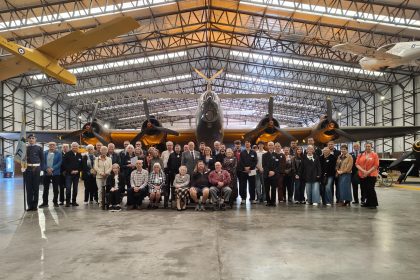
Despite the hardships, Bennett and his men completed their tour and returned home. His combination of grit, humor, and creativity left an indelible mark on those who knew him. Later in life, he shared his memories with fellow veterans and visitors at the Pima Air and Space Museum in Arizona, where his storytelling kept history alive for a new generation. Capt. Dewayne “Ben” Bennett passed away on March 10, 2011. Remembered as both a warrior and a wit, his legacy endures through stories of Schweinfurt, the Squawkin’ Chicken, and the unforgettable “toilet stool defense.” His life stands as a testament to the resilience and inventiveness of the young men who flew the Flying Fortress across hostile skies.










Capt. Bennett’s CO had not sense of humor and missed a great opportunity. He should have requisitioned more toilets and outfitted more bombers! Who knows how 8th Air Force might have added to their storied history?
Dewayne Bennett was my grandfather and an amazing man.
Greatest generation we all owe them a lit
I knew Ben Bennet and he was an mazing man. I was helping him design his webpage years ago and never knew what came of it since Ben passed. They don’t make them like Ben, that’s for sure. He loved the air museum and telling his amazing true story’s of his heroic missions. God Speed Mr. Ben.