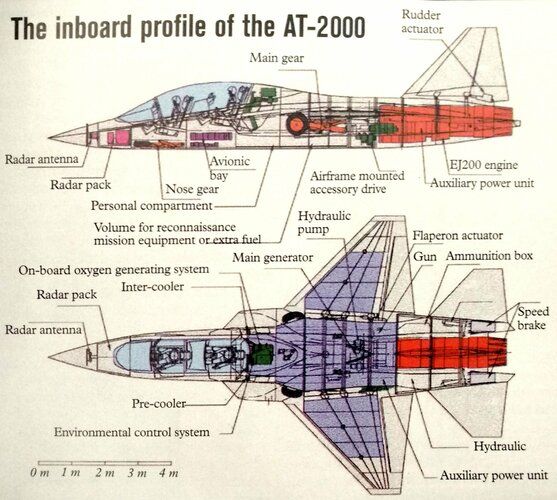
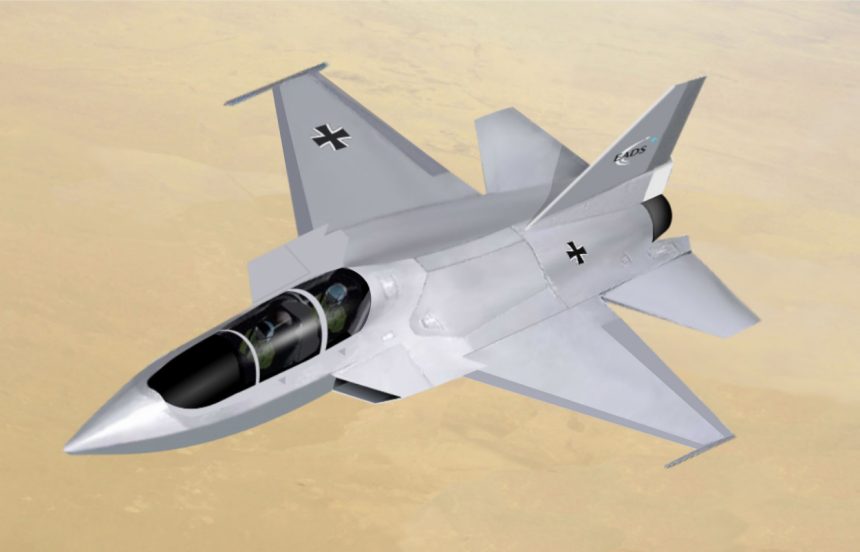


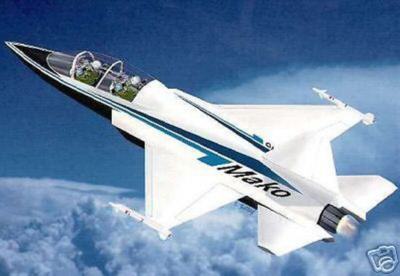
In 1989, Dornier of Germany and Aermacchi of Italy began work on a new advanced jet trainer called the AT-2000. The program aimed to develop an aircraft to train European air force pilots for fourth-generation fighters. However, in 1994, Aermacchi left the program, and Dornier, which had become a part of Deutsche Aerospace (DASA), continued alone. In 1998, the aircraft was renamed Mako. When DASA later joined the newly formed EADS consortium in 2000, the project moved under the EADS Military Air Systems division. The aircraft was planned as a high-performance trainer, with an option for a light combat version. It was also promoted for the proposed multinational Eurotrainer and Advanced European Jet Pilot Training programs. The EADS Mako was powered by a single engine mounted in the rear fuselage, fed by two air intakes at the wing roots. The wing was shoulder-mounted with 45 degrees of sweep on the leading edge. It had a trapezoidal shape with a sharp taper. Control surfaces included full-span leading-edge slats, single-section flaperons, an inset rudder, and an all-moving horizontal tail mounted just behind the wing. The landing gear was a retractable tricycle arrangement with one wheel on each strut. The cockpit was arranged for one or two crew members under a smooth bubble canopy. A modular avionics layout was planned to allow operators to select different radar and mission systems. Several radar options were studied, but none were formally selected.
Design of Mako
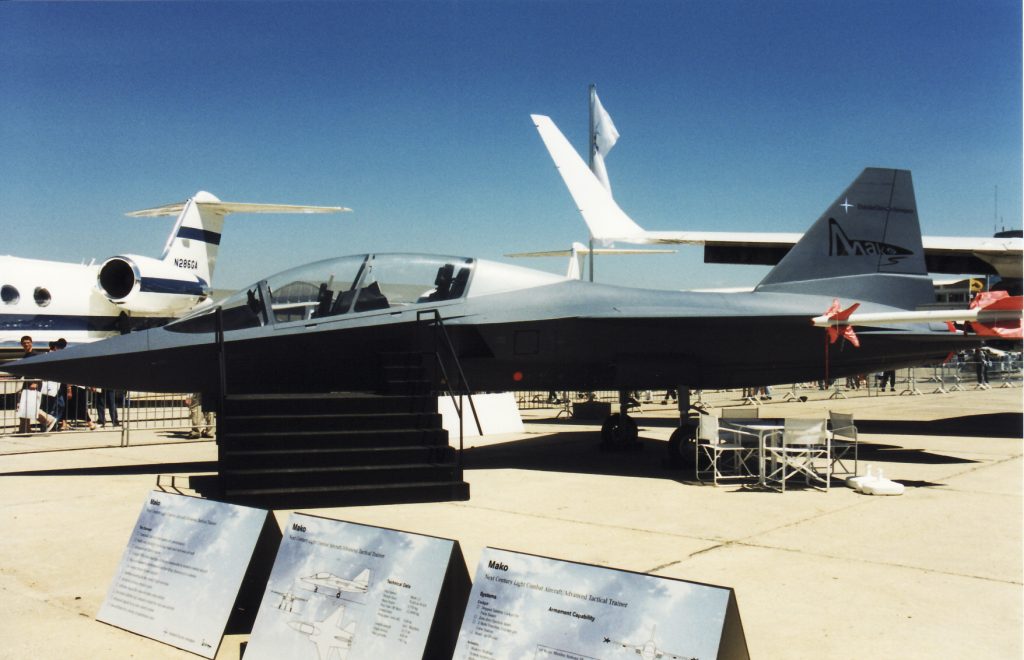
The Mako was to be equipped with a reprogrammable quadruplex digital fly-by-wire flight control system. Materials and components for the Mako were selected to meet predetermined cost targets, and fully developed equipment and subsystems were to be used in the aircraft to reduce development risk. Some shaping reflected earlier German low-observable research from the MBB Lampyridae program. In 2002, EADS selected a derivative of GE’s F414-GE-400 fighter engine, which also powered the US Navy’s F/A-18E/F Super Hornet for Mako. According to GE Aerospace, the F414, rated at 22,000 pounds (98kN) thrust with a nine-to-one engine thrust-to-weight ratio, was the most powerful fighter engine considered for the Mako program. However, for the trainer version, the engine would be derated to about 75 kN of thrust to extend service life and reduce maintenance. A full-power version was planned for a light combat model. Mako’s length was planned to be about 45 feet, with a wingspan of about 27 feet. Its maximum takeoff weight was envisioned as 28,660 pounds, and a service ceiling of about 50,000 feet. It would fly at speeds from Mach 1.3 to 1.5. The light combat version could carry a 27 mm gun and seven external stores, with weapon options including short- and medium-range air-to-air missiles, air-to-ground weapons, and bombs.
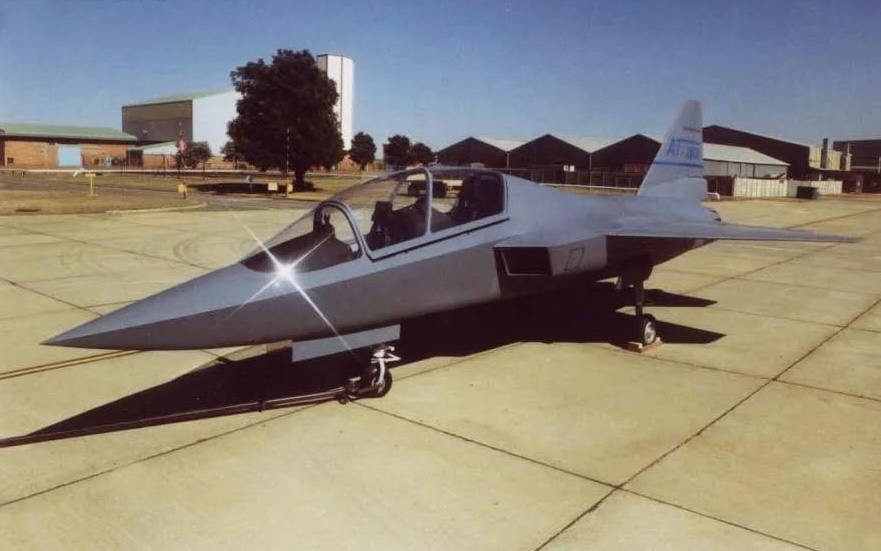
Three versions of Mako were planned, including Mako HEAT (High Energy Advanced Trainer), a single-seat Light Combat Aircraft (LCA), and a two-seat LCA. EADS partnered with several international partners to share cost and risk. In 2001, several companies from Europe, North America, and the Middle East signed Memoranda of Understanding (MoU) regarding potential participation in the Mako program. A Mako cockpit demonstrator was displayed at the 2001 Paris Air Show. Potential Mako suppliers that provided equipment for the demonstrator included BAE Systems North America (throttles and sticks), Essex Industries (grips), Martin Baker (front ejection seat), and Goodrich (rear ejection seat). The United Arab Emirates Air Force participated in early definition studies but did not commit to development. Other export efforts targeted South Korea and South Africa. In both cases, competing aircraft were selected instead. By the early 2000s, development costs were estimated at roughly €1.5 billion ($1.7 billion). EADS had invested more than $100 million by 2004. However, the company stated that around 60 firm orders would be required to formally launch production, while no launch customer had been secured.
No Orders
During the same period, competitors moved forward. The KAI T-50 flew in South Korea, and the Alenia Aermacchi M-346 made its first flight in 2004, with both aircraft entering production. The multinational European training initiative, which the Mako had once targeted, experienced repeated delays. Eventually, EADS itself partnered with Aermacchi on a proposal based on the M-346 rather than the Mako. That decision effectively ended the Mako’s prospects. In the end, no prototype was built; only a full-scale mock-up and a cockpit demonstrator were displayed at air shows, but the aircraft never flew. By the late 2000s, the Mako program had quietly been set aside. Without domestic European orders or export commitments, the business case could not be justified. The market for advanced trainers was becoming crowded, and governments were careful about funding new development programs, while Mako was still just a design study. Like many aircraft in the Grounded Dreams series, it has defined systems, selected engines, and projected performance, but it never entered production. Mako represented one of several European aerospace efforts of the post-Cold War period that reached technical maturity on paper but never flew. Read more Grounded Dreams articles HERE.