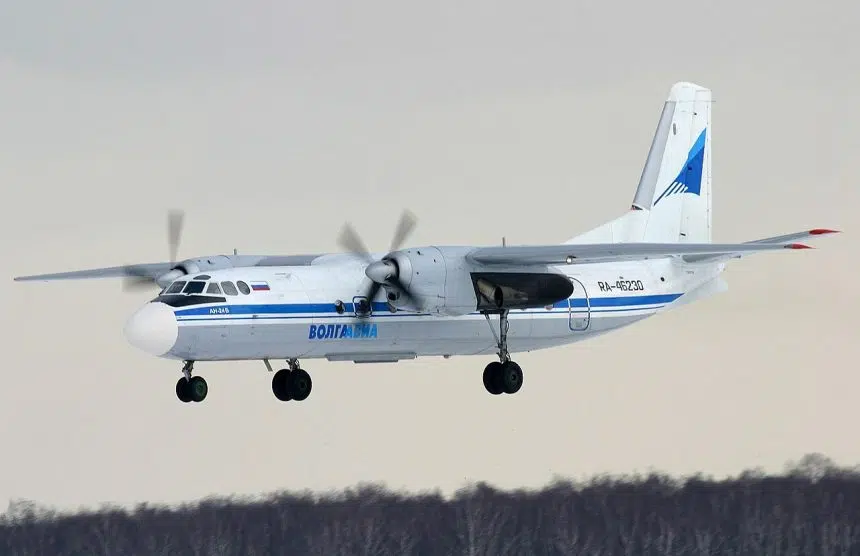

On this day in aviation history, 67 years ago (October 29, 1959), the Antonov An-24 took flight for the first time. Known to NATO as the “Coke,” the twin-engine turboprop was developed in the Soviet Union as a rugged regional airliner capable of operating from remote and poorly prepared airfields. Designed beginning in 1957, the An-24 was intended to replace the aging piston-powered Ilyushin Il-14 on short- and medium-distance routes. Antonov developed a high-wing aircraft powered by two Ivchenko AI-24 turboprops. Its high-mounted engines helped protect the propellers from debris, while rugged construction and minimal ground-support requirements allowed the aircraft to operate from unprepared airstrips throughout the Soviet Union.

The An-24 entered passenger service in 1962 and proved highly successful. Its rugged airframe was adapted for numerous roles, including military transport, ice reconnaissance, and aerial surveying. The basic design also led to the An-26 tactical transport, An-30 survey aircraft, and more powerful An-32. A total of 1,367 An-24s were constructed in the Soviet Union, while the design was also developed and produced in China as the Xian Y-7 family. The An-24V measured 77 feet 1 inch in length with a wingspan of 95 feet 10 inches and was powered by two 2,820-horsepower Ivchenko AI-24A turboprops. It could reach approximately 310 mph, cruise at around 280 mph, and had a range of roughly 1,700 miles with maximum fuel. The aircraft had a service ceiling of approximately 27,600 feet and could accommodate around 50 passengers.