


(Image credit: VAN)
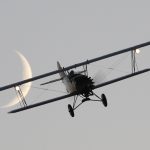
On this day in aviation history, 106 years ago (November 10, 1919), the first flight of the Blériot-SPAD S.27 was successfully completed. The S.27 was a French airliner that was designed by André Herbemont and built shortly after the end of the First World War. When the Great War came to a conclusion, Blériot began to seek markets within which to sell their surplus warplanes. By adapting their fighting planes into aircraft suitable for the civilian world, Blériot hoped to gain market share and overall popularity as a quality aircraft manufacturer.

Blériot’s SPAD S.27 was a modified S.20 (originally dubbed the SPAD S.XX) fighter plane. Developed too late to see combat in World War One, the surplus S.20s would find a new life as small airliners. Approximately 100 SPAD S.20s were built, and 10 of them were retrofitted as S.27s. The SPAD’s fuselage was overhauled into a cabin that could accommodate two passengers. Beyond the cabin augmentation, the S.27 looked nearly identical to the original S.20 fighter.

Compagnie des Messageries Aériennes (CMA), a French airline, operated three SPAD S.27s on its Paris – London route. CMA eventually merged into another French airline, Air Union. By the time of this merger, the total fleet of S.27s had risen to 10. Seating for a single pilot and two passengers was present within the SPAD S.27. The aircraft had a wingspan of 31 feet – 11 inches and was 23 feet – 11 inches long. A gross weight of 2,778 pounds and an empty weight of 1,874 gave the SPAD a useful load of 904 pounds. A 300-horsepower Hispano-Suiza 8Fa water-cooled V8 engine powered the S.27 to a maximum speed of 140 miles per hour. In a cruise, Blériot’s fighter-turned-airliner had an endurance of 3 hours.