







(Image credit: VAN)
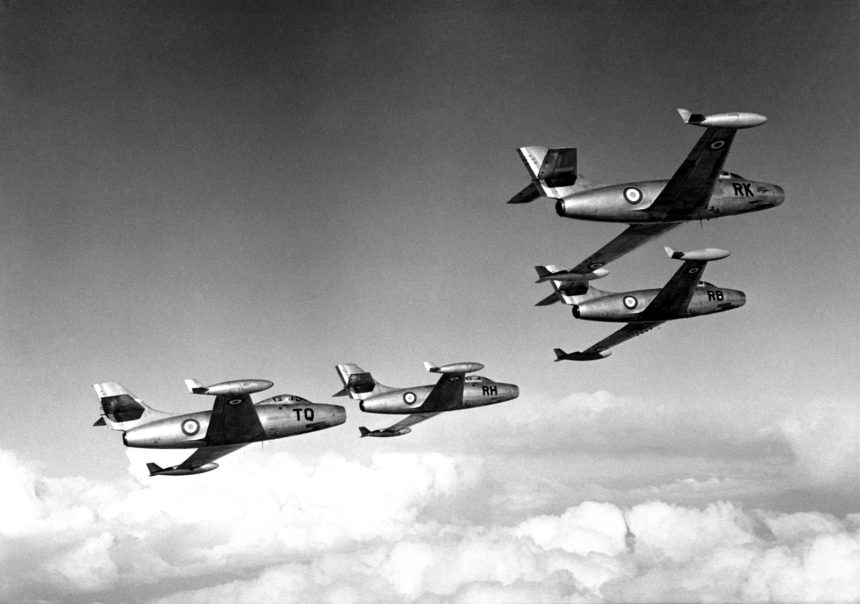
On this day in aviation history, 77 years ago (February 28, 1949), the first flight of the Dassault M.D.450 Ouragan took place. French for Hurricane, the Ouragan was a jet-powered fighter-bomber designed and manufactured by Dassault Aviation. Dassault began developing the Ouragan as a private venture, with the intent of producing an all-French aircraft powered by jet propulsion. The German occupation of France during the Second World War hindered the nation’s ability to experiment with jet aircraft, and there was some “catching up” to do.
French aircraft designer Marcel Bloch had returned to France in March of 1945, after a lengthy captivity at the Buchenwald concentration camp, at the hands of the Germans. Bloch was avid about re-igniting France’s aviation industry, primarily through jet technology. He wanted to begin work on a French fighter jet right away, in hopes of “cornering the market” both at home and abroad. Marcel would start a new company, Dassault, in early 1946, while subsequently changing his last name to match. The name Dassault had significance, as was Marcel’s brother’s wartime codename in the French Resistance.
Dassault drew inspiration for its new jet fighter primarily from American designs, rather than British. Aircraft such as the Lockheed P-80 Shooting Star and North American F-86 Sabre served as templates for the French firm’s design. Manufacturing of the M.D.450 prototype began on April 7, 1948, which was shortly followed by a contract issuance. Contract #2223/48 from the Service Technique de l’Aéronautique of the Ministère des Armées Air ordered the construction of three M.D.450 prototypes. The resulting fighter jet drew heavy inspiration from the Republic F-84 Thunderjet, having a striking resemblance at the time the prototypes began to roll off the assembly line.
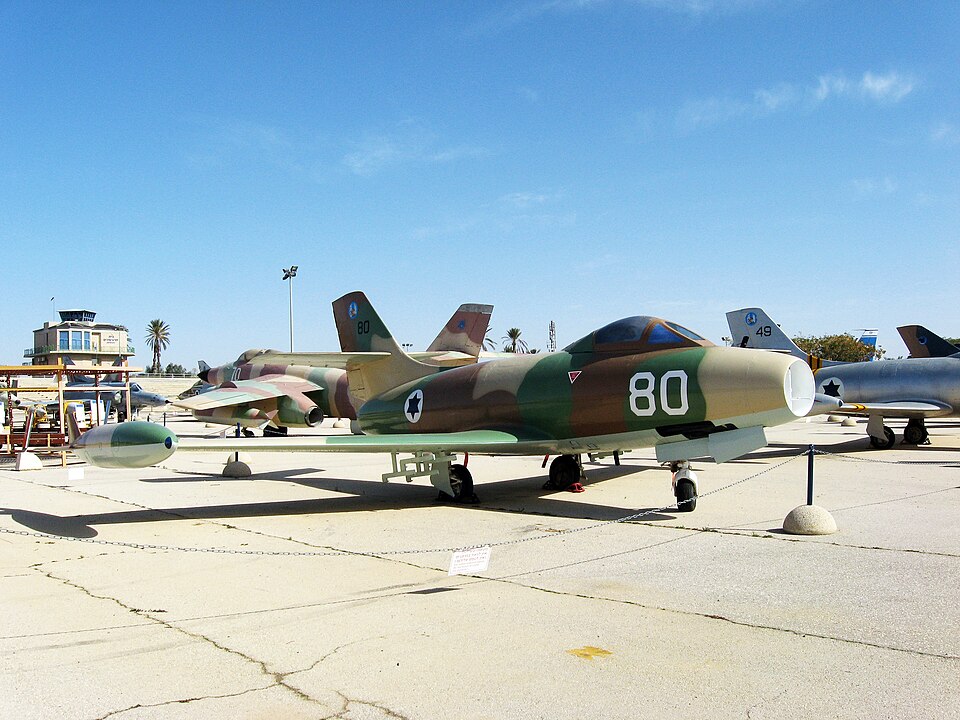
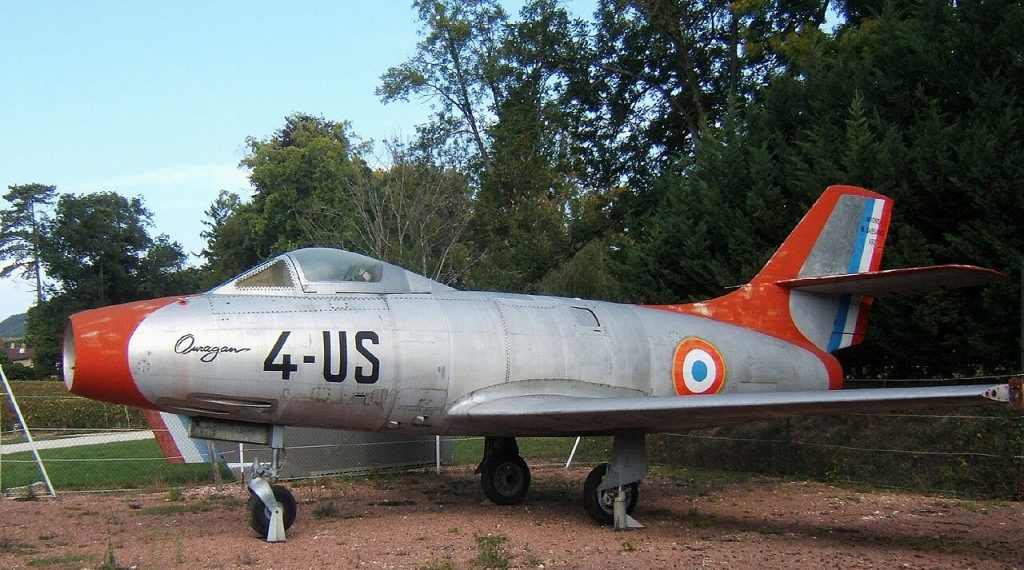
The M.D.450 had a cylindrical fuselage, tapered at both ends, and an air intake on the nose: standard convention for jet fighters of the period. The aircraft featured a bubble canopy, tricycle landing gear, thin wings, and a swept-back vertical stabilizer. Dassault opted to use the Rolls-Royce Nene Mk.104B turbojet engine, which provided the fighter with 5,000 pounds of thrust. The Nene was able to power the M.D.450 to a maximum airspeed of 580 mph, or to hang at a cruise speed of 470 mph. The Ouragan had a combat range of 240 nautical miles, a service ceiling of 43,000 feet, and a 7,500 feet per minute rate of climb. Armament came in the form of four 20 mm Hispano-Suiza HS.404 cannons, rockets, and up to 2,002 pounds of payload on the aircraft’s four underwing hardpoints. Dassault built just north of 567 M.D.450s between 1948 and 1954. The French-built jet-fighter would serve with the French, Indian, Israeli, and El Salvador Air Forces. A handful of Ouragans are known to exist today, fewer than half a dozen, all on display in Europe and the Middle East.
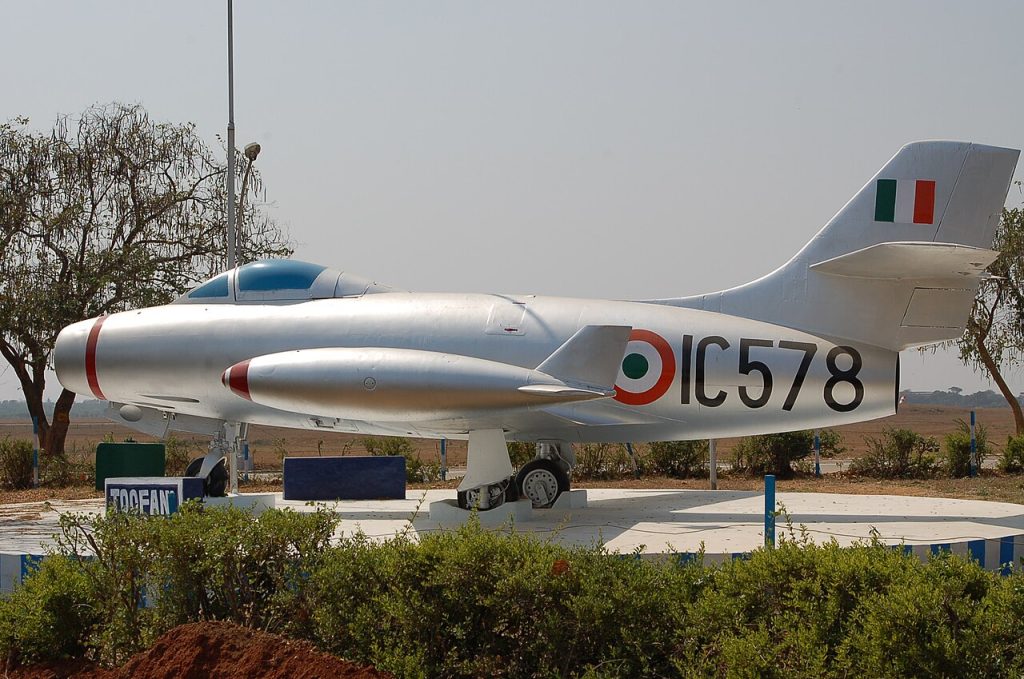



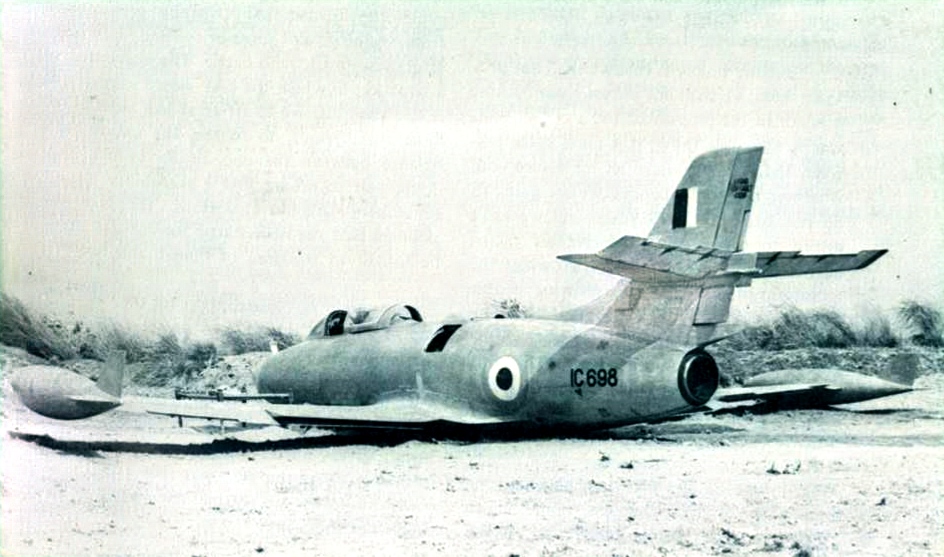
The Indian Air force has been repeatedly letting down Dassault Aviation. The first instance of the disrepute was in the 1965 India Pakistan war when an Indian pilot surrendered an armed French Oregon fighter jet,later blaming the jet.
Seventy years later the Indians repeated this disgrace to Dassault Aviation by letting at least three of these invincible jets to be shot down by Pakistan Airforce bringing tremendous amount of disrepute to Rafale jets which had so far a myth of being invincible.
When will the Frenchmen learn and at what cost??