






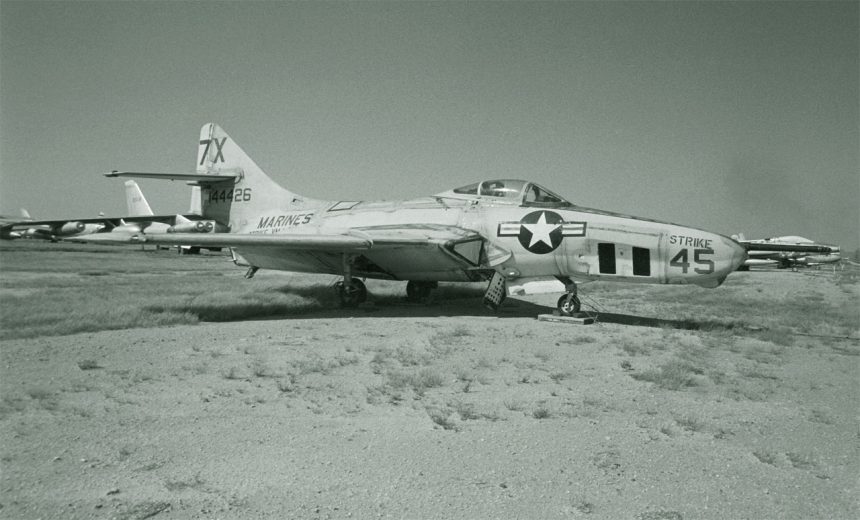

As we continue the Boneyard Files series, which showcases some of the retired aircraft resting at Davis-Monthan Air Force Base in Tucson, Arizona, in the late 1960s, today’s story features the Grumman F-9F Cougar through the lens of Neil Aird’s “Monthan Memories” photos. The Cougar was the first US Navy fighter jet with a swept-wing design for aircraft carriers. In October 1946, the Navy awarded Grumman a contract to develop the F9F Panther, which included a requirement for design plans for a swept-wing version of the fighter. Grumman was concerned about the poor low-speed performance of swept-wing aircraft, so they asked the Navy to postpone the development of the swept-wing Panther. However, the need for a swept-wing Panther became increasingly urgent when Soviet MiG-15s began flying over Korea in November 1950. The MiG-15 was powered by an engine similar to the one used in the Panther, but it was almost 100 mph faster. By Christmas 1950, the Navy and Grumman agreed to accelerate the development of a swept-wing version of the Panther and, on March 2, 1951, signed a contract to modify three Panther airframes for this purpose.
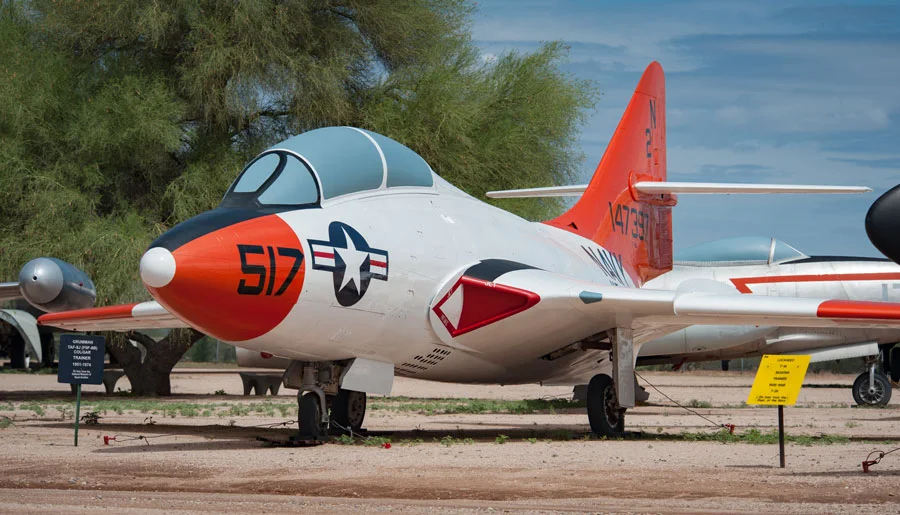
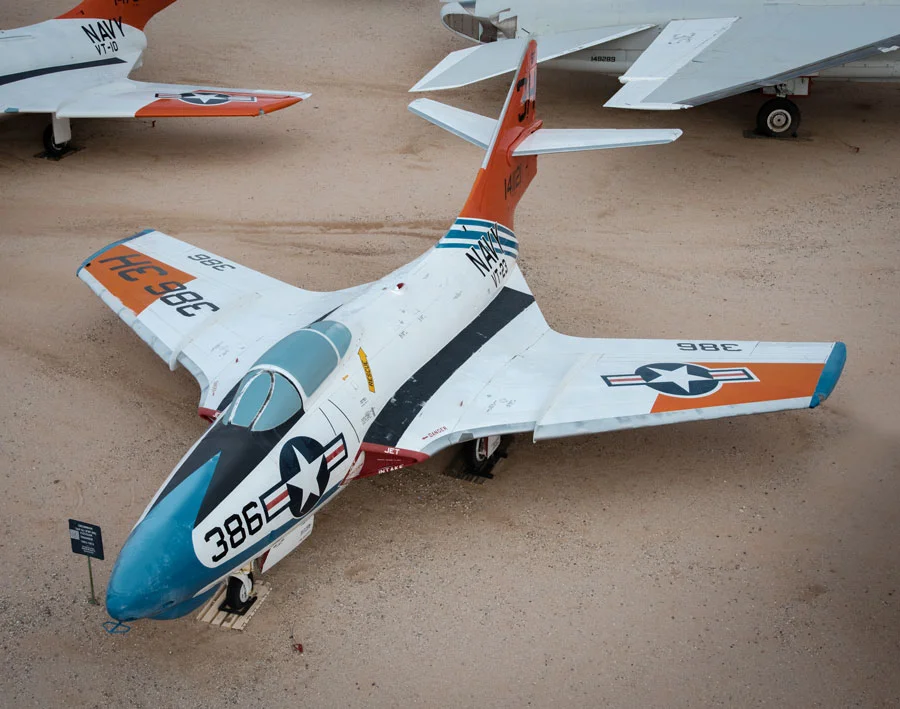
Grumman modified the F9F-5 Panther by retaining its fuselage, vertical tail, engine, and landing gear, and adding new wings and a 35-degree-swept horizontal tail. To improve the aircraft’s performance at slow speeds, the company made the wing larger by adding extended leading-edge slats and larger split flaps under the fuselage. The engineers also expanded the fuselage by 2 feet, moved the wing-root-mounted air intakes forward, and enlarged the wing-root fillets. The upper section of the rudder stayed the same, but it was connected to a yaw damper for better control. To maintain performance, Grumman had to remove the wingtip fuel tanks, which reduced fuel capacity. The new version was initially called the F9F-6 Cougar, later designated the Grumman F-9F Cougar in 1962. The first F-9F Cougar was ready to fly just six months after the contract was signed, and the Cougar flew for the first time on September 20, 1951. The single-seat aircraft was 40.11 feet long, 12.3 feet high, with a wingspan of 34.6 feet, and a wing area of 300 square feet. The empty weight of the aircraft was 11,483 pounds, the gross weight was 15,800 pounds, and the maximum takeoff weight was 21,000 pounds. The Grumman F-9F Cougar was powered by a Pratt & Whitney J48-P-8 centrifugal-flow turbojet engine, producing 7,250 pounds of thrust at 11,000 rpm for takeoff and 5,600 pounds of thrust at 10,450 rpm for continuous operation at sea level.
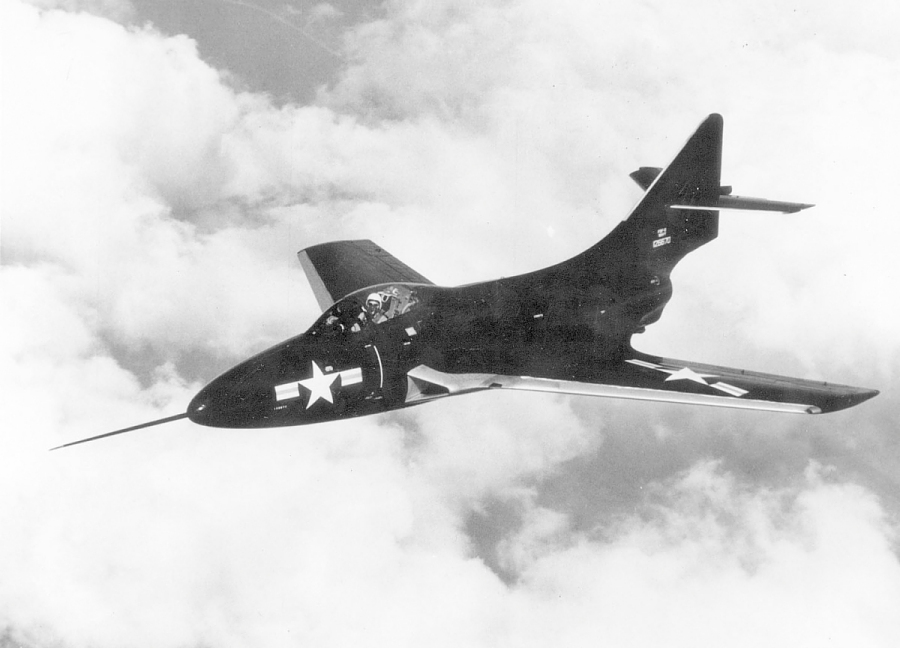
The maximum speed of the aircraft was 654 mph at sea level, and the cruise speed was 541 mph. It was armed with four 20 mm cannons, six 127 mm rockets, and two 1,000-pound bombs on inboard pylons and two 500-pound bombs on outer pylons. The Grumman F-9F Cougar was inducted into US Navy service in 1953, but arrived too late for its intended use in the Korean War. Its only combat experience was in Vietnam, where four two-seat training versions were used shortly as forward air control aircraft. The F9F-8 Cougar was the last fighter version and later served as an advanced jet trainer. On April 1, 1954, three F9F-6s from Fighter Squadron 21 made the first transcontinental flights in under four hours. Their record times for the 2,438-mile flight from San Diego to Floyd Bennett Field in New York were 3 hours, 35 minutes, and 30 seconds; 3 hours, 46 minutes, and 49 seconds; and 3 hours, 48 minutes. The Cougar was also the first swept-wing airplane flown by the Blue Angels flight demonstration team. Nearly 2,000 Cougars were built for the Navy and Marine Corps, serving as fighters, ground-attack planes, photo-reconnaissance aircraft (such as the RF-9F and RF-9J), and training aircraft. In the mid-1960s, the US Navy began retiring the Grumman F-9F Cougar, and some were sent to Davis-Monthan Air Force Base, known as “The Boneyard.” Read more Boneyard Files Articles HERE.









The author seems to be having trouble discerning the differences between the old (pre-1962) USN designation system and the Tri-Service system it replaced. F9F, in the old BuAer system, referred to ALL Panther and Cougar types. F-9F was one variant, but under the new system. It was F9F-6 under old. Picky, I know, but I think accuracy matters.