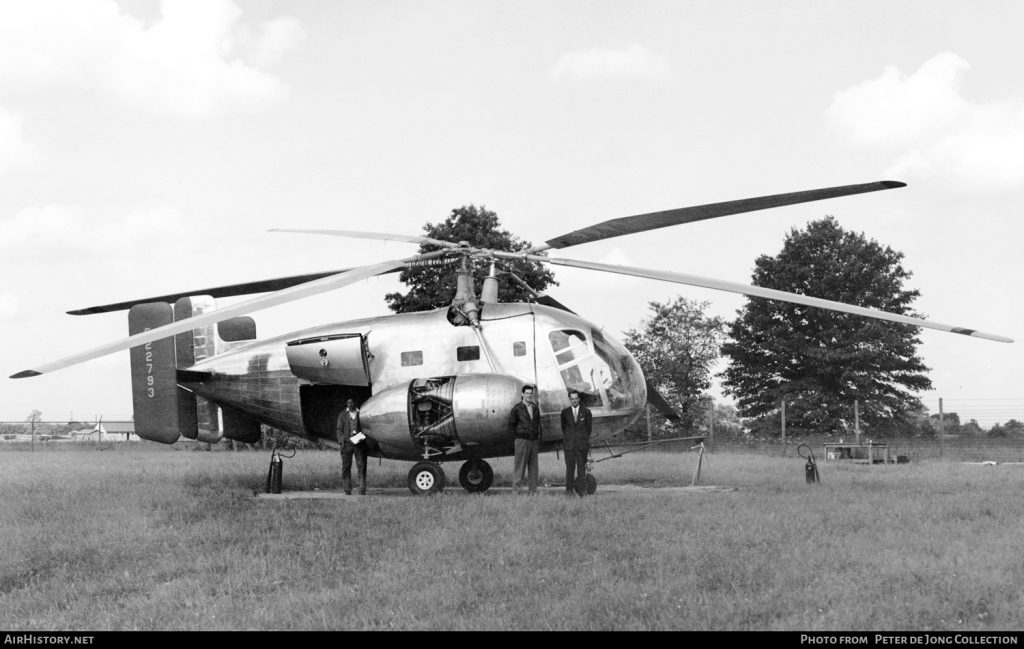
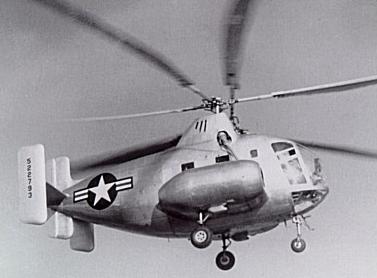


In the 1940s, the US Army Air Force (USAAF) was looking for a helicopter to transport troops, cargo, and wounded personnel. In response to the USAAF’s requirement, Kellett Autogiro Corporation proposed an enlarged version of its XR-8 helicopter equipped with twin intermeshing rotors. The aircraft, designated Kellett XR-10, was accepted by the USAAF, and the service ordered two prototypes. In April 1947, the first prototype of the Kellett XR-10 made its maiden flight. At that time, it was the largest and most powerful rotorcraft designed for the USAAF.
Design of Kellett XR-10
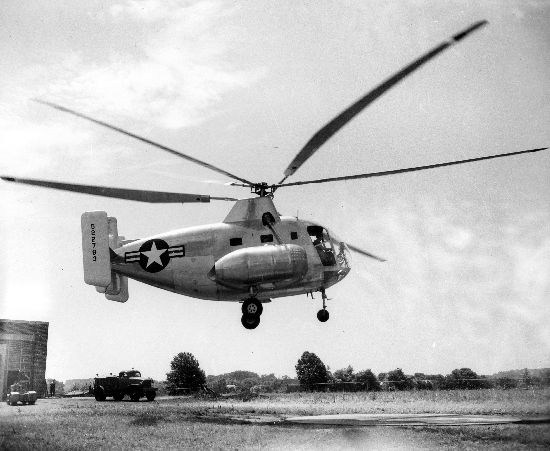
The rotors were powered by two engines mounted on either side of the Kellett XR-10, keeping the cargo area clear. The rotor blades could move up and down and side to side. In the side-to-side movement, special dampers reduced vibrations. The position of the blades was dependent on the force generated by spinning and the weight they carried, but there were limits to how far they could move. The rotors worked together through a connection between the upper gear systems. With a crew of two, the all-metal aircraft could carry 10 troops or 1,100 pounds of cargo. The Kellett XR-10 was 28.8 feet long, 13.9 feet high, with an empty weight of 8,200 pounds and a gross weight of 11,000 pounds. It was powered by two Continental R-975-15 nine-cylinder radial engines, each producing 525 horsepower. The aircraft had two main rotors, each having a diameter of 65 feet and an area of 3,320 square feet. The aircraft’s maximum speed was 120 mph, its range was 362 miles, and its endurance was nearly 5 hours at 62 mph. The service ceiling was 6,000 feet, and the XR-10 could fly at gross weight on just one engine at altitudes up to 4,500 feet.
The Cancellation
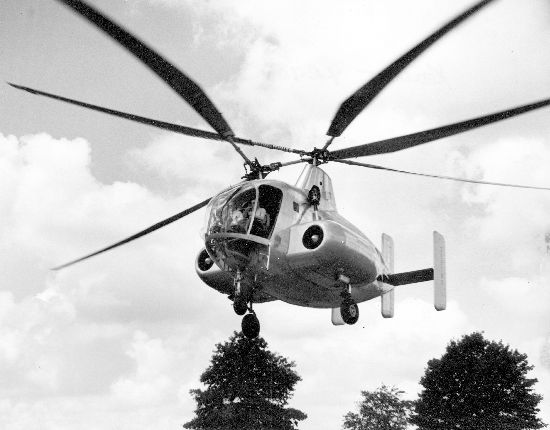
The Kellett XR-10 performed well during the flight test, but it had the same problem as XR-8’s rotor system. It was revealed that a blade from each rotor hit the other while the aircraft was flying. After making some fixes, flight testing continued. However, on October 3, 1949, the first prototype crashed due to a control-system failure, killing Kellett’s chief test pilot, Dave Driskill. The project was canceled shortly after this incident, and the 16-seat civil version, called the KH-2, never went beyond the design stage. In the Grounded Dreams series, the Kellett XR-10 was a helicopter project beset by many problems, sometimes with the rotors and sometimes with the control system. Read more Grounded Dreams articles HERE.