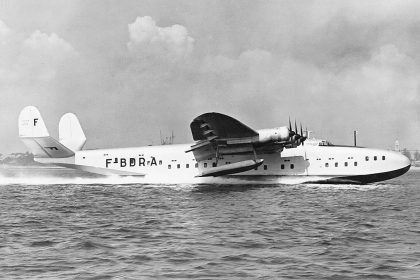
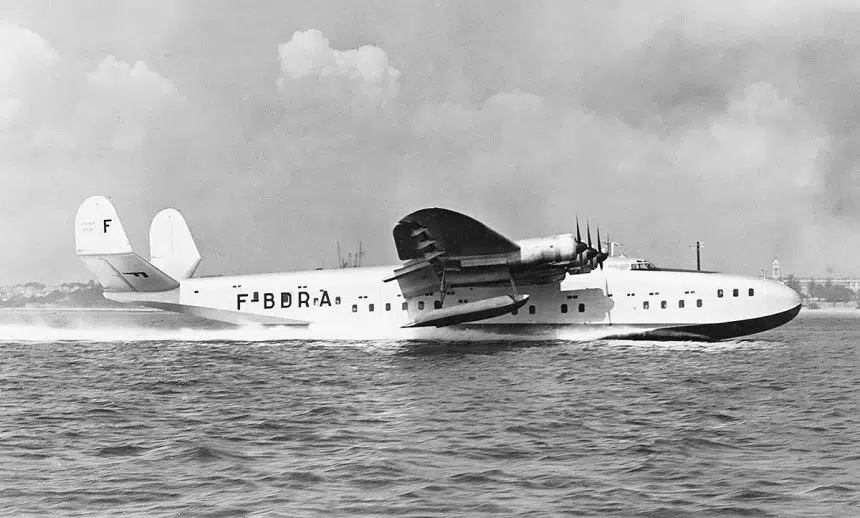


On this day in aviation history, 84 years ago (November 4, 1942), the Latécoère 631 took flight for the first time. Registered F-BAHG, the prototype six-engine French flying boat departed from the waters of Lake Berre near Marignane, France. Developed as a long-range transatlantic passenger aircraft, the Latécoère 631 was the largest flying boat ever constructed at the time of its maiden flight. Development of the Latécoère 631 began in response to a 1936 French Air Ministry requirement for a large flying boat capable of carrying passengers and cargo across the Atlantic Ocean. Designed by Pierre-Georges Latécoère, the aircraft featured an all-metal structure, an unusual V-tail, and retractable stabilizing floats that folded into the outer engine nacelles. Construction began before World War II but was interrupted by the outbreak of hostilities and the subsequent German occupation of France.

Despite wartime difficulties, the prototype completed its first flight in November 1942 and demonstrated promising performance. It was subsequently confiscated by German forces and transferred to the Luftwaffe, receiving the identification code 61+11. The aircraft was moved to Lake Constance, where it was destroyed during an attack by two RAF Mosquitos on April 17, 1944. Development resumed after the war, and Air France introduced the Latécoère 631 on transatlantic routes in July 1947. However, mechanical difficulties, high operating costs, and several fatal accidents ultimately brought its career to an end. Eleven aircraft, including the prototype, were constructed. The Latécoère 631 measured 142 feet 7 inches in length with a wingspan of 188 feet 5 inches. Production aircraft were powered by six Wright GR-2600-A5B Twin Cyclone radial engines producing 1,600 horsepower each. The enormous flying boat could reach a maximum speed of 245 mph, cruise at approximately 183 mph, and had a range of 3,750 miles. It carried a crew of five and could accommodate up to 46 passengers, with a maximum takeoff weight of approximately 165,347 pounds.