

(Image credit: VAN)
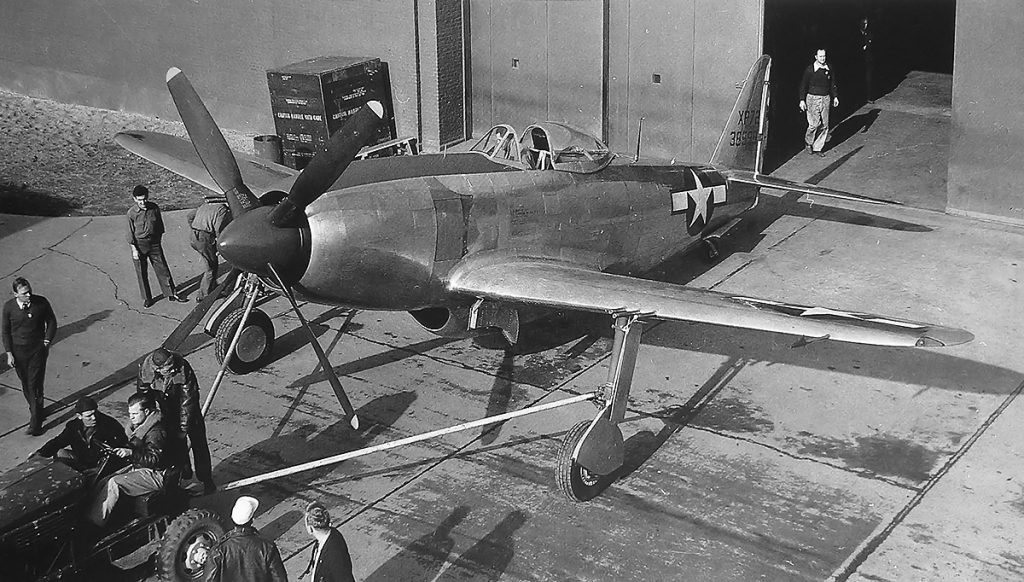
On this day in aviation history, 82 years ago (February 2, 1944), the first flight of the Republic XP-72 occurred. The XP-72 was a fighter-interceptor prototype developed as a progression of the highly successful P-47 Thunderbolt design by Republic Aircraft. Initially, the XP-72 was developed in parallel with Republic’s experimental 42-cylinder Wright R-2160 radial-powered XP-69. However, as both aircraft progressed through development, the XP-72 showed greater promise of the two. The XP-69 was canceled on May 11, 1943, and an order for two XP72 prototypes was made on June 18, 1943.

The first XP-72 prototype to fly was equipped with a four-bladed propeller, while the second spun an Aero-Products contra-rotating propeller. During flight testing, the XP-72 displayed superb performance, leading to an order for 100 production aircraft. As the XP-47 soared through flight tests, the need above the battlefield in World War II had evolved. No longer was there a need for high-speed interceptors. In lieu of long-range fighter escorts, the new priority became. Additionally, the idea of turbojet-powered interceptors showed greater promise than those driven by props. The production order for the P-72 was canceled.

Republic’s XP-72 was powered by a 3,500-horsepower Pratt & Whitney R-4360-13 radial engine that propelled the interceptor prototype to a maximum airspeed of 490 mph. The XP-72 had a range of 1,000 nautical miles, a service ceiling of 42,000 feet, and a 5,280 feet per minute rate of climb. Three different armament configurations were under consideration for the production P-72, the first being six .50 caliber Browning machine guns. Alternatively, a loadout of two 37 millimeter M4 cannons and four .50 caliber Browning machine guns, or four 37 mms and two 1,000-pound bomb, was an armament possibility. Neither of the two XP-72s built survives, so we are left with the images and flight testing records, wondering “what if?”