

Today In Aviation History: North American XB-70 Valkyrie Breaks Mach 3

On October 14, 1965, the North American XB-70 Valkyrie achieved a major milestone when it surpassed Mach 3, reaching 2,056 mph at 70,000 feet. Designed as a high-altitude strategic bomber during the Cold War, the six-engine aircraft pushed the boundaries of aerodynamics and engineering, becoming one of the fastest and most ambitious aircraft ever built.

Austin Hancock
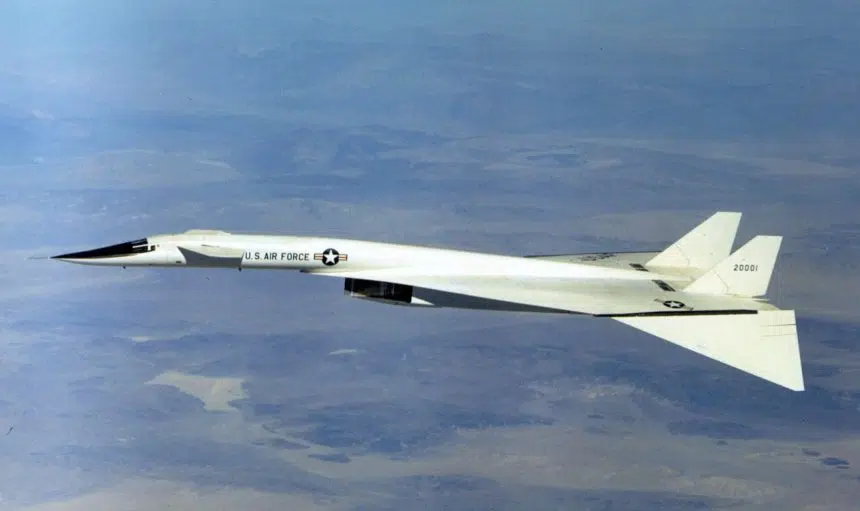
North American XB-70A Valkyrie in flight. (Image credit: U.S. Air Force/Wikimedia Commons)
AirCorps Aircraft Depot
VAN Today in Aviation History Banner
Welcome to VAN’s Today in Aviation History (Image credit: VAN)

On this day in aviation history, 61 years ago (October 14, 1965), the North American XB-70 Valkyrie exceeded Mach 3 for the first time. XB-70 AV-1, serial number 62-0001, reached Mach 3.02 at an altitude of 70,000 feet during the flight. The achievement demonstrated the extraordinary performance of an aircraft originally designed to carry nuclear weapons deep into Soviet territory at three times the speed of sound. Development of the B-70 began during the 1950s as the United States Air Force sought a new high-altitude strategic bomber to replace the B-52. North American Aviation developed a massive six-engine delta-wing aircraft capable of sustained Mach 3 flight. The XB-70 utilized compression lift generated by its own shock wave, while its outer wingtips could pivot downward as much as 65 degrees during high-speed flight. Two XB-70A prototypes were ultimately completed.

north american xb 70a valkyrie on the taxiway with a cherry picker. photo taken sept 21 1964 the day of the first flight 061122 f 1234p 017
North American XB-70A Valkyrie on the taxiway with a cherry picker. Photo taken Sept. 21, 1964, the day of the first flight. Note: The left main landing gear brakes locked during the landing, causing two tires to blow. (Image credit: U.S. Air Force/Wikimedia Commons)

The October 14 flight demonstrated both the capabilities and challenges of sustained Mach 3 flight. Heat and aerodynamic stresses damaged AV-1’s stainless-steel honeycomb structure, leaving approximately two feet of the left wing’s leading edge missing. Structural problems subsequently resulted in AV-1 being restricted to Mach 2.5. The second Valkyrie, AV-2, later reached Mach 3.08 and sustained Mach 3 for as long as 32 minutes before being lost in a mid-air collision in June 1966. AV-1 survives today at the National Museum of the United States Air Force. The XB-70 measured 185 feet in length with a wingspan of 105 feet and was powered by six General Electric YJ93 afterburning turbojets producing 28,000 pounds of thrust each. The Valkyrie could reach approximately Mach 3.1, or 2,056 mph, had a combat range of 4,287 miles, and a service ceiling of 77,350 feet. Its maximum takeoff weight exceeded 542,000 pounds, making the XB-70 one of the largest and fastest experimental aircraft ever constructed.
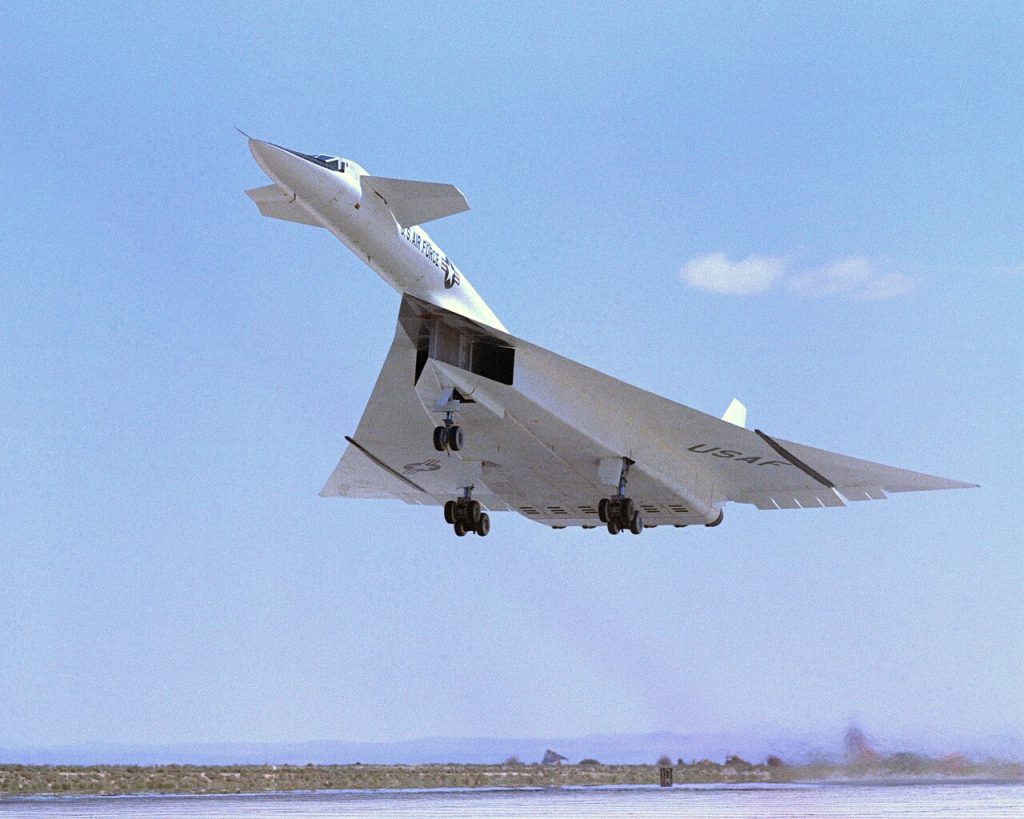

north american xb 70 above runway ecn 792 1
Viewed from the front the #1 XB-70A (62-0001) is shown climbing out during take-off. Most flights were scheduled during the morning hours to take advantage of the cooler ambient air temperatures for improved propulsion efficiencies. The wing tips are extended straight out to provide a maximum lifting wing surface.The XB-70A, capable of flying three times the speed of sound, was the world’s largest experimental aircraft in the 1960s. Two XB-70A aircraft were built. Ship #1 was flown by NASA in a high speed flight research program. (Image credit: NASA/Wikimedia Commons)
AirCorps Aircraft Depot
Share This Article
Commercial Pilot, CFI, and Museum Entrepreneur, with a subject focus on WWII Aviation. I am dedicated to building flight experience so I can fly WWII Fighters, such as the P-51 Mustang, for museums and airshows, and in the USAF Heritage Flight. I lead and run the Pennington Flight Memorial, to honor local MIA Tuskegee Airman F/O Leland “Sticky” Pennington.
Leave a Comment

Leave a Reply

Your email address will not be published. Required fields are marked *