Red Eagles: America’s Secret MiGs by Steve Davies is available on Amazon.
For American fighter crews training over the Nevada desert, few encounters could have been more surprising than finding a real MiG on the other side of a practice engagement. These were Soviet-designed fighters flown by American pilots, operating within a classified program intended to prepare U.S. aircrews for combat against the aircraft they might encounter in war. Steve Davies’s Red Eagles: America’s Secret MiGs tells the story of that operation through the people who built, maintained, and flew its unusual fleet. Drawing heavily on interviews with former participants, the book examines how a closely guarded collection of foreign fighters became an important part of America’s air combat training.

The program, known as Constant Peg, emerged from the difficult lessons of Vietnam. American crews needed more realistic preparation for fighting aircraft with different performance characteristics from their own. Aggressor squadrons, TOPGUN, and Red Flag helped address that need, while Constant Peg offered something particularly valuable: encounters with actual MiGs. Its purpose included reducing the uncertainty and nervous excitement that could accompany a pilot’s first combat engagement. The groundwork had been laid through earlier classified evaluations. Programs including Have Doughnut, Have Drill, and Have Ferry gave American specialists opportunities to investigate Soviet fighter technology and performance during the late 1960s. Constant Peg carried that knowledge into an operational training mission, bringing frontline crews into contact with the aircraft themselves. The 4477th Test and Evaluation Flight was established at Nellis Air Force Base on April 1, 1977, under Lt. Col. Glenn Frick. Gail Peck, a central figure in developing the program, subsequently oversaw its move to Tonopah Test Range in July 1979. The remote Nevada airfield provided a home for an undertaking whose aircraft and activities had to remain concealed. Even the program’s name had a personal connection. “Constant” came from Maj. Gen. Hoyt “Sandy” Vandenberg’s call sign, while “Peg” referred to Peck’s wife. The organization eventually became the 4477th Test and Evaluation Squadron, better known as the Red Eagles.

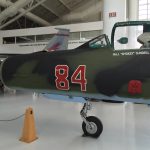
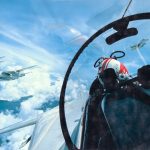
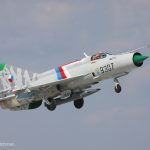
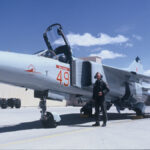
Its aircraft presented three distinct challenges. The MiG-17 Fresco was small and agile, making it a demanding opponent at close quarters. The supersonic MiG-21 Fishbed brought a different combination of speed, size, and performance. The variable-sweep-wing MiG-23 Flogger added a fast, powerful aircraft that was among the squadron’s most demanding machines to operate. Together, they exposed visiting crews to several generations of Soviet fighter development. Training progressed beyond simply seeing an unfamiliar aircraft. Crews began with familiarization, observing a MiG’s appearance and behavior, before practicing offensive and defensive maneuvering. More complex engagements followed. The experience allowed pilots to replace assumptions with firsthand knowledge and to practice responding before an encounter carried the consequences of combat. Keeping the fleet flying required an equally unusual maintenance effort. Aircraft restoration and parts availability shaped daily operations. According to Peck’s unit history, components sometimes had to be transferred between aircraft to make a particular MiG serviceable. New pilots also faced a striking limitation: the unit’s MiGs were single-seat aircraft, and there were no simulators. T-38s provided chase support during initial flights.

Davies gives considerable attention to the human cost. Fatal accidents involving Navy Lt. Cmdr. Hugh Brown in a MiG-17 and Air Force Capt. Mark Postai in a MiG-23 underscore the hazards behind the program’s achievements. His account also acknowledges the difficulty of reconstructing a secret operation from aging memories and an incomplete documentary record. Constant Peg’s flying operations ended in March 1988. Peck’s history credits the unit with more than 15,000 MiG sorties and training almost 6,000 Air Force, Navy, and Marine Corps aircrews. The Air Force publicly acknowledged the program in November 2006, bringing its work to a much wider audience. For aviation enthusiasts, Red Eagles preserves a remarkable chapter of Cold War flying: American crews learning the enemy’s aircraft from inside their cockpits, and a maintenance organization making that education possible far from public view.