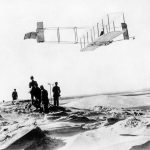
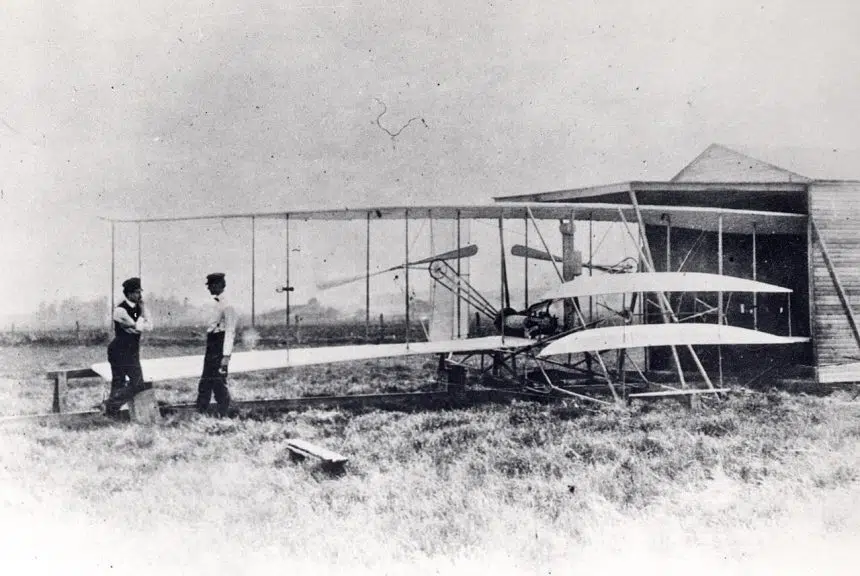

On this day in aviation history, 122 years ago (September 15, 1904), Wilbur Wright made his first successful turn while flying the Wright Flyer II. Taking off from Huffman Prairie near Dayton, Ohio, the achievement represented another important step toward transforming the Wright brothers’ airplane from a machine capable of straight-line flight into a practical, controllable aircraft. The Flyer II was the Wright brothers’ second powered airplane and closely resembled their historic 1903 Flyer. Changes included a slightly more powerful engine, a shallower wing camber, and the use of white pine rather than spruce in much of its construction. Flying from Huffman Prairie proved more difficult than at windy Kitty Hawk, however, and the brothers struggled to reach flying speed during the summer of 1904.

To solve the problem, the Wrights developed a catapult launching system using a falling weight to rapidly accelerate the aircraft along its launching rail. They began using the system on September 7, allowing longer and more controlled flights. Eight days later, Wilbur successfully turned the Flyer II in flight. On September 20, he went considerably further, completing the first full circle ever flown by an airplane. By the end of 1904, the brothers had made 105 flight attempts or flights with the Flyer II. The Wright Flyer II measured 21 feet 1 inch in length with a wingspan of 40 feet 4 inches and weighed approximately 925 pounds fully loaded. Its 15-horsepower four-cylinder engine drove two counter-rotating pusher propellers through chain drives. The aircraft could reach approximately 35 mph, while the Wrights’ best flights later in 1904 exceeded five minutes and covered around three miles.