







From an original article and research by Keith Wood
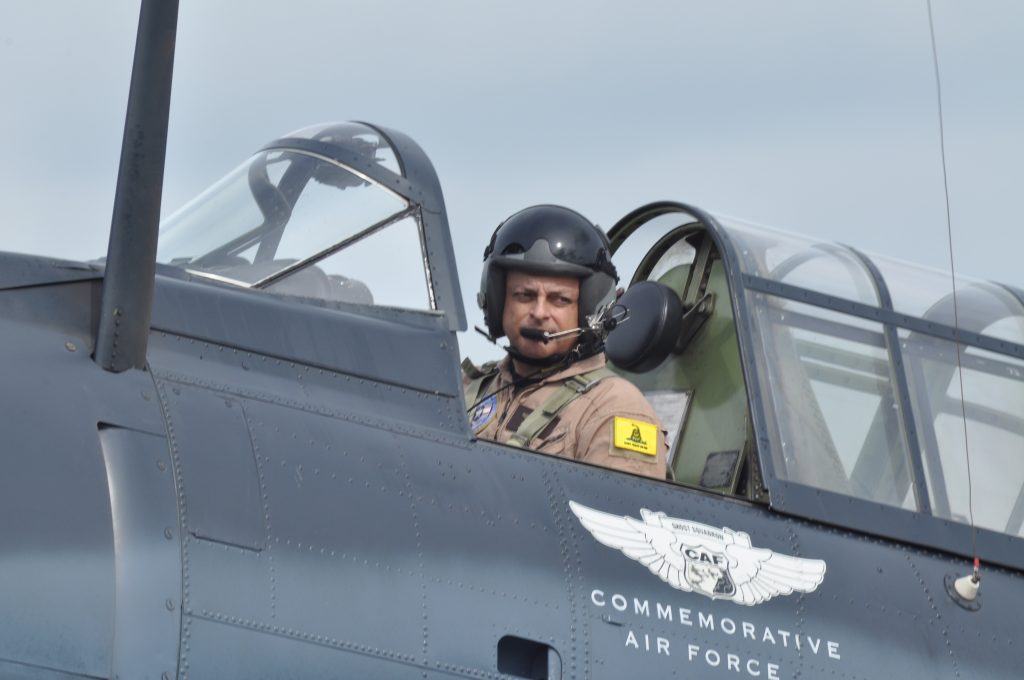
When you climb into the cockpit of a World War II dive bomber or any other Warbird, you’re not just flying a machine—you’re taking control of a living piece of history. But what happens when that history turns out to be wrong? That’s the question that drove Keith Wood, a pilot with the Commemorative Air Force’s (CAF) Airbase Georgia, to dig a few years ago into the origins of their Douglas SBD Dauntless. What he discovered was a tale of mistaken identity, ghost stories, aerial photography, and two airplanes with the same serial number—a journey that highlights how aviation history is often a puzzle missing more than a few pieces.
A Legend in the Hangar—But Which One?
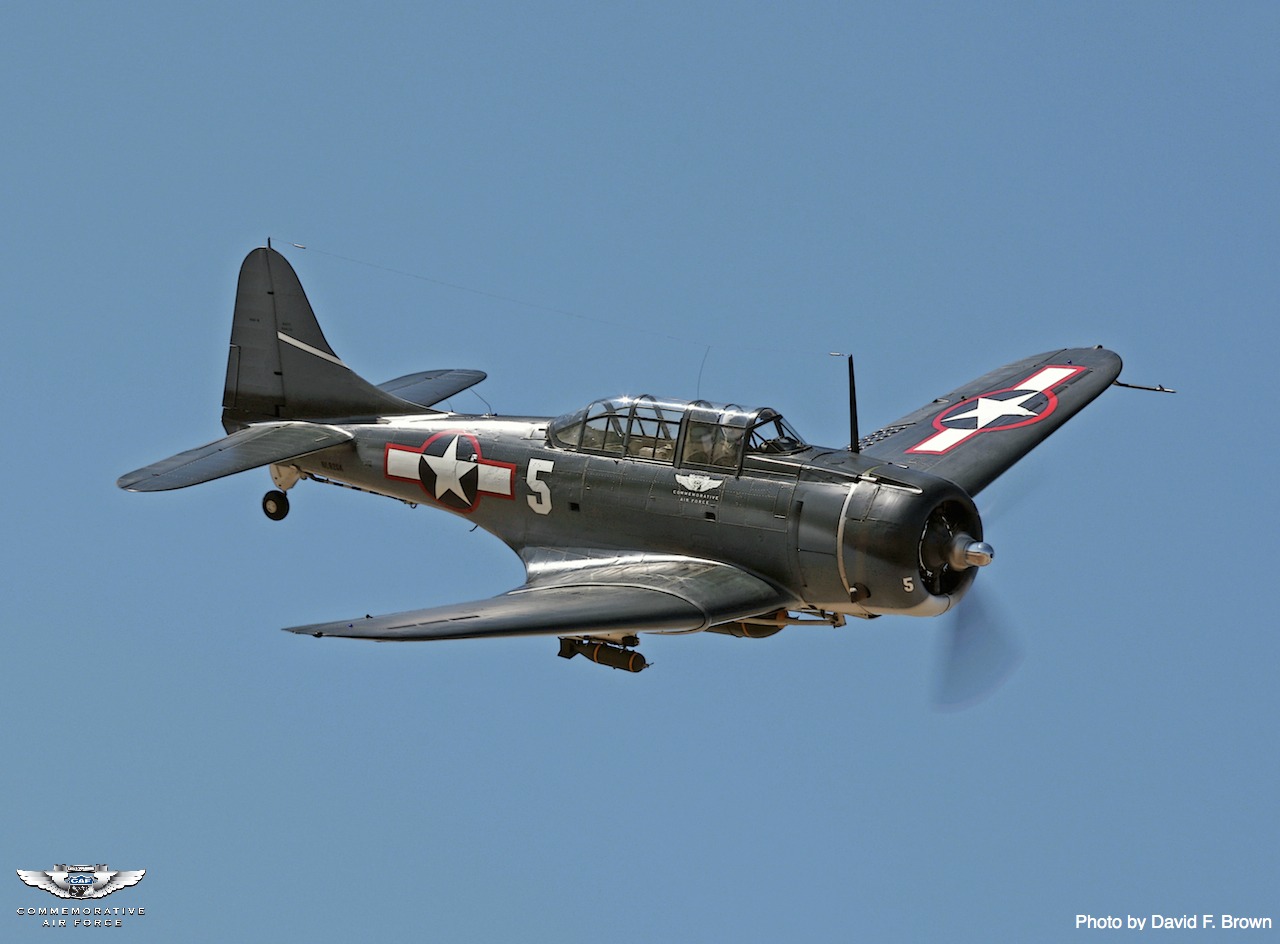
“Speedy D,” as she’s fondly known, arrived at the back then CAF Dixie Wing in 1991. At that point, it was one of the only two airworthy SBD Dauntless aircraft in the world ( the other one being the Planes of Fame’s aircraft); the airplane has wowed airshow audiences for decades. Back in those days, the commonly accepted history claimed she was a Douglas A-24B Banshee, the U.S. Army Air Forces’ version of the Navy’s SBD Dauntless. Built in Tulsa, Oklahoma, she was believed to carry the Army Air Forces serial number 42-54532.
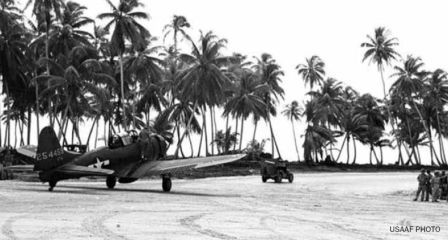
This seemed to line up with multiple publications and databases, which cited the aircraft as one of 615 A-24B-10-DTs ordered under Contract AC-28716 in 1942. Records showed 42-54532 was delivered to the USAAF on September 14, 1943, and soon shipped to Hickam Field in Hawaii, assigned to the 420th Sub Depot of the Seventh Air Force in the Pacific Theater. But then the trail took an ominous turn: on July 31, 1944, 42-54532 was listed as “CON”—Condemned—with the code “M” indicating “Missing Due to Enemy Action.” In other words, the aircraft was presumed lost in combat. As one source told Wood, “You’re flying a ghost.” Yet the plane clearly still existed, and Wood knew something didn’t add up.
The Truth Beneath the Paint
Realizing that the accepted story didn’t make sense, Wood began corresponding with respected aviation historians Dan Hagedorn and John Davis of the Latin American Aviation Historical Society. The breakthrough came with a single insight: there were two aircraft with the serial number 54532. The first was indeed A-24B 42-54532, lost in the Pacific. But the second was a U.S. Navy SBD-5, Bureau Number (BuAer) 54532, built at Douglas Aircraft’s El Segundo, California facility and accepted by the Navy on March 3, 1944.
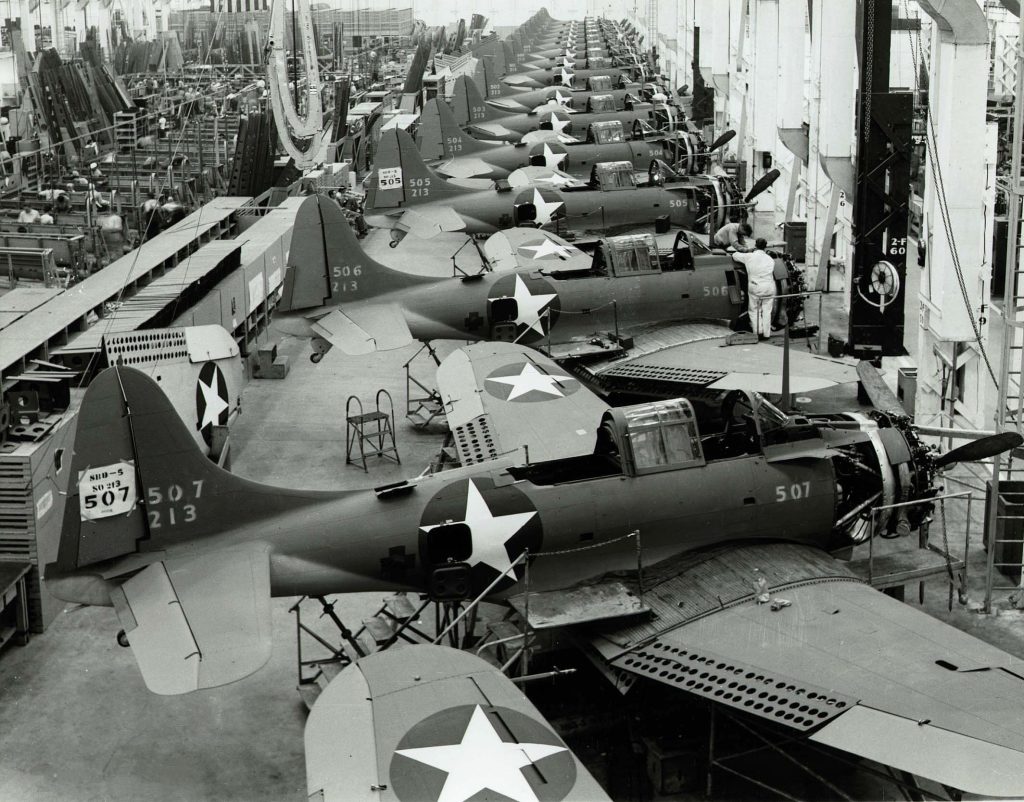
This SBD-5 never saw combat. After being delivered in April 1944, it was assigned to the Bureau of Aeronautics General Representative in Los Angeles—likely used as a transport or liaison aircraft. In June 1945, it was transferred to the Bureau’s Baltimore office, and in December 1946, it was moved into the general aircraft pool at NAS Norfolk. On February 8, 1947, it was struck from Navy records as “transferred to another agency.” That agency was the War Assets Administration, which listed the aircraft as for sale with the serial number 42-54532—the same as the lost A-24B, likely causing decades of confusion. But the construction number (c/n 6046) listed on its civilian registration, N1339V, correctly matched the Navy’s SBD-5 BuAer 54532.
From Warplane to Workhorse
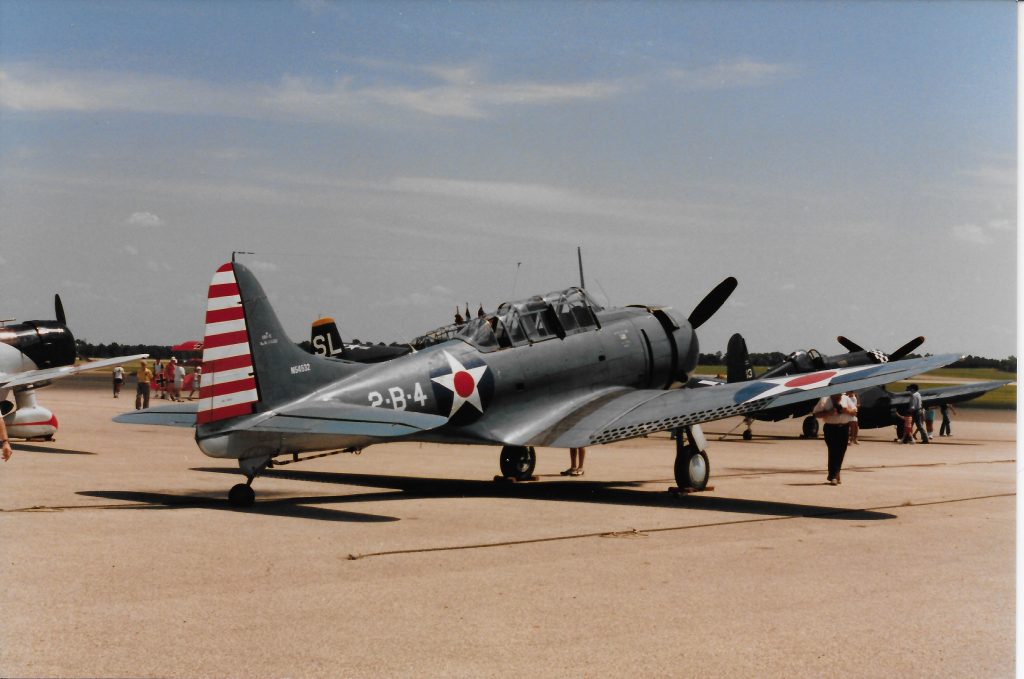
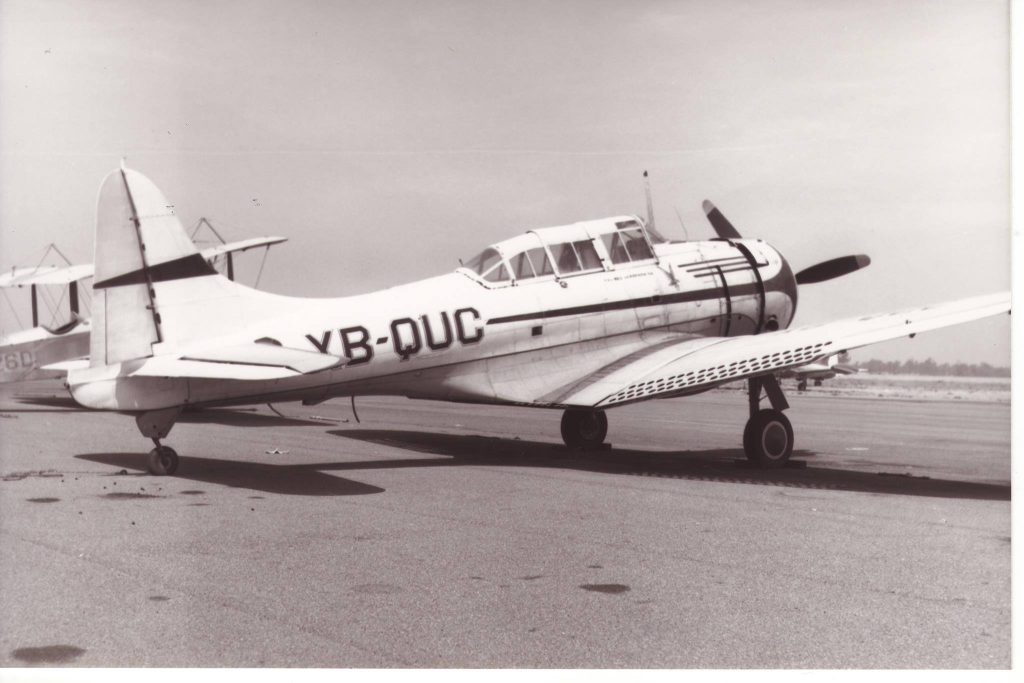
In civilian hands, the aircraft began a new life. It was first acquired by Andy Stinis of the Skywriting Corporation of America. Though intended for skywriting, the Dauntless burned fuel at nearly twice the rate of the company’s more efficient AT-6 Texans, making her uneconomical to operate. She was soon sold. In 1951, N1339V was purchased by CIA Mexicana Aerofoto, a premier aerial mapping firm founded by aviation pioneer Luis Struck. The aircraft was re-registered in Mexico as XB-QUC and spent the next 15 years taking photographs across Mexico and the United States—including work for PEMEX, the Mexican Electricity Commission, and even the U.S. Department of Agriculture in a project surveying the Mississippi Delta.
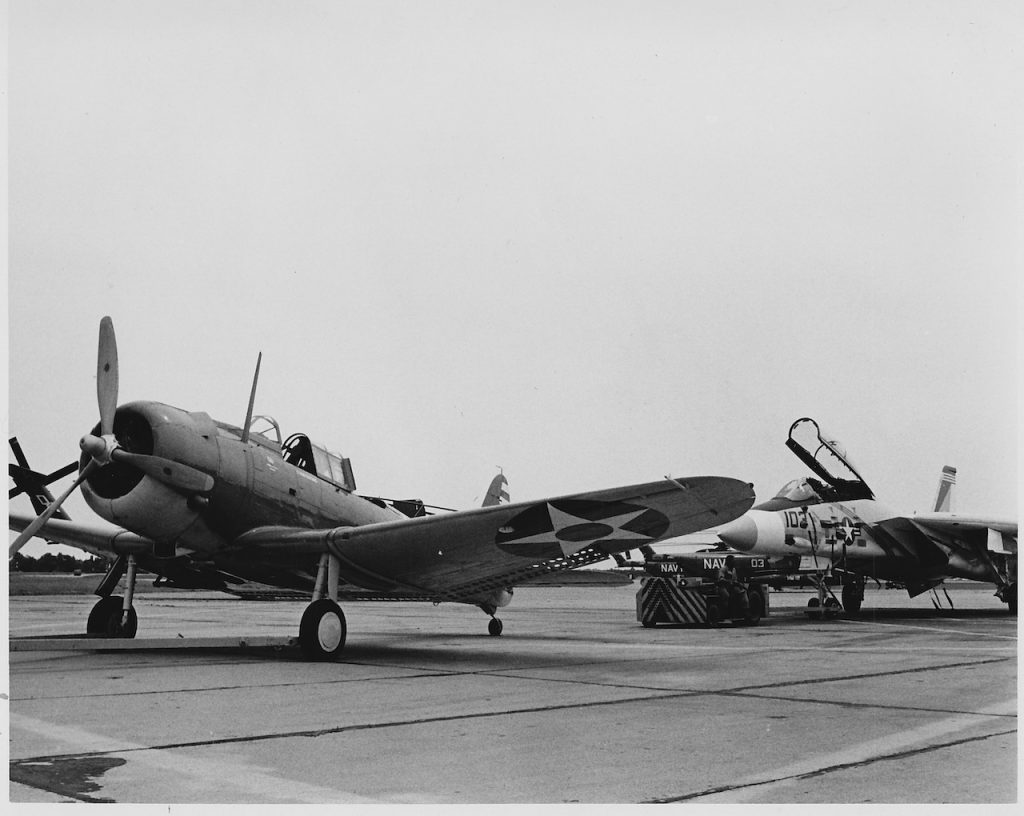
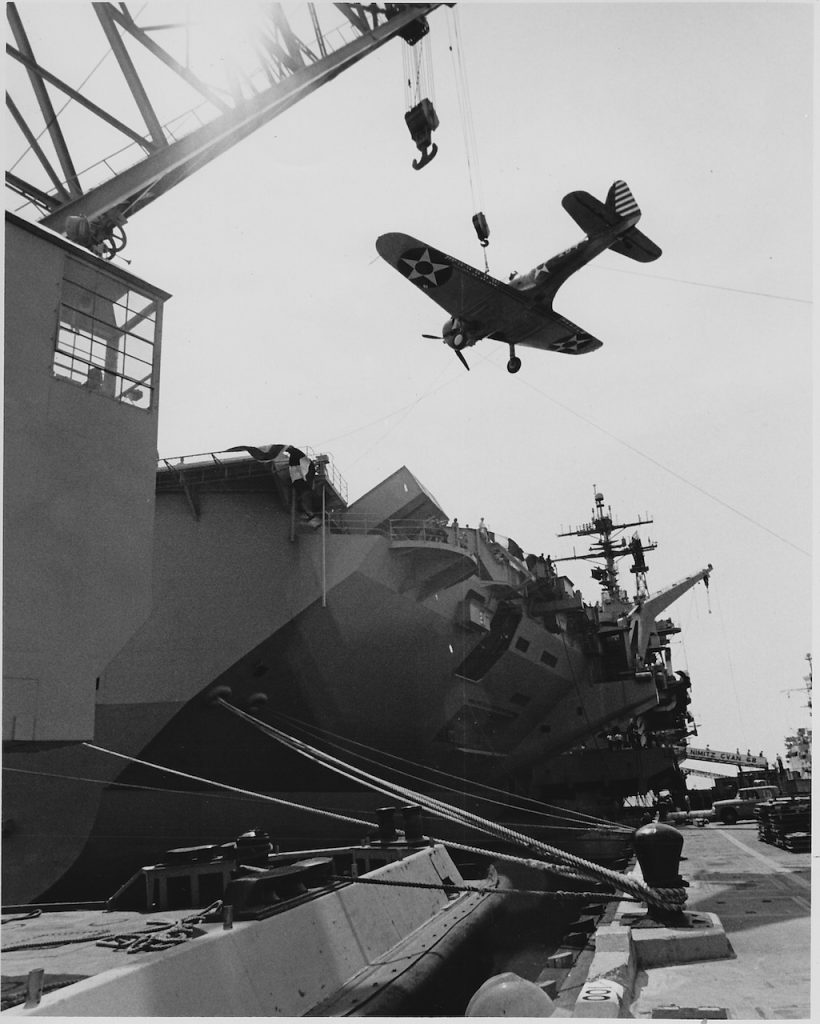
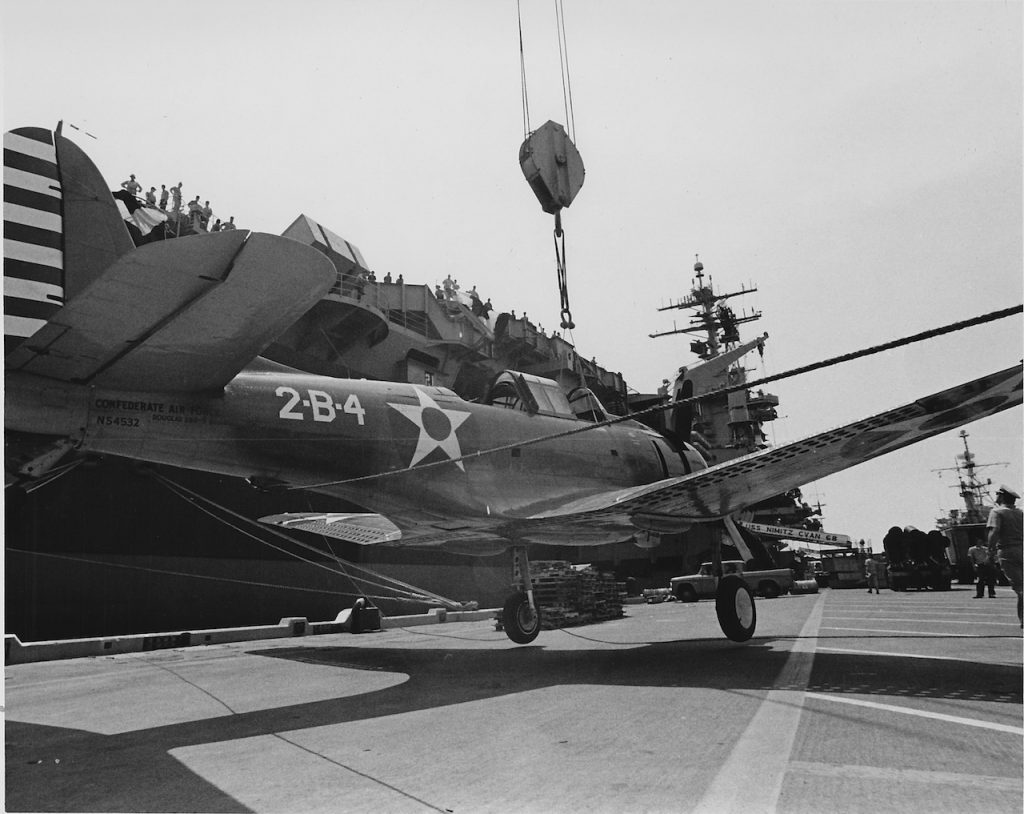
By 1966, the Dauntless was sold to Ed Maloney of the Movie World/Planes of Fame Museum in California for $1,600. It remained on static display until Robert Griffin, an early CAF benefactor, purchased the aircraft in 1971 and donated it to the organization. Griffin dubbed it “Speedy D” and was among the first to fly her under the CAF banner. He also donated the CAF’s SB2C Helldiver and FM-2 Wildcat. In 1975, “Speedy D” finally made it to the deck of an aircraft carrier—USS Nimitz—for the retirement ceremony of Admiral Ralph W. Cousins. The aircraft, repainted in Cousins’s wartime colors, sat proudly next to a then-new F-14 Tomcat.
Restoration and Return to the Skies
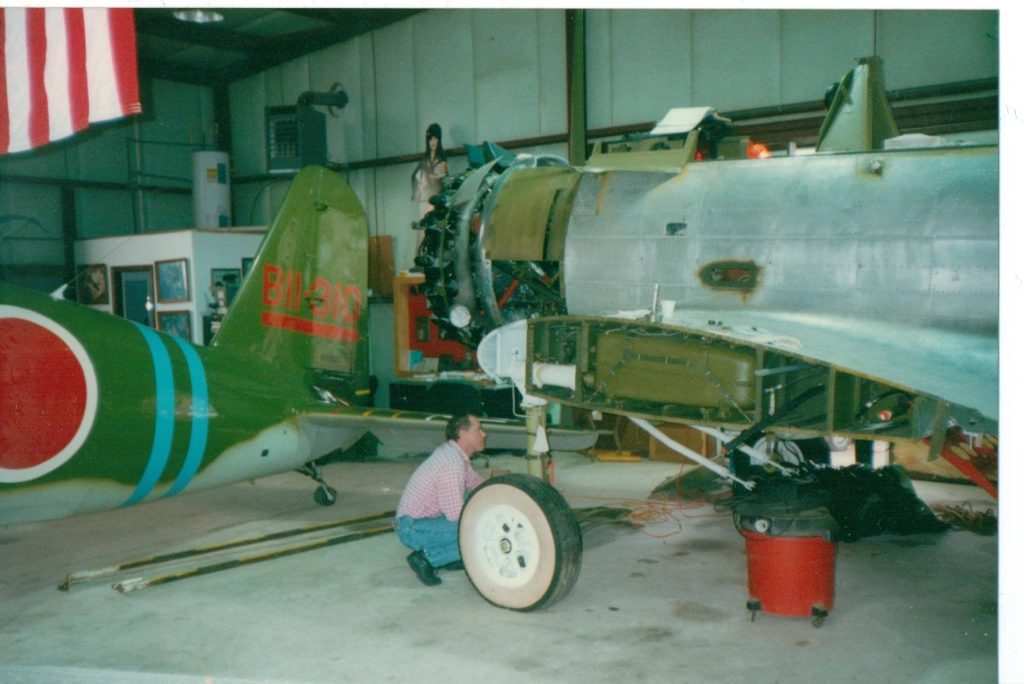
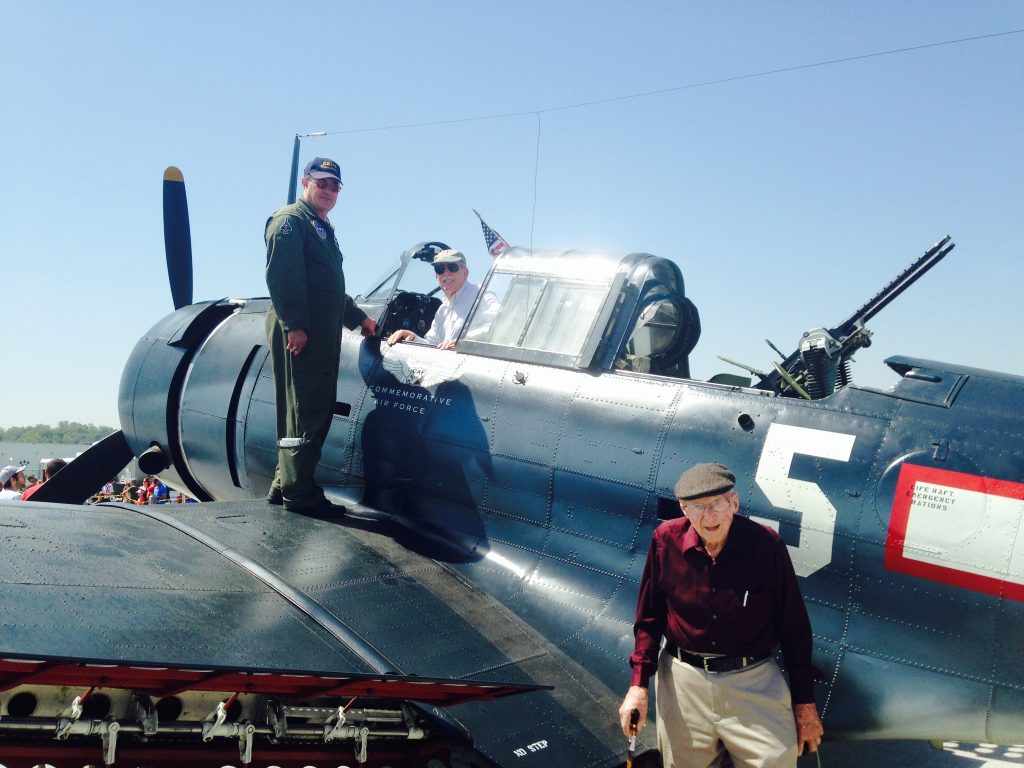
By the late 1980s, the aircraft had become a hangar queen in Harlingen, Texas, badly in need of attention. In 1991, it was reassigned to the Dixie Wing (now Airbase Georgia) for a complete restoration. The project, led by Mike Rettke, Gerald Carlson, and Tex Layton, spanned several years. On a cold morning in February 1999, “Speedy D” returned to the skies with Rettke at the controls, reportedly outpacing the T-6 Texan chase plane during its first flight. Since then, she has performed at hundreds of airshows across the Southeast and Midwest. Her current paint scheme—complete with authentic detailing—represents the markings used during the Battle of the Philippine Sea, better known as the “Marianas Turkey Shoot.”
Unraveling Warbird Mysteries
Keith Wood’s deep dive into the aircraft’s murky past proved that historical assumptions can persist for decades, even in respected sources. By sorting through misattributed records, duplicate serials, and Cold War civilian registrations, he not only corrected the record for CAF Airbase Georgia’s Dauntless—he also provided a blueprint for how warbird historians can tackle similar mysteries. “While I knew the airplane I am privileged to fly is certainly a legend in the annals of Navy and Marine Corps history, it is not a ghost,” Wood wrote. “It is a loud, 8,000 lb., 1,200-horsepower, smoke-belching, oil-leaking, avgas-drinking brute of an airplane.” Warbird history is often tangled, but thanks to dedicated researchers like Keith Wood, the truth eventually finds its way into the logbooks—and back into the skies.
To learn more about the CAF Airbase Georgia or to book a Living History Heritage Flight, click HERE.
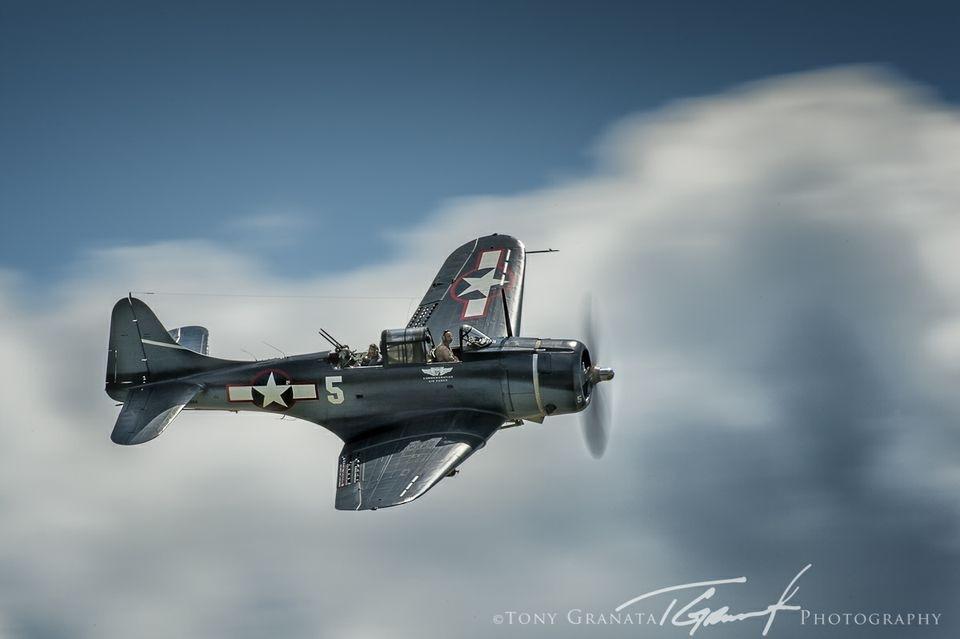





This aircraft wears the markings of an SBD that was in service a whole year before the Battle of The Philippine Sea, because the national insiginia s have the red surround that was used for a few months in 1943, by the time the Marianas were invaded in June 1944, the red surround had been replaced by an Insignia Blue surround. Also, great story.
Interesting that aviation historian/photographer William T. Larkin photographed this airplane on the Tallmantz ramp on what he dated as July 19, 1964, 17 months before it supposedly came out of Mexico. (His photo is actually the photo seen here in this article as XB-QUC mislabeled as being taken in 1951.) Frank Tallman got his A-24B from Mexico in February 1964…perhaps he got both of them at the same time and sold one to Maloney in 1966? That question also remains unanswered. More here on both airplanes: https://www.aerovintage.com/tallmantz-aviation/the-tallmantz-a-24b/
My dad used to say the big deal with these planes was, ” don’t shoot the tail off”.