





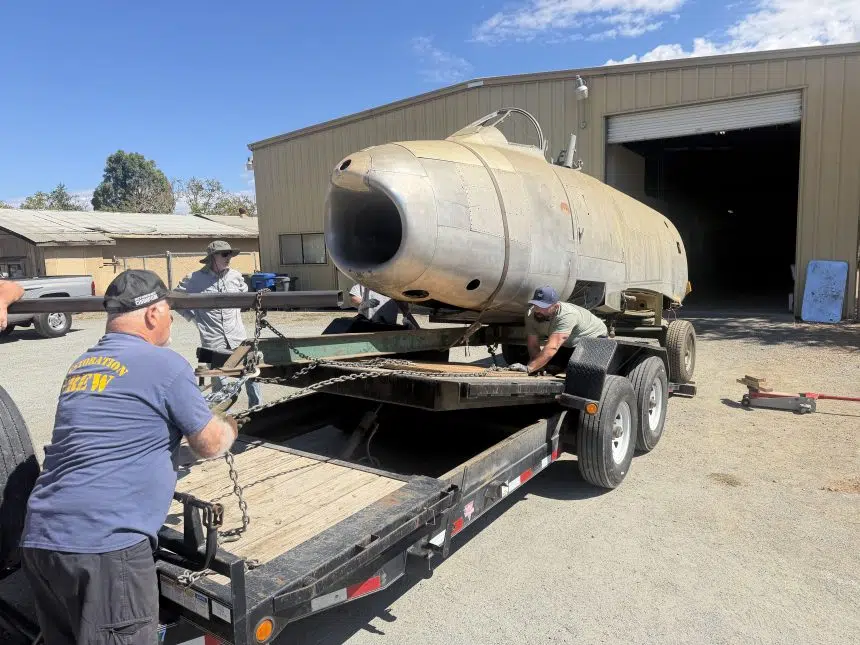

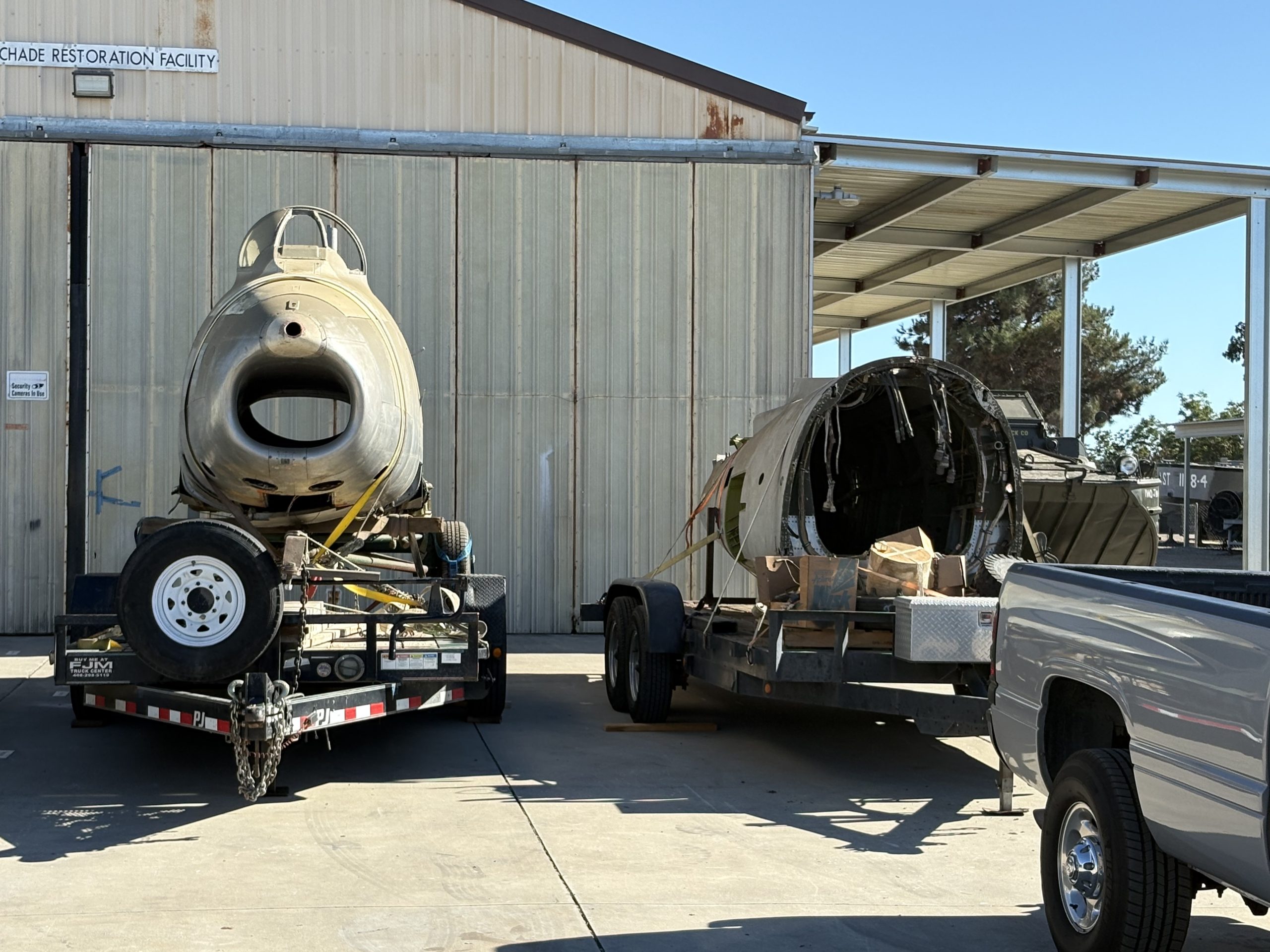
In 2024, we at Vintage Aviation News brought news regarding the Estrella Warbirds Museum’s acquisition of North American F-86F Sabre 52-4608, which was used in flight trials with several types of rocket engines that saw this aircraft fly faster, higher, and carry heavier loads than any F-86 Sabre. Now, two years after the wings and tail assemblies were transported to the Estrella Warbirds Museum in Paso Robles, California, the fuselage of this record-setting Sabre has at last arrived by truck from Gilroy, and the EWM will work to place this aircraft on display for the public to see this Sabre with its unique history.
As mentioned in our prior article, F-86F Sabre 52-4608 was originally built at the North American Aviation (NAA) plant in Inglewood, California, and flew with the 81st Fighter-Bomber Squadron, 50th Fighter-Bomber Group, at Clovis Air Force Base, New Mexico, went on deployments to West Germany and Libya before being assigned to the 4350th Combat Crew Training Wing at Williams AFB, Arizona. After surviving a midair collision in June 1959, 52-4608 was sent back to NAA Inglewood, where it was then allocated for flight tests involving rocket motors and Sidewinder air-to-air missiles. 52-4608 was initially redesignated as F-86F(R) before being redesignated as a JF-86F, and a Rocketdyne AR2-3 rocket engine was mounted to the underside of the fuselage, held in a nacelle the engineers likened to an antique bathtub. Fuel for the AR2-3 rocket was a mix of highly concentrated hydrogen peroxide and standard JP-4 kerosene fuel. 165 gallons of hydrogen peroxide would be carried in a pair of 200-gallon wing-mounted drop tanks for the tests, though 52-4608 was occasionally fitted with an extra pair of drop tanks to carry an additional 120 gallons worth of JP-4 fuel.
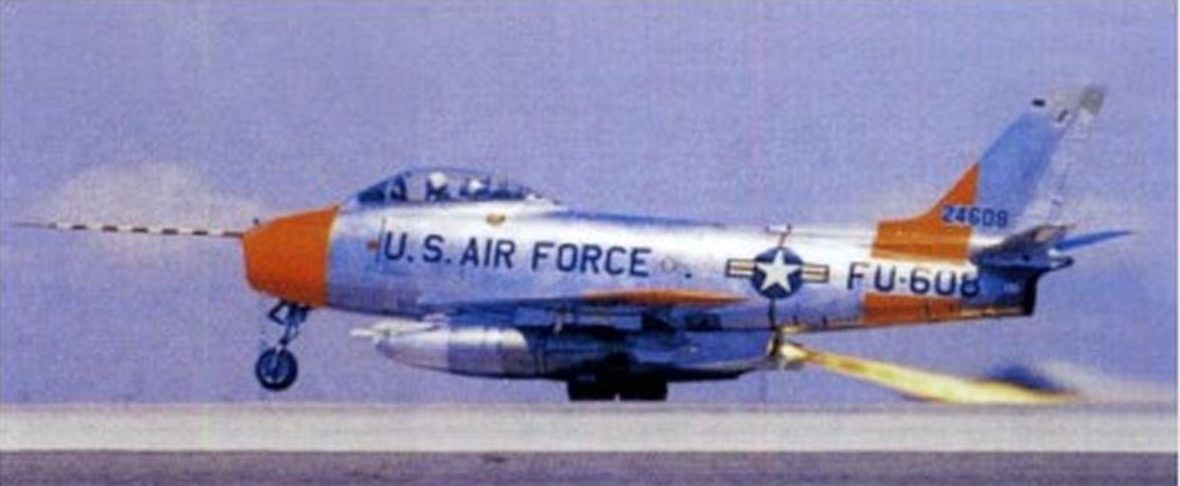
Though the aircraft’s standard armament of six Browning M2 .50 caliber machine guns was removed from JF-86F 52-4608, the fuel-laden Sabre would also carry out weapons testing with a pair of AIM-9B Sidewinders fitted on external pylons. In 1960, 52-4608 was flown extensively with its Rocketdyne engine out of Palmdale Airport, with Captain Norris J. Hanks serving as the project’s chief test pilot and 1st Lt. Duane E. Baker as the Project Engineer before NAA test pilots Jim Brooks and James “J.O.” Roberts carried out further flight testing at nearby Edwards Air Force Base. The AR2-3 rocket engine on 52-4608 allowed it achieve feats no stock F-86 Sabre would accomplish, from reaching speeds of up to Mach 1.22 at 60,000 feet, climbing to 70,840 feet when the service ceiling for a stock F-86F in combat configuration was 49,600 feet, achieving a climb rate of 40,000 feet in 66 seconds, and 60,000 feet in 2.4 minutes. When fully-loaded with the Rocketdyne AR2-3, four external tanks, and two Sidewinders, 52-4608 also became the heaviest Sabre to fly, weighing 22,850 lbs. compared to the 15,198 lb. gross weight of a standard F-86F Sabre.
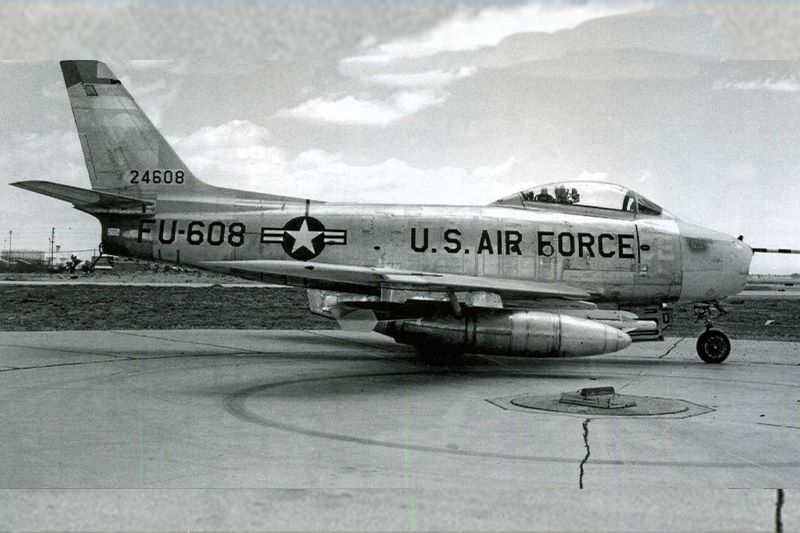
Despite the success of these rocket-assisted flights, though, the advent of more powerful jet fighters such as the Lockheed F-104 Starfighter, McDonnell-Douglas F-4 Phantom, and North American’s own F-100 Super Sabre ensured that JF-86F configuration remained unique to 52-4608, as although North American Aviation invited officers of the Japan Air Self Defense Force to witness the JF-86F’s flight trials in an effort to persuade the Japanese into ordering Rocketdyne engines to install on their fleet of F-86s, the Japanese ultimately favored the new F-104 Starfighter for their air defense requirements.

After JF-86F 52-4608 was stricken from the USAF inventory, the aircraft was acquired in 1970 by Robert D. Scott of Gilroy, California, a former USAF F-86 Sabre pilot and captain for Western Airlines and Delta Airlines. Scott registered the aircraft as N57963 and kept it in storage at nearby Hollister Municipal Airport. However, Scott never got around to flying N57963 before he died in 2011, but the old Sabre remained in the Scott family until it was donated to the Estrella Warbirds Museum by Dean Scott, Robert’s son. Although the wings and tail stabilizers were driven down to the museum at Paso Robles Municipal Airport in 2024, the fuselage was not brought to the museum until September 5, 2026, when it was disassembled into the forward and rear sections and driven on two trailers to the museum, along with the Rocketdyne AR2-3 used in the aircraft’s flight trials back in 1960.


Museum director Ken Neuman states of the current state of the restoration: “We are going to be assembling the fuselage again along with mating it to the wings and tail stabilizers at some point in the near future. This project is one of many and we hope to have work on it finished within 1-2 years based on our project load that our Restoration Department is involved with.”
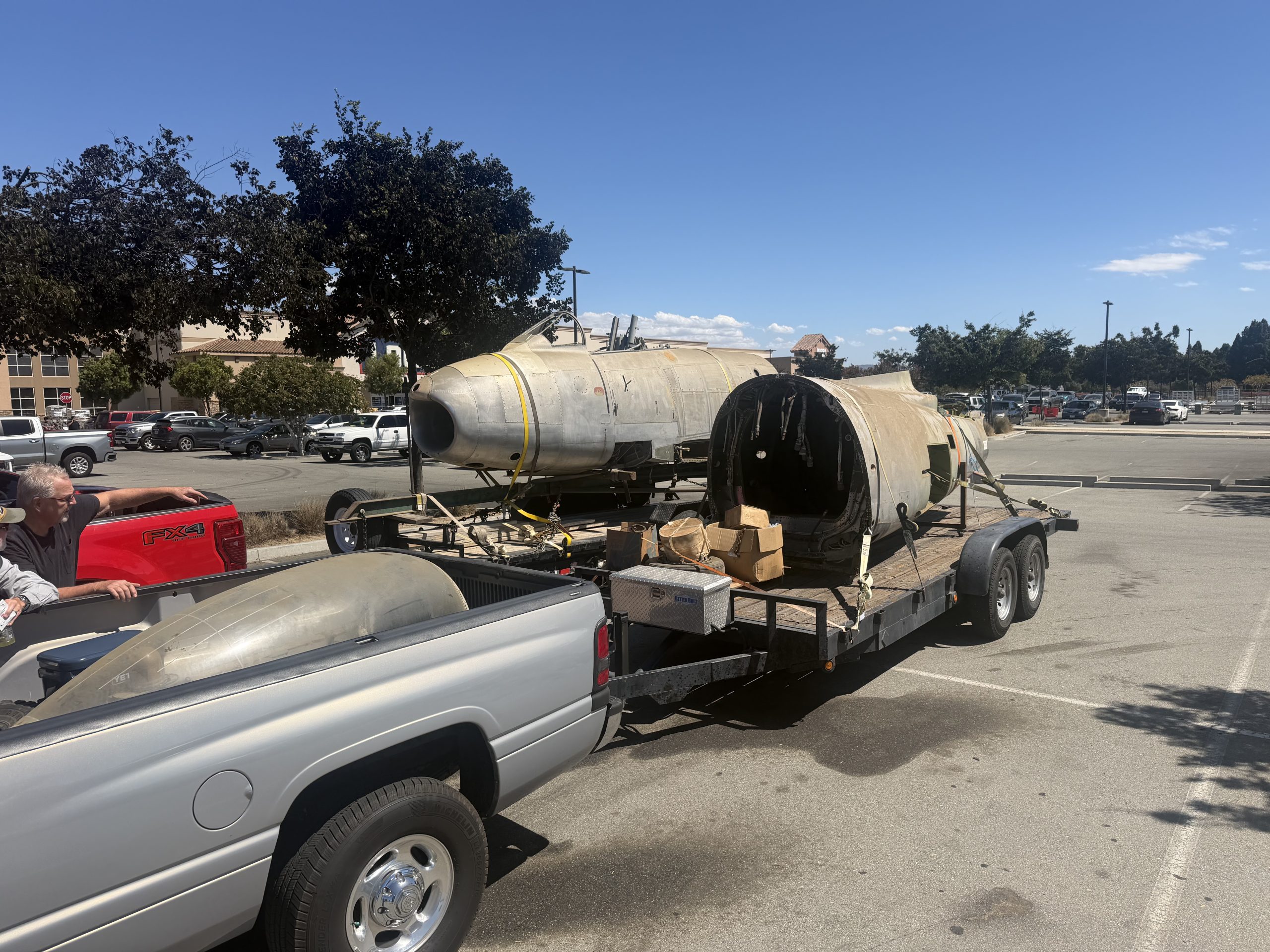
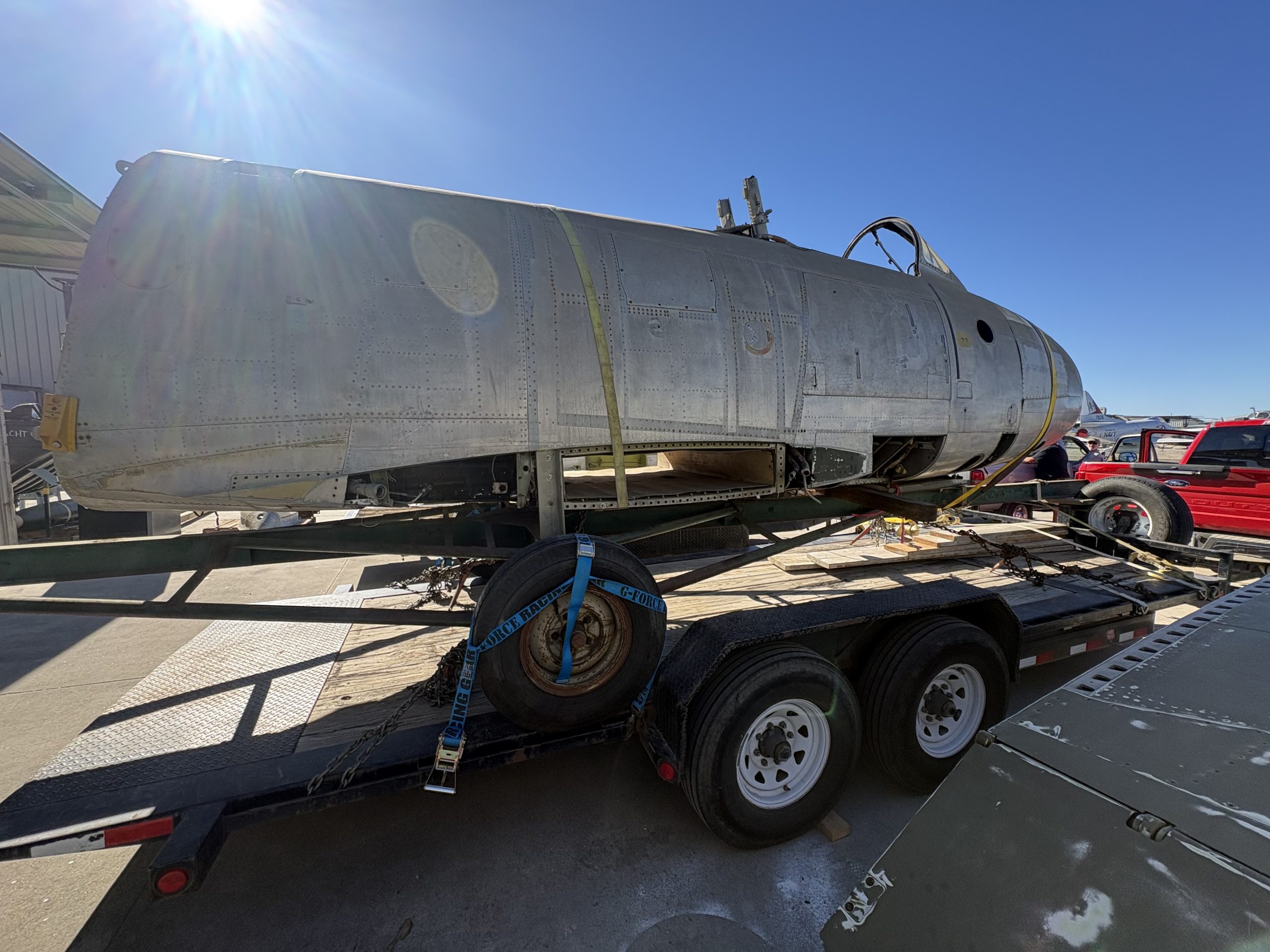
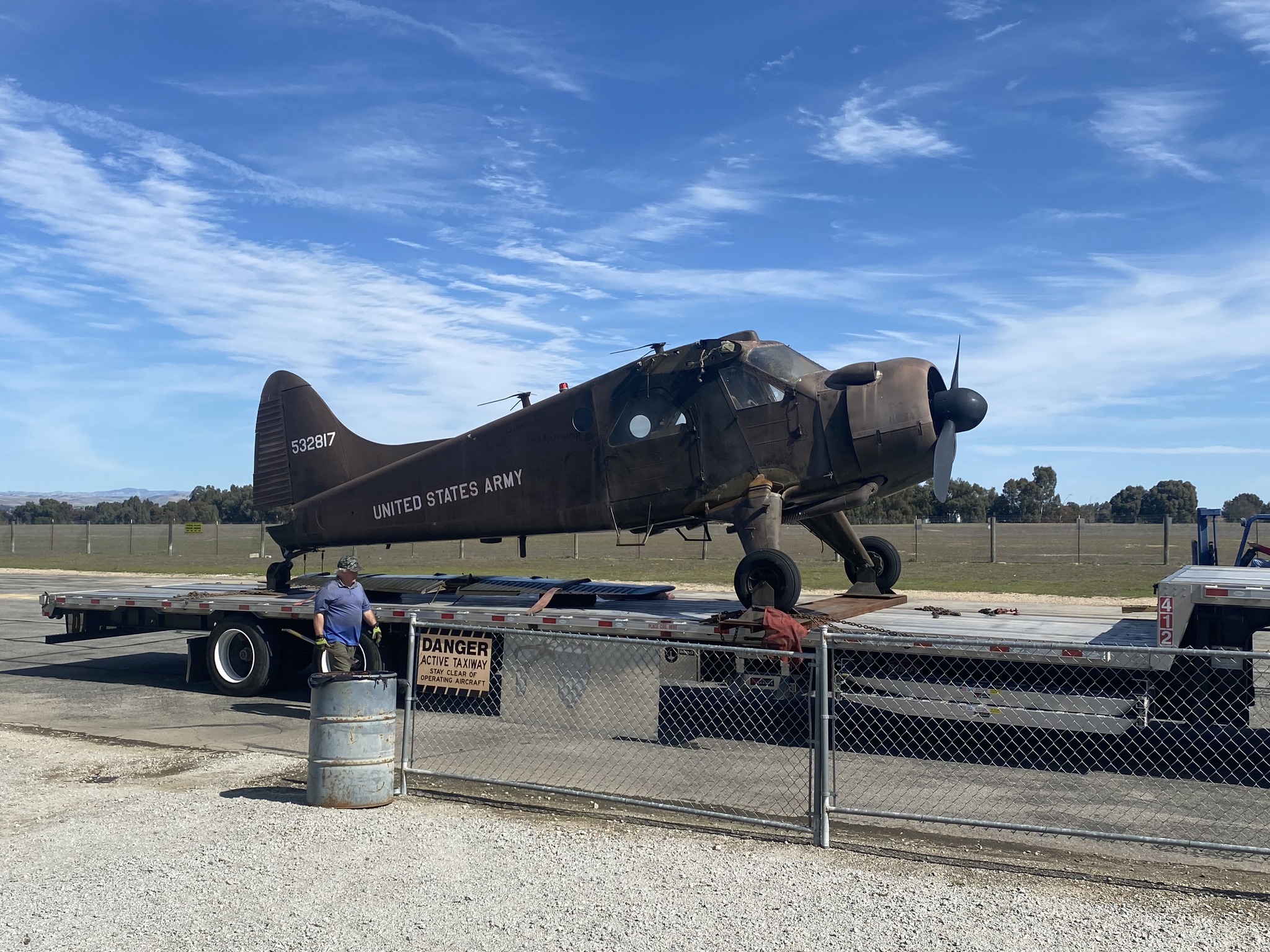
At the same time that JF-86F 52-4608’s fuselage was brought to Paso Robles, the Estrella Warbirds Museum has also been restoring its Saab RF-35 Draken, Royal Danish Air Force serial number AR-106/N106XD, and also has a set of aircraft from Camp San Luis Obispo awaiting restoration (a Cessna O-1A Bird Dog, de Havilland Canada U-6A Beaver, and Hiller OH-23C Raven), all of which were the subject of this article HERE.

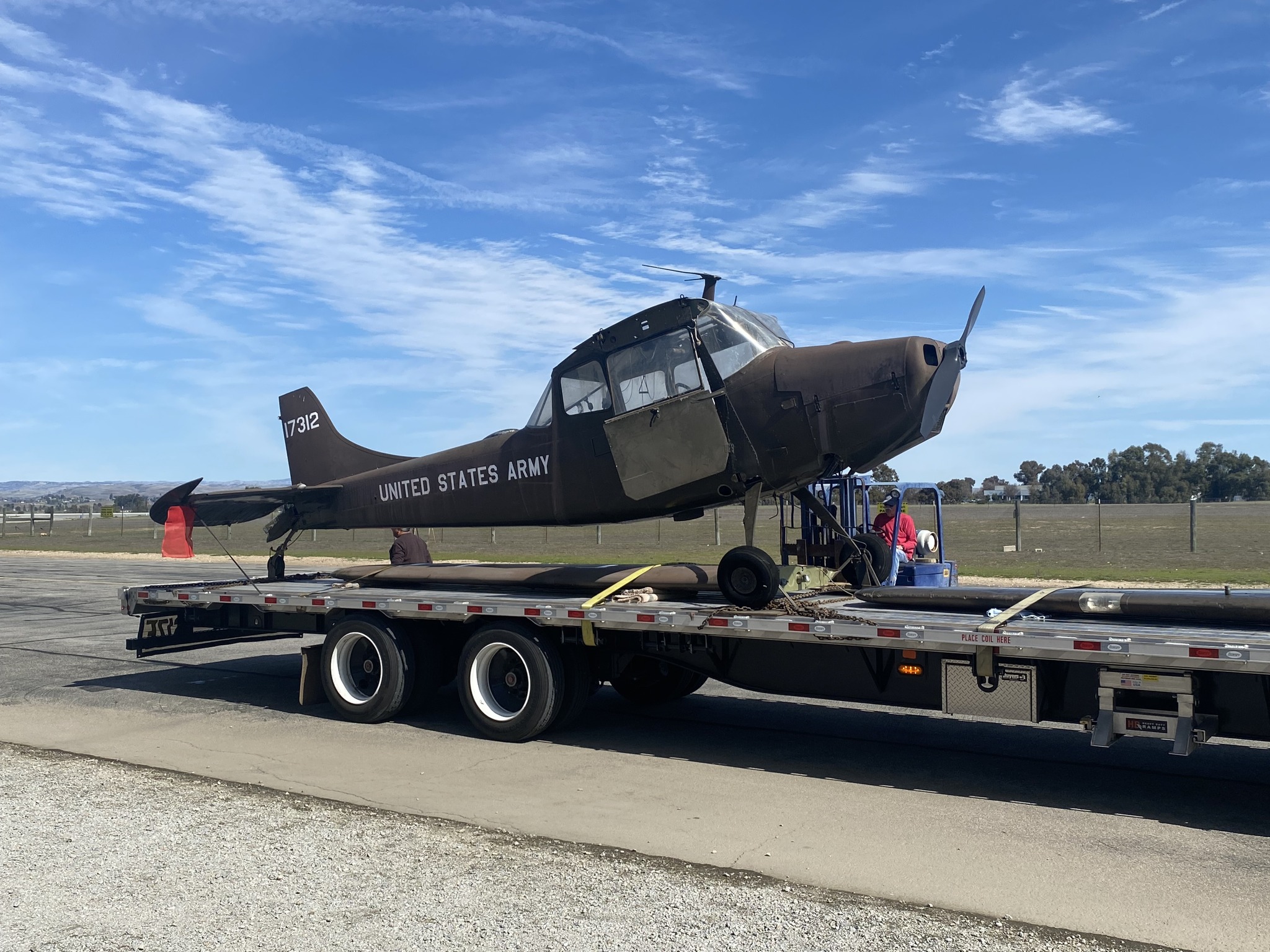
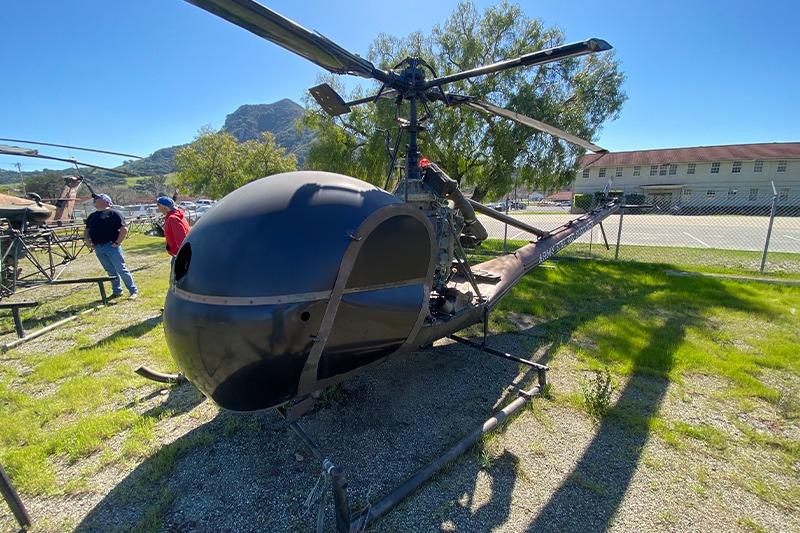
Once JF-86F 52-4608 is eventually restored, it will be displayed alongside the rest of the EWM’s extensive collection of Cold War fighters, which also includes another F-86 Sabre, RF-86F 52-4758 (Japan Air Self Defense Force (JASDF) s/n 52-6401), which was restored by museum volunteers between November 1997 and March 1999 following its use as a QF-86 target drone at Naval Air Weapons Station China Lake.

As mentioned in our 2024 piece, 52-4608 will not be replacing 52-4758, but the display of these two F-86F Sabres will certainly present a great opportunity for enthusiasts to compare the differences between these two aircraft. For more information, visit the Estrella Warbirds Museum’s website HERE.









Thanks Adam, Great article !!