






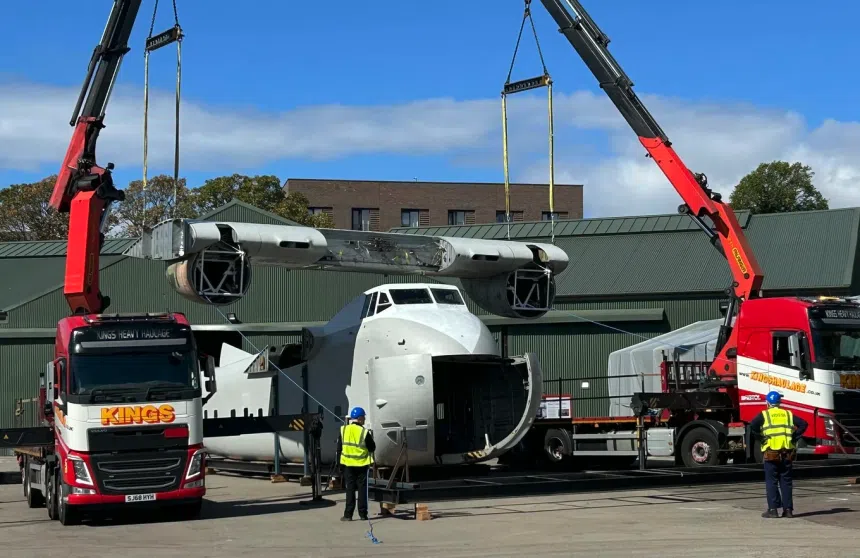

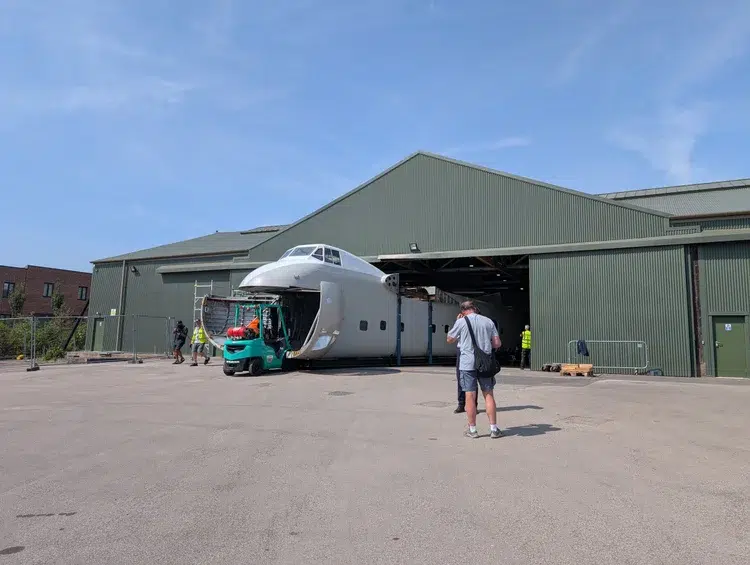
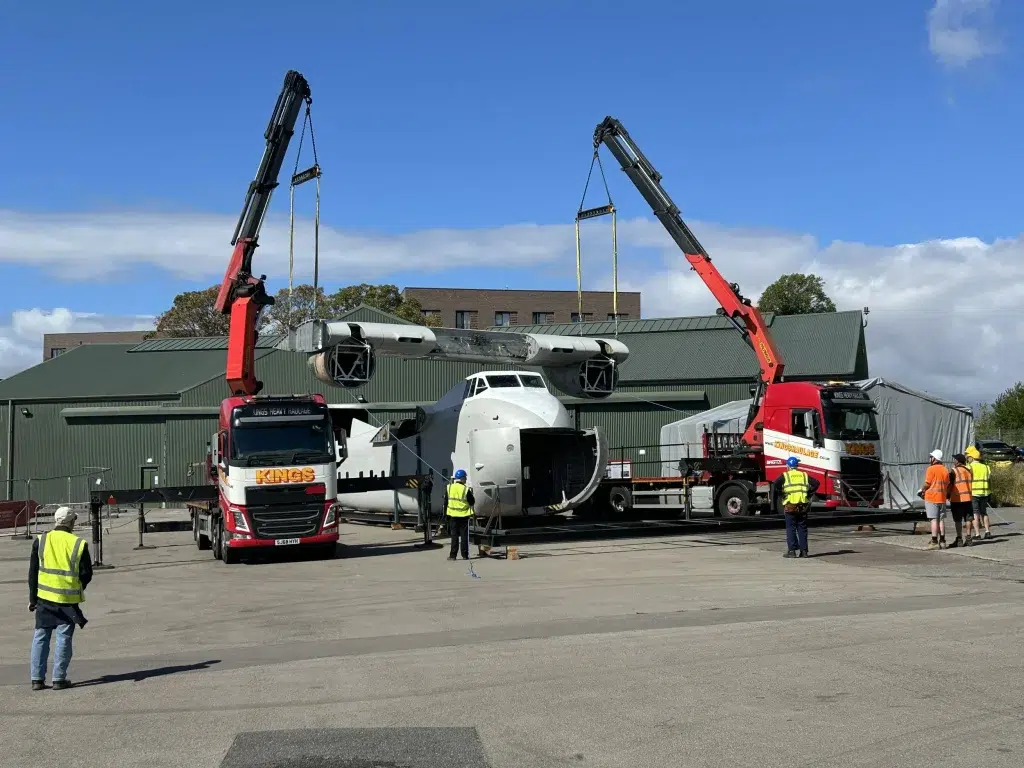
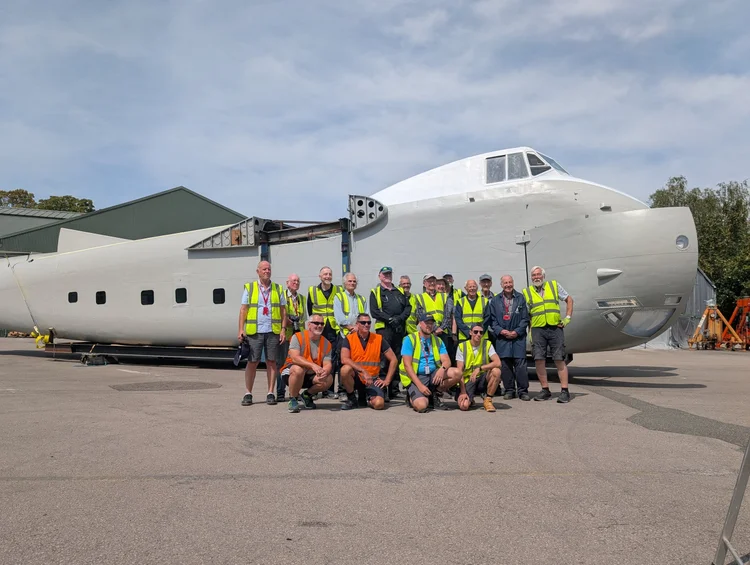
Aerospace Bristol has reached a major milestone in its most ambitious aircraft conservation project to date, successfully reattaching the center wing section to Bristol Freighter Type 170 NZ5911—the only surviving example of the type in Europe. Completed in early August, the carefully planned lift reunited the structural heart of the aircraft with its fuselage. The center wing carries the loads between the fuselage and the outer wing panels, making its installation one of the most technically significant stages in returning the 70-year-old Freighter to a substantially complete configuration. The achievement followed the aircraft’s move from its conservation hangar to a permanent outdoor location at the museum in late July. It was the first time the Freighter had emerged from the building since returning to Bristol from New Zealand in 2018.
(Image credit: Aerospace Bristol)
Months of planning preceded the move, which was carried out by a specialist team that included Aerospace Bristol volunteers and former aerospace engineers. Once positioned in the museum’s outdoor exhibition area, the aircraft was prepared for the center-wing installation and the subsequent stages of reassembly. “Lifting the center wing back into place is an incredibly rewarding moment for everyone involved in the project,” said Paul Jones, conservation project lead at Aerospace Bristol. “Every stage has required careful work, engineering expertise and countless hours of effort from our dedicated volunteers and conservation team. “The Bristol Freighter is a unique part of Britain’s aviation heritage, and we’re proud to be preserving it so future generations can continue to learn from and be inspired by this remarkable aircraft.”
(Image credit: Aerospace Bristol)
A Pioneering Postwar Transport
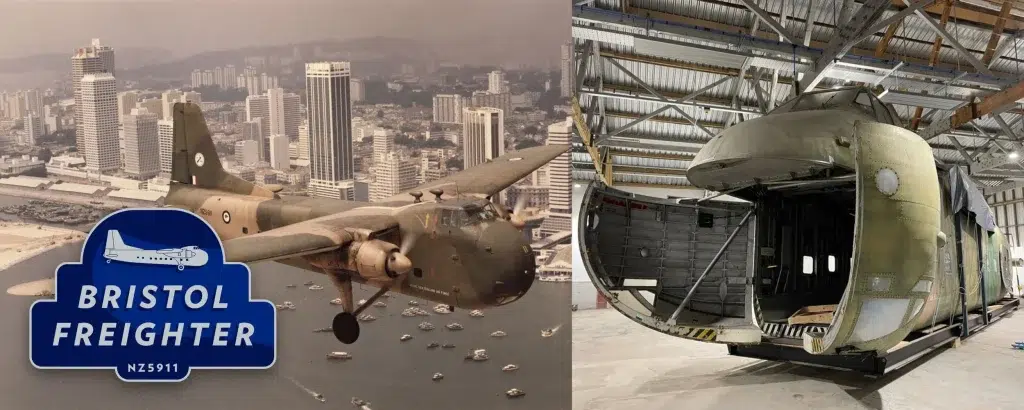
Designed and built by the Bristol Aeroplane Company at Filton during the late 1940s and early 1950s, the Bristol Type 170 was developed as a versatile postwar cargo aircraft. Its most recognizable features were its large clamshell nose doors, high-mounted flight deck, cavernous cargo compartment, and 108-foot wingspan. The arrangement allowed vehicles and other bulky loads to be driven or loaded directly into the fuselage. Freighters carried an unusually broad range of cargo around the world, including automobiles, machinery, general freight, and livestock. A passenger-carrying development was marketed as the Wayfarer. The Type 170 was also the first postwar aircraft to receive an unrestricted Certificate of Airworthiness, reflecting its place in the development of commercial aviation after WWII. Its rugged construction and operational flexibility led to service with both civilian and military operators in widely varied environments.

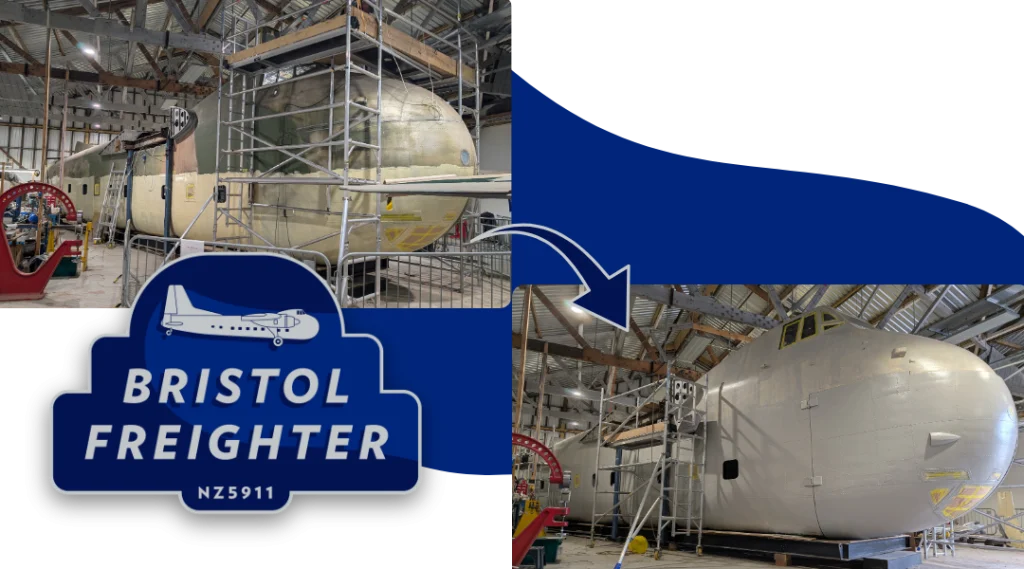
Aerospace Bristol’s aircraft, Royal New Zealand Air Force serial NZ5911, is one of only 12 Bristol Freighters known to survive worldwide. It entered service with the RNZAF’s No. 41 Squadron in 1955 and later operated across Southeast Asia during the Cold War and Vietnam War era. Retired in 1977, the aircraft was subsequently left on a New Zealand airfield and faced the prospect of being scrapped. After spending decades in storage in New Zealand, NZ5911 was recovered through a major international effort led by Aerospace Bristol volunteers, with support from several partners, including the Association for Industrial Archaeology. The dismantled aircraft arrived back in Bristol in 2018, returning to the city where it had been designed and built. Since its return, volunteers have devoted many hours to cleaning the airframe and treating areas where the metal had deteriorated through corrosion. The conservation team is now working to weatherproof the Freighter for permanent outdoor display. When the project is complete, NZ5911 will wear a Royal New Zealand Air Force color scheme and will be accompanied by new immersive interpretation intended to engage visitors and inspire future engineers.

Conservation in Full Public View
Officially launched on May 21, 2026, the multi-year project is being conducted as a live conservation program. Rather than carrying out the work entirely behind closed workshop doors, Aerospace Bristol is allowing visitors to follow the Freighter’s transformation in the museum’s outdoor exhibition area. Members of the public can observe conservation and reassembly work from close range, speak with participating volunteers, and learn about both the aircraft’s service history and the engineering challenges involved in preserving such a large airframe. “This is far more than a conservation project; it’s an opportunity for visitors to experience history being preserved before their eyes,” said Aerospace Bristol Chief Executive Sally Cordwell.
“Projects of this scale are rarely seen by the public. Visitors won’t just see the aircraft up close; they’ll meet the volunteers conserving it, discover the engineering behind the project, and experience a remarkable piece of Bristol’s aviation heritage as it’s brought back to life.” Further work will continue as the conservation team prepares and reinstalls additional components, completes the weatherproofing process, and applies the aircraft’s RNZAF markings. Each stage will bring the Freighter closer to becoming the centerpiece of a new permanent outdoor exhibition, while continuing to give visitors an unusually direct view of a major aircraft conservation program.
(Image credit: Aerospace Bristol)
The project supports Aerospace Bristol’s wider mission to preserve the region’s aerospace heritage and use it to encourage education and skills development in science, technology, engineering, design, and heritage conservation. The museum tells the story of more than a century of aerospace achievement in Bristol and the engineers, technicians, pilots, and factory workers who made it possible. The Bristol Freighter project has received a restoration grant from the Association for Industrial Archaeology. With the center wing now back in place, NZ5911 has taken a major step toward once again presenting the unmistakable profile of one of Britain’s most distinctive postwar transports. For more information about Aerospace Bristol, visit www.aerospacebristol.org
(Image credit: Aerospace Bristol)






I flew in one of these aircraft. There was an air ferry service from Southend to Rotterdam in 1966. I remember it well. I think it may also have been a radar testing aerial platform at RAF Defford a secret base near Malvern.
We flew in one from Le Touquet to Lydd our children and Ford Cortina, so quick and useful.
It would be worth reinstating it now but who would do it?
I saw the rebuild at an early stage, and let the staff know that I had travelled in one freighter flying from Newtownards airport, N. I., with my family, and car, to Scotland. The airline was Silver City airways.
At school back in the seventies, early eighties? lived near Bishop Stortford here in the UK….used to see one of these fly over for a while, high and ‘slow’….lovely sound!
I guess this was the last one flying in UK? Until the accident.
They were a familiar sight (and sound!) in New Zealand skies, serving as transports both military and civil. I had one long flight in an RNZAF B170 in winter, ending up both frozen and deafened.