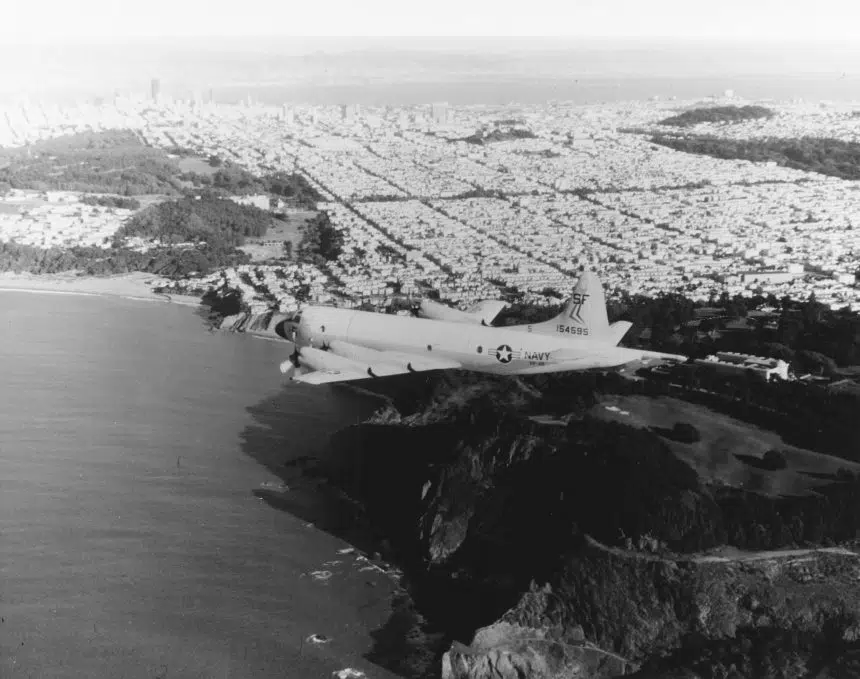

Patrol Squadron 48 (VP-48), called the “Boomerangers” from 1975 to 1980 and the “Boomers” from 1981 to 1991, was a US Navy squadron focused on maritime patrol. VP-48 started as Reserve Patrol Squadron VP-905 in 1946. It changed names several times before becoming VP-48 in February 1953. The squadron transitioned from using the PBY Catalina and PBM Mariner to the P-3 Orion. VP-905 formed in May 1946 at NAS Grosse Ile, Michigan, as part of the Navy’s post-WWII Air Reserve expansion. The squadron began with the PBY-5A Catalina and PV-2 Harpoon, then transitioned to the PBM-5 Mariner. In February 1950, the Navy reorganized its reserve patrol forces and renamed it VP-731. The Korean War changed VP-731’s status. The squadron was called to active duty on September 29, 1950, and sent to Buckner Bay, Okinawa, in February 1951. From there, and from a detachment in Sangley Point, Philippines, its Mariners patrolled the Formosa Strait and the China coast. The squadron deployed again in 1952 from Iwakuni, Japan, and started combat patrols over the Korean coastline on June 1. One of the most dangerous missions happened on July 31, 1952. A VP-731 PBM-5S2 was attacked by two Chinese MiG-15 fighters over the Yellow Sea. Two crew members died, and two others were seriously injured. However, Lieutenant E. E. Bartlett Jr. managed to land the damaged Mariner at Baengnyeongdo. The squadron deployed to WestPac again in July 1953, just as the Korean War was ending. During a patrol on July 30, a Mariner caught fire and crashed, killing 10 of the 15 people on board. In June 1954, the squadron changed from the PBM-5S2 Mariner to the P5M-1 Marlin, which was a more modern amphibious patrol aircraft.

Patrol Squadron 48 continued its operations in the Pacific, including missions to Japan and Hawaii. In 1956, two Marlins had to make emergency water landings while flying from California to Hawaii because of low fuel; rescue teams recovered both aircraft. By the early 1960s, VP-48 was increasingly focused on surveillance during the Cold War. In March 1964, it began its first deployment to WestPac in over four years, operating from NAS Sangley Point in the Philippines. After the Gulf of Tonkin incident in August, the squadron moved to the South China Sea, where it logged over 1,500 hours of patrol flying to support fleet operations. The following year, Patrol Squadron 48 sent six aircraft to Sangley Point for surveillance in the South China Sea and for coastal patrols off Vietnam as part of Operation Market Time. This detachment operated with support from seaplane tenders at Cam Ranh Bay and Buckner Bay, which placed the squadron directly in the expanding American war effort in Southeast Asia. In 1967, Patrol Squadron 48 started using the P-3A Orion and moved to NAS Moffett Field in California. The new land-based plane had better range and capabilities for anti-submarine warfare and maritime surveillance. By 1968, Patrol Squadron 48 was already operating the P-3B. The transition happened during a Cold War crisis. In January 1968, after North Korea captured the USS Pueblo, VP-48 provided round-the-clock anti-submarine protection for the Enterprise task force as it headed to the Sea of Japan. The mission was part of Operation Formation Star and was one of the squadron’s most important Cold War deployments.

Later that year, Patrol Squadron 48 deployed to Adak, Alaska, where its Orions monitored Soviet naval units. The mission earned the squadron a Meritorious Unit Citation. In 1970, VP-48 deployed again, this time to the Philippines and Vietnam. Its aircraft patrolled the South China Sea and detected eight enemy trawlers trying to transport weapons to the Viet Cong. In the 1970s, Patrol Squadron 48 operated in the Pacific from locations like the Philippines, Thailand, Alaska, Guam, and California. During a deployment in 1972, a team based in Guam tracked Soviet ships that tested missiles and recorded two missile impacts in a testing area. The squadron continued its Cold War surveillance into the 1980s. It deployed to Japan and Diego Garcia, supporting operations in the western Pacific and Indian Ocean. Patrol Squadron 48 also helped find Vietnamese refugee boats for rescue teams. In 1986, an earthquake struck while the squadron was deployed in Adak. It had to manage the situation before returning to regular operations. The P-3C aircraft underwent continuous upgrades to meet new maritime threats. Starting in 1986, the squadron’s planes received improved navigation systems, secure HF radios, and Harpoon missile capability. By 1990, VP-48 operated upgraded P-3C Update III aircraft. The squadron’s last major deployment happened at the end of the Cold War. In August 1990, VP-48 moved from Kadena to Cubi Point to support Operation Desert Storm. Patrol Squadron 48 was officially disbanded at NAS Moffett Field on May 23, 1991.