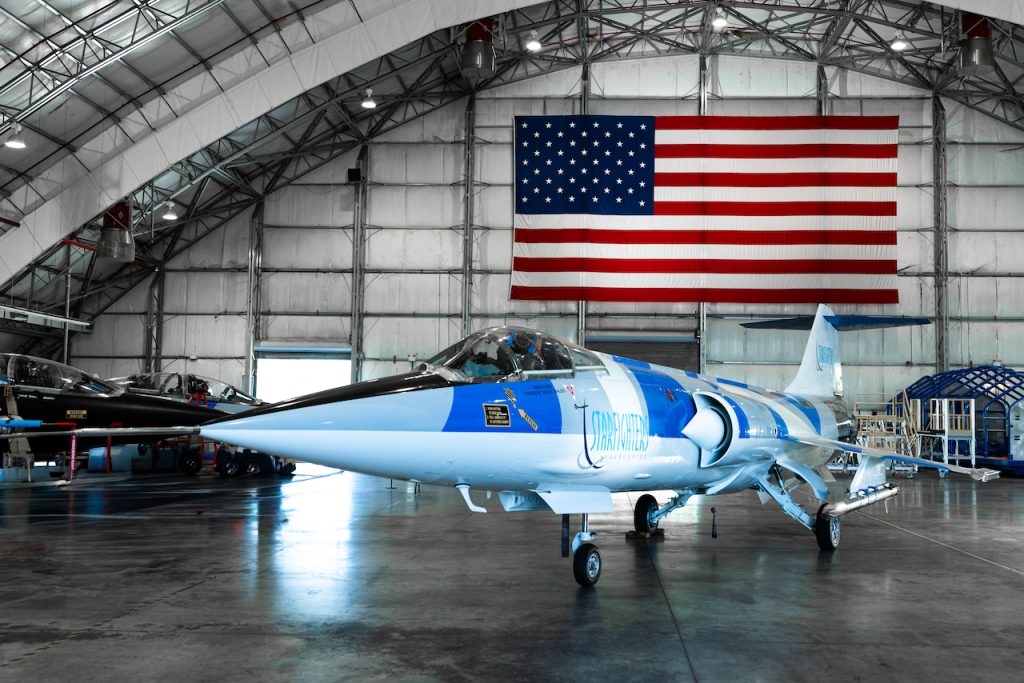


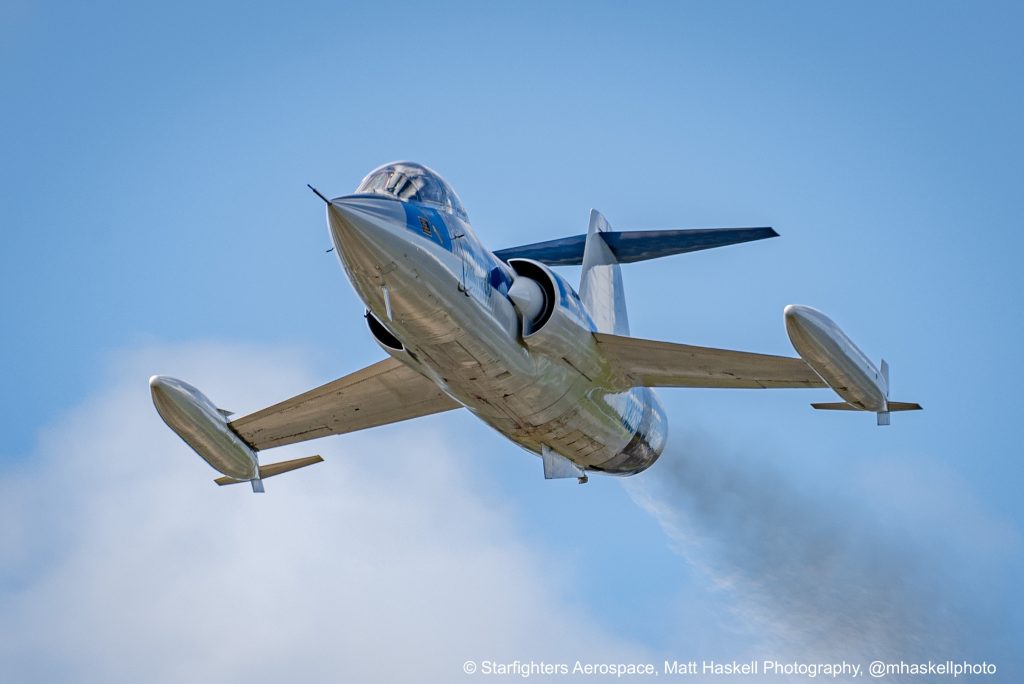
More than seven decades after the Lockheed F-104 first flew, the Starfighter is finding work testing technologies intended for the next generation of aerospace vehicles. At Starfighters Space, the aircraft’s speed, climb performance, and military systems provide a foundation for a business that combines airborne research with plans to enter the launch market. In an interview with Vintage Aviation News, CEO Tim Franta explained how the company is using its F-104 fleet today, outlined its developing “Wind Tunnel in the Sky” program, and described the steps ahead for its STARLAUNCH vehicles. For aviation enthusiasts who remember Starfighters as an airshow attraction, the operation has taken a different direction.

“We focus on R&D, T&E, research, development, test, and evaluation of hardware, software, components, and units to fly at high altitude and high speed,” Franta said. “And that’s what’s paying the bills today.” Franta estimates that approximately half of the company’s customer base involves military and defense work, with commercial customers accounting for about 30 percent and academic or civil research making up the remainder. Those categories sometimes overlap, particularly when commercial companies are developing technologies for defense customers.

The common requirement is access to flight conditions that help engineers evaluate their equipment. Customers may need to expose a sensor to high speed, assess avionics software, investigate airflow, or determine how a material behaves outside a controlled laboratory environment. The F-104 offers several practical advantages for that work. Its original radar installation occupied a nose section designed to allow radio signals to pass through. With the radar removed, Franta said, that space can accommodate approximately 250 pounds of research equipment, subject to aircraft balance requirements. The aircraft’s military wiring also remains useful. Circuits originally intended to control weapons can serve research payloads, allowing crews to activate equipment and initiate or interrupt test sequences. “A lot of people think fighter jets are fighter jets, but boy, that wiring is absolutely great,” Franta said. That ability to adapt existing systems is central to the company’s approach: using the Starfighter’s established capabilities to carry new experimental equipment.

A major addition is Wind Tunnel in the Sky, a modular system intended to carry customer experiments beneath the aircraft’s wings. Franta said the program began taking shape in May 2026, and the team had just received a shipment of hardware when the interview took place on October 15. The concept addresses a problem Franta hears from prospective customers: securing suitable wind tunnel time can involve lengthy waits and purchasing more facility time than a particular experiment requires. Starfighters aims to offer another route to obtaining flight data, including sustained supersonic exposure in the atmosphere. Depending on altitude and the mission profile, Franta said the F-104 could provide approximately six to seven minutes at Mach 2. Customers would be testing in actual atmospheric conditions, with the environmental variables that accompany flight. The modular hardware allows different sections to accommodate sensors, experimental shapes, inlet configurations, and other equipment. A customer investigating airflow, for example, could use instrumentation inside the test article to compare measured performance with engineering predictions. Franta identified inlet research as a particularly sensitive area of the company’s work. Although the F-104 itself operates at supersonic speeds, it can support the development of components intended for hypersonic applications. Those flights provide data within the aircraft’s operating envelope; they represent one part of a broader development process. Starfighters has ordered two Wind Tunnel in the Sky assemblies. Carrying one beneath each wing offers a balanced configuration and creates the possibility of conducting two experiments during a single flight. The payloads could belong to separate customers or provide a comparison between two configurations exposed to the same flight conditions.

Alongside that research business, the company is developing STARLAUNCH 1, an air-launched suborbital vehicle. Its planned December captive-carry flight would be an initial integration test, with an inert mass simulator remaining attached to the F-104 throughout the mission. The simulator is intended to represent the mass and flight characteristics of the rocket without carrying its fuel. Engineers would evaluate its behavior as the aircraft progresses through subsonic, transonic, and supersonic flight, looking for vibration, attachment problems, and other issues before attempting a release. “You’re looking for things like that, your connections, your processes,” Franta said. The eventual powered STARLAUNCH 1 vehicle is intended to carry experiments on suborbital trajectories. Franta described a preliminary target altitude of approximately 109 kilometers, while emphasizing that the design is evolving. Such missions could provide research payloads with longer periods of microgravity than an aircraft’s parabolic flight. STARLAUNCH 2 has a different objective: reaching orbit. Franta said that vehicle would be substantially larger and would require another carrier aircraft. “It will not be launched from the F-104,” he said. “It will be launched from a different aircraft, which I can’t describe right now.”
The intended market includes small payloads and individual spacecraft components that need flight experience. Rather than waiting to incorporate an experimental antenna, microthruster, or electronics package into a much larger satellite mission, a customer could seek a dedicated opportunity to test that component in space. That remains a development goal. Franta described a progression through successful test flights before establishing commercial launch operations, with frequency increasing as the vehicles and procedures mature. He placed orbital operations roughly two years after STARLAUNCH 1 enters commercial service, presenting that interval as a planning expectation. Keeping the F-104 fleet working is another essential part of the business. Franta said the company holds a parts inventory intended to support approximately another decade of operations. Updated avionics help maintain the aircraft’s usefulness, while consumable items require continuing attention. Tires are a notable example. According to Franta, a set may last only six or seven landings. The company maintains a tire mold with Dunlop in the United Kingdom and orders replacements in quantities of several hundred. Franta also acknowledged that the Starfighters have a finite remaining working life. He anticipates the aircraft reaching the end of their service over approximately the next 15 years, making additional platforms part of the company’s longer-term planning.
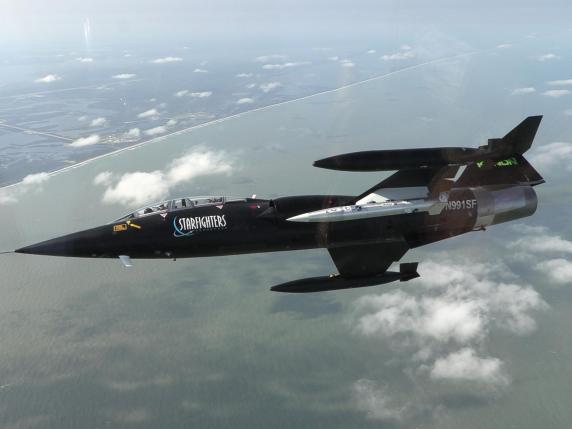
Its two operating locations serve complementary purposes. Kennedy Space Center provides access to offshore flight areas for supersonic testing and planned rocket work. Midland, Texas, offers a central position from which the aircraft can reach several military and aerospace facilities in a single flight, reducing the logistical demands of intermediate stops. For 2027, Franta anticipates approximately 36 to 50 Wind Tunnel in the Sky flights, with the potential to carry two customer payloads on each sortie. Actual activity will depend on customer demand and the program’s progress. Public appearances have become occasional opportunities within that working schedule. Franta said the company’s 2026 appearances at SUN ’n FUN and Midland coincided with pilot training and engine testing requirements. “We’re no longer an airshow team,” he said. For enthusiasts, those appearances still offer a rare chance to see a Starfighter fly. Behind them is an operation seeking to make the aircraft useful to engineers developing new aerospace technology. The F-104’s next chapter is being shaped by the experiments it can carry—and the flight data it can bring home. For more information, visit www.starfightersspace.com.