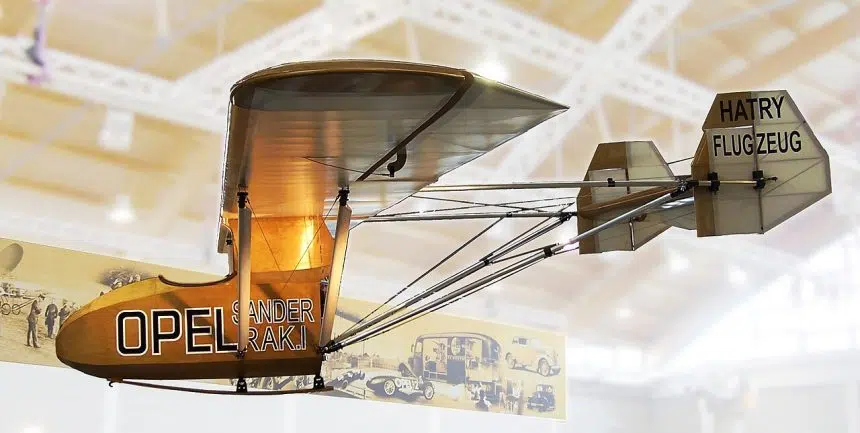

On this day in aviation history, 97 years ago (September 30, 1929), Fritz von Opel flew the Opel RAK.1, the world’s first purpose-built rocket-powered aircraft. Taking off from Rebstock Airport near Frankfurt, Germany, von Opel remained airborne for approximately 75 seconds in one of the earliest demonstrations of rocket propulsion applied to manned flight. The RAK.1 was developed as part of Opel’s ambitious rocket program, which had already experimented with rocket-powered automobiles and rail vehicles. Aircraft designer Julius Hatry designed the RAK.1 specifically around rocket propulsion, producing a glider-like aircraft with a high-aspect-ratio wing and a pod suspended beneath it for the pilot. Sixteen solid-fuel rockets supplied by Friedrich Wilhelm Sander were mounted at the rear of the aircraft.

After unsuccessful attempts earlier in the day, von Opel finally took off during the afternoon. The RAK.1 climbed to roughly 100 feet and reached an estimated maximum speed of around 90 to 95 mph. Accounts differ on the exact distance covered, ranging from approximately 1¼ miles to nearly two miles. After the rockets burned out, von Opel glided back toward the airfield, making a hard landing that severely damaged the aircraft. He escaped without serious injury. The Opel RAK.1 had a wingspan of approximately 36 feet and measured about 16 feet in length. Its propulsion system consisted of 16 solid-fuel rockets, each producing approximately 50 pounds of thrust. The aircraft remained airborne for roughly 75 seconds and reached an estimated 90 to 95 mph. Although the RAK.1 never developed beyond its experimental demonstration, its highly publicized flight provided an early glimpse of the potential of rocket-powered aviation.