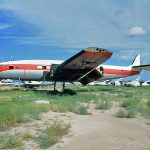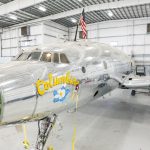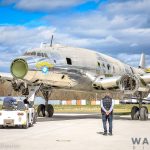

The restoration of President Dwight D. Eisenhower’s Lockheed VC-121A Constellation Columbine II continues to advance at Dynamic Aviation in Bridgewater, Virginia, with significant new progress inside the aircraft, in the cockpit, and toward securing the engines needed for its eventual return to flight. Vintage Aviation News recently spoke again with Bill Borchers, the mechanic and interior specialist closely involved with the restoration, who provided an update on the work taking place aboard the historic presidential aircraft. When VAN last checked in on Columbine II, much of the focus was on rebuilding the aircraft’s interior. The presidential stateroom was nearing completion; new bulkheads and the main entry door had been completed, and the rear lounge was structurally assembled with its bench seating and sinks installed. Work was also progressing on the bathroom and aft cabin. At the same time, the cockpit had been largely stripped in preparation for refinishing. Switch panels and instrument surfaces were being restored, and the team had matched the original military green used inside the cockpit. One Wright R-3350 engine had been completed, while discussions continued about obtaining additional overhauled engines. The restoration team was also studying how modern avionics could be incorporated without sacrificing the historic appearance of Eisenhower’s cockpit. Since then, several of those projects have taken important steps forward.

Bringing the Cabin Back to Life
One of the most visible developments is taking place in the passenger cabin, where the team has located two couches that Borchers described as nearly identical to those originally installed aboard the aircraft. Rather than simply restoring them cosmetically, however, the team is rebuilding them to withstand regular use. The original-style support beneath the cushions has been replaced with a grid fabricated from thin aluminum. The arrangement provides some flexibility while creating a much stronger seating structure. The couches retain their original-style mechanisms, allowing the seat backs to be raised into several positions or lowered flat. Attention has now turned to selecting cushioning and upholstery materials that will conform properly as the seats move between their upright and flat positions. The work represents another step toward giving visitors a better sense of what the interior of Columbine II looked and felt like when the aircraft was in presidential service.

A Major Repair to the Cockpit Crew Door
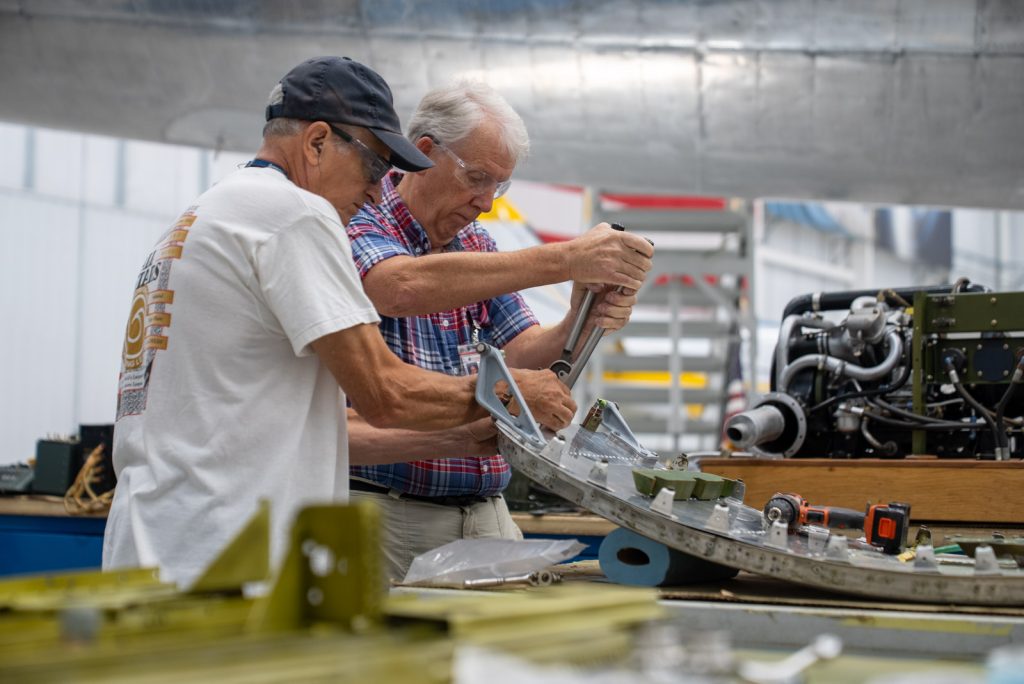
Another project proved considerably more involved than initially expected. The cockpit crew door was not sliding correctly, prompting the team to remove it for inspection. Once dismantled, significant structural damage became apparent. According to Borchers, the door travels vertically approximately four and a half feet and does not have springs to control its descent. When the release is activated, an unsuspecting person can allow the heavy door to drop rapidly to the bottom of its track. Repeated impacts had caused serious damage, including cracks through the aluminum structure on both sides of the door. Much of the interior skin was removed, and the door was extensively rebuilt. The sliding mechanism and bearing assemblies also required attention. The repair became something of a family project. Borchers turned to his 90-year-old father, a former automotive and geometry teacher who later became a dentist and retains considerable fabrication skills. He reproduced damaged compound-curved mounting components from solid aluminum rather than the formed sheet metal originally used.

The result, Borchers said, is a substantially stronger assembly. There was another small victory hidden within the door. Its approximately nine-inch acrylic window had become badly crazed and nearly impossible to see through. One of the project’s volunteers carefully sanded through the damaged surface before polishing the acrylic. According to Borchers, the restored window now looks nearly new. The team also found a way to prevent the same door damage from occurring again. While searching Dynamic Aviation’s collection of Constellation airframes and parts, Borchers discovered components from another aircraft that incorporate an additional mechanism at the bottom of the tracks to slow the door as it descends. Those parts were in good condition and are now expected to be incorporated into Columbine II before the repaired door is reinstalled.
The Nose Cone Returns After Nearly a Decade
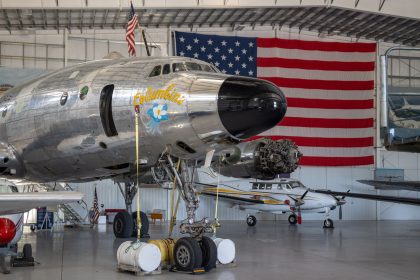
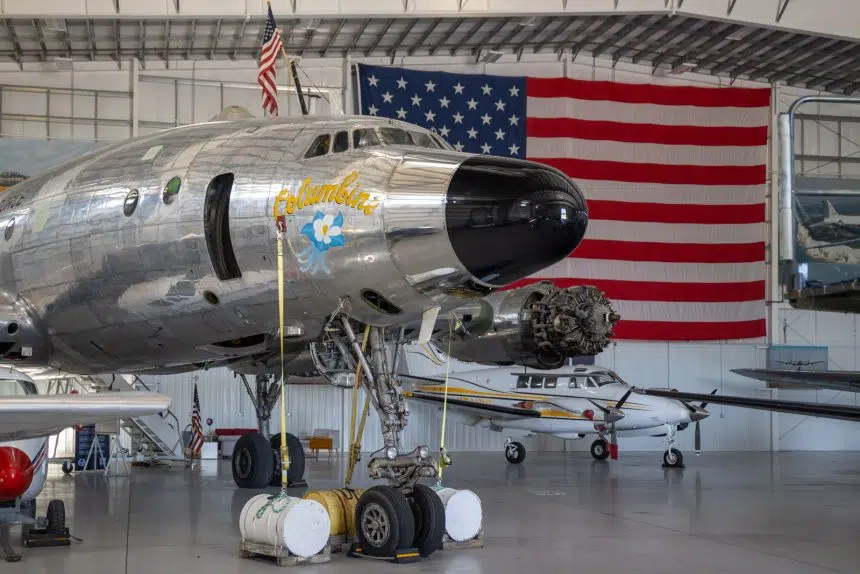
Perhaps one of the most satisfying recent milestones was the reinstallation of Columbine II’s nose cone. The component had been off the aircraft for nearly ten years while awaiting restoration. Once again, Borchers’ father became involved, repairing dents and imperfections and smoothing the assembly in preparation for refinishing. After the repairs were completed, the nose cone received its gloss-black finish and was finally installed back on the Constellation. For a restoration that has involved years of painstaking work on components that are often hidden from view, reinstalling such a prominent part of the aircraft provided a highly visible sign of progress.

Navigation Station Taking Shape
Work is also moving ahead on the aircraft’s navigation station. The station is made up of numerous individual metal components—Borchers compared the assembly to an Erector Set—and the team has now stripped and cleaned its various pieces. Borchers also rebuilt the vibration dampers used throughout the assembly, restoring them to working condition. Instruments associated with the navigation station are being addressed as well. At the time of VAN’s September 29 interview, Borchers expected the restored navigation station to begin going back into the aircraft within approximately two weeks

Modern Garmin Avionics Behind a Historic Cockpit
One of the biggest questions surrounding Columbine II has been how to reconcile two very different goals: preserving the cockpit as it appeared during Eisenhower’s era while equipping the aircraft for safe operation in today’s airspace. The restoration team now has a clearer path forward. According to Borchers, Columbine II is expected to receive a Garmin avionics system. The current concept calls for four modern displays to be incorporated into the area occupied by five original removable instrument panels. Crucially, the installation is being designed so that the modern equipment does not permanently alter the historic presentation of the cockpit. When Columbine II is displayed, the original panels will be capable of being placed back into position, allowing visitors to see the cockpit much as it appeared when Eisenhower flew aboard the aircraft.

Borchers said the Garmin equipment has been offered to the project at no cost, representing a significant contribution toward the effort to make the aircraft flyable while maintaining its historical integrity. Meanwhile, restoration of the cockpit itself continues. The glare shield has been stripped and is being prepared for paint, while Borchers plans to repaint the visible cockpit structure in the original green color previously matched by the restoration team. Reassembly can then begin as restored components return to the aircraft.

An Unexpected Discovery Beneath the Glare Shield
Removing the glare shield also produced one of the restoration’s more intriguing discoveries. Wedged into a roughly inch-and-a-half space between the top of the instrument panel and the glare shield on the copilot’s side was a pair of old gloves that may have been hidden there for decades. What particularly caught the restoration team’s attention was the original label still attached to the gloves. According to Borchers, the label identifies them as having been made in Taiwan and includes the letters “R.O.C.,” for Republic of China. Borchers believes the wording and markings on the tag may help establish the age of the gloves and indicate that they date from relatively early in the aircraft’s history. Their location makes the discovery even more intriguing. The gloves were found concealed on the copilot’s side of the cockpit, the position where Eisenhower would have sat when visiting the flight deck. Borchers also noted that the gloves are a medium size, which he considers consistent with the possibility that they could have belonged to Eisenhower. There is, however, no documentation establishing that the gloves belonged to the president, nor is it known exactly when or by whom they were placed beneath the glare shield. For now, any connection to Eisenhower remains an intriguing possibility rather than a confirmed attribution. Still, finding an apparently old personal item hidden deep within the cockpit of the historic presidential Constellation provides another fascinating mystery for the restoration team—and a reminder that dismantling an aircraft with such a long history can occasionally reveal artifacts that have remained untouched for generations.

More R-3350 Progress—and a Growing Challenge
The engine situation has also developed since VAN’s previous report. At that time, one Wright R-3350 had been completed, and the restoration team was exploring options for obtaining additional overhauled engines. Borchers now says there is a possibility that two engines have been completed, potentially representing an important step toward assembling the powerplants needed to return Columbine II to flight. The news comes with a significant financial challenge. According to Borchers, the price of the engines has increased by close to $100,000 per engine. He was also told that sending another engine into the overhaul pipeline now could result in approximately a two-year wait because of the backlog of large radial-engine work. That combination of cost and availability illustrates one of the major challenges facing organizations attempting to keep large piston-powered historic aircraft flying. Restoring an airframe is only part of the equation; maintaining a supply of serviceable engines, propellers, components, and specialized expertise becomes increasingly difficult as the aircraft and their support infrastructure age. For Columbine II, securing the required R-3350s remains one of the most important steps on the road back to flight.

Building Support for Columbine II
Alongside the physical restoration, the Foundation has been working to increase public awareness of the aircraft and raise funds for the project. Borchers has been speaking to Rotary clubs and other civic organizations about Columbine II, its history, and the ongoing effort to return it to the air. Borchers said the outreach has been producing encouraging support and donations. The aircraft has also welcomed notable visitors. Borchers recently provided Speaker of the House Mike Johnson with a tour of Columbine II. The restoration team continues to document its work publicly as well, with videos and interviews featuring Borchers and other volunteers appearing through the First Air Force One project’s online channels. Facebook, YouTube, Instagram, LinkedIn

Another Step Toward Flight
There is still considerable work ahead before Columbine II can fly again, and the restoration team has not announced a date for that milestone. But compared with VAN’s previous visit, several pieces of the enormous puzzle are beginning to come together. The presidential cabin is becoming increasingly recognizable. Furnishings are being installed and rebuilt. The navigation station is approaching reinstallation. The damaged crew door has received an extensive structural overhaul. After nearly a decade, the gloss-black nose cone is once again attached to the aircraft. Most significantly for the eventual return to flight, plans for the cockpit have progressed from considering a modern glass installation to a specific approach involving Garmin avionics hidden behind removable historic panels, while additional R-3350 engines may now be available. Each completed component brings the restoration closer to its ultimate goal: preserving the history of President Dwight D. Eisenhower’s Columbine II not simply as a static artifact, but as a living aircraft capable of taking to the skies once again. For more information and to support this project, visit www.firstairforceone.org.