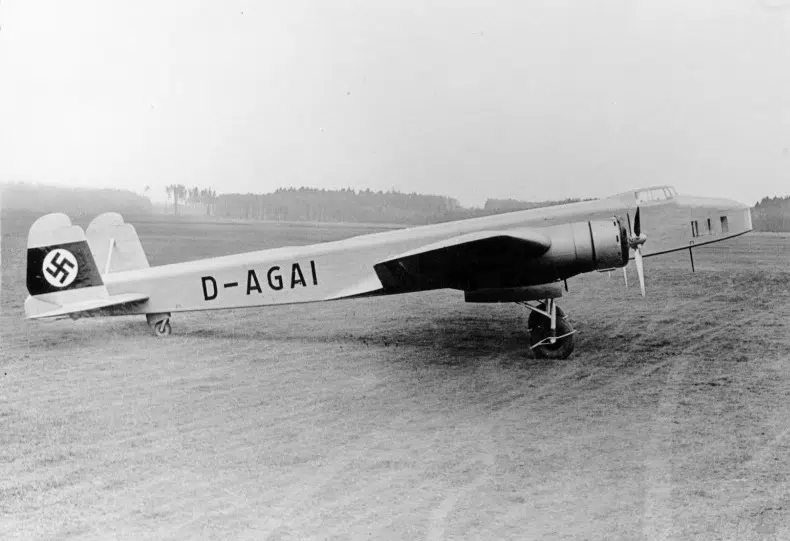

On this day in aviation history, 90 years ago (October 28, 1936), the Dornier Do 19 took flight for the first time. Developed as a four-engine heavy bomber for Germany’s Luftwaffe, the Do 19 was created as part of the “Ural Bomber” program, an effort to develop a long-range strategic bomber capable of striking targets deep within enemy territory. The program was strongly supported by Generalleutnant Walther Wever, the Luftwaffe’s first Chief of Staff. Dornier and Junkers were selected to develop competing designs, resulting in the Do 19 and Ju 89. Dornier’s aircraft was a large, mostly metal, mid-wing monoplane with retractable landing gear and twin vertical tails. Three Do 19 prototypes were ordered, with the V1 becoming the only example to fly.

The Ural Bomber concept lost its strongest supporter when Wever was killed in an aircraft accident in June 1936. Germany increasingly shifted its attention toward tactical bombers, while the Do 19’s relatively slow speed, modest bomb load, and limited range worked against it. The program was cancelled in 1937, and the incomplete V2 and V3 prototypes were scrapped. The sole flying Do 19 was converted into a transport in 1938. The planned Do 19 V2 measured 83 feet 6 inches in length with a wingspan of 114 feet 10 inches and was to be powered by four 715-horsepower Bramo 322H-2 radial engines. It had an estimated maximum speed of 196 mph, a range of approximately 990 miles, and a service ceiling of 18,400 feet. Planned armament included two 7.92 mm machine guns, two 20 mm cannons, and up to 3,500 pounds of bombs.